Politics
Newsom cuts $2.9 billion from California climate programs, delays an additional $1.9 billion

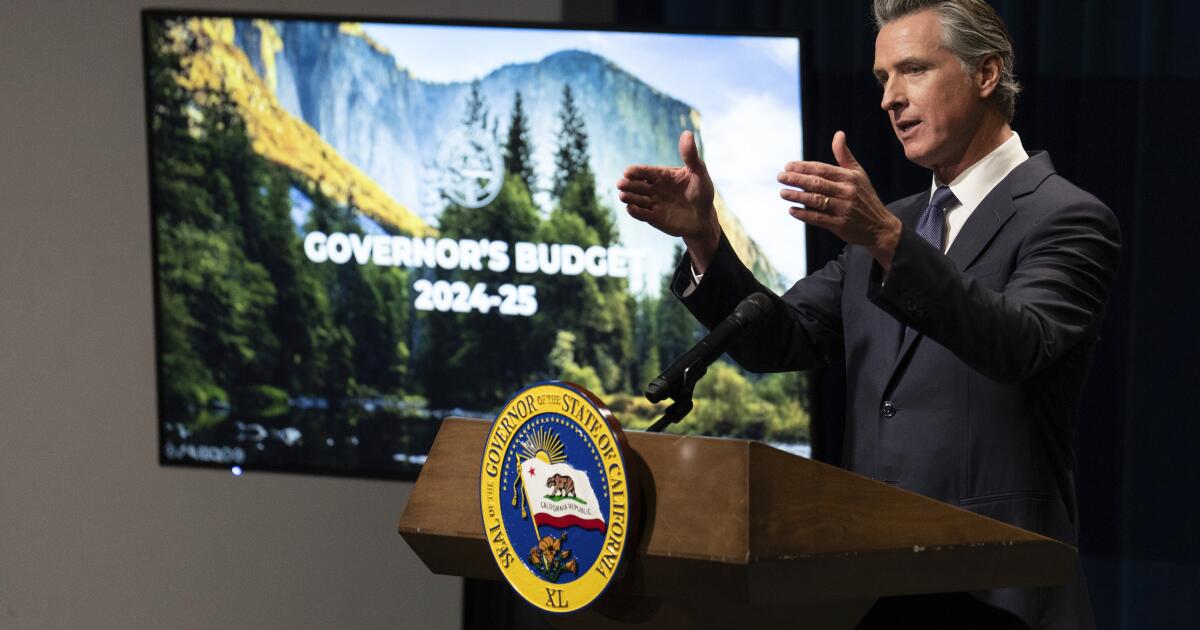
Investments geared toward combating climate change and transitioning away from fossil fuels are among the items on the chopping block as California Gov. Gavin Newsom seeks to close a $37.9-billion budget deficit.
The governor’s proposed 2024-25 budget, unveiled Wednesday, would see the state’s multiyear climate budget reduced to $48.3 billion — down 11% from the $54 billion approved in 2022. Among the trims are clean transportation programs and others that address forest maintenance, watershed resilience, coastal protection and sea level rise.
Newsom’s administration characterized the cuts as “limited” and said they will maintain the state’s momentum toward climate goals.
“$48.3 billion is a world-leading figure that exceeds [that of] many nations,” said Lauren Sanchez, Newsom’s senior climate advisor.
Aggressive and impactful reporting on climate change, the environment, health and science.
But some environmental groups were disappointed by the proposal, which would cut $2.9 billion in climate funding; delay an additional $1.9 billion; and shift $1.8 billion to other funds, primarily the state’s Greenhouse Gas Reduction Fund, which receives proceeds from cap-and-trade auctions.
“It’s a tough economic moment for sure,” said Mary Creasman, chief executive of California Environmental Voters. “At the same time, we would have hoped for a little bit more of a courageous proposal — something that is more creative and solutions-oriented about how to fund the transition that is so desperately needed toward clean energy and resilience.”
State officials stressed that the administration remains focused on accelerating California’s clean energy future and underscored progress made toward renewable energy resources and zero emission vehicles.
Yet the proposed budget includes notable trims for zero emission vehicle programs, including $600 million in delayed funds for the Clean Cars 4 All equity project and grants for electric fueling infrastructure. Creasman said that she was looking forward to drilling down into the details, but that the top-line figures did not reflect the urgency of the climate crisis.
“I feel like a broken record, but the cost of inaction is too great,” Creasman said. “There are real opportunities on the table to fund this transition, and California has globally relevant targets in place on emissions reductions and goals. … And yet we are not going to meet those unless we fund the work. That is our biggest obstacle left in the state.”
The proposal arrived only days after officials confirmed that 2023 was Earth’s warmest year on record. The year was marked by devastating wildfires, destructive floods and deadly heat waves — issues that are only expected to get worse in California and worldwide due to human-caused climate change.
But water, wildfire and heat were among the categories to see cuts under the proposed budget.
“The budget was horrible for all things wet,” said Mark Gold, director of water scarcity solutions for the Natural Resources Defense Council. “During a time of growing climate crisis and water scarcity concerns, seeing massive cuts in funding for water reuse, groundwater management and remediation, watershed and coastal resilience, and marine life protection is beyond disheartening. Climate and water resilience efforts cannot be further delayed.”
Among the proposed cuts are $350 million for various watershed climate resilience programs over the next two years; a delay of $100 million for water recycling and groundwater cleanup; a reversion of $50 million in general funds for dam safety investments; and a $30-million reduction in support for per- and polyfluoroalkyl substances, or PFAs.
Gold pointed out that the cuts also include more than $400 million in reductions for coastal resilience programs, at a time when the state has recently weathered extreme storms and damaging flooding.
“I’d say proportionately the coast took the biggest hit,” Gold said. Many of the large cuts “align directly with the climate stressors that have caused so much harm in the state of California, and that’s just beyond concerning,” he said.
There were other environmental blows as well, including a net reduction of $40.1 million for the state’s Extreme Heat and Community Resilience Program. An additional $100.7 million would be trimmed from wildfire reduction programs, including fuel treatment efforts and home hardening projects.
Wade Crowfoot, California’s natural resources secretary, said the budget maintains 95% of the $2.8 billion allocated toward wildfire resilience projects over the last five years, and said the California Department of Forestry and Fire Protection will continue to get new resources to fight fires.
He was one of many administration officials who focused on what they considered wins in the proposal. They noted that the governor was able to protect 89% of the existing climate budget even in the face of major deficits, and that many programs would remain intact, or close to it.
“We’re facing some dark financial storm clouds, but it’s also important to know the silver linings,” said Toks Omishakin, secretary of the California State Transportation Agency. “And when it comes to transportation, I believe there are many. Notably, while the budget proposals for transportation contain some funding shifts and delays, we’re able to maintain roughly 99% of funding in the governor’s historic transportation infrastructure package.”
Sanchez, Newsom’s climate advisor, said the state has also secured more than $10 billion in federal funding through President Biden’s Inflation Reduction Act, which will make up for some of the cuts at the state level and go toward water resilience, clean transportation projects, clean energy and more.
“The governor’s budget maintains critical climate investments for schools, jobs, housing and health,” Sanchez said. “Our budget also continues to prioritize equity and investments in underserved populations, which face disproportionate harm from pollution and from the climate crisis.”
In his remarks on Wednesday, Newsom vowed to continue to “hold Big Oil accountable” for its role in the climate crisis. That includes a recommendation in the budget to eliminate some subsidies that benefit oil and gas corporations, such as those geared toward intangible drilling costs and allowances for economic credits, among other items.
Barry Vesser, chief operating officer with the Climate Center, said in a statement that those were wise recommendations, but the governor should go even further and eliminate all tax breaks and subsidies for fossil fuel corporations.
“While it won’t close the deficit entirely, ending all of Big Oil’s subsidies would free up billions to invest in growing the skilled and trained clean energy workforce, implement sustainable agricultural practices, deploy more clean energy and storage, and carry out other initiatives now on the chopping block,” he said.
Presenting his proposal, Newsom indicated his administration will continue moving ahead with a long-term plan to build a giant water tunnel in the Sacramento-San Joaquin River Delta, saying “there’s a lot of momentum” on that and other water infrastructure projects.
Environmental activists criticized the governor for pursuing the multibillion-dollar tunnel project while cutting other spending this year.
“It will waste at least $16 billion that could be spent on actual climate resilience projects,” said Barbara Barrigan-Parrilla, executive director of the group Restore the Delta. “This is not serious climate water planning.”
Some experts were critical not only of the numbers but of the process itself. There is a “mismatch” between the budget’s articulation of the state’s climate challenges and its proposed solutions, said Laurie Wayburn, chair of the California Natural and Working Lands Expert Advisory Committee.
The traditional framework tends to silo issues such as wildfires, droughts and extreme heat away from integrated solutions such as carbon emission reductions and nature-based solutions, she said.
“As a result, that kind of fractionation really doesn’t help you understand either the level of investment very directly, or the impact,” Wayburn said.
She added that although California has undoubtedly made pioneering advancements in the climate space, “the budget doesn’t yet reflect that.”
Katelyn Roedner Sutter, California state director for the Environmental Defense Fund, said climate funding is critical.
“We get one shot to protect California communities from a future shaped by extreme heat, drought, wildfires, and harmful pollution but the state is not yet acting at the scale required for success,” Roedner Sutter said. “Bold action this decade provides our best chance to prevent a catastrophic climate future.”
Others praised the governor’s decision to preserve investments in providing safe drinking water in communities where people live with contaminated tap water.
“We’re heartened to see this program maintained and look forward to ensuring critical drinking water projects continue to move forward with the urgency they deserve,” said Kyle Jones, policy and legal director for the Community Water Center.

Politics
Commentary: Birthright citizenship ruling was a win for democracy — and a warning about erasing history

This week’s narrow Supreme Court decision protecting birthright citizenship is rightly being hailed as a triumph for the American experiment.
By some, anyway.
Check out MAGA world and you’ll quickly find Trump surrogates and even elected leaders spouting a kind of extremist anti-immigrant sentiment that once, not so long ago, was considered intolerable in the public sphere.
This has included suggestions that go as far as banning pregnant women from traveling to the United States for fear they might give birth here, and — no joke — one notable commentator writing that demanding female immigrants be sterilized might be a solution.
President Trump’s homeland security advisor Stephen Miller said after the ruling that children of immigrants might not be “qualified to carry on or capable of executing the inheritance of this country.”
“We have people from all over the world, from Third World nations, nations that on their own would have never invented the wheel, let alone modern technology, let alone medicine, let alone air travel, and they can just come into the country, have a baby at a hospital, paid for it by you and me, and then that baby is automatically a citizen,” Miller said.
Before you tell me that the Supreme Court has spoken and this is a done deal, no matter if there’s more gross Miller mush, let me tell you about Supreme Court Justice Ketanji Brown Jackson’s written opinion and why it matters. It is, if read in the right light, a warning for what comes next — a fight to rewrite history to serve political aims.
“The odds were long and the stakes were high,” Jackson wrote about the creation of the 14th Amendment in 1866, which has long been understood as granting citizenship to any child born on U.S. soil and which was the focus of this case.
Still, she wrote, despite the unlikeliness of post-Civil War America rising to the challenge of inclusiveness, the amendment was always meant to do just that — because free Black people, recently emancipated but denied citizenship, “fought for the shared humanity of all people.”
Signs sit available for protesters to demonstrate outside the U.S. Supreme Court as President Trump arrives to attend oral arguments on April 1 in Washington, DC.
(Heather Diehl / Getty Images)
An alternative interpretation by MAGA world of this amendment and this history was the center of this case.
To greatly simplify, the 14th Amendment was originally a response to a Supreme Court decision, the Dred Scott case, that said freed Black slaves could not be U.S. citizens. MAGA world was arguing that the authors of the 14th Amendment never intended much more than that — citizenship for ex-slaves and their descendants.
While concurring with the majority of the court, Jackson also wrote her own summary that makes a vital point: Without history that includes the Black experience — as most of the arguments in this case did — we are left bereft of the suffering that has shaped our values and which gives us the empathy required to be a pluralistic society.
Black history — any non-white history, really — is the history of resistance and the road map to recovery from this dark era of hate.
It’s hard to call someone your fellow citizen if you take away their humanity — which is exactly what this case was attempting to do by splitting into factions those who would fight for equality and rewriting history with only the voices that match the current administration’s goals.
It was disappointing that the court, whose individual justices bounced around arguments from a myriad of sources outside of their erstwhile adherence to the ideas of originalism, did not call out that erasure more forcefully, and that it was left to Jackson to do so.
Jackson took that narrow idea that Black people — and the white legislators sympathetic to their cause — had only themselves in mind when crafting the 14th Amendment and attacked it head-on, arguing that if we just look at what Black people were saying at the time, the larger intent of the amendment becomes clear.
“This alternative account pitches Black Americans against immigrants when the advocates who promoted the Fourteenth Amendment did no such thing,” Jackson pointed out of the MAGA version of events. “Freed Blacks fought for the shared humanity of all people.”
That “universalist vision of belonging and citizenship,” she wrote, “eventually won the day.”
The 14th Amendment was largely written by Sen. Lyman Trumbull of Illinois, who took much of the basis of it from the legal arguments of Black intellectuals, including Frederick Douglass, the most influential Black statesman of the era.
Trumbull then argued in Congress that the amendment was meant to be inclusive — even of so-called “gypsies” and Chinese immigrants, who faced extreme racism, especially in California.
One congressman opposed to the measure warned that if it passed, Chinese immigrants would “overrun” California and “will double or treble the population.” At the same time, the Romani would likely continue to “wander in gangs” and “have no homes, pretend to own no land, live nowhere, settle as trespassers where ever they go, and whose sole merit is a universal swindle,” he warned.
Asked if the amendment would grant citizenship to those two controversial groups of immigrants, Jackson points out that Trumbull gave an unapologetic “undoubtedly,” again drawing on the universalist ideas of Douglass and others.
The “child of an Asiatic is just as much a citizen as the child of a European,” Trumbull said (and Jackson quoted, drawing from an amicus brief by Evan Bernick of Northern Illinois University and Jed Sugerman of Boston University).
“There is a serious breakdown on the court that reflects the breakdown and echo chambers in America,” Sugerman, the professor, told me Wednesday. “When it comes to history and originalism, you have to read more broadly than just the founding fathers that you liked.”
So the history of the 14th Amendment is right there — equality not just for Black Americans but for immigrant Americans — but it required Jackson to write her own opinion to put it on the court record.
Legal scholars aligned with Trump did Olympic-level gymnastics in this case to parse what the authors of the 14th Amendment meant with the phrase “subject to the jurisdiction” — words that MAGA claimed were meant to secretly exclude undocumented immigrants.
Brown instead reminded us that outside of those white-only discussions when the amendment was written, it was the activism of Black people — their demand for colorblind equality — that actually shaped the final words that granted citizenship to all babies born within our borders.
Solidarity — the unbreakable strength of American democracy.
After the ruling, Trump wrote on social media that Congress could write legislation undoing birthright citizenship. Some pundits say that wouldn’t work, but I’m here to say Trump has managed a bunch of stuff that the pundits said wouldn’t work.
More chilling, and direct, were more comments from Miller.
“It’s an abomination,” he said of the ruling.
But “because of President Trump’s courage and leadership, we are now on the precipice. Yes, we were dealt a setback, but because of his courage alone, we’re on the precipice as a nation of being in a position to end this travesty once and for all, and that’s what we have to fight for.”
Miller and his ilk are seeking to rewrite history to justify their vision of the future of America.
Jackson alone in the court offered us both a warning and a path — a reminder that our history holds indisputable facts despite politics, and we erase them at our own peril.

NEWYou can now listen to Fox News articles!
President Donald Trump marked the eve of America’s 250th anniversary with a sweeping patriotic address at Mount Rushmore on Friday, declaring the United States the “most exceptional nation ever to exist” and vowing that it would “never be a Communist country.”
Speaking beneath the granite likenesses of four of his predecessors — George Washington, Thomas Jefferson, Abraham Lincoln and Theodore Roosevelt — Trump touted American exceptionalism as festivities marking the nation’s 250th anniversary ramped up across the country.
“In all the chronicles of the ages, never before has any nation celebrated so magnificent a triumph as this one,” Trump told the crowd.
TRUMP KICKS OFF FOURTH OF JULY WEEKEND WITH SYMBOLIC SALUTE TO AMERICA’S LEGACY
President Donald Trump delivers remarks at Mount Rushmore on the eve of America’s 250th anniversary. (Chip Somodevilla/Getty Images)
“At 250 years, America is the oldest republic on earth,” he continued. “We are the freest people on earth. We have the most righteous and enduring Constitution on earth. We are the strongest and most powerful country on earth. And by the grace of God, the United States of America is the most successful, most accomplished, most exceptional nation ever to exist in human history.”
Trump praised the nation’s history and argued that no other country had achieved as much as the United States.
“The birth and survival of the American nation under God is, quite simply, the best and most incredible thing ever to happen on this planet by human hands, ever,” he said. “No other country has done more good for this world than the United States of America.”
AMERICA’S NEXT 250 YEARS DEPEND ON PASSING FAITH AND FREEDOM TO OUR CHILDREN
Fireworks explode after President Donald Trump spoke at Mount Rushmore National Memorial, Friday, July 3, 2026, near Keystone, South Dakota. (AP Photo/Matt Gade)
Before Trump took the stage, the new Air Force One flew over Mount Rushmore as spectators cheered. After his remarks, the president stayed to watch a fireworks display over the Black Hills.
Trump argued the country was facing what he described as a growing communist movement that sought to undermine America’s “exceptional character” and “alienate us from our history.”
The president said the movement had raised the question, “What does it mean to be an American?”
MAMDANI BLASTS ICE AGENTS, ELON MUSK AND ‘SUPREMACY’ IN AMERICA 250 SPEECH AHEAD OF JULY 4 WEEKEND
President Donald Trump speaks at Mount Rushmore National Memorial, Friday, July 3, 2026, near Keystone, South Dakota. (AP Photo/Matt Gade)
Trump described communism as “the greatest threat” facing the United States.
“It is the greatest threat to our country, including World War One, World War Two, Pearl Harbor, or even 9/11,” Trump said. “We’re not going to let this happen to us. Believe me, we’re not letting it happen, because communism is the enemy of free people.”
“Communism is the exact opposite of life, liberty, and the pursuit of happiness — it is death, tyranny and the pursuit of evil,” he continued.
“But we will not let them win,” he added. “They have no chance against us.”
Trump issued a clear directive: “You can be loyal to Karl Marx, or you can be loyal to America. You can be a communist, or you can be a patriot. You cannot be both.”
President Donald Trump speaks beneath Mount Rushmore during a celebration ahead of America’s 250th anniversary. (Chip Somodevilla/Getty Images)
As Americans face those choices, Trump pointed to the nation’s past sacrifices as a guide for its future.
“Our American ancestors did not shed their blood at Concord and Trenton, Gettysburg and Shiloh, Midway and Normandy, just so that a band of thieves, radicals and lunatics could come in and loot, pillage our nation,” he said.
Trump also highlighted the four presidents carved into the mountain behind him, saying they represented America’s founding ideals.
“They were men of action, men of ambition, men of daring, men of destiny, and men of truly great intelligence,” he said. “Above all, they were great men of history. Tonight, on the threshold of our 250th year, we stand beneath the monument of these heroes, a true group of unbelievable people. And we rededicate ourselves to being a nation as big, bold, noble, and as great as these American giants.”
CLICK HERE TO DOWNLOAD THE FOX NEWS APP
Trump is scheduled to deliver another speech Saturday on the National Mall in Washington, D.C. before a fireworks display celebrating the nation’s 250th anniversary.
“We know that this is not an ending,” Trump said. “This is only the beginning of the golden age of America.”

California’s effort to restrict sales of handguns that can be converted into fully-automatic machine guns drew an immediate federal challenge Wednesday, with the Trump administration suing the state over its new “Glock ban” law just hours after it took effect.
The U.S. Department of Justice is seeking a court order to block the controversial state law that limits where most Glock and Glock-style pistols can be sold. The lawsuit, filed in U.S. District Court for the Central District of California, also aims to invalidate key parts of the state’s handgun roster — a list that dictates the types of firearms that Californians may legally purchase. In a statement Wednesday, acting Atty. Gen. Todd Blanche said that both policies “trample” the rights of law-abiding Californians.
“The Second Amendment is a sacred right belonging to all Americans, even those in California,” Blanche said. “California cannot ban the most popular type of handgun in America.”
California’s Assembly Bill 1127 does not explicitly name the Glock brand, but instead targets any handgun with a specific mechanism that can easily be converted by a black market device. These simple “Glock switches” convert semiautomatic handguns into a weapon capable of firing 20 rounds per second with a single squeeze of the trigger.
Advances in 3D printing have made the conversion devices widely available and cheap to produce. Federal authorities reported recovering 11,088 of them from crime scenes between 2019 and 2023. Switches have been used in several mass shootings, including one in Sacramento that resulted in six deaths and 12 injuries in 2022.
The new law does not prohibit the possession of affected handguns already owned by Californians, and includes exemptions for gun dealers, as well as law enforcement and military agencies.
Gov. Gavin Newsom signed the bill in October, and has maintained that firearm laws are responsible for California’s declining crime rates and gun deaths.
“The Trump administration is once again trying to dismantle California’s commonsense gun safety laws,” Diana Crofts-Pelayo, a spokesperson for the governor, said in a statement. “Our response is simple — these laws save lives.”
The federal government argues in its complaint that California can’t ban legal semiautomatic handguns simply because they could be illegally altered, adding that state and federal law already prohibit such pistol converters. The U.S. compared California’s approach to banning ordinary shotguns because they can be illegally shortened.
The lawsuit also challenges California’s decades-old handgun roster, which requires new handgun models to pass certain safety tests before they can be approved for retail sale. A federal judge tentatively blocked portions of the roster requirements in a separate 2023 case, which is being appealed before the 9th Circuit. That lawsuit was filed by the California Rifle & Pistol Assn. and other gun rights supporters following a landmark 2022 decision by the U.S. Supreme Court that set new standards for evaluating firearm restrictions.
Under those new guidelines, the Trump administration wants a judge to find that California’s gun restrictions violate the 2nd Amendment, and is seeking an order to bar the state from enforcing them.
The Trump administration is relying on a federal civil rights law typically used against police departments accused of repeated constitutional violations, arguing that California Atty. Gen. Rob Bonta and state Justice Department agents qualify as peace officers and therefore violate gun owners’ rights whenever they enforce handgun restrictions.
Bonta, who is named in the suit, has a winning court record over the Trump administration, and has secured at least 12 final court rulings and more than 35 preliminary injunctions or emergency orders.
“California’s gun safety laws helped drive firearm death rates to record lows in our state and are a blueprint for reducing gun violence nationwide,” Bonta’s office said in a statement. “We will review the complaint and respond as appropriate in court.”
-
 Business7 minutes ago
Want an AI-proof job? New research says you may be safer at companies embracing the technology
-
 Entertainment14 minutes ago
Taylor Swift and Travis Kelce: Revisit the roots of their love story ahead of MSG wedding bash
-
 Lifestyle17 minutes ago
A historically hot Paris Fashion Week photographed with a kid’s camera
-
Politics22 minutes ago
Commentary: Birthright citizenship ruling was a win for democracy — and a warning about erasing history
-
 Science29 minutes ago
July Fourth fireworks may bring ‘hazardous’ air quality to Southern California. What you need to know
-
 Sports32 minutes ago
Letters to Sports: Mixed emotions over LeBron James leaving Lakers
-

 World44 minutes ago
Nabatieh recovery begins amid ongoing southern Lebanon tensions
-
 News1 hour ago
Reflections on America’s 250th birthday

