Politics
Newsom celebrates political victory on gas price spike bill, but concerns remain about policy

At a campaign rally in the Coachella Valley, former President Trump on Saturday called out California’s cost of living and nation-leading gas prices as an example of Vice President Kamala Harris and other “radical Democrats” destroying the state.
“Today California has the highest inflation, the highest taxes, the highest gas prices, the highest cost of living, the most regulations,” he said. “We’re not going to let Kamala Harris do to America what she did to California.”
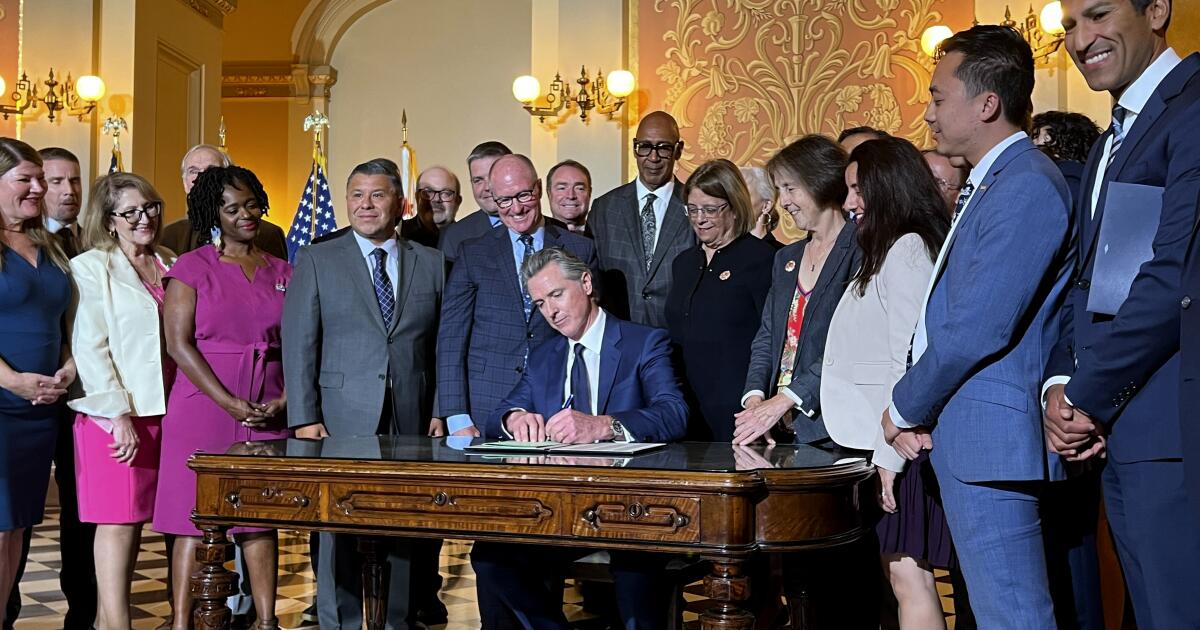
Two days later at the state Capitol, Gov. Gavin Newsom celebrated the passage of a new state law that could lower gasoline price spikes by giving regulators the authority to require that California oil refiners store more inventory.
Newsom and Democratic lawmakers cast the bill as a solution to high gas prices. With less than three weeks until the Nov. 5 election, affordability has become a major political issue and a potential vulnerability for Harris’ presidential campaign.
“It’s about time we stood up,” Newsom said after he signed the bill on Monday. “This is the fourth largest market in the world. This is a big damn deal.”
The newly passed law gives Newsom a win in his political battle with the oil industry, but whether Harris or other Democratic candidates will benefit from the governor’s victory remains unclear.
Newsom’s law will not immediately lower the cost of gasoline in California. While experts say it could ultimately offer reductions of future price spikes, regulators will have to complete a thorough review process to enact the new controls.
Governors in Arizona and Nevada wrote letters warning that the legislation could drive up costs for their constituents, potentially bolstering concerns in pivotal swing states about California’s policies.
Newsom called lawmakers back to Sacramento for a special session to pass the policy. At the same time, however, his administration is expected to adopt stricter limits on carbon fuels that could drive up per-gallon costs by almost half a dollar or more just days after the election.
The governor declined to answer a question at a news conference about whether he thought the new law would affect Democrats in the election, arguing that the effort wasn’t about politics. In a video posted to social media minutes before he signed the bill into law on Monday, Newsom accused the industry of being in “cahoots” with Trump by intentionally pushing prices higher to scare voters during election season.
Opponents have cast his push to address gas prices as an example of “political theatrics.”
“This is politics, not policy,” said Catherine Reheis-Boyd, chief executive of the Western States Petroleum Assn. “This is a show. This is anything but good policy.”
Newsom and the petroleum trade group have been locked in a political battle over gas prices since the summer of 2022. The governor ran ads in Florida calling out Gov. Ron DeSantis’ conservative policies, which prompted a response from the petroleum group blaming Newsom for California’s highest-in-the-nation gas prices.
Since then the governor has repeatedly accused the industry of intentionally gouging consumers.
His administration has pointed out that prices spike when refineries experience unplanned maintenance problems with their equipment, which limits the amount of gasoline available in the state and drives up prices. Requiring the refineries to increase fuel reserves, his administration says, will help prevent those shortages.
Reheis-Boyd has argued that requiring refineries to store more gasoline will increase costs for the companies and drive up prices at the pump. The industry contends that California’s nation-leading gasoline costs are a supply and demand problem in a state that has adopted environmental policies to limit oil drilling and production.
The cheapest way to lower gas prices is to allow oil companies to increase crude oil production in California and rely less on supply from overseas, Reheis-Boyd said.
The state should be working closely with California’s small number of refineries to ensure the state has enough gasoline, instead of adopting new regulations that restrict profits and pushing the companies out of business, she said.
“We have a governor who isn’t interested in the conversation,” Reheis-Boyd said. “He’s the only governor I’ve never met with, because he won’t meet.”
This year marks the second time in two years that Newsom has pushed lawmakers to adopt new oil regulations, an issue that divides Democrats as they navigate desires to fight climate change and lower gas prices.
In 2023, lawmakers balked at passing Newsom’s proposal to penalize oil companies that earn excessive profits. Instead lawmakers adopted new oversight of the industry and gave regulators the ability to cap profits through a rule-making process that has yet to result in any new restrictions.
Democrats in the Legislature were reluctant to pass Newsom’s new oil bill again this year.
Two weeks before the regular session concluded at the end of August, Newsom announced a proposal to require that petroleum refiners maintain a stable inventory in order to prevent fuel shortages and price spikes when refinery equipment is taken offline for maintenance.
Assembly Speaker Robert Rivas (D-Hollister) refused to take up the bill for a floor vote at the end of session, arguing that his caucus did not want to rush legislation through without properly vetting the policy. He agreed to work on the proposal in a special session.
Senate President Pro Tem Mike McGuire (D-Healdsburg) took the opposite approach. His caucus was ready to pass the bill at the end of session, he said, and he initially refused to participate in a special session before giving in to the governor’s demands.
During the special session, the Assembly held a series of hearings before passing the bill earlier this month. The Senate quickly signed off on the proposal the following week.
While some liberal Democrats quietly fumed as the governor forced them to vote on another one of his political proposals, many felt the policy could ultimately reduce price spikes that hurt consumers.
“The data is clear: Price spikes happen when refineries fail to plan for supply during scheduled maintenance,” said Assemblymember Gregg Hart (D-Santa Barbara). “This bill will hold oil companies accountable for resupply plans when refineries’ shutdowns occur, ultimately saving Californians billions at the pump.”
Several Democratic legislators competing for swing-district seats in November did not vote, or opposed the bill.
State Sen. Dave Min (D-Irvine), who declined to vote on the proposal, said he supported the goal to address the problem of high gas prices in the state but did not agree with the approach. Min is locked in a tight race for Congress against Republican Scott Baugh in Orange County.
Min said opponents to Newsom’s proposal “raised serious concerns” about whether it would be effective in lowering gas prices or even be counterproductive.
“These concerns deserve a fair and full vetting, which is difficult to do in a special session conducted just weeks before many of the current legislators will be leaving office,” Min said in a statement.
Republicans said Democrats would reduce gas taxes if they were serious about the problem of affordability.
“So, who’s making the money?” asked state Sen. Brian Dahle (R-Bieber). “Who’s gouging Californians for every gallon of gas? It’s the government. $1.42 for every single gallon of gas goes to taxes, whether it’s state, local or federal.”
Opposition to the proposal from labor unions representing workers in the industry added to the pressures on Democrats.
Tom Baca, the international vice president for western states of the International Brotherhood of Boilermakers, said giving regulators control over maintenance schedules, instead of relying on the insight of the workers with deep knowledge of the equipment, could put his members in dangerous conditions if work is delayed.
David Sikorski, business manager for the International Union of Operating Engineers Local 12, called the special session “unnecessary.”
His union represents 21,000 workers in California, Arizona and Nevada. He said Newsom’s policy could prove to be a liability to Harris in the neighboring swing states of Arizona and Nevada.
“We’ve made some real momentum, hit the ground running in Arizona, and we put a lot of resources into getting friendly politicians, and Kamala Harris, elected in that state,” he said. “This is just one more hurdle that we have to overcome with our membership and working people in general.”


new video loaded: Jan. 6 Rioter Hired by Pentagon
transcript
transcript
Jan. 6 Rioter Hired by Pentagon
Elias Irizarry, who pleaded guilty to climbing through a broken window at the Capitol on Jan. 6, 2021, now works for an office responsible for uncovering and defending against terrorism plots at the Pentagon.
-
“Full pardon or commutation?” “Full pardon.”
By Alisa Shodiyev Kaff
June 4, 2026

NEWYou can now listen to Fox News articles!
Democrats splintered over a resolution seeking to block the U.S. from assisting Israel’s war against Hezbollah, an Iranian-backed terrorist group, on Thursday.
The measure, offered by progressive Rep. Rashida Tlaib, D-Mich., would require President Donald Trump to withdraw U.S. forces from Lebanon. For months, Israel and Hezbollah, a U.S.-designated terrorist group and Iranian proxy, have been at war in southern Lebanon, but the United States has not joined the conflict.
A bipartisan coalition of lawmakers, including House Minority Leader Hakeem Jeffries, D-N.Y., rejected the measure. Critics argued the resolution could aid Hezbollah and potentially hamstring U.S. military operations in the country.
Tlaib’s resolution failed 92-324, with more than half of House Democrats joining nearly all Republicans to vote it down.
The Lebanon war powers resolution divided Democrats, with House Minority Leader Hakeem Jeffries, D-N.Y., joining Republicans in rejecting the measure. (Aaron Schwartz/Bloomberg)
REP RASHIDA TLAIB MOVES TO BLOCK US OPERATIONS IN LEBANON BUT IGNORES HEZBOLLAH
Rep. Thomas Massie, R-Ky., an Israel critic, was the lone Republican to support Tlaib’s measure. Meanwhile, Reps. Derek Tran, D-Calif., and Betty McCollum, D-Minn., voted present.
House Democratic leaders said shortly before the vote they would oppose Tlaib’s resolution and work with the progressive lawmaker on a narrower measure exempting some U.S. military operations in the country. Their statement also denounced Hezbollah as a “violent terrorist organization” and a “sworn enemy of the United States.”
Tlaib, who has accused Israel of committing “ethnic cleansing” in Lebanon, did not mention Hezbollah in her resolution. She and other proponents of the measure also avoided discussing the Iranian proxy force during heated floor debate over the measure.
Republicans highlighted the omission and accused the legislation’s supporters of serving as “proxies for Hezbollah.”
“Apparently they don’t want to see Israel killing Hezbollah, even though it’s Hezbollah that is killing Israeli children, Israeli adults, Israeli elders,” House Foreign Affairs Committee Chairman Brian Mast, R-Fla., said Wednesday, referring to his Democratic colleagues.
Tlaib asserted that her resolution would only affect U.S. forces actively engaged in hostilities. Republicans, however, disputed that claim and suggested it would hurt U.S. efforts to counter Hezbollah.
“It doesn’t say anything about [whether] you can keep the Marines that are in the embassy,” Mast said, referring to the U.S. embassy in Beirut. “That’s a pretty big oversight. It doesn’t say anything about whether we can keep United States armed forces that are training missions with the LAF [Lebanese Armed Forces]. Again, pretty big oversight.”
Rep. Rashida Tlaib, a Democrat from Michigan, attempted to bar U.S. forces from joining Israel’s war in Lebanon. (Tierney L. Cross/Bloomberg)
RASHIDA TLAIB HIT WITH HOUSE CENSURE THREAT, ACCUSED OF ‘CELEBRATING TERRORISM’ IN PRO-PALESTINIAN SPEECH
The debate turned personal when Rep. Max Miller, R-Ohio, a member of the House Foreign Affairs Committee, linked Tlaib to Hezbollah.
“Hezbollah is a terrorist organization … and its members are butchers that you like to hang out with to a certain extent,” the Ohio lawmaker said, referring to Tlaib.
A shouting match between the two then broke out, with Tlaib demanding that Miller’s remarks be stricken from the record.
The presiding chair ultimately complied with her request, but Miller doubled down on his remarks.
CLICK HERE TO DOWNLOAD THE FOX NEWS APP
“Yes, I said it. I own it, and I stand by it,” Mast said on behalf of Miller on the floor.
Tlaib’s failed war powers resolution comes as Iran has sought to tie Israel’s invasion of Lebanon to its ceasefire negotiations with the United States.
Hezbollah, which has long helped Iran project power in the region, rejected a ceasefire agreement between Israel and Lebanon’s government Thursday.

WASHINGTON — Initial efforts in the Senate failed Thursday to block the $1.8-billion fund that the Trump administration has sought to establish to pay people who claim the government wronged them, though further attempts were likely to come Thursday afternoon.
Republicans narrowly voted down a Democratic amendment to ban the payout fund and then Democrats killed a Republican amendment, which would have prohibited the use of federal money for the fund but would have sent $1.7 billion to the Justice Department’s fraud division.
It was the second effort in Congress to rebuke President Trump in two days, following the House vote Wednesday to rein in Trump’s war powers in Iran.
The dueling amendments were proposed by Senate Minority Leader Chuck Schumer (D-N.Y.) and Sen. Thom Tillis (R-N.C.). They were attached to the reconciliation bill that would fund Immigration and Customs Enforcement and the Border Patrol, a high priority for Republicans.
The votes came as the Senate began a “vote-a-rama,” during which lawmakers were expected to propose a stream of amendments to the immigration bill on various topics.
The Trump administration’s plan for the payment fund — widely seen as a way for Trump to compensate his political allies, including those who participated in the Jan. 6, 2021, attack on the Capitol — set off particular ire from some GOP lawmakers.
The plan has fueled growing unrest within parts of Trump’s party over his governance, compounded by the president’s endorsement of primary challengers to Sens. John Cornyn (R-Texas) and Bill Cassidy (R-La.), as well as Rep. Thomas Massie (R-Ky.), which angered some Republican senators.
Cassidy, who lost his primary and has since voiced strong opposition to Trump’s $1.8-billion fund, became a key player in the Thursday votes, voting down Schumer’s amendment but supporting Tillis’.
On Wednesday, Cassidy joined with Sen. Cory Booker (D-N.J.) to argue in a court filing that the $1.8-billion fund circumvents Congress’ authority and violates the Constitution’s spending and appropriations clauses.
“It is an unconstitutional attempt to spend the People’s money without Congressional approval,” Cassidy and Booker wrote in an amicus brief filed in the federal court case challenging the fund.
The fund was created by the Justice Department to settle a lawsuit brought by Trump against the Internal Revenue Service over the leak of his tax returns. Trump and his sons agreed to drop their personal lawsuit against the government in exchange for the creation of the $1.776-billion fund. Critics immediately questioned the plan, and it drew a rare backlash from Republicans.
In late May, GOP senators derailed plans to vote on the immigration bill over their displeasure with the payout fund and with Trump’s desire to use taxpayer funds for his planned White House ballroom. Senate Republicans removed the ballroom funding from the immigration package Wednesday, another setback for Trump.
The Trump administration sought to back away from its plans for the fund this week, following bipartisan outcry and a federal court ruling that temporarily blocked any payouts from the fund. Acting Atty. Gen. Todd Blanche said Tuesday the administration would end its plans to move ahead with the concept.
But Trump on Wednesday told reporters he didn’t know whether the fund was dead, calling it “a beautiful thing.”
After Schumer proposed the first amendment to ban the fund Thursday morning, the Senate came to a standstill as three key Republican senators deliberated. Schumer framed his effort to ban the fund Thursday as a way to force a referendum on Trump’s plan.
The amendment “offers Republicans a choice: Do you support Donald Trump’s $2 billion taxpayer-funded slush fund, or do you want to protect the American people and their paychecks?” Schumer said on the Senate floor before the vote.
Sen. Bernie Moreno (R-Ohio) urged Republicans to reject the amendment, saying Democrats were planning to “play so many games” on Thursday during the marathon session.
“We are going to fund immigration enforcement and border patrol, and I urge my Republican colleagues to stay united on that singular mission,” Moreno said.
The amendment failed after Cassidy voted against it. Republican Sens. Susan Collins of Maine, Jon Husted of Ohio and Dan Sullivan of Alaska voted in favor.
Schumer’s amendment was uniformly supported by Democrats, including California Sens. Adam Schiff and Alex Padilla.
Tillis, who also voted against Schumer’s amendment, immediately proposed his amendment. Sen. Jeff Merkley (D-Oregon) urged Democrats to oppose it, saying that the proposal would create “a new slush fund” by giving the money to the Justice Department.
“We heard over the last 48 hours that the acting attorney general said that this fund’s not moving forward. All this amendment does is codify what I believe the policy of the DOJ is,” Tillis said on the floor before voting began on his amendment. “This [fund] is unpopular, this administration has said they’re not moving forward with it; this is an opportunity for us to put it to bed.”
Responded Merkley: “Taking one slush fund and eliminating it and then creating a new slush fund still under control of the attorney general is not the way to go. The way to go is to get rid of these slush funds altogether.”
Trump has faced a recent string of failures, including the House vote Wednesday, a court ruling to remove his name from the Kennedy Center and a record-low approval rating among Americans as concern rises about economic issues, gas prices and Trump’s war with Iran.
On Wednesday, Trump lashed out against the four Republicans who backed the House war powers resolution, calling it “an unpatriotic thing” to do and calling the vote “meaningless.”
“They’re GRANDSTANDERS! They should be ashamed of themselves. MAGA!!! President DJT,” Trump wrote.
Times staff writer Ana Ceballos, in Washington, contributed to this report.
-

 Los Angeles, Ca1 hour ago
'Top Gun: Maverick' actor identified as victim stabbed to death in Tarzana
-

 Detroit, MI2 hours ago
Storm chances return, which could impact Motor City Pride, graduations this weekend across Metro Detroit
-

 San Francisco, CA2 hours ago
Hilton campaigns in San Francisco as California primary votes still being counted
-

 Dallas, TX2 hours ago
Crews cover up AT&T branding as stadium becomes
-

 Miami, FL2 hours ago
Miami leaders gather for FIFA World Cup Host Committee Gala
-

 Boston, MA2 hours ago
Package fire outside Boston’s Museum of African American History under investigation
-

 Denver, CO2 hours ago
Rockies beat reporter Patrick Saunders to leave Denver Post
-

 Seattle, WA2 hours ago
Seattle granted NFL Franchise on this day 52 years ago

