Politics
Nevada's secretary of state says lawyers who fill poll worker gap should earn continuing education credits


- Secretary of State Cisco Aguilar in Nevada seeks to address the shortage of poll workers by offering continuing education credits for lawyers who volunteer to fill the gap.
- Several states have adopted policies allowing poll working duties to count toward maintaining law licenses, with hopes for further expansion.
- Aguilar said he seeks to strengthen the pipeline of election workers with legal expertise.
With Nevada counties struggling to find poll workers in a pivotal election year, the top election official in the Western swing state is taking a page from his counterparts elsewhere and is asking the legal community to help fill the gap.
Secretary of State Cisco Aguilar wants lawyers who volunteer at the polls to be able to earn continuing education credits to fulfill annual requirements set by the State Bar of Nevada.
It’s a signal of how lawyers are increasingly seen as ideal candidates for stepping in as poll workers, as the positions have grown harder to fill as once-obscure county election departments have been thrust into the spotlight.
DUELING REPUBLICAN CONTESTS: TRUMP TO ROMP IN NEVADA GOP CAUCUS AFTER HALEY LOSES PRESIDENTIAL PRIMARY
Aguilar likens it to how doctors and nurses stepped up during the pandemic.
Nevada Secretary of State Cisco Aguilar speaks at the old Assembly Chambers on May 30, 2023, in Carson City, Nev. With Nevada counties struggling to find poll workers in a pivotal election year, Aguilar is taking a page from his counterparts elsewhere and is asking the legal community to help fill the gap. (AP Photo/Tom R. Smedes, File)
“Everybody needed medical care during the time of COVID. … And this is a time when we need poll workers,” Aguilar told The Associated Press. “That legal community can stand up and protect the Constitution.”
From swing states like Michigan to conservative strongholds like Tennessee and Iowa, election officials have been tapping lawyers and law students as they struggle to fill poll worker spots — a challenge that has become more difficult amid changing procedures and hostility stemming from former President Donald Trump’s claims of a stolen election in 2020.
AFTER TRUMP ROMPS IN NEVADA, GOP PRESIDENTIAL RACE MOVES TO HALEY’S HOME STATE OF SOUTH CAROLINA
Other recruiting campaigns have focused on veterans and librarians. In 2020, LeBron James helped spearhead an initiative to help turnout in critical swing states and combat Black voter suppression, in no small part by recruiting poll workers.
Poll workers are on the front lines of increasingly contentious environments — ushering people in, answering technical questions and using a handful of training hours to essentially act as guides for a process where disagreements and misinformation can stir up strong emotions.
Since 2020, eight states have adopted policies to allow poll working duties to count toward credits needed to maintain a law license, and national advocates hope more are on the way.
After pitching the idea at a conference earlier this month, a group of bar association presidents now is tailoring the initiative to individual county election offices, rather than blanket approval from the bar associations for entire states.
“Lawyers are careful, and I respect that. I’m one of them, and it takes a while to process,” said Jason Kaune, chair of the American Bar Association’s standing committee on election law, of getting the initiative approved by state bar associations. “This is just a quicker way to get some real results on the ground.”
For Aguilar, his proposal in Nevada — where turnover has ravaged local election departments since 2020 — is part of a wider plan to protect election workers, whom he refers to as “heroes of democracy.”
Since defeating a Republican election denier in the 2022 midterms, Aguilar has sought to create a better environment for election employees. Last year, he pushed a bill signed by Republican Gov. Joe Lombardo that made it a felony to harass, intimidate or use force on election workers performing their duties in Nevada.
Aguilar also hopes that this latest initiative will strengthen the pipeline of full-time election workers with those already well-versed in the law.
Aguilar had hoped the State Bar of Nevada would have implemented his proposal before Nevada’s Feb. 6 presidential preference primary, but the secretary of state’s office has yet to make a formal request for the association to consider, per the State Bar.
During Nevada’s first-in-the-West presidential preference primaries, many election departments scrambled to find poll workers up until the last minute — particularly in rural areas.
In the state’s two most populous counties — Clark County, which includes Las Vegas, and Washoe County, which includes Reno — all poll worker slots were fully staffed by the start of early voting, according to county and state election offices. But they’ll need more before the June primary and November general elections.
In rural Douglas County, officials recruited 46 poll workers — far short of the 120 needed, clerk-treasurer Amy Burgans said. Lyon County also came up short with 32 of 45 poll workers needed, clerk-treasurer Staci Lindberg said.
Nevada’s concentrated educational landscape could make it difficult for lawyers and law students to spread across many of the state’s far-flung counties, which are some of the largest yet least populated in the country. The University of Nevada, Las Vegas is home to the state’s only law school.
And of the 12,000 attorneys licensed to practice law in Nevada, half are in Clark County, about 14% are in Washoe County and just under 3% are located in the state’s rural counties outside the state capital, according to data from the State Bar of Nevada.
Burgans said she doesn’t know if any lawyers in Douglas County — which borders a large chunk of Lake Tahoe — would take up the offer to earn credit by working at the polls. “But I will tell you that anything that Secretary Aguilar can do to assist us is appreciated by me and the clerks across the state,” she said.
Poll workers have been particularly difficult to find in Douglas County, partly because it has an abundance of part-time residents and there was widespread confusion recently over a state-run primary happening two days before a Nevada GOP-run caucus.
Burgans also noted there’s some fear around becoming an election worker.
For the first time, she had to set up training after letters containing fentanyl were mailed to election officials in several states including Nevada. With a background in law enforcement, Burgans also set up active shooter training. Like election officials across the state, she received emails and calls from voters frustrated about dueling Republican nominating processes earlier this month but said there had been no direct threats.
WHY NEVADA’S HOLDING DUELING GOP PRIMARY AND CAUCUS WITH TRUMP AND HALEY ON SEPARATE BALLOTS
Humboldt County Clerk Tami Rae Spero said the impact of legal education credits for working the polls could be “minimal.” Still, she appreciates the effort and said it could be a steppingstone for similar programs that could better reach her county with its population of just over 17,000. One option might be offering community college or high school credits, she said.
Aguilar is more optimistic that the program can reach all corners of the state.
“I think there are some people who are pretty driven by the mission and understand the importance of poll workers and understand the process of democracy,” he said. “So they’ll make extraordinary efforts to make sure that happens.”
Get the latest updates from the 2024 campaign trail, exclusive interviews and more at our Fox News Digital election hub.



NEWYou can now listen to Fox News articles!
President Donald Trump said Tuesday he plans to lift U.S. sanctions on Turkey and signaled he is prepared to move forward with the long-stalled sale of F-35 stealth fighter jets, marking a dramatic reversal in U.S. policy toward the NATO ally years after Ankara was expelled from the program for its purchase of a Russian missile defense system.
Speaking alongside Turkish President Recep Tayyip Erdoğan during a bilateral meeting at the NATO summit in Ankara, Turkey, Tuesday, Trump said his administration would remove sanctions imposed on Turkey’s defense sector.
“I can tell you we’re going to be taking the sanctions off, OK?” Trump said. “I don’t want him to waste his time answering that question. It’s time. We don’t sanction friends.”
TRUMP BETS ON FORMER NATO TROUBLEMAKER AS TURKEY’S STRATEGIC VALUE SURGES
Turkish President Recep Tayyip Erdogan welcomes US President Donald Trump at Ankara Airport, who is paying an official visit to Turkey ahead of the 36th NATO Heads of State and Government Summit in Ankara, Turkey, on July 07, 2026. (Dogukan Keskinkilic/Pool via REUTERS)
Asked whether he would sell F-35 fighter jets to Turkey despite existing legal restrictions tied to Ankara’s purchase of the Russian-made S-400 air defense system, Trump indicated he was open to doing so.
“Many people, including the people sitting right here thinks why wouldn’t we do that?” Trump said. “Turkey has been in many ways much more loyal than other countries that we think would be loyal.”
Pressed on concerns about Turkey’s continued possession of the S-400, Trump dismissed them.
“I have no concerns about anything.”
The remarks represent Trump’s clearest indication yet that he intends to restore defense ties with Turkey, building on months of efforts to revive military cooperation with one of NATO’s largest armed forces after years of strained relations.
Turkey was removed from the multinational F-35 program in 2019 after taking delivery of the Russian-made S-400 air defense system, prompting Washington to argue that operating the Kremlin-built system alongside America’s most advanced stealth fighter could expose sensitive U.S. technology. Congress subsequently imposed sanctions under the Countering America’s Adversaries Through Sanctions Act, or CAATSA.
‘WRITTEN IN OUR DNA’: POLISH PILOTS WHO REMEMBER SOVIET RULE PREPARE FOR AMERICA’S MOST LETHAL FIGHTER JET
Congress long has been one of the biggest obstacles to restoring Turkey’s access to the F-35, with bipartisan lawmakers arguing that Ankara should not receive America’s most advanced fighter aircraft while it continues to possess the Russian-made S-400 air defense system and pursues policies they say run counter to U.S. interests.
A U.S. airmen watches an Air Force F-35 Lightning II joint strike fighter aircraft approach for the first time on July 14, 2011 at Eglin Air Force Base in Florida. (Samuel King Jr./U.S. Air Force)
Beyond political opposition, the Trump administration also faces legal hurdles.
While the president has authority over sanctions policy, Congress enacted additional restrictions after Turkey’s purchase of the S-400. Section 1245 of the fiscal year 2020 National Defense Authorization Act bars the transfer of F-35 aircraft to Turkey unless the executive branch certifies that Ankara has met statutory requirements related to the Russian missile system.
In recent days, a bipartisan group of House lawmakers urged Trump not to move forward with an F-35 sale, arguing that doing so without satisfying those legal requirements would violate U.S. law and undermine national security.
Lawmakers also have warned that Turkey’s continued possession of the S-400, support for Hamas and tensions with fellow NATO allies Greece and Cyprus raise broader concerns about restoring Ankara’s access to the stealth fighter.
Russian S-400 missile air defence systems are seen before the military parade to commemorate the 75th anniversary of the battle of Stalingrad in World War Two, in the city of Volgograd, Russia February 2, 2018. REUTERS/Tatyana Maleyeva – UP1EE220T3A2B
CLICK HERE TO DOWNLOAD THE FOX NEWS APP
The Pentagon has maintained that the S-400’s sophisticated radar could collect data on the F-35’s radar signature and electronic profile during routine operations, potentially allowing Russia to better detect and defeat the aircraft in a future conflict if that information were shared with Moscow.
When the Trump administration removed Turkey from the F-35 program in 2019, the White House said “the F-35 cannot coexist with a Russian intelligence collection platform that will be used to learn about its advanced capabilities.”
Pentagon acquisition chief Ellen Lord similarly warned at the time that allowing Turkey to operate both systems would jeopardize the long-term security of the F-35 program because “much of the F-35’s strength lies in its stealth capabilities.”
SEATTLE — Is everybody happy now? You good, Mr. President?
Put our boys in a blender, President Trump did, with those phone calls to FIFA President Gianni Infantino. Messed with their mojo by politicking to get American striker Folarin Balogun’s red card rescinded.
We’ll have to check VAR, but it might be the first time Trump succeeded at having a decision overturned.
Probably because this time what he sought to overturn — discipline stemming from Balogun’s accidental contact in the United States’ victory over Bosnia and Herzegovina — actually was unjust. Balogun should not have received a red card.
The problem is, having our President butt in here was a joke. Unfunny and out of bounds, offsides, an own goal — all of the things.
It put the U.S. team at the center of a geopolitical maelstrom, which is exactly what they did not need in the hours before the biggest match of their lives and the biggest match in the history of the U.S. men’s soccer program.
Some 40 or 50 million viewers were expected to tune in; how many of them watched for the first time? And what sort of impression did Monday’s 4-1 blunder-filled meltdown against Belgium make? That we stink at soccer — still?
If you were one of them, please, believe your soccer-fan friends when they tell you the Americans played much better in previous matches.
But so much for a magical run. On their home turf, the Americans pulled up lame before the finish line (aka, for the U.S. team’s purposes, its first quarterfinals since 2002).
To their credit, after the debacle, members of the U.S. team didn’t complain about anything being rigged. They didn’t use the distraction as an excuse. And they didn’t point fingers at anyone — anyone at all.
U.S. striker Folarin Balogun (20) walks to the locker room at halftime against Belgium in the World Cup on Monday at Lumen Field in Seattle.
(Allen J. Schaben / Los Angeles Times)
“We’re playing on home soil,” defender Chris Richards said. “So the only pressure we put on ourselves is to perform for our country, and ultimately didn’t feel the way we wanted to today. But I don’t think the antics of the last 24 hours had anything to do with it.”
No, they said the “debate,” or “outside noise” or “political manipulation” — as Tim Ream, Alex Freeman and coach Mauricio Pochettino described what others are calling “Balogate” — were not to blame for the gut-punch that answered the question: Why not us?
Because the U.S. is not yet good enough to beat the world’s great teams. Especially not when their pregame preparation includes having to try to block out an international uproar.
To have any hope against the Belgians in the round of 16 — a matchup between FIFA’s Nos. 9- and 17-ranked sides — the Americans needed to be going full-tilt, to be focused and ferocious and probably also a little bit lucky.
Instead, they looked shook, rattled. And they got rolled.
They were the worst version of themselves at the worst time, which was so weird from a team that had been on its front foot from the first whistle against Paraguay.
Not Monday. Against Belgium, they were on their heels from the outset. Heavy touches, slow afoot, playing like they had the weight of the World Cup on their shoulders.
And all that White House maddening meddling — for what?
Balogun started and played most of the match, but it could just as well have been reserve striker Ricardo Pepi. Or you or me, Balogun was that ineffective.
His play of the day came postmatch, when he approached Belgian coach Rudi Garcia and the two had a respectful exchange. A real diplomat, that Brooklyn-born, Britain-raised American by birthright.

This loss was a real team effort, of course. Christian Pulisic came off in the 59th minute after twisting his right ankle — leaving this World Cup without a goal in the four matches he appeared.
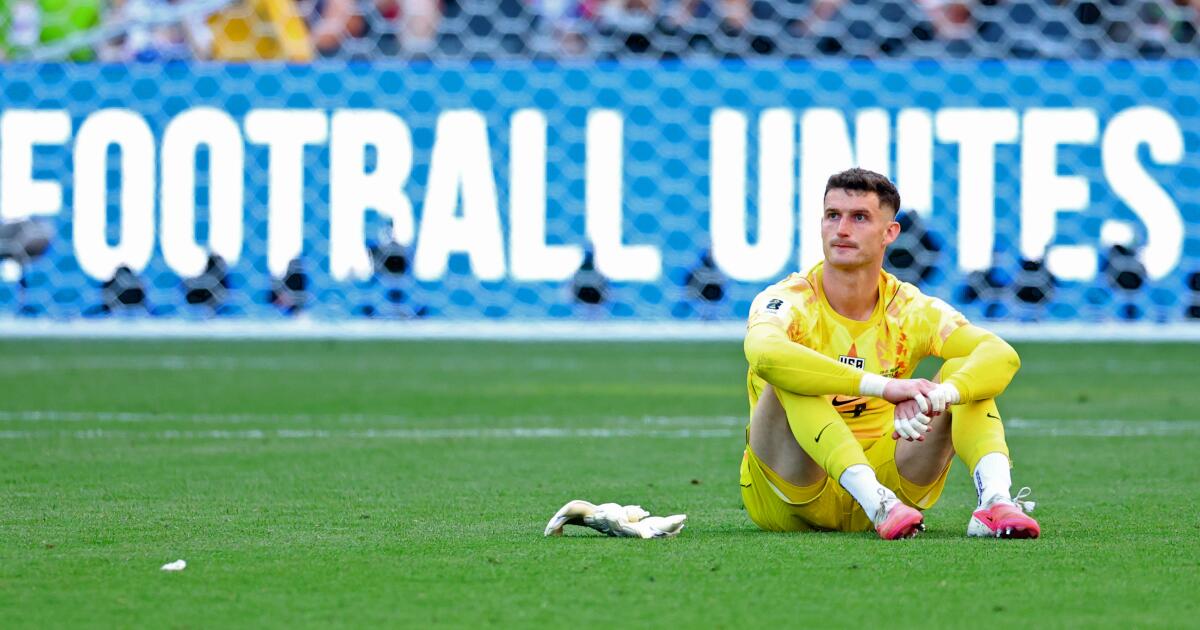
Matt Freese, the Harvard-educated starting goalkeeper, had a brain cramp of epic proportions when he stepped outside of the box and failed to corral a ball. Belgium’s Charles De Ketelaere kicked it loose and set up Hans Vanaken, whose shot traveled behind Ream for an easy score that made it 3-1 in the 57th minute.
There was a lot of poor decision-making with this match, on and off the pitch.
In the end, Trump’s appeal to Infantino did more harm than good. But what if some good could come from it?
Hey, FIFA, what about giving teams a process to appeal cards, like our American athletes in the NBA, NFL and MLB have?
Offering a suggestion box wouldn’t be opening Pandora’s box, not if it were a transparent and regular part of the game that would, hopefully, offer increasingly fair outcomes in a tournament where every match is so monumental — as our President recognized, much too enthusiastically.

U.S. coach Mauricio Pochettino waves to the crown after a 4-1 loss to Belgium at the World Cup on Monday.
(Allen J. Schaben / Los Angeles Times)
Prosecutors on Monday began laying out their case against the man accused of murdering Charlie Kirk. It was the first day of a weeklong preliminary hearing that will determine whether or not there is enough evidence against the accused killer to stand trial.
-

 Pennsylvania2 minutes ago
The 11 Most Picturesque Small Towns in Pennsylvania
-

 Rhode Island5 minutes ago
The Must C’s of Rhode Island
-

 South-Carolina10 minutes ago
When is South Carolina’s tax free weekend? Here’s what to know
-

 South Dakota17 minutes ago
150-mile power line to connect substation near Fargo to northeast South Dakota
-

 Tennessee20 minutes ago
When is Tennessee’s tax-free weekend in 2026? Here’s what you need to know
-
Texas25 minutes ago
Trump takes credit for Toyota moving some truck production from Mexico to Texas: ‘That’s what tariffs do’
-

 Utah32 minutes ago
Utah Shutters Boarding School Paris Hilton Says Abused Her
-

 Vermont35 minutes ago
Letter to the Editor | Judy Murphy: In support of Molly Gray

