Politics
In this historic Black neighborhood in Milwaukee, the Biden question is met with indifference

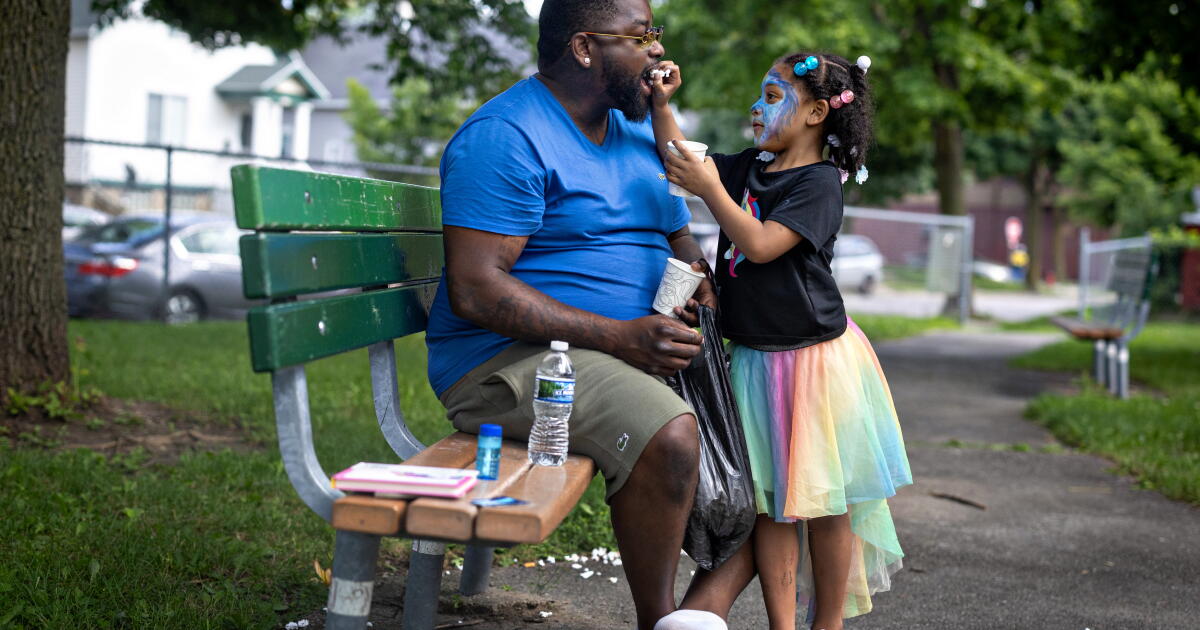
Lisa Collins sat in the shade of a green ash tree Wednesday in the Milwaukee neighborhood of Lindsay Heights handing out free hot dogs and hamburgers as part of a “joyful rebellion” against the nearby Republican National Convention.
Though she plans on voting for President Biden in the upcoming election, it is not without trepidation.
“That made me so mad at that debate, I said I’m not voting, I’m just not,” she said of Biden’s awful performance. “But you know I am.”
Hers is a kind of ambivalence common in this part of town, where the dreams of Black Americans have flourished, withered and risen again, in a city and state that will play a critical role in deciding which candidate wins the Oval Office.
Lisa Collins works the food station at the Milwaukee Childcare Collective event during the Republican convention.
(Jason Armond / Los Angeles Times)
Much of the world is obsessing over big questions: Would a second term for Donald Trump be a step toward authoritarianism? Is Biden mentally competent? Should Biden step aside, and if he did, could Kamala Harris successfully carry a campaign? Should it be left to an open field of Democratic contenders?
But in Lindsay Heights, like many places, a lot of folks have yet to think about the election. Those who have are often uninterested in those soul-searching questions that dominate headlines.
At this event arranged by the Milwaukee Childcare Collective, most people didn’t know they were gathered in response to the convention. They came for the face painting and food, and their concerns are more mundane: teaching kids to read, paying the bills, finding a napkin to clean Popsicle juice off chubby toddler legs.
Deshay Majors, sitting with his son and young daughter, she of the sticky knees, said he has not yet decided whom he will vote for.
“It all depends what they are talking about,” he said of how he will make his decision, though he isn’t sure which issues will sway him, or what he wants to hear.
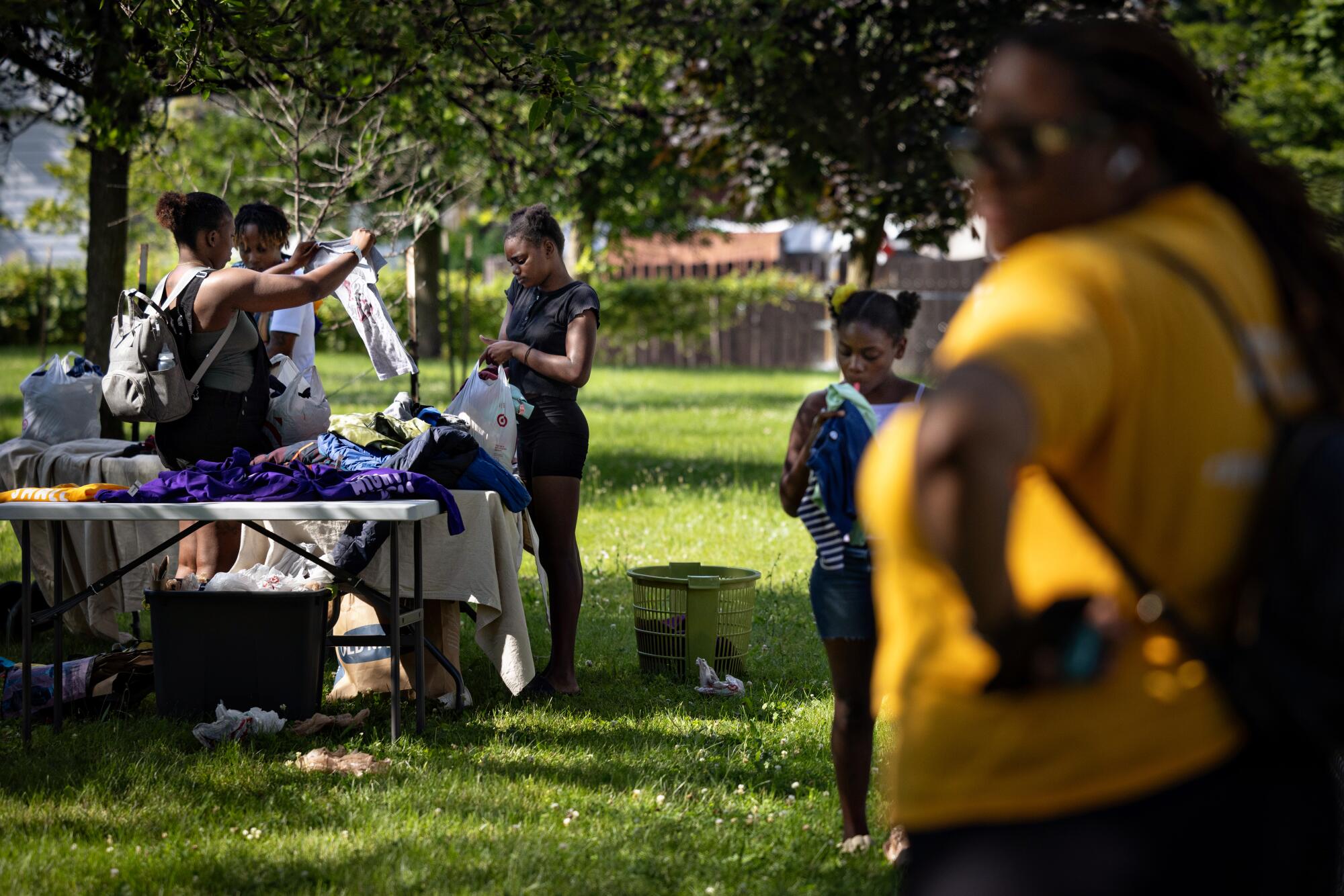
Community members get free clothes at the Milwaukee Childcare Collective event.
(Jason Armond / Los Angeles Times)
It’s a reminder that it ain’t over until it’s over, but time is running out.
On the national front, there is an air of despondency. Many are convinced that as long as Biden remains atop the ticket, the party is destined to lose the White House. Possibly in a Trump landslide. Very likely in addition to losing control of the Senate.
Even before his debate debacle, Biden was struggling to match his performance four years ago with Black voters, a vital Democratic constituency, especially in swing states.
Paul Maslin, who has been polling and strategizing in political contests since the days of Jimmy Carter, put Biden’s chances of reelection “somewhere between slim and none.”
“And slim,” he said, “is making reservations to leave town.”
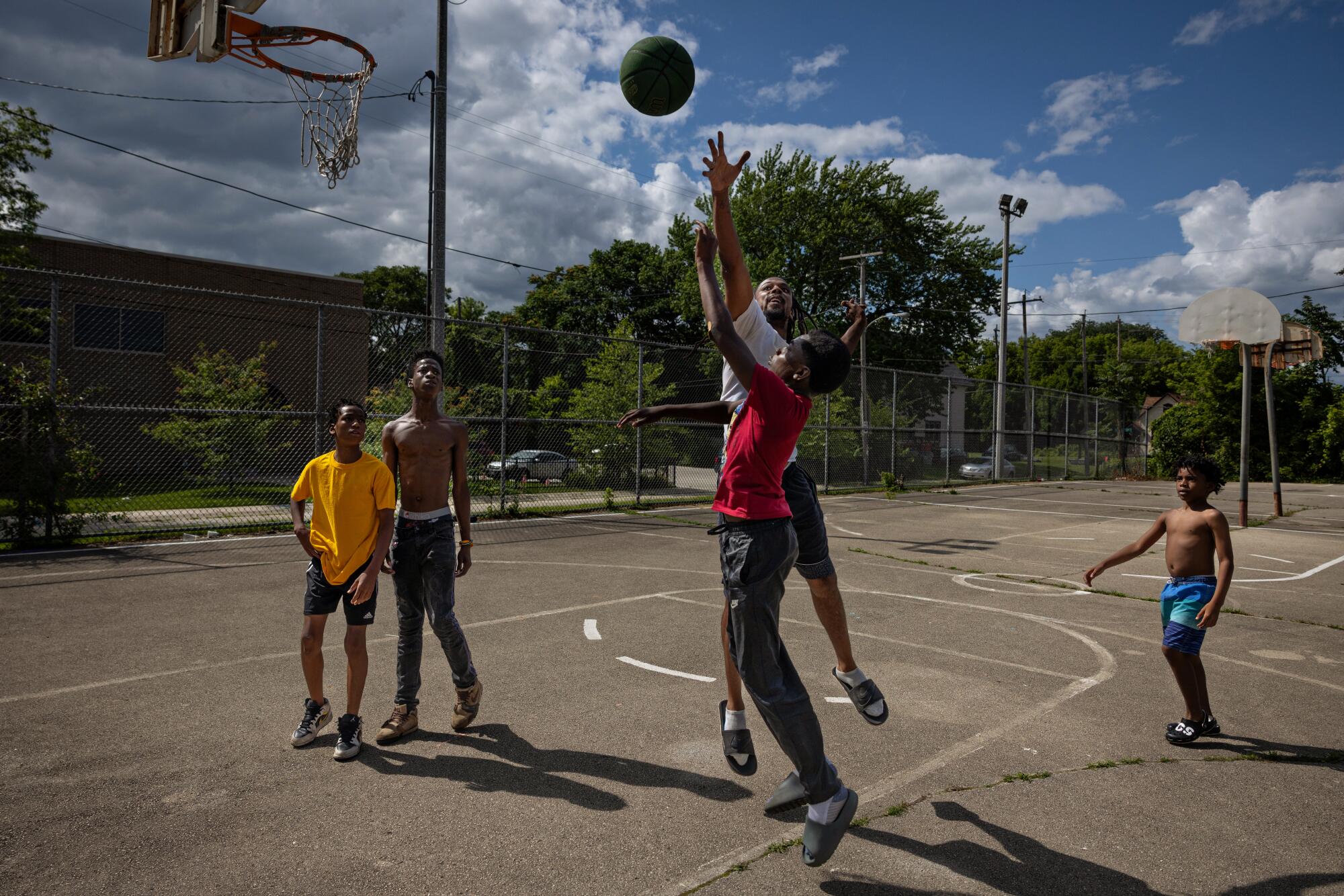
Kids play basketball at the Milwaukee Childcare Collective event.
(Jason Armond / Los Angeles Times)
A recent poll by the Associated Press and University of Chicago found nearly two-thirds of Democrats surveyed said Biden should withdraw from the presidential race and let his party nominate someone else.
Biden’s standing with independent and undecided voters is even worse, said Maslin, who has decades of experience in Wisconsin politics.
“His campaign has to have told him, or should be telling him, ‘Mr. President, one thing the voters you need to win this election have in common is they don’t like you,’ ” Maslin said. “They owe it to themselves, to him, to the party, to the country.”
The upper echelon of Democrats (those “elites” Biden has taken to railing against) are voting with their wallets.
“I can tell you, having talked to a lot of donors, their depression and despair has curdled into anger,” said Paul Begala, a strategist who twice helped put Bill Clinton in the White House. “They’re very angry. And angry people don’t donate.”
But that outrage hasn’t reached this parklet, where the basketball hoops lack nets and the closest bathroom is in a nearby church.
The area is named for Bernice Lindsay, the first Black woman to obtain a journalism degree from Ohio State University. She moved to these narrow streets north of downtown in the 1920s, intent on helping to create a place where Black professionals could own homes and raise families. For awhile, the community thrived — until freeways, violence and neglect tumbled it into decline, like so many other minority enclaves in America.

Kids gather for free ice cream at the Milwaukee Childcare Collective event.
(Jason Armond / Los Angeles Times)
Now, it’s a community working to raise itself back up. Vacant-lot gardens grow strawberries, and residents organize to help themselves and win what they need from a government that has too often passed them by — Democrat or Republican.
Some of the Victorian and Queen Anne homes are fixed up, some are boarded up, and most have front porches where people gather.
Sheyenne Wilson, 25, has been visiting those porches to talk about Biden, though the organizer says she likes to mostly listen.
What she hears isn’t pro-Biden or pro-Trump, but more pro-Lindsay Heights.
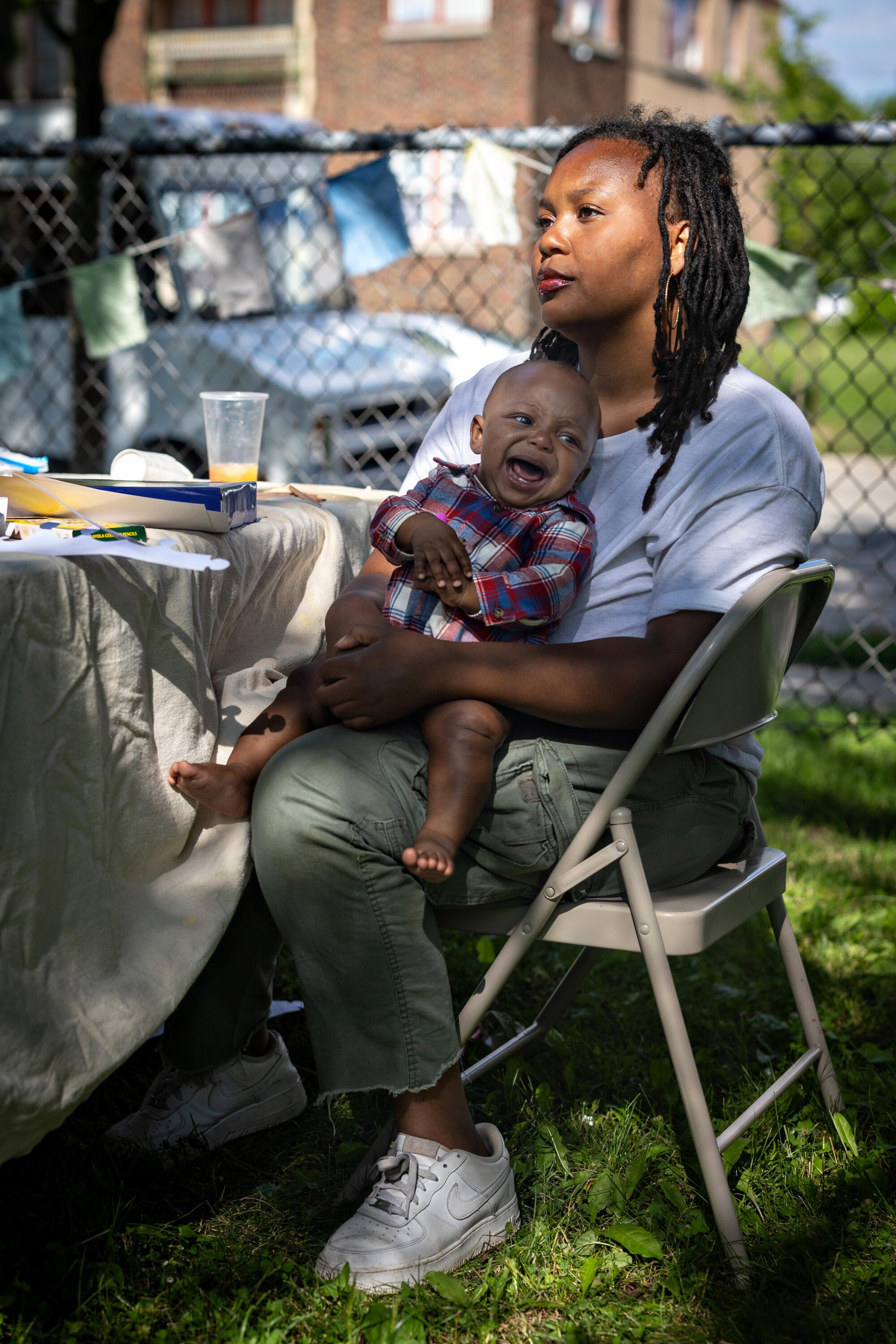
Sheyenne Wilson, with her son, Khalif El, is an organizer for the Biden campaign.
(Jason Armond / Los Angeles Times)
“Basically people want someone who will support the community,” she said, her 10-month-old son, Khalif, on her lap.
That, said her fellow organizer Trasus Wright, is the opening he uses. He sees abortion as the kind of personal issue that can move voters — even his wife, Dea Wright, is undecided.
Dea Wright likes Trump’s stance on school choice — their six children benefited from such a program, she said.
“Where Trump gets me is where they start saying Christianity in schools,” she said.
Trasus Wright said he isn’t bothered by his wife’s uncertainty because he believes that “Joe is going to bring her around. His policies around advocating for women are going to be what matters.”
And what of Biden being too old?
“They’re both old,” said Eric Donelson, unbothered by reports of Biden’s mental decline as he ate a hamburger.
And what about Vice President Kamala Harris? Would she be a better candidate?
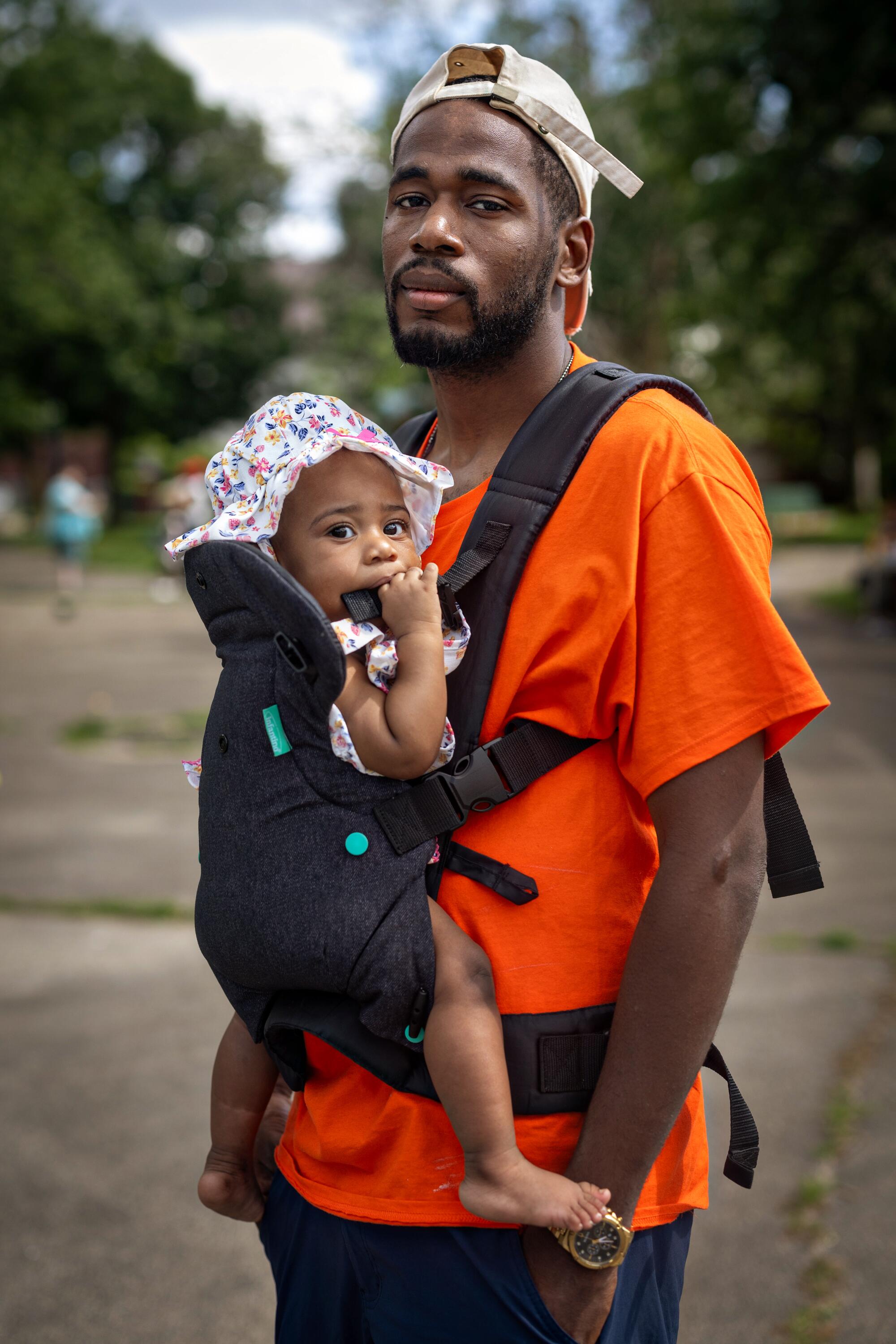
Robert Jackson and his daughter, Blessing, at the Milwaukee Childcare Collective event.
(Jason Armond / Los Angeles Times)
“Do we vote for somebody just because they look like us, or for what they represent?” said Wilson, who has concerns about Harris’ prosecutor past.
“I still don’t think there will ever be a lady president,” said Collins, the woman handing out food.
“We forget she’s vice president. She don’t talk,” Donelson said. “Speak up, woman.”
And as for anyone else? There aren’t any names familiar enough to warrant an opinion.
But Trump is no shoo-in here, either — despite his push for Black voters in recent weeks, including a convention airing of an Amber Rose/Forgiato Blow rap video meant to show the party’s inclusiveness.
“I am not voting for Trump, I’m letting you know. I don’t like nothing about Trump, I am going to keep it real,” Donelson said.
“Trump’s got a little more energy in his body than Biden,” Collins argued.
“Biden is getting old, but I’d rather work with old, senile than a crazy man,” Donelson shot back.
“I’m going to tell you something. I said, this is all a mess to me,” Collins said.
What Linsday Heights shows is the disconnect between the political elite and the voters, for either party.
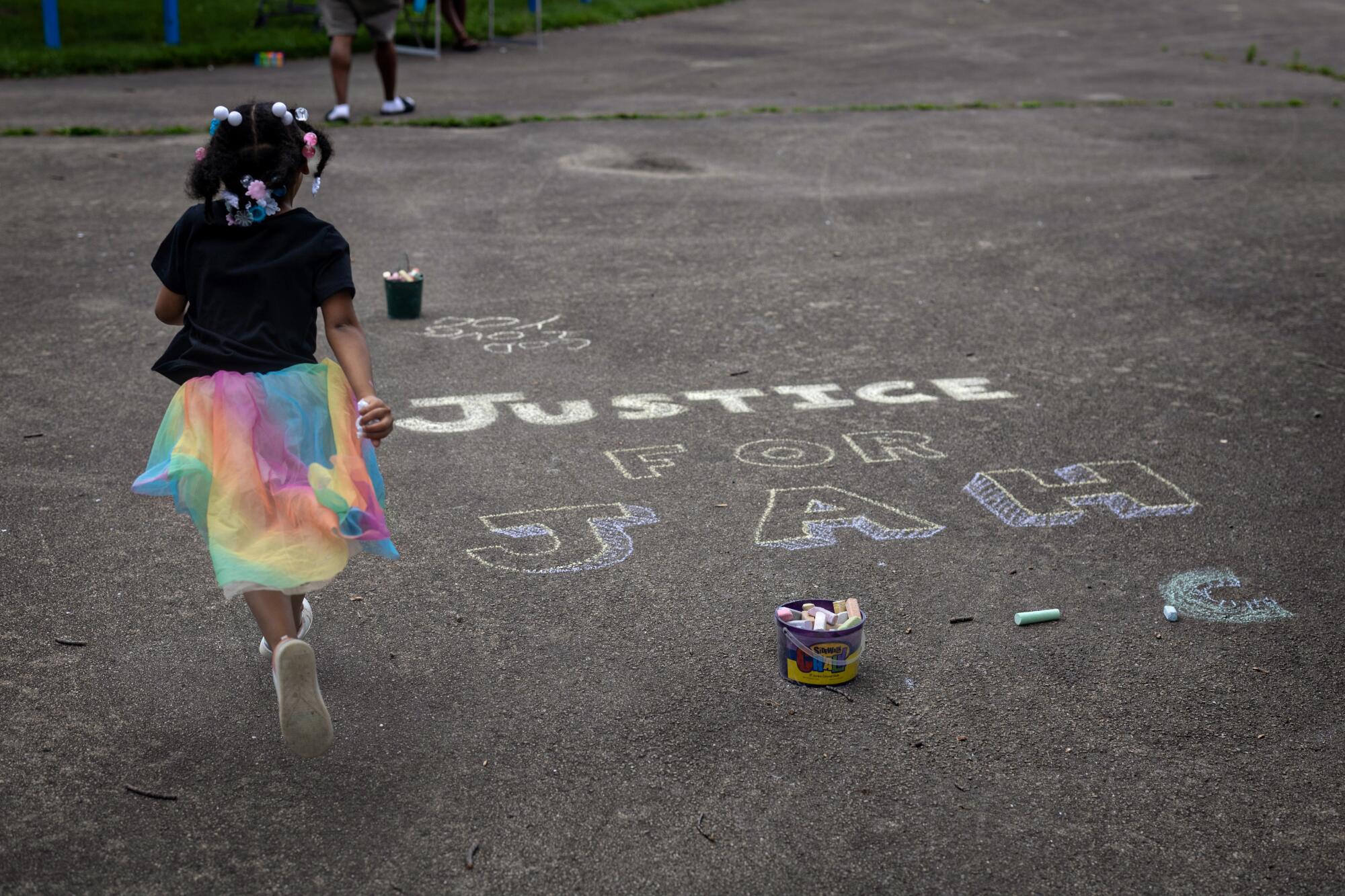
“Justice For Jah” is a reference to Samuel Sharpe Jr., who was killed by members of the Columbus, Ohio, Police Department who were in Milwaukee for the Republican National Convention.
(Jason Armond / Los Angeles Times)
Biden will have to decide in a matter of days if he is staying or leaving — and the pressure has grown intense.
Democrats are set to have a virtual roll call for delegates in early August to formally pledge their allegiance. Once that is done, it becomes increasingly hard for another candidate to step in.
But for the voters in Lindsay Heights, mistrustful of politics and concerned about daily life, time is running out for either party to reach them with a message that carries enough meaning to carry them to the polls.
If that neglect continues, it probably won’t make much of a difference what Biden decides.



Since moving back in, President Trump has significantly altered the “People’s House.” East Wing: gone. Oval Office: maximalized. Rose Garden: Mar-a-lago-ified. And the art? Lots of Trump.
Over the last year, The New York Times has captured at least nine paintings, posters, memes, and even a mugshot outside the Oval Office, that Mr. Trump added throughout the historic space.
Many of the selections are gifts from his supporters that highlight his political stature and reinforce the idea that Mr. Trump is invincible.
All presidents or first ladies add to and shuffle the art in the White House.
Barack Obama brought in abstract paintings.
George W. Bush decorated with images from his Texas roots.
In Mr. Trump’s first term, Melania Trump added a sculpture by Isamu Noguchi to the Rose Garden.
But never before has a sitting president displayed so much of his own image on the White House walls.
There is an “assertion of symbolic power that he wants to be on view essentially everywhere in that space,” said Cara Finnegan, a communication professor at the University of Illinois and author of “Photographic Presidents: Making History from Daguerreotype to Digital.”
Even outside his current residence, Mr. Trump’s visage has proliferated in unexpected places — on banners hanging from government buildings, on National Parks passes and on social media, where he has been likened to a king. There has also been talk of a U.S. Treasury-minted coin with Mr. Trump on both sides.
Break with tradition
In recent decades, each president’s official White House portrait has been unveiled in a ceremony hosted by his successor.
The Carters hosted the Fords:
The Clintons hosted the Bushes:
And the Bushes hosted the Clintons:
The mood has often been lighthearted, with political party tensions melting away.
“I am pleased that my portrait brings an interesting symmetry to the White House collection,” George W. Bush joked in a ceremony hosted by the Obamas. “It now starts and ends with a George W.”
In a break with tradition, Mr. Trump did not schedule a ceremony for the unveiling of the Obamas’ portraits during his first term. Joe Biden later did, in a ceremony with a “Welcome Home!” vibe.
Typically, the latest available presidential portrait — often a realistic oil painting — hangs in the main entrance hall, where heads of state are welcomed.
The Obama portrait was in the spot until April …
… when Mr. Trump replaced it with this painting by Marc Lipp, a Florida pop artist, last April.
It depicts a striking moment in 2024 when a bloodied Mr. Trump pumped his fist in defiance, soon after being shot at by a would-be assassin during a campaign event.
Presidential historians have criticized the departure from convention.
Though Mr. Trump had a portrait commissioned for the Smithsonian’s American Presidents collection after his first term, none was confirmed for the permanent White House collection, and the White House said that this is where that portrait would have hung.
It is not totally unprecedented for a president to hang a painting of himself in the White House during his term. Theodore Roosevelt, William Howard Taft and Grover Cleveland all did, according to the White House Historical Association. But more often than not, paintings of presidents and first ladies are hung after they have left office, historians said.
Flags, fists and faith from fans
In what has become something of a muse for many of the president’s artistic supporters, there are at least three other depictions of the fist-pumping scene in the White House.
The image “is in people’s garages when I walk around my neighborhood,” said Leslie Hahner, a Texas resident and communication professor at Baylor University, who studies visual political culture. “People love that image.”
Behind the Oval Office, one is in a small room that houses Trump merchandise:
Another was seen in the West Wing next to a “Still Life with Fruit” painting from 1850:
A statue form was spotted in the Oval Office:
The sculptor, Stan Watts, told a Utah TV station last year that he believes the president was saved by God that day. Many of Mr. Trump’s Christian supporters have echoed that sentiment.
At least two works by a self-described “Christian worship artist,” Vanessa Horabuena, are among Mr. Trump’s White House collection. He has called Ms. Horabuena, who often paints live in front of an audience, “one of the greatest artists anywhere in the world.”
In 2022, she painted a portrait of Mr. Trump at a booth at the Conservative Political Action Conference. When he saw it, he asked to meet her, Ms. Horabuena’s representative said. She most recently painted Mr. Trump live at a New Year’s Eve party at Mar-A-Lago.
One of her portraits was spotted in the Cabinet room in January.
It shows Mr. Trump, his eyes closed, in front of a mountain with a small cross on the top:
Ms. Horabuena hand-delivered it to the White House, according to her website.
Her other painting shows the president walking through a phalanx of flags. It was seen hanging prominently in a hallway leading to the Cabinet Room and the Oval Office:
“He’s positioned as this embattled warrior in a lot of these images,” Dr. Hahner said.
Historical figures Mr. Trump adulates are co-stars in some of the art he has chosen.
In an image created by the team of White House trade adviser Peter Navarro, Mr. Trump is pictured with William McKinley and Henry Clay, who, like the president, championed the use of tariffs:
Here, Mr. Trump is with two other Republican presidents, Abraham Lincoln (to whom he has compared himself) and Ronald Reagan (whom he is a fan of):
Titled “Great American Patriots,” the piece was painted by Dick Bobnick, an illustrator and Trump supporter from Minnesota. He said he mailed several prints to 1600 Pennsylvania Avenue, but he had no idea his work was on the White House walls until a USA Today reporter called him about it.
“I could hardly believe it,” said Mr. Bobnick. (He said the print is now his best-seller.)
If not in portraits, Mr. Trump’s image is reflected on mirrors that he has added to the White House complex.
Two are in the Oval Office …
… making his image visible from the Resolute Desk.
The mirrors, the portraits and the gilding mimic the look of his properties, like Mar-a-Lago, his Florida estate.
“Trump is obsessed with his image,” Dr. Hahner said. “And he is so controlling of his image.”
Trump everywhere, all the time
One portrait seen in the White House has become a communication tool between Mr. Trump and his supporters in the real world.
This is his social media profile picture.
It was seen last October hanging between former first ladies Laura Bush and Barbara Bush in the now-demolished East Wing:
The portrait was painted by Lena Ruseva, an immigrant from the former Soviet Union, who goes by the name MAGALANGELO. Mr. Trump invited her to his Bedminster golf club in 2022, and she gave it to him as a birthday gift.
“Every time social media or the news quotes the president and I see my artwork alongside it, I feel proud and grateful,” she said.
For a time, the same portrait hung next to Hillary Clinton, his political rival and a former first lady.
Supporters at that time lauded the placement on social media:
This example of a positive feedback loop demonstrates how Mr. Trump has used social media to redefine the presidency and presidential communication. Ms. Ruseva’s portrait was used on social media, hung up in the real world, then photographed and put back on social media by supporters who praised the president.
When Mr. Trump was elected to his first term in 2016, Dr. Hahner said that scholars referred to him as the first “meme president.”
Mr. Trump and his internet fans are used to a meme culture based on irony, and rehashing, repurposing and remixing existing images. The collection of White House artwork — much of it originating from his supporters — sits in an uncanny valley between realism and meme-ism, Dr. Hahner said.
Like memes that multiply, Mr. Trump’s image has been reproduced in other ways, outside the White House.
Last month, a huge banner with Mr. Trump’s face was draped outside the Justice Department headquarters …
Last year, similar signage was strung over the Labor Department building …
… and the Agriculture Department building (this one, alongside Lincoln).
At his request, Mr. Trump’s portrait was recently updated at the Smithsonian’s National Portrait Gallery:
Still, Mr. Trump wants more. The White House has suggested that the National Portrait Gallery add a separate section for Trump-related art.

NEWYou can now listen to Fox News articles!
President Donald Trump on Monday sent an official notification to Congress about the U.S. strikes against Iran, in which he attempted to justify the military action in the now expanding conflict in the Middle East.
In a letter obtained by FOX News, Trump told Senate President Pro Tempore Chuck Grassley, R-Iowa, that “no U.S. ground forces were used in these strikes” and that the mission “was planned and executed in a manner designed to minimize civilian casualties, deter future attacks, and neutralize Iran’s malign activities.”
This comes after joint U.S.-Israeli strikes against Iran on Saturday as part of Operation Epic Fury, triggering a response from Tehran and a wider conflict in the region. The strikes killed the Islamic Republic’s Supreme Leader Ali Khamenei and other military leaders.
President Donald Trump on Monday sent an official notification to Congress about the U.S. strikes against Iran. (AP Photo/Alex Brandon)
Trump wrote that it is not yet possible to know the full scope of military operations against Iran and that U.S. forces are prepared to take potential further action.
“Although the United States desires a quick and enduring peace, not possible at this time to know the full scope and duration of military operations that may be necessary,” Trump wrote. “As such, United States forces remain postured to take further action, as necessary and appropriate, to address further threats and attacks upon the United States or its allies and partners, and ensure the Government of the Islamic Republic of Iran ceases being a threat to the United States, its allies, and the international community.”
“I directed this military action consistent with my responsibility to protect Americans and United States interests both at home and abroad and in furtherance of United States national security and foreign policy interests,” he added. “I acted pursuant to my constitutional authority as Commander in Chief and Chief Executive to conduct United States foreign relations.”
A general view of Tehran with smoke visible in the distance after explosions were reported in the city, on March 2, 2026, in Tehran, Iran. (Contributor/Getty Images)
Trump said he was “providing this report as part of my efforts to keep the Congress fully informed, consistent with the War Powers Resolution,” as some Republican and Democrat lawmakers attempt to restrain the president’s military action, which they affirm is unconstitutional without congressional approval.
The president also accused Iran of being among the largest state sponsors of terrorism in the world and purported that the “Iranian regime continues to seek the means to possess and employ nuclear weapons,” even after the White House said in June that precision strikes at the time “obliterated” Iran’s nuclear enrichment facilities.
US SURGES FORCES TO MIDDLE EAST AS PENTAGON WARNS IRAN FIGHT ‘WILL TAKE SOME TIME’
A person holds an image of Iran’s Supreme Leader Ayatollah Ali Khamenei as Iranian demonstrators protest against the U.S.-Israeli strikes, in Tehran, Iran, Feb. 28, 2026. (Majid Asgaripour/WANA (West Asia News Agency) via Reuters)
CLICK HERE TO DOWNLOAD THE FOX NEWS APP
“As I previously communicated to the Congress, Iran remains one of the largest, if not the largest, state-sponsors of terrorism in the world,” Trump said in the letter on Monday. “Despite the success of Operation MIDNIGHT HAMMER, the Iranian regime continues to seek the means to possess and employ nuclear weapons. Its array of ballistic, cruise, anti-ship, and other missiles pose a direct threat to and are attacking United States forces, commercial vessels, and civilians, as well as those of our allies and partners.”
“Despite my Administration’s repeated efforts to achieve a diplomatic solution to Iran’s malign behavior, the threat to the United States and its allies and partners became untenable,” he continued.
Fox News’ Tyler Olson contributed to this report.
Related Article

Northern California Rep. Kevin Kiley (R-Rocklin), whose congressional district was carved up in the redistricting ballot measures approved by voters last year, announced Monday that he would not challenge fellow Republican Rep. Tom McClintock of Elk Grove. Instead, he plans to run in the Democratic-leaning district where he resides.
“It’s true that I was fully prepared to run in [McClintock’s district], having tested the waters and with polls showing a favorable outlook in a ‘safe’ district. But doing what’s easy and what’s right are often not the same,” Kiley posted on the social media site X. “And at the end of the day, as much as I love the communities in [that] District that I represent now – and as excited as I was about the new ones – seeking office in a district that doesn’t include my hometown didn’t feel right.”
Kiley, 41, currently represents a congressional district that spans Lake Tahoe to Sacramento. He did not respond to requests for comment.
But after California voters in November passed Proposition 50 — a ballot measure to redraw the state’s congressional districts in an effort to counter Trump’s moves to increase the numbers of Republicans in Congress — Kiley’s district was sliced up into other districts.
As the filing deadline approaches, Kiley pondered his path forward in a decision that was compared by political insiders to the reality television show “The Bachelor.” Who would receive the final rose? McClintock’s new sprawling congressional district includes swaths of gold country, the Central Valley and Death Valley. The district Kiley opted to run in includes the city of Sacramento and the suburbs of Roseville and Rocklin in Placer County.
Kiley was facing headwinds because of the Republican institutional support that lined up behind McClintock, 69, who has been in Congress since 2009 and served in the state Legislature for 26 years previously. President Trump, the California Republican Party and the Club for Growth’s political action committee are among the people and groups who have endorsed McClintock.
Conservative strategist Jon Fleischman, a former executive director of the state GOP, said he was thrilled by Kiley’s decision, which avoids a divisive intraparty battle.
“If you open up the dictionary and look for the word conservative, it’s a photo of Tom McClintock. He is the ideological leader of conservatives, not only in California but in Congress for many, many years,” Fleischman said, adding that the endorsements for McClintock purposefully came because Kiley was considering challenging him.
Kiley, who grew up near Sacramento, attended Harvard University and Yale Law School. A former Teach for America member, he served in the state Assembly for six years before being elected to Congress in 2022 with Trump’s backing. But he has bucked the president, notably on tariffs. He also unsuccessfully ran to replace Gov. Gavin Newsom during the 2021 recall, and has been a constant critic of the governor.
Kiley is now running in a Sacramento-area district represented by Rep. Ami Bera (D-Elk Grove). Democrats in the newly drawn district had a nearly 9-point voter registration edge in 2024. Bera is now running in the new version of Kiley’s district.
In Kiley’s new race, his top rival is Dr. Richard Pan of Sacramento, a former state senator and staunch supporter of vaccinations.
“Kevin Kiley can try to rebrand himself, but voters know his extreme record,” Pan said in a statement. “He has stood with Donald Trump 98% of the time and was named a ‘MAGA Champion.’ The people of this district deserve better than political opportunism disguised as moderation. This race is about who will actually fight for healthcare, public health, and working families. I’ve done that my entire career. Kevin Kiley has not.”

Bruce Campbell announces cancer diagnosis; ‘Fear not,’ he tells fans

Vigil held for 2-year-old girl killed in SF Mission Bay crash

Dallas Fed says ‘older, experienced workers’ likely have less cause for concern about AI job displacement

Miami Heat-Brooklyn Nets Injury Report, Betting Lines, How to Watch, Lineups & More

Boston police officials dominate the list of highest-paid city workers in 2025 – The Boston Globe

Florida High School Football Rankings: Top 25 teams – Oct. 21

Cleary's 21 help Le Moyne down Central Connecticut State 69-64 in OT

How old is Bo Nix? What to know about Oregon quarterback ahead of 2024 NFL Draft

99th annual Pony Swim held in Virginia

Indiana Members Credit Union announced as new anchor tenant at Bottleworks District

Trump sends official notification to Congress on strikes against Iran

Unexpected birth brings hope to near-extinct Amazon tribe

Supreme Court blocks redrawing of New York congressional map, dealing a win for GOP

Map: Earthquake Shakes Central California

Gas prices could jump as Middle East tensions threaten global oil supply
-

 World5 days ago
Exclusive: DeepSeek withholds latest AI model from US chipmakers including Nvidia, sources say
-

 Massachusetts6 days ago
Mother and daughter injured in Taunton house explosion
-

 Denver, CO6 days ago
10 acres charred, 5 injured in Thornton grass fire, evacuation orders lifted
-

 Louisiana1 week ago
Wildfire near Gum Swamp Road in Livingston Parish now under control; more than 200 acres burned
-

 Technology1 week ago
YouTube TV billing scam emails are hitting inboxes
-

 Politics1 week ago
OpenAI didn’t contact police despite employees flagging mass shooter’s concerning chatbot interactions: REPORT
-

 Technology1 week ago
Stellantis is in a crisis of its own making
-

 Oregon4 days ago
2026 OSAA Oregon Wrestling State Championship Results And Brackets – FloWrestling