Politics
In Silicon Valley, more support for Trump is trickling in. Is it a big threat to Biden?

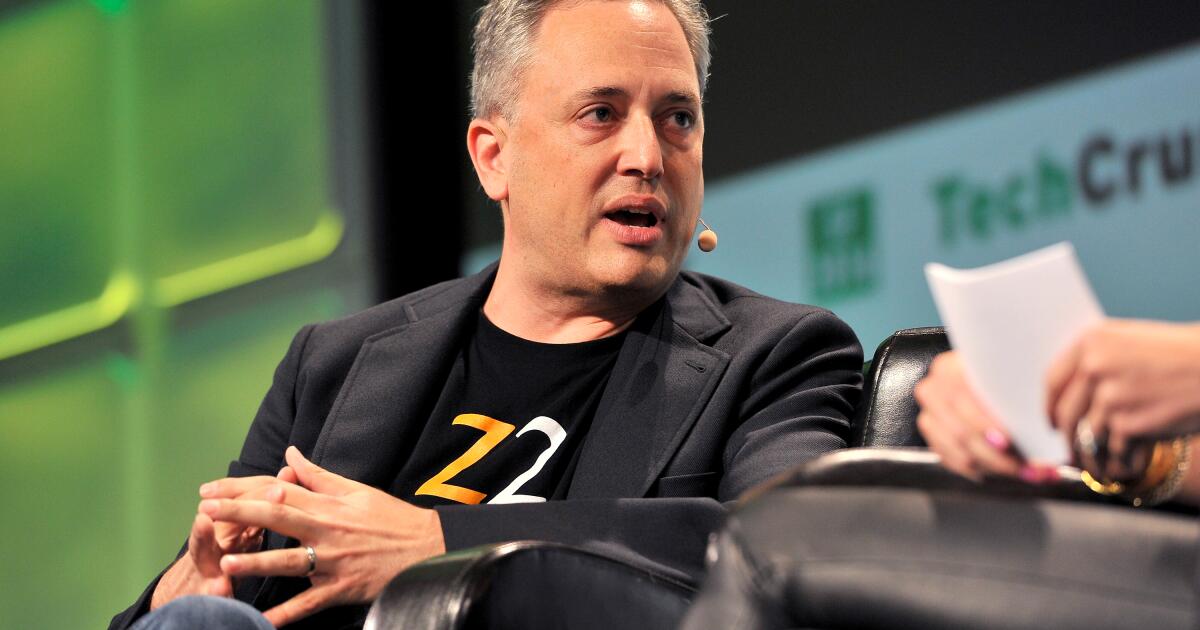
If California is the political fundraising powerhouse of the nation, Silicon Valley has grown into one of the increasingly dominant forces of campaign cash. And while Northern California tech entrepreneurs overwhelmingly support Democratic candidates, a small but powerful group of defectors has moved rightward in recent years.
A gathering of tech’s conservative cohort enjoyed a visit from former President Trump on Thursday evening at a tony fundraiser held at venture capitalist David Sacks’ San Francisco home. The estate, nestled on Billionaires’ Row in Pacific Heights, welcomed about 80 elites to the sold-out event. Cost of admission: up to $300,000 per person and $500,000 per couple, according to an invitation obtained by The Times.
“It was a couple hours of high-quality networking in a very beautiful private home,” said Harmeet Dhillon, California’s Republican national committeewoman and a San Francisco-based attorney who acts as an official legal surrogate for the Trump campaign. “The seats were all filled. It was totally packed.”
The gathering raised $12 million, Dhillon added.
Across the country, tech leaders and employees have poured millions into politics. People who work in the communications and electronics sector, which includes technology companies, have given $18.1 million to Biden and groups supporting his campaign, and $1.4 million to Trump and organizations backing his effort this year, according to campaign finance data released May 21 by the Federal Election Commission.
The analysis of the contributions was conducted by Open Secrets, a nonpartisan group that tracks electoral finances. The total donated to candidate committees and outside groups supporting the campaigns amounted to $25.8 million, with 71.7% going to Democrats and 22.1% to Republicans.
In Silicon Valley itself — the geographic area that is considered the hub of the tech industry and includes San Jose, Menlo Park, Palo Alto, Mountain View, Cupertino, Santa Clara, Redwood City and Sunnyvale — about 3% of donors who gave to a Democratic nominee in 2016 or 2020 donated to Trump in the following cycle, a Times analysis of FEC data found. While many tech leaders and workers live in these cities, many other residents of this region do not work in the industry.
Demonstrators call for a cease-fire in Gaza as Vice President Kamala Harris arrived for a San Francisco fundraiser on Wednesday.
(Anabel Sosa / Los Angeles Times)
“Silicon Valley and the Bay Area are the beating heart of the global innovation ecosystem. Given the region’s economic dynamism, as well is its cultural, technological and social impact, it should come as no surprise that more candidates are engaging with our business leaders,” Ahmad Thomas, chief executive of the Silicon Valley Leadership Group, said in a statement. “That’s part of the reason why our region will continue to be a political powerhouse, helping to set a national agenda that supports innovation, entrepreneurship and growth.”
While a sliver of the population is growing attracted to Trump’s friendliness toward emerging technologies such as crypto, Silicon Valley remains reliably Democratic. The region’s tech world is known for its penchant for disruption, with a historic libertarian streak.
“Obviously there’s been some defection, but the reality is the vast majority are still supporting the president,” said Rep. Ro Khanna (D-Fremont), who represents Silicon Valley in Congress.
On Wednesday, Vice President Kamala Harris attended a fundraiser in Oakland Hills before appearing before a crowd of about 100 in San Francisco. During a 13-minute speech, she called for a cease-fire in the Israel-Hamas war, and for Hamas to return the remaining hostages to Israel.
Her remarks did not satisfy the crowd of protesters outside the venue, who shouted “Shame on you!” as Harris arrived.
Khanna recently convened 100 tech leaders for a retreat in Napa to inspire them to stick with the Biden administration.
“Democrats need to have a clear vision on celebrating entrepreneurship,” Khanna said. “Yes, there needs to be guardrails and smart regulation, but we need to be for innovation. We need to be for entrepreneurship. We need to be for wealth generation. We need to be future oriented.”
But for some Silicon Valley tech executives, being future-oriented means campaigning for Trump.
In the latest episode of their podcast, “All-In,” Sacks and his co-host for the fundraiser, Chamath Palihapitiya, emphasized that they had previously hosted fundraisers for independent presidential candidate Robert F. Kennedy Jr. and Trump’s former Republican opponent Vivek Ramaswamy.
Palihapitiya, a self-described “apolitical” person, said he had donated to Democrats in the past, even as he joined Sacks for the Trump fundraiser Thursday. The two podcasters joked about the flak their other two co-hosts, Jason Calacanis and David Friedberg, were getting for associating with Trump supporters.
“I think you guys are getting more blowback, and that’s an indication of just sort of the cowardly response to it. It’s like a cancellation tactic,” Sacks said. “And I think the reason why they’re doing that is because, quite frankly, there’s a lot of preference falsification going on in Silicon Valley.”
Cian O’Brien, an entrepreneur and former vice president for a Sunnyvale tech company, said he has become a pariah in Silicon Valley since pledging his allegiance to Trump. He said he had supported Democrats throughout his life, though he did not vote for President Obama. After donating to former Secretary of State Hillary Clinton’s campaign in 2016, O’Brien, 56, said he switched his support to Trump after he saw how “the apparatus” — media and other governmental institutions — went against him.
“They consider him a threat, because there he’s going to expose or crack down on … whatever their particular set of operations are,” O’Brien said. “And most of the operations are around people enriching themselves with power and money.”
Nibbling on sliders with American flag toothpicks, mini lobster rolls and a dessert buffet, attendees to the Sacks fundraiser included the Winklevoss twins, famed for their feud with Mark Zuckerberg about the creation of Facebook; Coinbase executives; and some AI leaders. Ohio Sen. J.D. Vance and North Dakota Gov. Doug Burgum, who are reportedly being vetted as Trump’s potential running mates, also attended.
Trump spoke for about an hour on a wide range of topics, including AI, cryptocurrency and being the victim of deepfakes, prompting a young AI executive to give a detailed explanation about using encrypted keys. He also argued that the world was safer under his administration, the border more secure, and he railed against transgender women being allowed to play in women’s sports.
The former president did not directly address the 34 felony counts he was convicted of last week, but he spoke broadly about the judicial system, Dhillon said.
“He was in great spirits. He said that there were some terrible judges out there. He didn’t get specific; he knows he’s under a gag order,” she said. “He said Republican judges go out of their way, bend over backward to look like they’re being fair, to be fair to the other side. And that Democrats are salivating, can’t wait to get their hands on the gavel and do what they want politically.”
Outside Sacks’ multimillion-dollar residence, police barricaded six city blocks surrounding the Pacific Heights residential enclave. Some attendees rolled up inside black Escalades, while others came on foot or motorcycle. Many arrived in pickup trucks waving large flags that read “Trump 2024.” One driver exchanged fist bumps with a bystander while at a stop sign. A group of middle school-aged girls stood nearby, donning Trump baseball caps.
“It’s a historical event,” said Jen Kelly, 60, of Sacramento, who called herself a lifelong Republican. “I know it’s a private fundraiser, but the fact that Trump is in California is very rare.”
After his swing through Silicon Valley, Trump traveled south, with fundraisers in Beverly Hills and Newport Beach planned for the weekend.
Sosa reported from San Francisco. Ahn, Mehta and Pinho reported from Los Angeles.

Politics
Jeffries welcomes Democratic Socialists into the fold as critics warn party is revealing ‘exactly who it is’

NEWYou can now listen to Fox News articles!
House Minority Leader Hakeem Jeffries publicly embraced a new crop of congressional nominees Saturday, including three Democratic Socialists of America-backed candidates whose primary victories have fueled fresh debate over the Democratic Party’s leftward shift ahead of the 2026 midterms.
The powerful New York lawmaker’s post highlights the challenge facing the top House Democrat as he works to unite his party ahead of the general election. If Democrats take back the House in November, Jeffries is expected to become the next speaker. That means he’ll likely be leading a Democratic caucus with more self-described Democratic Socialists than ever before. So far, more than a dozen Democratic Socialists of America-backed candidates have won or advanced in primaries across the country this election cycle.
In a post on X, Jeffries wrote, “Congratulations to our Democratic nominees,” before listing the party’s congressional candidates from across New York. Among those recognized were Brad Lander, Claire Valdez and Darializa Avila Chevalier, all of whom are affiliated with or backed by the Democratic Socialists of America and secured victories in closely watched Democratic primaries last week.
House Minority Leader Hakeem Jeffries has called Trump official Bill Pulte a “malignant clown.” (Aaron Schwartz/Bloomberg)
“From public servants to union organizers to community activists, the path is different but the work is the same,” Jeffries wrote. “We must decisively address the affordability crisis and crush far-right extremism!”
RISING SOCIALIST STARS ON TRACK TO CONGRESS: WHO ARE DARIALIZA AVILA CHEVALIER, BRAD LANDER AND CLAIRE VALDEZ?
Lander, Chevalier and Valdez all received backing from New York City Mayor Zohran Mamdani, whose endorsements helped cement the growing influence of the Democratic Party’s progressive wing in New York politics. Lander and Chevalier defeated Jeffries-endorsed incumbents Reps. Dan Goldman and Adriano Espaillat in their respective Democratic primaries. Jeffries did not endorse in the race won by Claire Valdez, which was an open seat.
Now, as Democrats turn their attention to the general election, he appears to be rallying behind the party’s nominees as they try to win back the House in November.
The socialist candidates have also faced scrutiny over resurfaced social media posts, support for defunding the police and anti-Israel rhetoric, positions that have put them at odds with many in the Democratic Party.
Socialist New York congressional nominees Darializa Avila Chevalier (L), Claire Valdez (C) and Brad Lander. (Michael M. Santiago/Getty Images; Michael Nagle/Bloomberg via Getty Images; Adam Gray/Bloomberg via Getty Images)
Chevalier has faced scrutiny over resurfaced social media posts, including one in which she called to “literally abolish the border.”
She has also faced renewed scrutiny over past social media posts targeting leading Democrats, including calling former President Joe Biden a “war criminal,” attacking former Vice President Kamala Harris and rebuking Sen. Bernie Sanders over Israel.
Like Chevalier, Valdez and Lander, who is Jewish, share her sentiment that Israel is committing “genocide” in Gaza.
LIBERAL MS NOW WRITER CALLS MAMDANI PRIMARY SWEEP A ‘GENUINELY SCARY NIGHT FOR NEW YORK CITY JEWS’
Jeffries’ decision to publicly congratulate the three nominees quickly drew criticism.
The Republican Jewish Coalition blasted Jeffries’ congratulatory message, warning Jewish voters that these candidates are not the Democrat “fringe” but the new faces of the party.
“To Jewish Democrats: your party is telling you EXACTLY who it is,” the Coalition wrote. “These future members of Congress, who @hakeemjeffries is welcoming with open arms, want to: Abolish prisons and borders. Defund the police. Downplay 9/11,” rattling off other serious controversies stemming from the candidates.
Jamie Metzl, a former National Security Council and State Department official and lifelong Democrat, blasted Jeffries for congratulating the nominees.
New York City Mayor Mayor Zohran Mamdani speaks at a news conference Thursday in Manhattan. (Spencer Platt/Getty Images)
“When I first read this post, I assumed it was from a spoof account. I am deeply concerned that it appears to be all too real,” Metzl wrote. “To welcome these nominees without acknowledging and criticizing their self-declared sympathies for U.S.-designated terrorist organizations, their calls to abolish the police, their stated desire to dismantle Western civilization, and their blatant anti-Americanism is to sacrifice the core principles of the Democratic Party.”
Metzl accused Jeffries of putting his bid to become House speaker ahead of the Democratic Party’s principles.
“I understand your ambition to become Speaker should Democrats retake the House, but you should not sacrifice the principles of our party to advance your own political aspirations,” Metzl wrote.
Democratic leadership has been in the hot seat this week facing questions from the media about how to reconcile support for the New York slate of socialist candidates, particularly after Valdez’s supporters were seen shouting “you’re next” at a television screen showing Jeffries on Tuesday night.
“They’re gonna eat you next Congressman – and replace you with one of their own,” conservative commentator Meghan McCain posted on X.
“This is funny,” conservative commentator Robby Starbuck posted on X. “Hakeem still doesn’t realize that the communists are going to eat him alive. Clearly not a student of history. Bless his heart.”
CLICK HERE TO DOWNLOAD THE FOX NEWS APP
In a CNN appearance on Friday, Jeffries said, “I think that what happens in a handful of primaries in one of the bluest cities in the country is not in any way indicative of what needs to happen in November, where we need to reelect every single frontline Member, common sense Democrats, authentically committed to making life better for the American people, opposing these extreme Republicans who have been nothing but a reckless rubber stamp for Donald Trump’s agenda.”
“And at the same period of time, make sure that we flip red seats blue, including in New York-17, where we have a combat veteran, incredibly patriotic American Cait Conley, who came out of a primary on Tuesday as well and is an incredibly strong candidate. She will defeat Mike Lawler in New York in November.”

Twenty-four days after the polls closed on election day, Los Angeles County officials have certified the results from the 2,227,461 ballots cast. Despite questions raised about the pace of the vote count, a Times analysis found ballots this June were tallied faster than in previous cycles.
California is known to have a slow vote count, partially because of the state’s grace period for mail-in ballots. This year, counties were required to report most of the ballots by June 15, with some exceptions, including for mail-in ballots received within seven days of election day and ballots requiring additional verification such as signature curing. The process has spurred baseless claims of fraud from President Trump and others, leading the U.S. Supreme Court to take up a case on whether mail-in ballots must be received by election day to count.
The state has reported 9.4 million processed ballots. Officials estimate about 5 ballots remain to be counted and 17,650 are waiting to cure a missing or mismatched signature.
Compared with the last time both governor and Los Angeles mayor were on the ballot, county election officials counted more ballots, and tallied them faster than in 2022, The Times found.
In Los Angeles County, turnout jumped from 28% of eligible voters in the 2022 primary to 38% this June, according to the county registrar. Meanwhile, the share of vote-by-mail ballots dropped about 3 percentage points to 82%, indicating a rise in in-person voting.
Statewide, early results show 41% of registered voters turned up for the June election, up from 33% in 2022, according to the secretary of state. County elections officials must report their final results by July 3, giving state officials a week to certify all election results.
The Los Angeles Times reports election results from the county clerk as well as from the Associated Press. The AP provides ballot counts, a calculation of the expected vote and race calls for statewide and national races.
The expected vote percentage, or EEVP, is an estimate of the total number of votes that will eventually be certified. That number can be adjusted based on new information over time.
“Before counting begins in California, our estimates are primarily informed by turnout in past similar elections plus pre-election data on ballot returns, with projections based on what percentage of ballots had already been received at the same point in past elections,” AP director of election analytics Emily Swanson said in an email.
In the gubernatorial and mayoral races, more than half of the votes were counted by the end of election day, EEVP data show.

Swanson’s team also observed a faster vote count this year than in the 2022 and 2024 primaries.
In January 2024, L.A. County consolidated its election operations into a new ballot processing center in the City of Industry. Dean Logan, head of the L.A. County registrar-recorder/county clerk’s office, told The Times earlier this month that the facility, which is open to observers, is designed for transparency, security and efficiency.
“It doesn’t take long to count. The counting process is very fast,” Logan said ahead of election day. “What extends the time period is those options that are provided under California law for voters — to allow everyone the opportunity to vote up until election day, and then allowing us the time to process those with the same level of security and integrity that we did the ballots that were received two weeks before the election.”
Despite the faster count, the Associated Press took longer to call winners, suggesting these races were more competitive. The AP makes such declarations by determining whether there is an opportunity for a trailing candidate to catch up to the race leader. It has been calling races for nearly 180 years.
Both the gubernatorial and Los Angeles mayoral race saw a 30% increase in votes from 2022. The governor’s race received more than 9.2 million votes compared with 7 million in 2022. The Los Angeles mayor’s race received more than 850,000 votes, an increase from nearly 650,000 in 2022.


The vote counting process for California, Washington, Oregon, Nevada and Alaska may change for the November midterm election, depending on which way the U.S. Supreme Court rules.
Data and graphics assistant editor Sean Greene contributed to this report.

NEWYou can now listen to Fox News articles!
The attorney who helped persuade the Supreme Court to strike down Hawaii’s private-property concealed-carry restriction on Thursday criticized the state’s reliance on a Reconstruction-era Black Code to defend the law.
In a 6-3 decision in Wolford v. Lopez, the Court held that Hawaii cannot require licensed gun owners to obtain express permission before carrying firearms onto private property open to the public. Gun-rights challengers dubbed the policy the “vampire rule” because lawful gun owners had to be “invited in” before entering businesses while armed.
“It is disgraceful that any state would rely on a law specifically aimed at taking away the Second Amendment rights or any constitutional right of Black Americans as it was at that time,” attorney Kevin O’Grady, who represented the plaintiffs, told Fox News Digital.
“And it’s not surprising, however, that Hawaii would rely on it as they are diametrically opposed to the Second Amendment. We fully expected that the Supreme Court would identify that as the kind of law that one absolutely should not look to determine whether or not something is constitutional because this is the perfect example of something which is not constitutional.”
SUPREME COURT HANDS SECOND AMENDMENT WIN TO CONCEALED CARRY HOLDERS IN BLUE STATE GUN CONTROL CASE
Justice Ketanji Brown Jackson speaks on stage during the “Ketanji Brown Jackson on Lovely One: A Memoir” panel at The Atlantic Festival in Washington, D.C., on Sept. 20, 2024. (Tasos Katopodis/Getty Images for The Atlantic)
A major flashpoint was Hawaii’s effort to justify the law under the Supreme Court’s 2022 decision in New York State Rifle & Pistol Association v. Bruen. Since Bruen, courts evaluating firearm regulations have generally asked whether modern gun restrictions are consistent with the nation’s historical tradition of firearm regulation.
Hawaii cited several historical laws, including an 1865 Louisiana statute enacted as part of the post-Civil War Black Codes. The law made it unlawful to carry firearms onto another person’s property without the owner’s consent.
Justice Samuel Alito, writing for the majority, rejected that argument outright, calling the Louisiana statute a “tainted artifact” that was enacted to disarm newly freed Black Americans and leave them defenseless after the Civil War. He concluded the law “cannot be taken seriously” as evidence of the Second Amendment’s original public meaning.
Justice Ketanji Brown Jackson, however, argued in her dissent the Court skipped an important constitutional question.
Jackson did not defend the Black Codes, which she acknowledged were racist and used to oppress newly freed Black Americans. But she argued the Court should have first decided whether the Louisiana law itself violated the Second Amendment, or whether the real constitutional problem was that it was enforced in a racially discriminatory way.
SUPREME COURT TAKES SECOND AMENDMENT CASE CHALLENGING HAWAII GUN LAW
Todd Settergren handles pistols inside his display case at Setterarms gun shop in Walnut Creek, Calif., on Jan. 13, 2017. (Michael Macor/The San Francisco Chronicle via Getty Images)
“It might well be that the Black Codes are invalid inputs for Bruen’s test,” Jackson wrote, “but only if they violated the Second Amendment — which may or may not be the case.”
Instead, she argued that under the Supreme Court’s Bruen framework, the Court could not simply dismiss those laws without first explaining why they should not count as historical evidence.
She outlined two possibilities: either the firearm restrictions in the Black Codes were constitutional but enforced in a racially discriminatory manner — making the constitutional defect an equal-protection problem — or the restrictions independently violated the Second Amendment. The Court, she argued, never resolved that question before excluding the Louisiana law from consideration.
US APPEALS COURT STRIKES DOWN CALIFORNIA’S OPEN-CARRY BAN IN MAJOR SECOND AMENDMENT RULING
“Either history does matter, and if so, all potentially relevant historical experiences must be thoroughly examined,” she wrote. “Or, it does not, and the Court should just admit that the test it has created is boundless.”
Her reasoning immediately drew pushback from critics, who argued the Fourteenth Amendment was passed in response to laws like the Black Codes that denied newly freed Black Americans their constitutional rights, like the right to bear arms.
Rain clouds roll over the United States Supreme Court building in Washington, D.C., on June 18, 2026. (Chip Somodevilla/Getty Images)
“I would simply point her to what Justice Alito pointed out in the majority ruling — it was in response to these types of laws that the Fourteenth Amendment was enacted in the first place,” Hannah Hill, vice president of the National Association of Gun Rights, told Fox News Digital.
US JUDGE TOSSES ILLINOIS’ BAN ON SEMIAUTOMATIC WEAPONS, GOVERNOR PLEDGES SWIFT APPEAL
“That right there is your answer,” Hill continued. “Yes, there was a historical tradition — they enacted a constitutional amendment to fix that deprivation of rights, and that is also in the Constitution now, so I think she should probably go back to law school.”
Tyler Yzaguirre, president of Second Amendment Institute, echoed O’Grady and Hill’s criticism.
“Those laws were not legitimate expressions of our Nation’s constitutional tradition; they were examples of government using its power to deprive Americans of a fundamental right,” Yzaguirre told Fox News Digital. “The Court was right to reject the notion that such laws could define the historical limits of the Second Amendment.”
CLICK HERE TO DOWNLOAD THE FOX NEWS APP
Businesses may still ban guns by posting or enforcing a “no firearms” policy. But what Hawaii can’t do, the Court said, is treat every business as off-limits to licensed gun owners unless the owner specifically says guns are allowed.
-

 New York43 minutes ago
Metropolitan Diary Challenge Day 1: What Is Your N.Y. Story?
-

 Los Angeles, Ca50 minutes ago
LASD releases video of man shot by deputy after allegedly charging them with knife
-

 Detroit, MI1 hour ago
Rick Mahorn returns to coaching Detroit basketball with BIG3 Amps
-

 San Francisco, CA1 hour ago
Suspect arrested after shooting near San Francisco Pride events, police say
-

 Dallas, TX1 hour ago
Dallas shooting injures 2 as police search for suspect
-

 Miami, FL1 hour ago
Colombia wins Group K after 0-0 draw with Portugal in Miami Stadium; both teams advance to World Cup knockouts
-

 Boston, MA2 hours ago
Beyond the frame: ‘Where’s Boston?’ revisited through new oral histories – Boston News, Weather, Sports | WHDH 7News
-

 Denver, CO2 hours ago
Arizona Cardinals will face Denver Broncos QB Bo Nix for 1st time

