Politics
Hunter Biden pleads not guilty in L.A. on tax charges


Hunter Biden, the son of President Biden, pleaded not guilty Thursday in downtown Los Angeles on federal tax charges — one of two criminal cases filed after the collapse of a plea deal that would have averted trial during the 2024 campaign season.
Biden, a resident of Malibu, was indicted last month in California on nine tax offenses, including failing to pay his taxes on time from 2016 to 2019, filing false and fraudulent tax returns in 2018 and tax evasion. The charges span a period when Biden, 53, was addicted to alcohol and crack cocaine and, as laid out in a 56-page indictment, spending profligately on hotels, drugs, cars and adult entertainment.
Appearing in a navy blue suit and tie, Biden stood beside his defense attorney, Abbe Lowell, and entered his plea before U.S. District Judge Mark Scarsi. Before he was appointed to the federal bench by former President Trump, Scarsi was a prominent L.A.-based intellectual property attorney.
“You are here today because you have been accused by the United States with a criminal offense,” Scarsi told Biden at the outset of the 30-minute hearing, later asking, “Have you had the opportunity to review the indictment?”
“Yes, your honor,” Biden replied. Later, a clerk for the judge asked Biden: “How do you plead to counts 1 through 9 in the indictment? Guilty or not guilty?”
“Not guilty,” Biden said.
Biden’s case drew legions of media from around the world, with TV crews set up overnight outside the First Street U.S. Courthouse downtown.
The court appearance comes a day after Biden surprised lawmakers in Capitol Hill by arriving at a hearing where Republican congressional leaders were pushing to hold the president’s son in contempt. Last month, rather than sit for a closed-door questioning in response to a subpoena, Biden addressed the media and vowed to testify only in an open hearing, to avoid selective leaks of his testimony.
“Republicans do not want an open process where Americans can see their tactics, expose their baseless inquiry or hear what I have to say. What are they afraid of?” Biden told reporters on Dec. 13.
Contempt charges against Biden were passed in the House oversight and judiciary committees, with unanimous Republican support and all Democrats opposed.
The tax case in L.A. along with a separate criminal case in Delaware — on charges that Biden lied on a federal firearms form when he swore he was not addicted to drugs — were both filed after a plea deal collapsed last year. Under that deal, he would have received two years of probation for pleading guilty to misdemeanor tax charges and he would have avoided prosecution on the firearms case under a diversion agreement.
Biden also has pleaded not guilty to the Delaware firearms case, and his legal team — led by Abbe Lowell — has moved to dismiss those charges as unconstitutional, the result of a vindictive and politically motivated prosecution, and barred by the very diversion agreement that was part of the plea deal. Biden’s lawyers maintain that agreement is still valid and binding; prosecutors disagree.
In Thursday’s hearing, Scarsi noted that he had reviewed the pending motions in the Delaware case, adding, “It would not surprise me if the same issues raised in Delaware are raised here.”
In the tax case, prosecutors allege that Biden “willfully” failed to file and pay his taxes to the Internal Revenue Service on time and that he instead plunked down cash for a bacchanalia across L.A. featuring “drugs, escorts and girlfriends, luxury hotels and rental properties, exotic cars, clothing, and other items of a personal nature.”
Prosecutors allege that when preparing tax returns in 2020, in the early months of his sobriety, Biden misclassified a long list of personal expenses from 2018 as business expenses to reduce his tax burden. Those expenses include tuition for his daughter and a Venmo payment to an exotic dancer, according to the indictment.
If convicted of all charges — six misdemeanors and three felonies — Biden would face a maximum penalty of 17 years in prison, although federal guidelines would call for a far shorter sentence.
But the case is still complicated for prosecutors. For one, Biden has already paid off his tax debts, largely with the help of loans from a wealthy L.A.-based entertainment attorney who is now a close friend, Kevin Morris. Second, the charges occurred during a period when Biden dealt with highly publicized addiction issues.
His lawyers are expected to point to his well-publicized addiction to explain his chaotic financial affairs and that, once sober, he was able to pay off his taxes plus penalties and interest.
In his brief appearance last month, Biden acknowledged his mistakes and the mishandling of his affairs but scoffed at the allegations — which are unsubstantiated — that his father profited off his son’s business dealings.
“In the depths of my addiction, I was extremely irresponsible with my finances. But to suggest that is grounds for an impeachment inquiry is beyond the absurd. It’s shameless. There is no evidence to support the allegations that my father was financially involved in my business, because it did not happen,” Biden said in December.



NEWYou can now listen to Fox News articles!
With the deadline to file taxes a week away, a record number of voters say their taxes are too high, according to the latest Fox News Poll. They are also bothered by the rich not paying their fair share and how the government uses their money. In addition, three-quarters feel government spending is wasteful — up almost 20 points since last year.
Last year, 57% said a great deal (44%) or almost all (13%) of government spending was inefficient; now that’s up 18 points, with 75% feeling that way (53% a great deal, 22% almost all).
FOX NEWS POLL: BROAD ANXIETY ABOUT AI DOESN’T EXTEND TO JOBS
The increase in those thinking spending is wasteful is seen among most demographics, with the biggest bumps among Democrats and independents. Three-quarters of Republicans think government spending is wasteful, down from more than 8 in 10 in March 2025.
Voters are also down on how the Trump administration has handled identifying and cutting wasteful government spending, with nearly two-thirds, 64%, calling their efforts only fair (20%) or poor (44%), up from 56% last March (13% only fair, 43% poor).
While there is broad bipartisan agreement that a significant share of government spending is wasteful and inefficient — with roughly three-quarters of Democrats, Republicans, and independents saying so — a sharp partisan divide emerges on the Trump administration’s handling of identifying and cutting that waste: nearly all Democrats (90%) and a large majority of independents (80%) say it is not doing a good job, while 7-in-10 Republicans (69%) give it a positive rating.
A record 70% of voters think the taxes they pay are too high — up 11 points from last March and surpassing the previous high of 64% in March 2024. It also marks the largest year-over-year increase since the question was first asked in 2004, when 51% felt taxes were too high. A majority of voters have consistently said their tax burden is too much.
FOX NEWS POLL: SOUR VOTERS SAY WASHINGTON IS OUT OF TOUCH
Compared to last year, groups showing the highest increase in concern over how much they are paying include voters with graduate degrees (+24 points since 2025), very liberal voters (+20), Democratic men (+19), moderates (+19), rural voters (+17), White voters without a college degree (+16), and women ages 45+ (+16).
What bothers people most about federal income taxes is the wealthy are not paying enough (38%), although that figure has dipped slightly from last year’s record high of 45%. Close behind is concern about how the government spends their tax dollars, up 3 points from a year ago to 29%.
Other irritations are the amount of taxes paid (14%), feeling too many people don’t pay enough (10%), and the complexity of the system (9%).
Democrats (57%) and independents (40%) are the most concerned about the rich not paying enough, while Republicans’ biggest issue is the amount the government uses (39%).
“The data show why Democrats persistently frame budget, spending, and tax policy questions as a matter of the rich paying their fair share,” says Republican Daron Shaw, who conducts the Fox News survey with Democrat Chris Anderson. “It’s one of the only ways the party is competitive on these issues given public skepticism about government performance.”
Disapproval of how President Trump is handling taxes has reached a record high of 64%, up 11 points from a year ago.
CLICK HERE FOR CROSSTABS AND TOPLINE
Dissatisfaction is up across the board, including among Democrats (+9 points disapproving since April 2025), independents (+14) and Republicans (+9).
One more thing…
AI use is on the rise, but not for tax prep.
Nearly 9 in 10 voters (87%) say they are not using AI to help with their taxes this year, while roughly 1 in 10 (13%) say they will or already have. Those most likely to say they will use AI are Republicans under age 45 (29%), voters under 30 (23%), Hispanic voters (21%), Black voters (20%), and employed voters (19%).
Conducted March 20-23, 2026, under the direction of Beacon Research (D) and Shaw & Company Research (R), this Fox News survey includes interviews with a sample of 1,001 registered voters randomly selected from a national voter file. Respondents spoke with live interviewers on landlines (104) and cellphones (641) or completed the survey online after receiving a text (256). Results based on the full sample have a margin of sampling error of ±3 percentage points. Sampling error for results among subgroups is higher. In addition to sampling error, question wording and order can influence results. Weights are generally applied to age, race, education and area variables to ensure the demographics are representative of the registered voter population. Sources for developing weight targets include the most recent American Community Survey, Fox News Voter Analysis and voter file data.
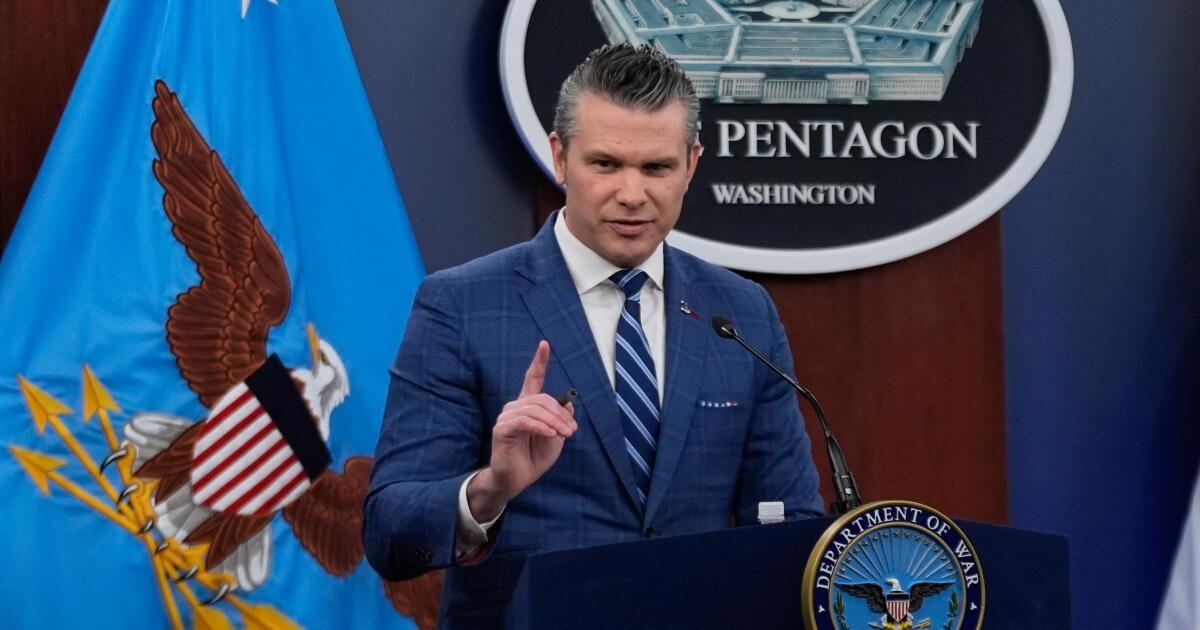
WASHINGTON — A day after the United States and Iran agreed to a two-week ceasefire, the tentative truce showed early signs of strain amid continuing attacks across the region and reports that Iran moved to restrict traffic through the Strait of Hormuz.
The developments tested President Trump’s ability to convert a fragile pause in fighting into a lasting peace deal with a country he has spent weeks threatening to destroy, and raised questions about whether the Trump administration had the diplomatic leverage to hold the deal.
Defense Secretary Pete Hegseth and the White House sought to project confidence at separate news briefings on Wednesday, and warned Iran to keep its end of the bargain or face the consequences.
Hegseth said the U.S. military plans to maintain a presence in the region to ensure Iranian compliance, saying American troops are ready to “go on offense and restart operations at a moment’s notice” if the truce broke down.
“We’ll be hanging around,” he said. “We are going to make sure Iran complies with this ceasefire and then ultimately comes to the table and makes a deal.”
The warning came as several Gulf nations reported Iranian missile and drone attacks on their territories despite the ceasefire being in effect. Kuwait said its air defenses intercepted drones, while Bahrain reported that an Iranian attack has sparked a fire at one of its facilities.
Hegseth downplayed the continued Iranian attacks in the region, saying that “it takes time sometimes” for ceasefires to take hold, but advised Iran to “find a way to get a carrier pigeon to their troops in remote locations” and ensure compliance moving forward.
Israel added to the regional turmoil on Wednesday, carrying out its largest strike against Hezbollah since the militant group began launching rockets in solidarity with Iran last month. Lebanese health authorities said hundreds were killed and wounded in the strikes.
Trump and Israeli Prime Minister Benjamin Netanyahu have both maintained that Lebanon is not subject to the agreed upon terms to pause the hostilities.
Pakistani Prime Minister Shehbaz Sharif, who helped broker the ceasefire, wrote on X that violations to the ceasefire had been reported at “a few places across the conflict zone” and urged all parties to exercise restraint. Though he did not detail the violations, he said the attacks “undermine the spirit of the peace process.”
The regional instability appeared to push the Iranian Navy to restrict traffic through the Strait of Hormuz, a crucial waterway whose opening was key in the ceasefire negotiations, according to Fars News, an Iranian news outlet aligned with the Islamic Revolutionary Guard Corps.
“Any vessel trying to travel into the sea … will be targeted and destroyed,” the Navy told shipping vessels, according to the Fars News report.
At a press briefing Wednesday, White House Press Secretary Karoline Leavitt said Trump was aware of the media reports that the Strait of Hormuz had been closed, a move that she called both “completely unacceptable” and “false.” She added that the president’s expectation is that the waterway will be “reopened immediately, quickly and safely.”
Hegseth told reporters earlier in the day that “commerce will flow” through the Strait of Hormuz with the ceasefire in effect. Leavitt, however, sidestepped questions about who currently has control over the oil route.
The situation in the Strait of Hormuz underscores how much remains uncertain about the agreement between the United States and Iran. The full terms of the ceasefire have not been publicly disclosed, and Trump wrote on Truth Social the “only group of meaningful ‘POINTS’ that are acceptable to the United States” will be discussed behind closed doors.
Trump also seemed to take issue with the 10-point peace plan that Iran publicly released on Wednesday. He said that there are terms being floated by people that have “absolutely nothing to do” with the negotiations between the United States and Iran. He said that “in many cases, they are total Fraudsters, Charlatans, and WORSE.”
Leavitt declined to offer details about the working proposal being negotiated, saying the talks will take place privately. Both Leavitt and Hegseth, however, mentioned that the United States wants to ensure Iran does not have stockpiles of enriched uranium, the fissile material that is key in developing nuclear weapons.
“This is on the top of the priority list for the president and his negotiating team as they head into the next round of discussions,” Leavitt said.
Hegseth told reporters earlier in the day that Iran may “hand it over.” If they don’t, Hegseth said: We will take it out, or if we have to do something else ourselves like we did [with] Midnight Hammer or something like that, we reserve that opportunity.”
Leavitt reiterated that administration officials “hope it will be through diplomacy,” but left open the possibility that it could be retrieved through ground operations.

new video loaded: Acting Attorney General Says Only Trump Knows Why Bondi Was Fired
transcript
transcript
Acting Attorney General Says Only Trump Knows Why Bondi Was Fired
The acting attorney general, Todd Blanche, said during his first news conference on Tuesday that “nobody has any idea” why President Trump fired Pam Bondi last week.
-
Nobody has any idea why the attorney general is no longer the attorney general and I’m the acting attorney general, except for President Trump. I grow tired of people in the media saying why President Trump did or did do something, because President Trump’s only one that knows that. I did not ask for this job. And if President Trump chooses to keep me as acting, that’s an honor. If he chooses to nominate me, that’s an honor.

By Jackeline Luna
April 7, 2026

Protesters in Boston call for end to war in Iran

Montel Williams’ national tour on school safety kicks off in Denver

Detectives Investigating Drive-By Shooting in South Seattle – SPD Blotter

From pink and mint green to …? Padres to unveil new City Connect jerseys

Milwaukee leaders take action to address food desert crisis on city’s north side

Florida High School Football Rankings: Top 25 teams – Oct. 21

How old is Bo Nix? What to know about Oregon quarterback ahead of 2024 NFL Draft

Cleary's 21 help Le Moyne down Central Connecticut State 69-64 in OT

99th annual Pony Swim held in Virginia

Indiana Members Credit Union announced as new anchor tenant at Bottleworks District

Video: Military Families Bear the Burden of War, Again

Fox News Poll: Record number say taxes are too high; government spending seen as wasteful

‘Even the street cats ran’: Inside Israel’s deadliest attack on Beirut

California Supreme Court halts GOP sheriff’s voter fraud investigation

AOC doubles down on call for Trump’s ouster even after ceasefire announcement
-

 Atlanta, GA4 days ago
1 teenage girl killed, another injured in shooting at Piedmont Park, police say
-

 Culture1 week ago
Do You Know Where These Famous Authors Are Buried?
-

 Movie Reviews7 days ago
Vaazha 2 first half review: Hashir anchors a lively, chaos-filled teen tale
-

 Georgia2 days ago
Georgia House Special Runoff Election 2026 Live Results
-

 Pennsylvania2 days ago
Parents charged after toddler injured by wolf at Pennsylvania zoo
-

 Education1 week ago
Video: We Put Dyson’s $600 Vacuum to the Test
-
 Milwaukee, WI3 days ago
Potawatomi Casino Hotel evacuated after fire breaks out in rooftop HVAC system
-
 Entertainment7 days ago
Inside Ye’s first comeback show at SoFi Stadium