Politics
How Johnson pulled off another impossible win with just 1-vote margin on $9.4B spending cut bill


NEWYou can now listen to Fox News articles!
It came down to one vote last Thursday afternoon.
Again.
That’s often the case in the House of Representatives. The GOP sports a modest eight-vote margin in the House. 220-212 with three vacancies. Republicans can only lose three votes and still pass a bill without Democratic assistance.
REPORTER’S NOTEBOOK: WHY THE SENATE IS UNLIKELY TO DEBATE THE ‘BIG, BEAUTIFUL BILL’ UNTIL NEXT WEEK
Capitol Building, NPR, PBS (llison Robbert/Bloomberg via Getty Images; Eva Marie Uzcategui/Bloomberg via Getty Images)
And when the House closed the roll call, lawmakers voted 214-212 to strip USAID and public broadcasting of $9.4 billion. This was the first “rescissions” bill by the House. An effort to claw back money which lawmakers just green-lit in March. But flip one vote, and the measure would have collapsed. A 213-213 vote doesn’t get it. By rule, ties fail in the House.
The bill represented the first chance for the GOP to make good on proposed cuts from DOGE. From a constitutional standpoint, DOGE can only recommend cuts. Congress has authority over spending. That means lawmakers must vote on every dollar. Lawmakers appropriated the money, but they must also vote to take it back.
No vote, no cuts. It’s that simple.
SENATE GOP CAREFULLY WEIGHING CONTROVERSIAL TAX PROVISIONS BEFORE BRINGING BIG, BEAUTIFUL BILL TO THE FLOOR
Speaker of the House Mike Johnson, left, and U.S. Capitol Building, right (Getty)
Earlier in the day on Thursday, it was unclear whether congressional Republicans had the votes to approve the spending cancellation package. It’s known as a “rescissions” bill because it “rescinds” money already approved by Congress. But the stakes for this bill were hard to understate for the GOP. Republicans crow a lot about cutting spending and reducing the deficit. But unless you can actually pass a bill to cut spending, talk is cheap.
And government programs are expensive.
All of official Washington would have trained its attention on the House floor late Thursday afternoon to see how Republicans fared with the spending cancellation request. But the shocking video of the feds tangling with Sen. Alex Padilla, D-Calif., and handcuffing him quickly consumed every cubic centimeter of news oxygen.
Sen. Alex Padilla speaks during a press conference at the Federal Building on Wilshire Blvd Thursday, Jun. 12, 2025, in Los Angeles. (Luke Johnson / Los Angeles Times via Getty Images)
The Congressional Hispanic Caucus and California Democrats planned to march to the office of Senate Majority Leader John Thune, R-S.D. A cavalcade of angry Democratic senators seized the Senate floor, excoriating the Trump Administration’s tactics and demanding action from Thune and House Speaker Mike Johnson, R-La. A wild scene erupted in the House Oversight Committee. Rep. Maxwell Frost, D-Fla., demanded that Oversight Committee Chairman James Comer, R-Ky., commit to subpoenaing Homeland Security Secretary Kristi Noem after the Padilla fracas.
“Will you just shut up!” implored Comer of Frost. “Just shut up! Shut up!”
“You’re not going to tell me to shut up!” bellowed Frost.
“He’s been arrested as a former Antifa member,” piled on Rep. Marjorie Taylor Greene, R-Ga.
You see why it was hard for the press corps to concentrate on the rescissions vote.
But back to the House floor.
The bill was heading to defeat midway through the roll call. Six Republicans posted nay votes on the board.
House of Representatives (Chip Somodevilla)
Rep. Nicole Malliotakis, R-N.Y. was among them. She told reporters her constituents supported public broadcasting. And she didn’t like the mechanics of the administration sending a request to Congress to rub out spending.
“I think this does give too much discretion to the White House to make cuts when we are the House that has the power of the purse,” said Malliotakis. “And I’ve seen some of the cuts, as I’ve said in the past, the World Trade Center Health program, the Women’s Health program. These are things that we had to go fight and get restored.”
But there were huddles on the floor during the vote itself. Rep. Nick LaLota, R-N.Y., chatted with Johnson and House Majority Whip Tom Emmer, R-Minn. A few moments later, LaLota and Rep. Don Bacon, R-Neb., who was a no, switched their ballots to yes.
Rep. Tom Emmer speaks during the Republican National Convention Tuesday, Jul. 16, 2024, in Milwaukee. (AP Photo/Charles Rex Arbogast)
Republicans gaveled the vote closed at 214-212.
“I ultimately voted yes after a conversation or two with the Speaker and the Whip raised my confidence level,” said LaLota. “I trust those two individuals. We’ve dealt with each other for the last couple of years. We’ve gotten on the same page.”
Bacon had spoken glowingly in recent days about his relationship with public broadcasters in Nebraska. He also had reservations about cutting PEPFAR, the global AIDS mitigation effort. But now Bacon didn’t fry his party.
“I was assured that PBS would receive funding in this year’s budget. And I discussed PEPFAR with the speaker,” said the Nebraska Republican.
A few moments later, Johnson was outside the House chamber, bragging about his colleagues for passing the bill.
“We are fulfilling the promises we made to the American people,” said Johnson. “Today’s passage of this initial rescissions package marks a critical step towards a more responsible and transparent government that puts the interests of the American taxpayers first.”
Failing to pass this teardrop of spending reductions amid a deep federal sea would have been catastrophic for the GOP. Again, especially because of all the braggadocio about cutting spending. Now Republicans can focus on bigger and more controversial spending cut requests from the Trump administration.
But few reporters cared much about what Johnson had to say at that moment because of the immediate mania involving Padilla. The Capitol descended into chaos. The outcome of the critical vote was relegated to a footnote on a wild news day. By nightfall, no one was talking about the rescissions package at all. Let alone Padilla.
Despite the staggering news traffic, the vote notched yet another narrow victory for Johnson and House Republicans. Like it or not, Johnson has piloted the fractious House Republican Conference to a series of slim victories on tough bills all year long.
In February, the House narrowly approved its initial framework for the Big, Beautiful Bill. The outline was essential to help ease eventual passage in the Senate. At one point, it looked like Republicans lacked the votes. In fact, House leaders began sending Members home for the night. Then, they suddenly reversed themselves. Johnson and the GOP eked out a 217-215 victory, approving the framework and sending it to the Senate.
Switch one vote, and the gig was up. The House and Senate would not be on the same page with a budget framework for the touchstone of President Trump’s agenda. That would neutralize the entire exercise.
A few weeks later, the House approved an interim spending bill to avoid a government shutdown, 217-213. Again a narrow vote. Only Rep. Thomas Massie, R-Ky., voted nay. Flip two votes and the tally is 215-215. Again, a tie vote kills the bill.
Rep. Thomas Massie attends the inauguration of U.S. President-elect Donald Trump in the Rotunda of the U.S. Capitol on Jan. 20, 2025, in Washington. (Kevin Dietsch/Getty Images)
The Senate okayed one framework for the Big, Beautiful Bill in February. Another one in the spring. But the House and Senate still weren’t on the same page. In mid-April, the House and Senate finally aligned. The House adopted the Senate’s final blueprint for the Big, Beautiful Bill, 216-214. Massie and Rep. Victoria Spartz, R-Ind., voted nay. Again, change one vote and it’s a tie. Defeat would have stalled the process for the Big, Beautiful Bill.
Finally, Johnson and the GOP scored perhaps their biggest win of the year in mid-May. The House voted 215-214 with one member voting “present” to pass the initial version of the Big, Beautiful Bill and send it to the Senate. Rep. Andrew Garbarino, R-N.Y., had problems with the bill. But missed the vote because he fell asleep as the House debated the measure in the middle of the night. House Freedom Caucus Chairman and Rep. Andy Harris, R-Md., also had reservations. But he cast the “present” vote. Either of these members could have tanked the legislation had they voted nay.
Former House Speaker Nancy Pelosi, D-Calif., was the master at lugging challenging votes across the finish line by a vote or two. She’s the reason Obamacare passed. But Pelosi often had larger majorities. Her secret sauce was understanding what members needed to vote yes on controversial legislation.
Former House Speaker Nancy Pelosi, a Democrat from California, speaks during a news conference at the U.S. Capitol in Washington on Thursday, Nov. 4, 2021. (Craig Hudson/Bloomberg via Getty Images)
The speaker has Trump on his side and a GOP conference that is willing to do practically whatever he wants. That helps a lot. But Johnson’s resume of pushing through tough bills by the tiniest of margins is beginning to mirror Pelosi’s success. However, the level of difficulty is higher for Johnson thanks to the minuscule majority.
Pelosi was a parliamentary maestro when she was Speaker. And so far during his speakership, Johnson has defied political gravity. But whether you like Johnson’s politics or not, keen political observers are noticing that he has a knack for pulling off the seemingly unachievable. That was long the calling card of Pelosi.
And it may eventually prove to be the calling card of Johnson, too.



new video loaded: Hillary Clinton Denies Ever Meeting Jeffrey Epstein
transcript
transcript
Hillary Clinton Denies Ever Meeting Jeffrey Epstein
The former first lady, senator and secretary of state, Hillary Clinton, told congressional members in a closed-door deposition that she had no dealings with Jeffrey Epstein.
-
“I don’t know how many times I had to say I did not know Jeffrey Epstein. I never went to his island. I never went to his homes. I never went to his offices. So it’s on the record numerous times.” “This isn’t a partisan witch hunt. To my knowledge, the Clintons haven’t answered very many questions about everything.” “You’re sitting through an incredibly unserious clown show of a deposition, where members of Congress and the Republican Party are more concerned about getting their photo op of Secretary Clinton than actually getting to the truth and holding anyone accountable.” “What is not acceptable is Oversight Republicans breaking their own committee rules that they established with the secretary and her team.” “As we had agreed upon rules based on the fact that it was going to be a closed hearing at their demand, and one of the members violated that rule, which was very upsetting because it suggested that they might violate other of our agreements.”

By Jackeline Luna
February 26, 2026
Politics
Vulnerable House Dem lashes out at Trump’s ‘racist’ SOTU challenge: ‘That was uncomfortable’

NEWYou can now listen to Fox News articles!
Rep. Janelle Bynum, D-Ore., called a challenge from President Donald Trump at the 2026 State of the Union “racist” when he asked listeners to stand if they agreed the U.S. should prioritize the safety of its own citizens over illegal aliens.
“If you agree with this statement, then stand up and show your support,” Trump said.
“The first duty of the American government is to protect American citizens, not illegal aliens.”
Democrats remained seated for over a minute and a half as the Republican side of the chamber burst into prolonged applause.
President Donald Trump pictured ahead of his 2026 State of the Union Address on Feb. 24, 2026. (Kenny Holston-Pool/Getty Images)
After the address, Bynum, who is on the National Republican Congressional Committee’s list of vulnerable Dem incumbents, said the moment made her uneasy.
“I think you can agree with the ‘what’ — like standing up for American citizens,” Bynum said. “But I disagree with the ‘how.’”
“There’s thinly veiled racist language, anti-immigrant language in what he was asking, and that was uncomfortable,” Bynum said.
Bynum’s office did not immediately respond to a request for comment on how Trump’s challenge had asked lawmakers to discriminate on the basis of race.
TRUMP SHAMES DEMOCRATS IN VIRAL STATE OF THE UNION CHALLENGE ON MIGRANT CRIME: ‘FIRST DUTY’
Trump’s remarks to Democrats on Tuesday came as a partial government shutdown drags on over demands Democrats have made to reform the agency at the heart of Trump’s immigration crackdown.
Rep. Janelle Bynum, D-Ore., left, pictured alongside President Donald Trump, right. (Bill Clark/CQ-Roll Call, Inc via Getty Images; Craig Hudson For The Washington Post via Getty Images)
Democrats are demanding a set of 10 enforcement reforms for Immigration and Customs Enforcement (ICE) and won’t vote to fund the Department of Homeland Security (DHS) until Republicans meet their demands.
DHS, which oversees ICE, went into a shutdown on Feb. 14.
DHS SHUTDOWN DRAGS INTO WEEK TWO AS IRAN THREAT, SOTU CLASH COMPLICATE HILL TALKS
Among other changes, Democrats are looking for a ban on masks, an end to roaming patrols, visible identification and stiffer warrant requirements for arresting illegal aliens in public.
Republicans have dismissed those demands, arguing that Democrats must first pass legislation to restrict “sanctuary cities” — local communities that have instructed their law enforcement not to cooperate with federal agents on immigration apprehensions and deportations.
DHS Agents in Charlotte, North Carolina on a mission. (Ryan Murphy/Getty Images)
CLICK HERE TO DOWNLOAD THE FOX NEWS APP
In a press release after the State of the Union, Bynum, who voted against DHS earlier this year, listed Trump’s framing of his immigration crackdown among her many critiques of the address.
“Tonight, I watched President Trump spend the majority of his speech lying about the state of our economy, demonizing immigrants and spewing more of the same divisive BS. I can’t say I’m surprised,” she wrote.
Related Article

Politics
Trump’s State of the Union address draws 32.6 million viewers, marking smallest audience yet
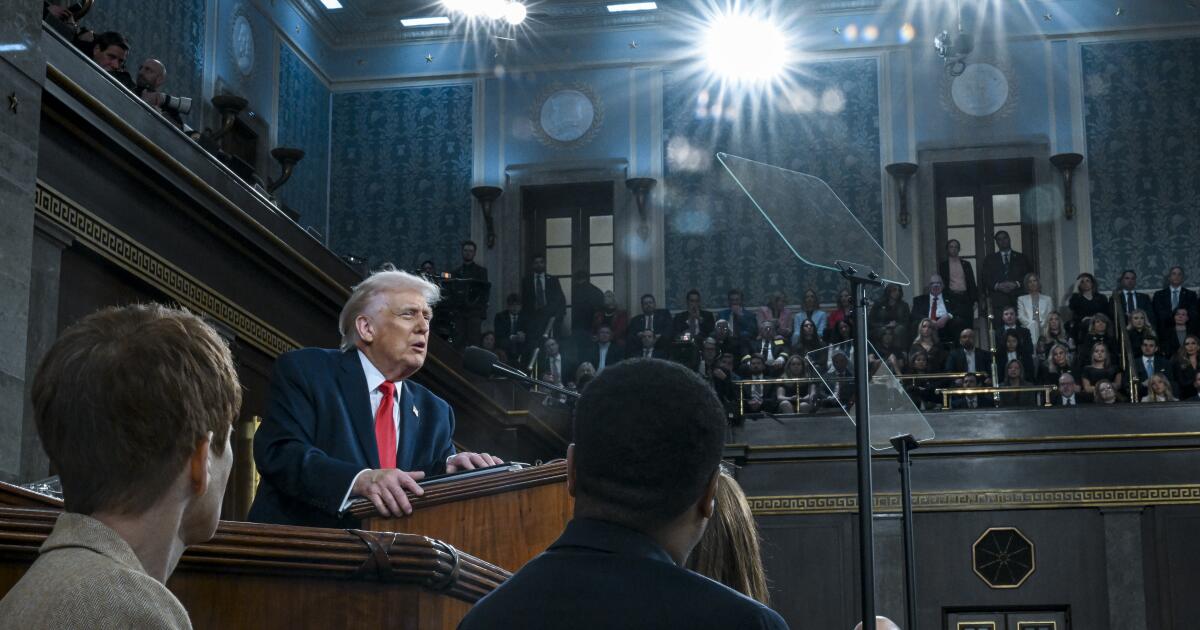
Over 32.6 million viewers watched President Trump address the nation on Tuesday night, according to Nielsen data.
It’s both the smallest audience Trump has received for the annual speech to a joint session of Congress, and the longest State of the Union address in recent history.
This was the president’s first State of the Union address of his second term. Previously, his addresses scored 45.5 million in 2018, 46.8 million in 2019 and 37.1 million in 2020, the Nielsen data show.
This year’s speech clocked in at 107 minutes, topping the record set by President Clinton in 2000.
Facing low approval ratings, Trump played up positive economic numbers, some of which were misstated, and the administration’s aggressive crackdown on undocumented immigrants, drawing polarized reactions in the chamber.
Trump also recognized the Men’s Olympic hockey team, which won its first gold medal since 1980 on Sunday with its victory against Canada, and a number of other guests attended the address, including the widow of right-wing activist Charlie Kirk and Paramount Skydance’s CEO David Ellison.
The U.S. Olympic men’s ice hockey team arrives for the State of the Union address .
(Kenny Holston / Pool, Getty Images)
There were 15 networks that televised the speech. Fox News had the largest audience with 9.1 million viewers. ABC was second with 5.1 million, followed by NBC‘s 3.6 million, CBS’ 3.3 million, MS NOW’s 2.4 million, CNN’s 2.2 million, and the Fox broadcast network’s 2.1 million.

Robert ‘Fish’ Jenkins helped Detroit students soar in sports and life

San Francisco court clerks strike for better staffing, training

Mavericks vs Kings Final Score: Dallas falls to Sacramento, 130-121

Red Sox insider hints Boston may have Pablo Sandoval problem with Masataka Yoshida

David Fountaine Black Obituary | The Denver Post

Florida High School Football Rankings: Top 25 teams – Oct. 21

Cleary's 21 help Le Moyne down Central Connecticut State 69-64 in OT

How old is Bo Nix? What to know about Oregon quarterback ahead of 2024 NFL Draft

99th annual Pony Swim held in Virginia

Indiana Members Credit Union announced as new anchor tenant at Bottleworks District

Read Judge Schiltz’s Order

Vulnerable House Dem lashes out at Trump’s ‘racist’ SOTU challenge: ‘That was uncomfortable’

Italy calls for suspension of EU carbon market

Chicagoans pay respects to Jesse Jackson as cross-country memorial services begin

DHS shutdown triggers TSA ‘emergency measures’ as lawmaker warns airports could feel economic pain
-

 World1 day ago
Exclusive: DeepSeek withholds latest AI model from US chipmakers including Nvidia, sources say
-

 Massachusetts2 days ago
Mother and daughter injured in Taunton house explosion
-

 Montana1 week ago
2026 MHSA Montana Wrestling State Championship Brackets And Results – FloWrestling
-

 Oklahoma1 week ago
Wildfires rage in Oklahoma as thousands urged to evacuate a small city
-

 Louisiana4 days ago
Wildfire near Gum Swamp Road in Livingston Parish now under control; more than 200 acres burned
-

 Technology6 days ago
YouTube TV billing scam emails are hitting inboxes
-

 Denver, CO2 days ago
10 acres charred, 5 injured in Thornton grass fire, evacuation orders lifted
-

 Technology6 days ago
Stellantis is in a crisis of its own making