Politics
Granderson: With this guilty verdict, Trump has gone full Bond villain

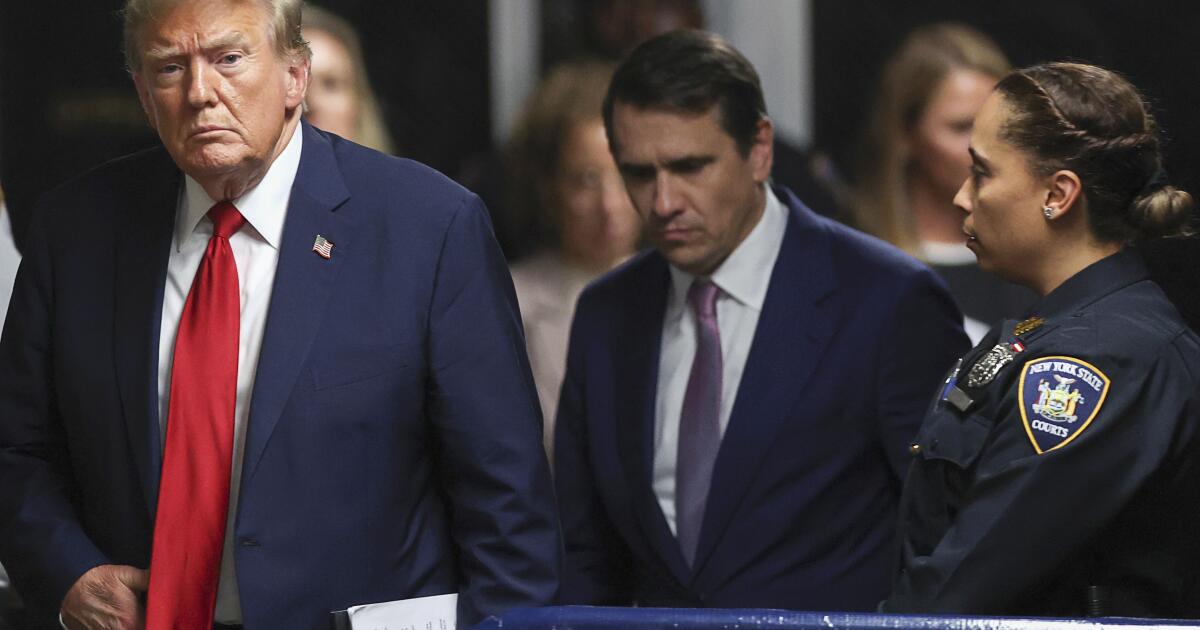
When Donald Trump’s Thursday morning started with a former producer of “The Apprentice” accusing him of using a racist slur to describe a Black contestant, the former president didn’t know that was going to be the best news of his day.
Opinion Columnist
LZ Granderson
LZ Granderson writes about culture, politics, sports and navigating life in America.
That afternoon, a jury of his peers handed down a 34-count conviction. Quite the bookends for a man who a year ago was also found liable for sexual assault and defamation by a jury. In 2022, two of his companies were convicted of fraud.
As if all that weren’t enough reason to be concerned about the corruption a potential second Trump term could bring, there are now reports that the former president is buddying up with Elon Musk. In fact, Trump is said to be considering adding Musk as an advisor if he wins in November.
Imagine: one of the richest men in the world joining forces with a convicted felon running for president. It’s the kind of pairing Ian Fleming would have appreciated. A duo of villains worthy of Bond.
Musk wants to put a computer chip in your brain, and Trump said he wants to be a dictator for a day. Musk prevented Ukraine from using Starlink internet services in its fight against Russia. Trump admires Russian President Vladimir Putin and said he would encourage Russia to attack NATO countries.
Musk grew up affluent in apartheid South Africa and today speaks ill of diversity efforts in the workplace.
According to Trump’s niece Mary, racist slurs like Trump is accused of using on set were common in the Trump household. Antisemitic slurs as well, which probably explains why Trump said that white nationalists — the ones carrying torches and chanting, “Jews will not replace us” — were “very fine people.”
That was 2017, back when Trump was calling himself the “law and order” president. I’m pretty sure his supporters didn’t take that to mean that he and many of the people he brought with him to the White House — Paul Manafort, Stephen K. Bannon, Mike Flynn, Roger Stone — would be facing jail time.
But then again, if Republicans really cared about “law and order,” Trump never would have made it to the Republican debate stage back in 2015. He and his businesses had already been involved in thousands of lawsuits. In fact, when Trump initially announced his candidacy, he was concurrently dealing with a class action suit filed against Trump University. (Alleging fraud, in case you were wondering.)
Republicans like House Speaker Mike Johnson of Louisiana, who after the verdict on Thursday said “today is a shameful day in American history,” can try to characterize the hush money trial as “the weaponization of our justice system,” but the reality is Trump has been in trouble with our legal system since Johnson was in diapers. I’m not joking. The saga began in 1973 with the Nixon administration. By now, Trump’s been involved in 4,095 lawsuits and counting.
He is not a victim being unfairly targeted by Democrats.
Trump is a con artist who keeps getting caught.
When he first ran for president, he told supporters not to worry about his lack of political experience because his business pedigree qualified him for the job. And then we found out that his companies had been cooking the books for decades and that Trump’s father repeatedly bailed him out of bad financial decisions. No shame in having help, unless you’ve been claiming to be self-made and successful.
And many believed his boasts, even though he became a millionaire at the age of 8, not through shrewd deals but because of his family’s wealth.
The guilty verdict on Thursday marked the first time a former president has been convicted of a felony. That is indeed historic.
However, Trump himself being found guilty in a court of law should not surprise anyone.
Especially not in New York, where Trump grew up, made his name, made his money and had most of his run-ins with the law.
Perhaps in 2016, because of his charisma and celebrity, it was easy to overlook just how corrupt Trump was. Now, his corruption is hard to avoid.
None of this is to suggest he can’t still win the White House. However, this time around, there is no plausible pretense of “draining the swamp” or “making America great.”
No, this time around voters know Trump is a criminal. Now we’ve got the receipts.


California Democratic senators failed to advance a proposal Tuesday that would have barred registered sex offenders from running for office.
State Sen. Scott Wiener (D-San Francisco) voted against Assembly Bill 2753, while fellow Sens. Tom Umberg (D-Santa Ana) and Ben Allen (D-Santa Monica) abstained from a vote that ultimately failed 2-1-2 in the Senate Elections and Constitutional Committee.
The committee’s lone Republican, Steve Choi (R-Irvine), and Sen. Sabrina Cervantes (D-Riverside) voted in favor of the bill, which is likely dead because it failed to get support from a majority of the five-member panel.
AB 2753 could be reviewed in a floor session Thursday, but staff from the office of Assemblywoman Esmeralda Soria (D-Fresno), who authored the bill, are conceding that’s unlikely.
The defeat comes on the heels of unanimous support, including a 60-0 vote in favor on the Assembly Floor on May 7.
“I am deeply disappointed and disheartened after the Senate Elections Committee has failed to advance AB 2753, a bill that would have prohibited any registered sex offender in the State of California from running for local or state public office,” Soria said in a statement.
The bill’s wording said the legislation would “prohibit a person from being a candidate for, or elected to, any state or local elective office if the person has ever been required to register as a sex offender.”
Inquiries to the offices of Sens. Wiener, Umberg and Allen were not immediately returned.
Sex offenses in California are broken up into three tiers. First-tier offenses call for a minimum of 10 years placement on the sex offender registry. Second-tier offenses call for a minimum of 20 years and third tier crimes could result in a lifetime on the registry.
The types of offenses for each tier vary. Tier 1 offenses range from indecent exposure to misdemeanor child pornography and sexual battery. Tier 2 includes incest and penetration with a foreign object, and Tier 3 includes felony possession of child pornography, rape and pimping and pandering of a minor.
Wiener asked for amendments to the bill during the bill’s review and in the committee meeting, including that the lifetime ban only be applied to Tier 3 members.
He pointed to committee analysis of the bill that could affect so-called “Romeo and Juliet” couples — those close in age, for instance with one partner being 19 and the other being 17. If the younger partner sent sexually explicit digital content to the older partner (a misdemeanor), this law could ban the older partner from public office for life.
There were also concerns listed in the analysis that the registry, which dates back to 1947, could include LGBTQ+ offenders from decades ago who were convicted of offenses that are no longer crimes.
Wiener mentioned in the committee meeting civil rights strategist and fighter Bayard Rustin being placed on the California sex offender’s registry list after being arrested by Pasadena Police for having consensual sex with another man in 1953.
“Without the amendment contained in the analysis, I will be voting ‘no’ on this bill and recommending that the committee vote ‘no,’” Wiener said at the committee hearing.
He added that the sex offender list was “not punishment,” but instead “a tool for law enforcement to monitor who may potentially cause a risk.”
While Soria agreed to one bill amendment, she did not accept other provisions, including the elimination of lifetime bans on Tier 1 or 2 offenses.
“The bottom line is this: I was not willing to make additional amendments to this bill,” she said. “I made a promise to my community that I would do everything in my power to ensure they would never have to go through something like this again. Accepting additional amendments to this bill would have jeopardized that promise.”
Some of the impetus behind her bill revolved around the June 2 Fresno City Council election. Registered sex offender Rene Campos fell short of the necessary votes in his bid to run for Central Valley Council.
He was charged with possession of child pornography in 2018 and hosted his campaign kickoff in front of an elementary school.
Nelson Esparza, Fresno City Council President, spoke at the Senate Elections and Constitutional Committee meeting in favor of AB 2753.
“My office received dozens of calls from our residents asking how this could be allowed,” Esparza said of Campos’ candidacy. “AB 2753 closes this loophole.”
It’s unclear if this bill will be reintroduced next year at least at the Assembly level, as Soria is running for the state senate in November.
Politics
Mamdani ripped for claiming victory over capitalism after NYC’s multi-billion dollar taxpayer funded bailout

NEWYou can now listen to Fox News articles!
New York City’s mayor is again under fire after spewing outlandish claims that his socialist policies are to credit for a balanced budget in the Big Apple, just after the city received a multi-billion dollar bailout from the state.
“In January, our administration inherited a $12 billion budget deficit — a fiscal crisis greater than the Great Recession,” Mayor Zohran Mamdani said in a Tuesday post on X announcing that the debt had been cleared.
“We balanced the budget by taxing the rich and making government more efficient,” Mamdani continued. “We did not balance this budget on the backs of working people, and we never will.”
New York City Mayor Zohran Mamdani speaks during a primary-night watch party for NYC Congressional candidate Claire Valdez at 99 Scott Studio on June 23, 2026 in the East Williamsburg neighborhood of the Brooklyn borough in New York City. (Michael M. Santiago/Getty Images)
MAMDANI ALLOCATES $500K FOR REPARATIONS TALKS AS NYC FACES $5.4B DEFICIT
But the real reason the budget it balanced is because the city was handed $1.5 billion by the state of New York in January — funded by working class taxpayers across the state — as part of a multi-year plan to bail out the fiscally-challenged city. In late May, the city received another $4 billion.
Of the combined $8 billion provided to the city’s bailout fund under former Mayor Eric Adams’ tenure and now Mamdani’s mayorship, $5 billion was directly earmarked for the city to address fiscal measures. This includes allowing city government to defer pension contributions to close the budgetary gap.
Mamdani’s claims about socialist policies producing results — and his failure to mention the massive bailouts provided by taxpayer dollars — did not fly on social media.
New York Gov. Kathy Hochul holds media availability press conference and makes an announcement on abortion rights at the office on 633 3rd Avenue. (Lev Radin/Pacific Press/LightRocket via Getty Images)
MAMDANI ALLOCATES $500K FOR REPARATIONS TALKS AS NYC FACES $5.4B DEFICIT
“This is a lie,” independent journalist Nick Shirley said in a reply to the mayor.
“You balanced the budget by borrowing billions from the NY state government which pushed back pension payments, so you literally took money from ‘the backs of hardworking people.’ Don’t get it twisted,” he added.
Commentator and journalist Nick Sortor also flamed the mayor over the loan and his classification of the bailout.
“Are you saying New Yorkers can ‘balance their budgets’ by taking out massive credit card loans?” he asked sarcastically.
Independent journalist Nick Shirley sat down for an interview with Riley Gaines as part of the launch of Outkick’s “The Riley Gaines Show.” (OutKick)
BROADCAST NETWORKS TOUT MAMDANI’S VICTORIES, PROCLAIM SOCIALISM IS ‘RESONATING’
“Mamdani balanced the budget by taking money from Albany, who in turn taxed Rochester and Buffalo” another social media user said. “That’s who is paying for all of Mamdani’s free crap.”
In a press conference earlier in the day, Mamdani claimed victory over capitalism.
“Throughout this process I have been reminded of the words of the Austrian economist Friedrich Hayek: ‘if socialists understood economics, they wouldn’t be socialists.’”
A man sleeps on the E train, one of the subway lines most utilized by homeless New Yorkers for shelter, in Queens, New York, on Monday, April 7, 2025. (Victor J. Blue for The Washington Post/Getty Images)
After the Republican National Convention (RNC) posted that clip, Mamdani also faced ridicule for that.
“It always looks good at first until the chickens come home to roost,” one person replied.
CLICK HERE TO DOWNLOAD THE FOX NEWS APP
“He’ll soon ‘deliver’ bread lines instead,” said another.
Mamdani’s office did not return Fox News Digital’s request for comment.

In 1913, Antonino Alati left southern Italy to find a better life in a land where many people regarded him as little better than scum.
He joined millions of his fellow countrymen in the United States, where the press vilified Italians as poor, swarthy, violent Catholics who had too many babies, refused to assimilate and could never possibly be considered “white.”
Politicians were already working to shut the door on them. A congressional report released two years before Alati’s arrival cited southern Italians as evidence that “the new immigration as a class is far less intelligent than the old.” They came to the U.S., the report asserted, “with the intention of profiting, in a pecuniary way, by the superior advantages of the new world and then returning to the old country.”
Alati wouldn’t let bigotry win. He soon sent for his wife and children, including his infant son Salvatore. Alati turned to Alito, Salvatore became Samuel. A generation later, the family had a Supreme Court justice in Samuel A. Alito Jr. — the second Italian American, after Antonin Scalia, to sit on the highest court in the land.
During his 2005 confirmation hearings, Alito praised his father as an “extraordinary man who came to the United States as a young child and overcame many difficulties” to ensure a better life for him and his sister. By then, Italian Americans were established as an essential part of this country’s fabric, from music to politics to food.
It’s the most American of tales — which is why it’s so surprising, yet not, to read Alito’s blistering dissent in the Supreme Court’s 6-3 decision rejecting President Trump’s effort to end birthright citizenship.
If there’s one constant in this country besides death and taxes, it’s how quickly descendants of immigrants, and sometimes immigrants themselves, forget how loathed their ethnic group was and how they proved the haters wrong. Too many become uncharitable to the policies that helped them and the immigrants who followed.
But Alito’s stance against birthright citizenship goes beyond just forgetting his roots. His 39-page opinion describes the supposed impact of undocumented migrants on the U.S., using words — “overran,” “soared,” “exploded,” “massive,” “a stream,” “huge” — that read like the same invective used against Italians in his grandfather and father’s time.
The justice channels anti-Italian conspiracies of the past by casting doubt on the national allegiances of the U.S.-born children of Mexican, Guatemalan and Salvadoran immigrants — the same patriotism test that Italian Americans faced generations ago when xenophobes questioned their Catholicism. Alito claims without evidence that millions of agricultural workers were able to apply for American citizenship after President Reagan’s 1986 amnesty “at least in part because of fraud” — a charge also leveled against Italians who sought to naturalize back in the day.
And so it goes, each passage a jumbled argument dressed up in judicial interpretations largely rejected by his fellow Catholic Supreme Court justices John Roberts, Amy Coney Barrett and Brett Kavanaugh. Coney Barrett signed on to the majority opinion that Roberts wrote, and Kavanaugh concurred.
Rev. William Barber II speaks during a rally outside the U.S. Supreme Court on April 1 while justices heard oral arguments on birthright citizenship.
(Al Drago / Getty Images)
I know how quickly families forget their own immigrant histories. Yet I look at people like Alito and wonder how they ended up thinking the way they do, because I could never imagine doing the same.
My maternal grandmother was born in Arizona to parents who fled their home country during the Mexican Revolution, becoming an American citizen by birthright. My father, who crossed the border in the trunk of a Chevy, legalized his status in an era when it was far easier to do so.
Like Alito’s paisanes, my Mexican family was also demonized for supposedly being insufficiently American and posing a threat to national unity. They also sacrificed their own dreams so their children and grandchildren could achieve theirs.
And just like Alito, some members of my family have forgotten our history and support Trump or favor some of his immigration policies, dismissing new arrivals as criminals or lazy. That’s why I will always side with undocumented people and welcome anyone who gives birth in this country with the hope that their newborn finds a better life.
It seems from his dissent that Alito somewhat agrees with me. He posits that millions of Americans who were born in this country to parents without papers “have a strong moral claim to be able to remain in the land where they grew up.” Congress “can and should address their situation,” he writes.
The justice blasts birth tourism, where women from China and other countries travel to the U.S. to have a baby, then return home, benefiting from our generosity and offering nothing in return.
I agree that’s a mockery of what being an American should be and ruins it for people who want to contribute to building a better nation. But Alito throws out the baby with the bathwater by failing to recognize that Trump’s attempt to erase birthright citizenship via executive order is presidential overreach based on bigotry, not rule of law. He’d rather cut up the Constitution to spite something he doesn’t like. Thank God his side lost, yet it’s sad that Trump’s pathetic attempt to define who can be an American went as far as it did.
Alito concludes by stating that the court’s decision to uphold the 14th Amendment is “a mistake that will seriously affect the country’s future.”
What new immigrants might inflict on this country is the perpetual worry of immigration restrictionists — and yet history keeps proving them wrong. Alito’s family did; so did mine. Only in these United States can the progeny of people once portrayed as parasites and invaders side with those making the same argument about the latest batch of newcomers.
History will see Alito’s vote for what it is: a forsaking of the promise his family once fulfilled, to support the people who never wanted them here in the first place.
-

 Health4 minutes ago
West Nile virus detected in southern state as health officials warn residents about mosquitoes
-

 Sports11 minutes ago
USA World Cup star Folarin Balogun receives controversial red card during Round of 32 match
-

 Technology14 minutes ago
A missing kitten rode under a car hood. AI brought her home
-
 Business19 minutes ago
As Trump reports $2.2 billion in 2025 income, ethics experts raise alarms
-
 Entertainment26 minutes ago
Danny Glover reveals Alzheimer’s diagnosis, says family has his back
-

 Lifestyle29 minutes ago
François-Henri Bennahmias to Launch New Luxury Swiss Watch Brand N3W5
-
Politics34 minutes ago
Bill to ban sex offenders from running for office fails in California senate committee
-
 Science41 minutes ago
After Trump axed federal employees running climate site, thousands crowdfund its comeback

