Politics
Democrats book $27 million in ads in California congressional races

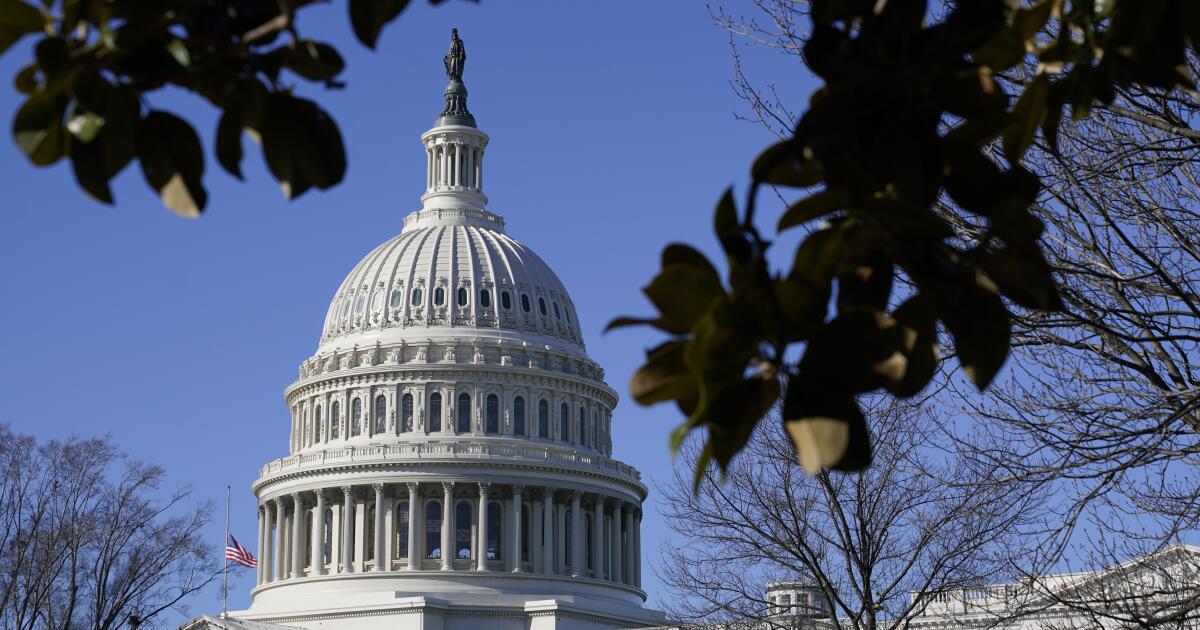
In a sign of how important several tight California congressional races are to determining control of Congress in the November election, a Democratic super PAC has booked more than $27 million in television and digital ads in the state.
It’s the most the House Majority PAC booked in any state in its initial $186-million advertising buy announced Sunday, the largest amount the organization has ever spent in early campaigning.
“House Republicans have done nothing but sell out the American people while creating chaos, and we are holding them accountable for their anti-American extremist policies and agenda,” said Mike Smith, the president of the PAC allied with House Minority Leader Hakeem Jeffries (D-N.Y.).
“Through these historic television and digital reservations, House Majority PAC has made it clear that we are ready to do whatever it takes to flip the House and elect Hakeem Jeffries the next Speaker of the House,” Smith said in a statement.
The Congressional Leadership Fund, the Republican version of the House Majority PAC, has not yet released its early-spending plans. However, the group’s leader expressed confidence in the GOP’s chances in the fall.
“We have incredibly strong Republican incumbents in the toughest races, far better recruits, and a political environment that seems to favor Republicans,” Congressional Leadership Fund President Dan Conston said in a statement. “If the resources are there, we will hold the Majority this fall.”
The Democratic political action committee announced last year that it would spend $35 million in the state, roughly triple what it did on California congressional races in the 2022 midterm elections, when Democrats underperformed in some districts that should have been strongholds.
Political groups on both sides of the aisle don’t always follow through with their advertising reservations, so it remains to be seen how much the PAC will actually spend in California.
However, Democrats need to win four seats to take control of the House, which is why the House Majority PAC’s spending plan — which is aimed at 45 congressional districts nationwide, including Republican-held seats in districts that President Biden won in 2020 — is so focused on California.
The state’s 52-member delegation is the largest in the nation, and California’s independent redistricting process replaced the prior gerrymandering that created safe districts for both parties, resulting in more competitive races.
Of the 435 members of the U.S. House of Representatives, 69 are running in November races that are rated as toss-ups, competitive or potentially vulnerable by the nonpartisan Cook Political Report, which has tracked House and Senate races for decades. Ten of those are in California.
Additionally, the state is home to some of the nation’s most expensive media markets.
These factors are reflected in the House Majority PAC’s spending plans.
In its initial ad buy, the group plans to spend $18.1 million in the Los Angeles media market as well as an addition $1.1 million on Spanish-language messaging. This area’s television ads are seen by voters in the districts of GOP Reps. Mike Garcia of Santa Clarita, Ken Calvert of Corona, Michelle Steel of Seal Beach and Young Kim of Anaheim Hills, several of which are expected to be fiercely contested in November, as well as the bitter race being waged for the purple Orange County seat vacated by Katie Porter for the Democrat’s unsuccessful U.S. Senate run.
Other spending in the state targets GOP districts held by Reps. David Valadao of Hanford, John Duarte of Modesto and Kevin Kiley of Rocklin, as well as efforts to prop up Democratic Reps. Josh Harder of Tracy and Mike Levin of San Juan Capistrano.


As election officials continued tallying ballots Wednesday, Republican Steve Hilton and Democrat Xavier Becerra continued to lead in the unsettled race to replace termed-out Gov. Gavin Newsom, with billionaire Democrat Tom Steyer hoping for a surge in late-arriving votes to push him into one of the top-two spots to advance to the November general election.
Hilton, a British immigrant and former Fox News commentator, told reporters outside the state Capitol in Sacramento Wednesday morning that he was “very encouraged” by the latest results, though he stopped short of declaring victory.
“It does look as if change is coming to California, and that is good news for everyone, every small business, every working family, everyone who wants to see our state set back on track,” he said.
Becerra and Steyer did not hold public events as of Wednesday afternoon.
Election data analyst Paul Mitchell said it would be nearly mathematically impossible for Steyer to close the gap.
“As we start to get more data, the runway is going to get shorter and shorter,” he said.
He said Steyer, to finish in the top two in the primary, would have to get about 30% of the remaining uncounted votes while Becerra would need to be limited to 15%. The self-funded billionaire has “a very high hill to overcome, and the challenge gets steeper and steeper as we get more data from the counties,” Mitchell said.
Once mired near the bottom of a crowded pack of Democrats in opinion polls, Becerra, a former Biden administration cabinet member, rocketed ahead of his rival candidates after former Rep. Eric Swalwell dropped out of the race in April amid allegations of sexual assault and misconduct. The scandal triggered an upswing of voter interest in California’s once sluggish governor’s race and in Becerra, who seized the moment.
“Here in Hollywood’s hometown, we love a good underdog story,” Becerra told cheering supporters at his election night party at La Plaza de Cultura y Artes in downtown Los Angeles.
Becerra spoke about his Mexican immigrant parents and becoming the first in his family to attend college. Though a longtime California politician, Becerra said that his campaign for governor was outspent and that he faced calls to drop out of the race.
“The underdog stayed in the fight,” he said. “Like my parents, I never gave up. … Never stopped believing in the beacon-light goodness of California and thankfully, neither did you.”
Steyer, who spent more than $216 million of his wealth on the race, has not conceded defeat.
His campaign manager, Heather Hargreaves, wrote in a letter to supporters Wednesday that “we’re going to give democracy time to work. County election officials are still counting ballots and don’t expect to know how many people voted in total until” Thursday, when officials are required to report the estimated number ballots left to process.
The billionaire former hedge fund owner campaigned against the corporate and special interests that have a powerful presence in Sacramento and often spend heavily in elections, including this year against Steyer.
Billionaires “do everything they can to hoard their wealth and avoid paying taxes, and we see corporations continue to rig the system for themselves — raising your prices to juice their profits. Screw that,” Steyer said at his election watch party at the Regency Ballroom in San Francisco.
Other candidates in the race included Republican Riverside County Sheriff Chad Bianco and Democrats including former Rep. Katie Porter, San José Mayor Matt Mahan, former Los Angeles Mayor Antonio Villaraigosa and state Supt. of Public Instruction Tony Thurmond.
Villaraigosa, Mahan and Porter conceded the race Tuesday night.
California’s 2026 race for governor started slow but ended with a flourish, including the demise of a scandal-ridden Democratic favorite, the anointing of a Republican by Trump and Becerra’s unexpected rise from the depths of the candidate field.
Unlike gubernatorial elections in the last quarter of a century, this year’s race lacked a clear crowd-pleasing front-runner able to win over voters, such as movie star Arnold Schwarzenegger or Jerry Brown, a sage of the California electorate and scion of a storied political family. But it unfolded at a time when the state’s residents are overwhelmed by high housing costs, steep gas prices and overall unaffordability that threatens the “California dream” that once drew millions of people to the state.
“Normal people are not living and breathing politics on a daily basis,” said Tim Rosales, a strategist who ran Republican John Cox’s unsuccessful 2018 gubernatorial campaign. In today’s information-saturated environment, Rosales said, the race and its roster of “extremely milquetoast candidates” didn’t break through until the Swalwell scandal grabbed voters’ attention.
The 2026 gubernatorial primary has been one of the most unpredictable and expensive in decades and a race that was shaped early on by a number of heavyweight Democrats staying on the sidelines.
Though supporters urged them to run, former Vice President Kamala Harris, Sen. Alex Padilla and Atty. Gen. Rob Bonta passed on the race. It was in a state of limbo for months last year as Harris, one of the state’s most high-profile politicians, weighed whether to jump in.
“I don’t ever recall a playing field that looks like this one. Usually there’s a clear front-runner,” said veteran Democratic strategist Darry Sragow. “It’s easy to say that it reflects a lack of talent [but] that’s absolutely not true. Almost any of the candidates running could make a good governor.”
Still, candidates struggled for months to break through to voters.
In February, polls showed the crowded field of Democrats splitting liberal voters and opening a statistical possibility that the party would be boxed out of November under California’s open, top-two primary, which places all candidates on the same ballot. Only the first- and second-place finishers in the primary advance to the general election, regardless of their party affiliation.
Just when Swalwell appeared on the cusp of becoming the Democratic front-runner the San Francisco Chronicle and CNN published allegations that he sexually assaulted a former staffer and acted inappropriately with other women. Swalwell suspended his campaign.
It was Becerra who benefited the most. In less than two months, he vaulted from polling in the low single digits to the top of the field of candidates, according to surveys conducted by UC Berkeley’s Institute of Governmental Studies that were co-sponsored by the Los Angeles Times.
“Becerra caught lightning in a bottle,” Rosales said. “It could have easily gone to any of the other candidates,” but many had baggage. Videos of Porter losing her temper hurt her image, the source of Steyer’s wealth and his unbridled campaign spending weighed on voters’ minds, and Villaraigosa and Mahan were “more centrist than what most Democrats wanted, and so Xavier Becerra was really the safe choice,” Rosales said.
Before Democratic voters began to narrow down their choices, Trump endorsed Hilton in early April. It helped the former Fox News host break away from Bianco, his main GOP rival.
In the days before the primary election, the race solidified into a three-way contest involving Becerra, Steyer and Hilton.
Steyer stepped up his fight in the remaining days, seeking to squeeze into one of the top two spots by battering Becerra in ads and at campaign rallies as a politician propped up by corporate special interests.
“We cannot afford to have a governor who’s been bought off by Big Oil. Period,” he said at a Sunday rally in Los Angeles.
Corporations, along with labor unions and interest groups including the California Assn. of Realtors, had spent more than $18.7 million to boost Becerra, according to the election spending tracker California Target Book. Many of the same groups also gave money to a committee intended to attack Steyer.
As the election neared, Becerra sharpened his attacks against Steyer, calling the billionaire a “liar” and accusing him of trying to buy the election.
“We are not going to let a billionaire or Trump’s handpicked candidate take over this state,” he said during a Sunday rally in Long Beach.
If Becerra faces off with Hilton in November he’ll have a distinct advantage. Democratic voters outnumber Republicans nearly 2 to 1 in left-leaning California.
Winning the general election would make the 68-year-old Becerra the first elected Latino governor of California. At roughly 40% of the state’s population, Latinos are California’s largest ethnic group but have not been represented in the governor’s mansion since 1875, when then-Lt. Gov. Romualdo Pacheco was elevated to fill a 10-month vacancy.
Times staff writers Iris Kwok, Susanne Rust, Andrew Khouri and Christopher Goffard contributed to this report.

new video loaded: Steve Hilton Holds Slim Early Lead in California Governor’s Race
transcript
transcript
Steve Hilton Holds Slim Early Lead in California Governor’s Race
Steve Hilton, a Republican and former Fox News host, held a narrow lead in early votes over two Democratic opponents in California’s nonpartisan primary for governor. The top two candidates will advance to the general election in November.
-
“Change is coming to California, and it’s long overdue. I want to just say something from my heart to every single person who’s voted for me. We’re not — We’re not there yet, but it’s looking good.” [cheers] “Tonight, the people of the great state of California, in the greatest nation on earth, have spoken. [cheers] Loudly and proudly. [cheers] And while I take nothing for granted, there are lots of ballots left to be counted, it appears that we are on track to advance to November.” [cheers] “It might take some time to figure out where this is going. We’re going to wait until every ballot is counted. We’re going to give democracy a time to work, and we know we finished really strong.” [cheers]
By Axel Boada
June 3, 2026
Politics
Spencer Pratt surges to runoff in LA mayor’s race after angry voters send message to Karen Bass

NEWYou can now listen to Fox News articles!
Reality television personality Spencer Pratt appears on track to clear a key hurdle in Los Angeles’ mayoral race as he seeks to unseat incumbent Mayor Karen Bass in November.
Bass, who has led the city since 2022 amid a turbulent stretch rocked by her response to wildfires, advanced to a runoff after failing to secure a majority of the vote in Tuesday’s primary election. With no candidate surpassing the 50% threshold, the top two finishers will face off in a November runoff.
The anticipated runoff is a symbolic blow to Bass, who was endorsed by Gov. Gavin Newsom, D-Calif., and former Vice President Kamala Harris and has spent decades serving California in a series of elected Democratic offices.
Pratt, a first-time candidate known for the MTV reality show “The Hills,” was running in second place as of Wednesday morning.
Los Angeles Mayor Karen Bass attends the Women for Bass Phone bank event in the Baldwin Hills area of Los Angeles on June 1, 2026. (Louise Barnsley/Splash for Fox News Digital)
REALITY TV STAR SPENCER PRATT TESTS LA VOTERS’ APPETITE FOR POLITICAL OUTSIDER
“Obviously, God wanted five more months of me exposing the failures of our mayor,” Pratt gloated to reporters as the returns came in Tuesday evening.
Pratt has relentlessly hammered Bass on issues that have long plagued the city, including fire recovery, street homelessness and crime. The insurgent candidate holds Bass personally responsible for devastating wildfires that destroyed more than 18,000 structures in the city, including his Pacific Palisades home.
Pratt’s surge appears to have shut out Los Angeles City Council member Nithya Raman, a former ally of Bass who challenged the incumbent from the left and was once viewed as a threat to her bid for a second term. Raman is a member of the Democratic Socialists of America and has argued for steering the city in a more progressive direction.
Raman has not yet conceded despite running well behind Bass and Pratt as of Wednesday morning.
Pratt, a registered Republican, faces an uphill battle to defeat Bass in November if he advances to the runoff election.
Less than 20% of voters in the heavily Democratic city identify with the GOP, though Los Angeles’ mayoral contest is officially nonpartisan.
Media personality and independent candidate Spencer Pratt, left, pictured alongside LA mayor Karen Bass, right. (Robert Gauthier/Los Angeles Times via Getty Images; Justin Sullivan/Getty Images)
KAREN BASS GRILLED OVER BROKEN HOMELESSNESS PROMISE, BLAMES BUREAUCRACY FOR SLOWED PROGRESS
Rep. Darrell Issa, R-Calif., who represents a San Diego-anchored seat, told Fox News Digital that Pratt has won a following in the mayoral contest due to widespread voter discontent with Bass’ leadership.
“He’s catching fire among ardent historic Democrat voters because Karen Bass has been so ineffective,” Issa said in an interview. “And every time she opens her mouth, she’s talking about more of the same to people who have seen their streets, both crime-ridden and in fact … ineffectively managed.”
Bass, conversely, argues that her leadership is leading Los Angeles in the right direction.
“Los Angeles is at a turning point. After decades of rising homelessness, under-built housing and a shrinking police force, it’s Mayor Karen Bass who finally stepped up to change how City Hall works,” Bass’s website reads.
Los Angeles City Councilmember Nithya Raman appears likely to finish in third place, keeping her out of the November runoff. (Eric Thayer/Getty Images)
CLICK HERE TO DOWNLOAD THE FOX NEWS APP
“Homelessness is down, more housing is being built, and the LAPD is hiring new officers,” it also claims.
Fox News Digital’s Leo Briceno contributed reporting.
-
Politics8 minutes ago
Hilton and Becerra lead California’s unsettled governor’s race; Steyer faces elimination
-
 Sports16 minutes ago
‘SNL’ star Marcello Hernández to host 2026 ESPYs as show leaves L.A. for New York
-

 World26 minutes ago
US House passes Iran war powers resolution in rare moment of Trump backlash
-

 News53 minutes ago
House votes to rein in Trump on Iran as war loses GOP support
-

 Los Angeles, Ca2 hours ago
Police investigate deadly stabbing in Tarzana; suspect in custody
-

 Detroit, MI3 hours ago
Detroit Tigers sweep Tampa Bay Rays in win as Dillon Dingler stays hot
-

 San Francisco, CA3 hours ago
Retired San Francisco firefighter dies from lung cancer after Blue Shield denies treatment claims
-

 Dallas, TX3 hours ago
Trackdown: Dallas 7-Eleven robbery suspect wanted

