Politics
Column: What too many Republicans still don't understand about Donald Trump's agenda

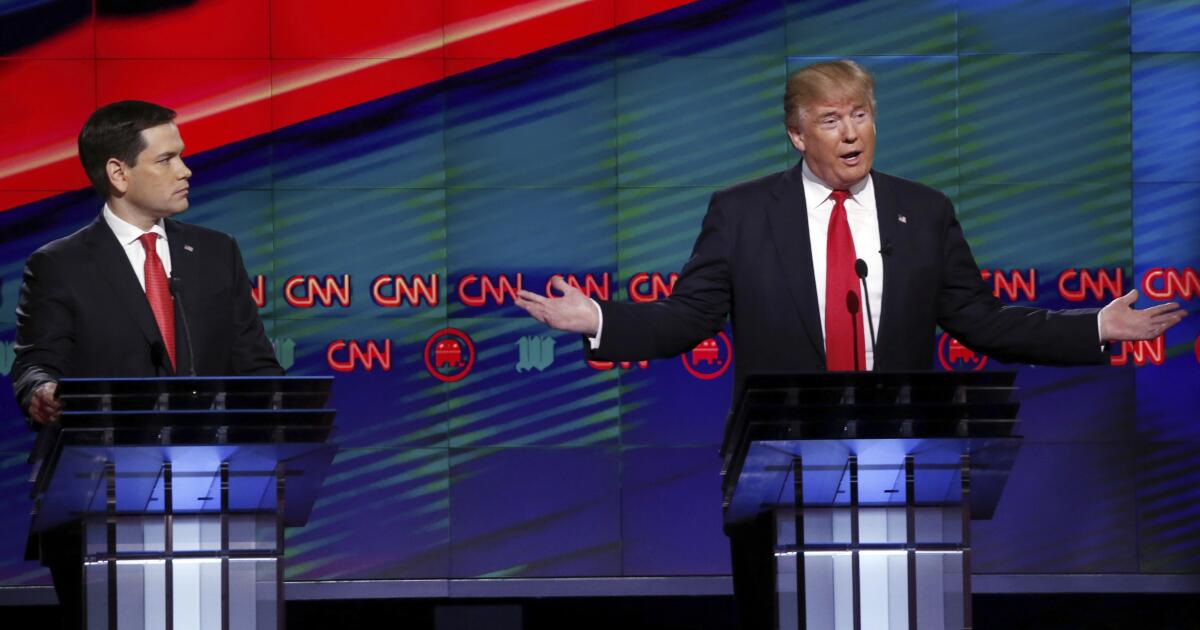
Donald Trump isn’t normally thought of as a consensus-builder, but in one sense that’s exactly what he is. Many of Trump’s most ardent fans and foes alike believe he is the leader of a political movement with a clear and defined set of principles and goals. They disagree only on whether that agenda is good or bad.
The tendency to cast Trump as a tool of the ideological right serves the purposes of both sides. The right needs to believe Trump is a warrior for its causes to justify its support for him, and the left wants to believe the same to justify its opposition.
I’ll concede that this is not an outlandish view. It’s certainly how he ran in 2016, when he promised in many respects to be an instrument of the Republican base’s will. He even quite brilliantly agreed to a list of potential Supreme Court appointments compiled by the Heritage Foundation and the Federalist Society to reassure skeptical conservatives that he would be their servant. And since he left office, Trump has frequently told right-wing groups that he remains their loyal champion. So maybe you can’t blame people for believing him.
Or maybe you can. While the notion that Trump is an ideological conservative isn’t outlandish, it is outdated. It’s certainly true that if Trump is reelected, he will do things that please the GOP and conservatives. But let’s not get the causality backward: His supporters will like what he does — and his enemies will hate it — because Trump did it. They’ll look up the arguments later.
Right-wing apologists’ attempt to construct an intellectually consistent Trumpism is one of the oldest stories of the Trump era. And time and again, Trump has beclowned them for it.
Consider the recent humiliation of Kevin Roberts, the Heritage Foundation’s president. Roberts has worked tirelessly to turn the storied think tank into the ideological avant-garde of Trumpism. Along with a who’s-who of former Trump administration officials and conservative groups, he launched Project 2025 as both a playbook for another Trump term and a how-to manual for the true believers the group is screening to staff the administration.
Appearing on MAGA goon Steve Bannon’s “War Room” podcast last week, Roberts told a guest host (Bannon being busy serving a stint in federal prison) that he is leading a “second American revolution” that will “remain bloodless if the left allows it to be.” This typically dopey radical posturing invited a wave of legitimate criticism, annoying Trump.
“I know nothing about Project 2025,” the former president declared on Truth Social. “I have no idea who is behind it. I disagree with some of the things they’re saying and some of the things they’re saying are absolutely ridiculous and abysmal. Anything they do, I wish them luck, but I have nothing to do with them.”
Never mind that this is a demonstrably audacious lie: Project 2025 has enough ties to Trump that it might as well rent space at Mar-a-Lago. The point is that Trump rewarded Roberts for his efforts by publicly disavowing them.
Or consider the Trump campaign’s success in softening the GOP platform’s position on abortion. For years, dedicated opponents of abortion rights rationalized their support for Trump with the conviction that he would champion their cause. Their gamble paid off with the Supreme Court’s overturning of Roe vs. Wade. But now abortion is a political problem for Trump, so he has changed his position again. The onetime proponent of punishing women who obtain abortions and banning the procedure across the country says that the issue should be left entirely to the states and that the abortion pill mifepristone should remain legal nationwide.
The leading contenders to serve as Trump’s running mate responded by changing their positions too. “I think our platform has to reflect our nominee,” longtime antiabortion Sen. Marco Rubio of Florida explained over the weekend. It’s a tactically defensible position, but it illuminates the absurdity of claiming the party supports Trump because he reflects the party. The only platform Trump cares about is whichever one he happens to be standing on.
Trump has always wanted the party to be his pool of Narcissus, reflecting his personal glory and dominance. That’s why he supported candidates who hewed to his lie that the 2020 election was stolen, preferring that the party lose with loyalists than win with truth-tellers. That’s why he no longer cares about the Federalist Society, which produced judges who rejected his false election claims. Oh, and last month, the guy who infamously called for a ban on Muslim immigration said he wants to give every foreign-born graduate of a U.S. college a green card.
The problem with the search for an intellectually serious Trumpism is that Trump has no use for ideas except as expedients of his ambition. The instrumentalism that paved the way for Trump sought to make him the right’s tool. Instead, it made a lot of right-wingers look like tools.


NEWYou can now listen to Fox News articles!
PORTLAND, Maine — Democratic Senate candidate Graham Platner used a profane insult against Sen. John Fetterman during a Sunday town hall in southern Maine, escalating his feud with the Pennsylvania Democrat just two days before Maine’s Senate primary.
The Senate really is a place of, it’s a lot about relationships, and I I don’t want to go down there and simply be nonfunctional,” Platner said in response to a question from a supporter about who he is looking forward to working with in Washington, D.C., if elected in November.
“I mean, as you can all probably tell, we got a lot of criticisms about the way this government functions. But in order for us to make it functional, we’re going to have to do stuff. And you can’t just go down there and be John Fetterman and just and just kind of just sort of be an a–hole.”
Platner added, “He’s said mean things about me, I’m allowed to say that.”
JOHN FETTERMAN ERUPTS OVER ‘CREEPER’ GRAHAM PLATNER, SUGGESTING HE’S A ‘NAZI SYMPATHIZER’
Democratic Maine Senate candidate Graham Platner called Sen. John Fetterman, D-Pa., a profanity during a town hall event in Portland, Maine, on Sunday night. (Graeme Sloan/Getty Images ; Scott Eisen/Getty Images)
Platner and Fetterman have been going after each other in recent days with the Pennsylvania Democratic senator calling out the Maine progressive over his history of inflammatory remarks while challenging him to release messages linked to a Kik account that has become a flashpoint in his campaign.
“This is a guy that had a problem with me, how I dress, but he seemed to have no problem posing in a towel at a disgusting website that consistently had serious problems about that kinds of depravity,” Fetterman, who has faced strong criticism from within his own party over his strident support for Israel, told Fox News host Sean Hannity.
PLATNER STILL HAS ACTIVE ACCOUNT ON ANONYMOUS APP DUBBED ‘PREDATOR’S PARADISE’ AMID CHEATING SCANDAL
The Democrat later challenged Platner to make public messages he allegedly exchanged with women on the platform.
“Let me make a deal. I’ll tell P-Hustle, I’ll wear a suit every day, if he releases all those texts and messages that he’s had… [with] the dozen women,” he continued, referencing Platner’s username on the platform.
Over the weekend, Platner posted on X that “John Fetterman seems to genuinely think that the reason no one likes him is because he refuses to wear a suit.”
“It’s not the hoodie, dude. It’s because you’ve become a stooge for AIPAC and the Republican Party.”
Fox News Digital reached out to Fetterman’s office for comment.
Platner was not asked by the audience, nor did he bring up on his own, the various criticisms he has faced in recent months ranging from a Nazi tattoo, to deleted Reddit posts trashing the military, to sexual messages sent to other women during his marriage, to an explosive New York Times report where an accuser alleged that Platner exhibited “toxic” traits and was physically abusive toward her.
THE GROWING LIST OF CONTROVERSIES THREATENING DEMOCRAT GRAHAM PLATNER’S MAINE SENATE BID
Sen. Bernie Sanders and Democratic Senate candidate Graham Platner stand together during a “Fighting Oligarchy” tour stop at the Collins Center for the Arts on the University of Maine campus in Orono, Maine last weekend. (Joe Raedle/Getty Images)
“I am very much just some random guy from Sullivan, Maine,” Platner told the raucous crowd of supporters shortly before receiving a standing ovation for claiming in November “we are going to beat Susan Collins.”
Platner’s message to voters focused strongly on wealth inequality and painted a picture of a Congress that is beholden to the powerful as opposed to the voters.
“We must understand that we have entered a new phase in the American political story,” Platner said. “We have entered an era that I think looks a lot more like the 1880s or the 1930s or the 1960s than the last 40 years. We have entered an age of a politics of power, and we need to start acting like it.”
Platner, widely believed to be the presumptive Democratic nominee for Senate, heads into a Tuesday night primary election where Democratic Gov. Janet Mills and former senior government official David Costello are on the ballot.
CLICK HERE TO DOWNLOAD THE FOX NEWS APP
If victorious, Platner will square off against incumbent Republican Sen. Susan Collins in November.
Fox News Digital’s Taylor Penley contributed to this report.

BEIRUT — Israel and Iran suspended military attacks on each other on Monday, heeding President Trump’s call to end a flare-up that threatened derail a brittle two-month ceasefire and engulf the Middle East in all-out conflict once again.
Iran’s military said in a statement on Iranian state media that it had “delivered a painful response” to Israel’s attacks on Lebanon.
“Accordingly, the operations of the armed forces are hereby halted,” the statement said. But it added that “if the aggressions and evils continue, including in southern Lebanon, much more severe and crushing measures will be on the way.”
Israel too signaled it would cease attacks on Iran, according to an unnamed Israeli official quoted in Israeli media, who said the decision came at the behest of Trump. Still, the official said Israel would continue fighting in south Lebanon.
The tit-for-tat attacks, which involved at least 30 ballistic missiles launched on Israel and dozens of Israeli airstrikes on Iran, threatened to widen the scope of a conflict that has already killed and wounded thousands, displaced more than a million people and rattled economies across the globe.
“Israel and Iran must immediately stop ‘shooting.’ ” wrote Trump early Monday on his social media platform, Truth Social.
Later, he wrote, “Both sides, Israel and Iran, are looking to do an immediate CEASEFIRE!”
“Final negotiations on ‘Peace’ are proceeding, subject to ignorance or stupidity getting in its way. The Blockade will remain in place, and in full force and effect, until a ‘Final Deal’ is reached. Things should move quickly.”
Yet it appears likely Iran and Israel will again be on a collision course over Lebanon.
Later on Monday, Israeli Defense Minister Israel Katz said in a statement the Israeli military will continue attacking in Lebanon, including Beirut, if Hezbollah, an Iran-supported paramilitary faction and political party, attacked northern Israel.
Over the last two months of the ceasefire, Trump repeatedly claimed he was on the verge of signing a deal with Iran, despite repeated confrontations that underscored the fragility of the truce.
The latest escalation came after Israel attacked the suburbs of Lebanon’s capital Beirut on Sunday in what it said was a targeted strike against Hezbollah.
In recent days, Iran conditioned a ceasefire agreement with Israel and the U.S. on a cessation of hostilities across all fronts, including Lebanon, threatening it would respond to any Israeli action on the Lebanese capital. Israel rejects linking both battlefields, and insists on having a free hand to attack Hezbollah.
A number of U.S.-brokered ceasefires between the Lebanese and Israeli governments — but without Hezbollah involvement — failed to stop most of the fighting, with Israeli warplanes pounding wide swaths of Lebanon’s south while Hezbollah launched drones and missiles on northern Israel. Nevertheless, the Lebanese government has rejected being included in Iran’s negotiations with the U.S.
By Sunday night, Iran’s threats came to pass with several waves of Iranian ballistic missiles, which caused no injuries and were the first Tehran had fired at Israel since a ceasefire took hold in April. Iran’s military said the fusillade was a warning. But Israel said it would retaliate.
Trump initially downplayed the Iranian attack on Sunday, saying in an interview with the Financial Times that Iran’s barrage was “not going to have any impact on the deal” and telling the Axios news site that he would talk to Israeli Prime Minister Benjamin Netanyahu to halt any Israeli response.
“He won’t have any choice,” Trump said in a phone interview with the Financial Times, referring to Netanyahu having to accept any deal the U.S. negotiates with Iran.
“I call the shots. I call all the shots. He doesn’t call the shots,” Trump said.
Yet by the early morning on Monday, dozens of Israeli warplanes were striking western and central Iran. They hit a petrochemical complex in Mahshahr in southwestern Iran, and waged extensive strikes on “strategic defense systems,” according to Israeli military statements, in what observers said was a prelude to a wider offensive. Residents in Tehran, Isfahan, Tabriz and Shiraz reported powerful explosions.
The Israeli military said in a statement it expected several days of fighting with Iran but was prepared for a prolonged campaign. It said the strikes on Iran were conducted by Israel on its own, but that they had been done in “full coordination” with U.S. Central Command, which also helped in intercepting Iranian missiles launched at Israel.
But that distinction appeared to matter little to Iran’s foreign ministry spokesperson, Esmail Baghaei, who said in a press conference on Monday that the U.S held direct responsibility for recent ceasefire violations and Israel’s action “cannot be looked at in isolation from the U.S.”
“No one believes the Israeli regime would take any action without coordination with the United States,” he said.
“The U.S. bears responsibility for the Israeli regime’s aggression, and it will also be responsible for the consequences of any escalation in tensions.”
Iran launched additional barrages throughout Monday, targeting Israeli airbases in Nevatim and Tel Nof and a petrochemical plant in Haifa, according to a statement from Iran’s Revolutionary Guard Corps. It added Israel was engaging in “a dangerous game by targeting civilian and oil infrastructure — a game that will now encompass all regional energy targets, with global economic consequences resting on America.”
The renewed hostilities also saw Yemen’s Houthis — who receive support from Iran and Hezbollah, and are part of a regional network of Iran-backed factions called the “Axis of Resistance” — enter the fray with a pair of ballistic missiles lobbed at Israel. The Israeli military said one of the missiles was intercepted; the second fell short of Israel.
Houthi spokesman Brig. Gen. Yahya Sarea confirmed the attack in a televised statement on Monday, and said Israeli maritime navigation in the Red Sea would be targeted.
During the Gaza war, the Houthis attacked commercial shipping in the Red Sea — including ships with no link to Israel — to pressure Israel into lifting its blockade on the enclave.
But, unlike Hezbollah, which attacked Israel on March 2, three days after the U.S. and Israeli campaign on Iran, the Houthis had refrained from helping their ally, until Monday.
Their involvement now raises the specter of another squeeze on energy markets already beleaguered by closures on the Strait of Hormuz and which have relied on the Red Sea as an alternative passageway for energy supplies, especially for those from Saudi Arabia.
If the Houthis closed the Bab Al-Mandab Strait, it would all but paralyze commercial flows.
Oil prices spiked in the wake of the exchanges, with Brent Crude rising 5% to hit $98 a barrel, before deflating once more.
Monday’s strikes are the most serious breakdown in a ceasefire marred by repeated fighting between Israel and Hezbollah, and clashes between the U.S. and Iran. But up until Sunday there was no direct confrontations between Israel and Iran since the ceasefire took hold.
In recent weeks, Lebanon proved to be a particularly sensitive flashpoint, with Israel continuing attacks in southern Lebanon and its ground troops systematically razing towns and villages. At Trump’s urging, Beirut remained out of bounds, but Israeli military leaders said they would hit the capital if Hezbollah attacked northern Israel.
But that equation proved untenable for Iran.
“Iran’s attack in defense of Lebanon was not merely a military response; rather, it was the formal declaration of a strategic doctrine,” said Sadegh Larijani, who chairs Iran’s Expediency Council, an advisory body to the Iranian Supreme Leader.
Referring to attack Iran launched Sunday, he said, “This action sent a clear message that if one of the sides of the axis of resistance is attacked, it will result in a response beyond geographical borders and will change the equations of the region.”
In Israel, the drawdown of hostilities places additional pressure on Netanyahu, whose political base has repeatedly excoriated him as not doing enough to combat Hezbollah while being too weak to stand up to Trump. Many in Israel view a peace deal without regime change in Iran as a strategic failure; one that is likely to restrain Israel’s ability to attack Hezbollah.
That he launched strikes on Iran in defiance of Trump may win him points ahead of an uphill election fight. Yet it is unlikely to endear him to Trump, who recently scolded Netanyahu during a phone call last week and called him “crazy.”
Politics
Raman overtakes Spencer Pratt in razor-thin race, AP count shows, but race remains uncalled

NEWYou can now listen to Fox News articles!
Los Angeles City Council member Nithya Raman has overtaken reality television star Spencer Pratt in the latest Associated Press vote count, although the outlet has not called the race.
Pratt, a Republican, had led earlier in the day, but the latest tally now shows Raman, a Democrat, ahead by more than 3,000 votes, or about 0.4 percentage points, in the officially nonpartisan mayoral race.
Incumbent Mayor Karen Bass, a Democrat, has already advanced to a runoff as she seeks a second term. She is now waiting for the candidate she will face in the runoff, as AP has not yet called a second candidate to advance.
CALIFORNIA’S SLUGGISH VOTE COUNTING RIPPED ACROSS THE POLITICAL SPECTRUM: ‘EXTREMELY EMBARRASSING’
Los Angeles City Council member Nithya Raman has overtaken reality television star Spencer Pratt in the latest Associated Press vote count. (HIGHFIVE/Bauer-Griffin/GC Images; Myung J. Chun / Los Angeles Times via Getty Images)
In Los Angeles’ nonpartisan mayoral election, if no candidate wins a majority in the primary, the top two vote-getters advance to the November runoff.
Los Angeles County continues to count ballots postmarked on or before Election Day and received by June 9, drawing the attention of the Republican National Committee. County officials must complete final official results by July 2, and the secretary of state will certify results by July 10.
California’s vote count often extends beyond Election Day because every active registered voter receives a mail ballot, ballots postmarked by Election Day may arrive up to seven days later, and election workers must verify signatures and process late-arriving ballots.
WATCH: LEFT-WING LA MAYOR FACES REALITY TV CHALLENGER’S BLUNT TAKEDOWNS IN HEATED MAYORAL DEBATE
Spencer Pratt was leading earlier in the day. (Gilbert Flores / Getty Images)
“The California primary ended on June 2, 2026; yet California is still counting ballots,” the RNC website tracker counting the seconds since polls closed reads.
“The state’s election system is a complete joke. The RNC is tracking every hour it takes California to finish the count,” it added.
Pratt and other Republicans have decried the ongoing ballot count in the race. Election officials and voting experts have said California’s extended count is largely driven by state mail ballot rules, signature verification and the processing of late-arriving ballots.
Incumbent Mayor Karen Bass, a Democrat, has already advanced to a runoff. (Louise Barnsley/Splash for Fox News Digital)
CLICK HERE TO DOWNLOAD THE FOX NEWS APP
“The question to the rest of the world is what happened to California elections? Well, I’ll tell you, it’s Gavin Newsom,” McCarthy told Fox News’ “Sunday Morning Futures.” “When Gavin Newsom was elected governor of California, you knew who was elected in a day to two days. Now it takes more than weeks, almost a month.”
“Why did we get here?” McCarthy continued. “Gavin changed a number of election laws in which you want to see is what did he do and why did he cause it?”
Fox News’ Eric Mack contributed to this report.
-

 Detroit, MI4 minutes ago
14-year-old boy shot in chest during Detroit teen takeover testifies in court
-

 San Francisco, CA12 minutes ago
OpenAI confidentially files for IPO, signaling major public debut for SF AI company
-

 Dallas, TX19 minutes ago
Defense rests in Karmelo Anthony trial
-

 Miami, FL22 minutes ago
New inductees to the Miami-Dade County Women’s Hall of Fame | Featured#
-

 Boston, MA27 minutes ago
Boston high school student in STEM aviation program flies plane for first time
-

 Denver, CO34 minutes ago
Photos: Hail larger than a quarter in Denver area Monday afternoon
-

 Seattle, WA37 minutes ago
Safety forces say they’re ready for World Cup in one week
-
 San Diego, CA42 minutes ago
University of California pushes for $12B scientific research bond to counter federal cuts

