Politics
Column: We hold these truths to be self-evident — the Golden State is still golden. And yes, we are Americans

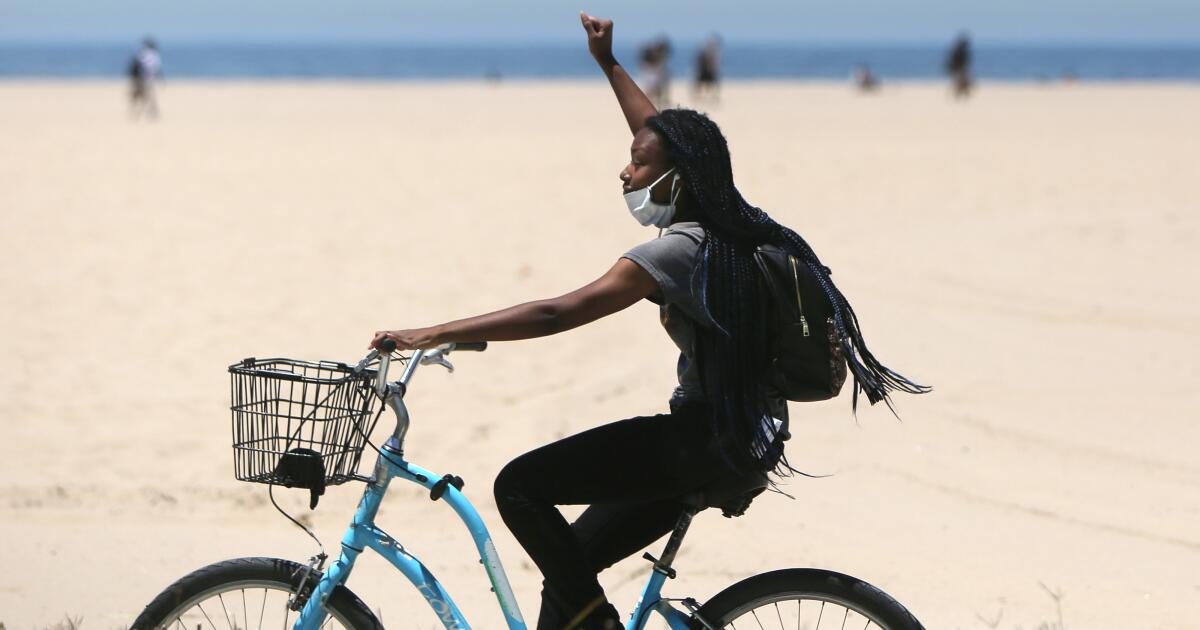
California has been a beacon, a destination, a paradise and promised land ever since its headlong expansion in a rush of gold fever.
It’s also been a perennial source of envy, mockery and contempt.
That naysaying has gained much greater currency in recent years as California’s population has contracted for the first time in more than a century.
The “exodus” has become an industry, stoking real estate markets from Nevada to Tennessee, fanning the red-versus-blue political flames and launching a thousand what-went-wrong analyses.
The latest insult — or bracing reality check? — came last week in a Los Angeles Times poll that found 50% of adults nationwide believe California is in decline. (Bummer, man.)
Nearly half the Republicans surveyed said the state is “not really American.” Whatever that means.
L.A. Times columnists Mark Z. Barabak (a proud California native) and Anita Chabria (a happy Ohio transplant) discuss the poll, the hating by haters and the state of their troubled but still much-loved state.
Barabak: So first off, Anita, are you OK? You haven’t choked to death on the noxious air pollution, or been run over by some smash-and-grab robber making a getaway through your pothole-filled neighborhood?
Chabria: To paraphrase Mark Twain, reports of our death are greatly exaggerated — again. The Golden State remains alive, kicking and, dare I say it, a thriving part of the United States.
But I am troubled that nearly 30% of respondents agreed with the statement that California is “not really American.” Nearly half of Republicans thought that, which is less shocking. But inexplicably, 21% of Californians did, too. That’s more than just the Fox crowd regurgitating the right-wing narrative of California as the spawning ground of social evils.
People, we joined the union in 1850 — ahead of Kansas, West Virginia and Nebraska to name a few. We’ve been American longer than many of the so-called heartland states. I’ve been puzzled for days over whether a third of America is terrible at geography, or history — or if they think it’s some sort of dig at California.
What do you think, Mark? Are we in fact not American in some fundamental way I don’t understand?
Barabak: I suppose it depends how you define American.
If you’re talking about a certain kind of America — one that is overwhelmingly white and conservative in its social, political and cultural values — than, no, California fails to measure up to that, er, standard.
We’ve been a majority-minority state now for more than a generation. Politically, the state has leaned strongly Democratic for decades, after supporting Republicans for much of our history.
Culturally, we’ve always tended toward broadmindedness — or being overly permissive, in the eyes of critics. Fresh starts and reinvention have been a lure since the first gold seekers — the ones digging actual nuggets — flocked here from the more straitened and class-conscious East Coast.
As you suggest, it’s not just Fox News. There are plenty of alienated Californians — the state has more than 5 million registered Republicans, which exceeds the population of many states — who feel overlooked in Sacramento and looked down upon by the supposed sophisticates in San Francisco and Los Angeles. That probably accounts for the 21% that had you scratching your head.
But to be clear, a lot of folks interviewed in the poll are obviously viewing California through a partisan lens. Or, perhaps it should be said, while wearing a thick set of blinders.
I mean, 3 in 10 Republicans said the state has a worse natural environment than other states. Really? Go shout that from the top of Yosemite Falls. Or in Santa Barbara at sunset. Or on a sunny winter day in Joshua Tree National Park, as folks in the Midwest thaw their snow shovels so they can dig their cars out of the drifts.
That said, we’ve got plenty of problems, no?
Chabria: Every place does and, of course, we are no exception.
The survey highlighted one problem most of us agree on: The cost of living in California is too high. More than 80% of California residents felt that way, and it’s no shock.
I’d venture to guess that has a lot to do with the price of housing. People can’t afford rent, which leads to a whole host of other problems — including older people being forced into homelessness.
I genuinely believe that California’s future depends on finding a way to build massive amounts of new housing, not just a few units here and there. We need the mental health beds promised by Proposition 1 on the March ballot and to find ways to create more affordable homes for the broad swath of middle-class Californians.
And that’s just for starters.
But the survey also pointed out that the majority of Californians, including myself, are happy living here.
So the Huntington Beach City Council can rant all they want, and the haters can hate. California will always stand for diversity, freedom and tolerance — all values that sadly seem to be growing scarcer east of the Sierra.
Where do you see the bright spots, Mark?
Barabak: Apart from its unsurpassed physical beauty, California is still a place that attracts innovators and entrepreneurs. It’s still a harbor for the politically persecuted and those who feel unwanted or unwelcome living elsewhere as their genuine selves.
Yes, our sales and income taxes are high compared to some other places. Housing, as you suggested, is obscenely expensive and we desperately need more of it.
But check out life in other cheaper, supposedly better places. Look into the cost of insurance in Florida. Get nickel and dimed every few miles on toll roads back East. Sweat your way through a summer in Texas and hope the power grid — and your air conditioning — doesn’t go out.
Sure, our government regulates with a heavier hand than elsewhere, and it’s not hard to find examples of excess. But isn’t it nice, for instance, to breathe clean air and be spared the teary eyes and clenched chest that smog-suffocated folks in Southern California experienced not so many decades ago?
Speaking of seeing through the gloom, here’s one heartening finding in that otherwise dismal poll: The attitude of young people.
Seven in 10 of those ages 18-34 see California as a trendsetter and, at 43% of respondents, were twice as likely as other Americans to say they would consider moving to the state. They believe California’s future is bright. Me, too.
I’ve moved around a lot, including the obligatory stint — for a political hack like me — in Washington, D.C. I thought I’d spent my career covering our nation’s capital, but lasted just seven years. Like Dorothy, who went all the way to Oz to know she really wanted to be in Kansas, California tugged at me the whole time I was away.
For all the state’s difficulties — or challenges, if you prefer — I can’t imagine ever living any place else. California resides deep in my heart.
How about you?
Chabria: I love California.
As a mixed-race woman with mixed-race kids, I value its tolerance and diversity. I value its willingness to fight and lead at this critical time when democracy is fragile. I value that it’s truly a live-and-let-live kind of place, even when people don’t agree.
To me, the poll results say less about life in California than the sad effectiveness of right-wing political propaganda and the power of fearmongering over truth. MAGA needs California to be a villain, to represent the supposed failures of the Democratic Party, especially around crime and immigration, and reality be damned.
If no one else wants them, we’ll take the tired and poor, the huddled masses. California always has and always will embody the American dream, that each of us matters and each of us belongs.
That respect for equity and equality is what makes us the Golden State.


Gov. Gavin Newsom has signed off on a 100% state tax on money any Californians receive from Trump’s $1.8-billion “anti-weaponization” fund for his political allies.
Newsom unveiled his proposal in May, after Trump’s Justice Department said it would create a fund to compensate Trump’s allies who claim they have “suffered weaponization and lawfare” under Biden’s Justice Department.
The settlement fund was criticized by politicians on both sides of the aisle, including Sen. Mitch McConnell (R-Ky.), who described it as a “slush fund to pay people who assault cops.”
The fund remains in legal limbo. Earlier this month, a federal judge in Virginia extended a court-ordered block on the plan, which critics warned could be used to pay pardoned Jan. 6 rioters.
Fast-tracked into law as part of Senate Bill 122, Newsom’s plan imposes “a tax on any settlement fund payment from the federal Anti-Weaponization Fund, or any subsequent fund, settlement, or agreement, as provided, at a rate of 100%,” according to the bill text. The tax applies to all tax years between 2026 and 2030.
Newsom signed the bill Tuesday. In a statement, his office said the tax is meant to ensure that, should Trump’s fund proceed, California recipients won’t “receive favorable state treatment on those payments.”
“We believe democracy is worth defending, the rule of law matters, and public dollars should support victims—not those who attacked the very institutions that protect our freedoms,” Newsom said in the statement.
University of Southern California law professor Ariel Jurow Kleiman, an expert on tax law and policy, said that while Newsom’s tax is a “novel legal strategy,” she believes there is “no categorical legal restriction” preventing California from implementing it.
States have a “wide degree of discretion” to design their tax systems — including how they define income — so long as they do not violate their constitutions, Jurow Kleiman said.
If a California resident wanted to challenge the tax in court, they would need to show they were harmed by it to have standing to sue, according to Jurow Kleiman. That would mean receiving a payment from Trump’s settlement fund and then paying the 100% California tax. Unless the settlement fund is established and distributes payments, that scenario is unlikely.
While there have been proposals to levy a 100% tax on income above certain thresholds — Sen. Bernie Sanders (I-Vt.) in 2023 said he supports a 100% tax on income exceeding $1 billion — Jurow Kleiman said she is not aware of any governments that have adopted such a policy.

NEWYou can now listen to Fox News articles!
The House has officially shipped a colossal bipartisan housing package to President Donald Trump, and lawmakers are hoping that, at the very least, he doesn’t veto it.
Trump was supposed to sign the 21st Century ROAD to Housing Act last week, but his last-minute decision to ghost the signing ceremony with House Speaker Mike Johnson, R-La., and Senate Majority Leader John Thune, R-S.D., put into question whether the bill was dead.
His refusal to sign the bill, which passed with overwhelmingly bipartisan support in both chambers, was to leverage the Safeguarding American Voter Eligibility (SAVE) America Act, which doesn’t currently have the votes to succeed in the Senate.
WARREN TELLS TRUMP TO ‘SIGN THE DAMN BILL’ AS BIPARTISAN HOUSING PACKAGE REMAINS STALLED IN WASHINGTON
Trump has refused to sign the 21st Century ROAD to Housing Act. (Shawn Thew/EPA/Bloomberg via Getty Images)
Trump appears to be in no hurry to sign the bill, despite Republicans who are hungry for a win in the affordability fight ahead of the midterm elections.
“It’s so unimportant … compared to the SAVE America Act,” Trump told reporters in the Oval Office on Monday. “I think the SAVE America Act is exactly what it says. It’s saving America from crooked elections.”
“Here’s what I would like to sign, much more than a bill that — big deal, it’s a yawn,” he continued. “Some people say it’s wonderful. To me, compared to the SAVE America Act, just about everything is a big yawn.”
GOP INFIGHTING OVER TRUMP’S VOTER ID BILL ERUPTS AS TOP SENATOR CALLS STRATEGY ‘FANTASY’
It’s legislation that is loaded with nearly 60 provisions from both sides of the aisle in both chambers that’s designed to make it easier for homes to be built and for younger Americans to buy their first home. It also includes a ban on hedge funds buying up housing stock that Trump pushed Congress to include during the State of the Union earlier this year.
Sen. Elizabeth Warren, D-Mass., one of the architects behind the bill in the upper chamber alongside Sen. Tim Scott, R-S.C., charged that Congress handed the bill to Trump “on a silver platter.”
“When you ask me what happens next, if he cared about the American people, he’d have already signed the damned thing, and we’d be underway,” Warren said on WCVB’s “On the Record” on Sunday.
But Trump doesn’t have to put his signature on the bill for it to become law.
IRATE REPUBLICANS ACCUSE TRUMP OF HANDING DEMOCRATS A WIN AFTER BLOWING UP HOUSING PACKAGE
The Senate advanced a massive, Trump-backed housing package geared toward lowering the costs of homes and supercharging the housing supply. Sen. Elizabeth Warren, D-Mass., pitched it as legislation to prevent America from becoming a “nation of renters.” (Jemal Countess/Getty Images for Protect Borrowers; Anna Moneymaker/Getty Images)
The Constitution grants presidents the ability to veto a bill within 10 days of it being transferred over to the White House. In that scenario, Congress could override a veto of the housing package.
It’s happened before under the Trump administration. In early 2021, Congress overrode Trump’s veto of the annual National Defense Authorization Act — a massive Pentagon funding authorization package that some House Republicans are trying to use as a vehicle to pass the SAVE America Act.
But during that 10-day period, if Trump doesn’t sign the bill, it would automatically become law. That’s unless Congress completely adjourns, in which case a “pocket veto” could happen. The Senate is currently in recess and the House is scheduled to leave town by week’s end, but neither count as a full adjournment.
CLICK HERE TO DOWNLOAD THE FOX NEWS APP
Johnson, who spent the last few days meeting with Trump at the White House about the housing bill and the SAVE America Act, said: “I hope he does sign it.”
“If he doesn’t, it’s still law,” Johnson said. “We’ll still celebrate it, but he’s trying to make a point, and I think he’s making it very effectively. And the fact that you all ask me every three steps down the hallway illustrates that he has achieved the desired objective, and that is to make SAVE America the number one thing, because if we don’t get that right, everybody’s concerned about what happens next.”
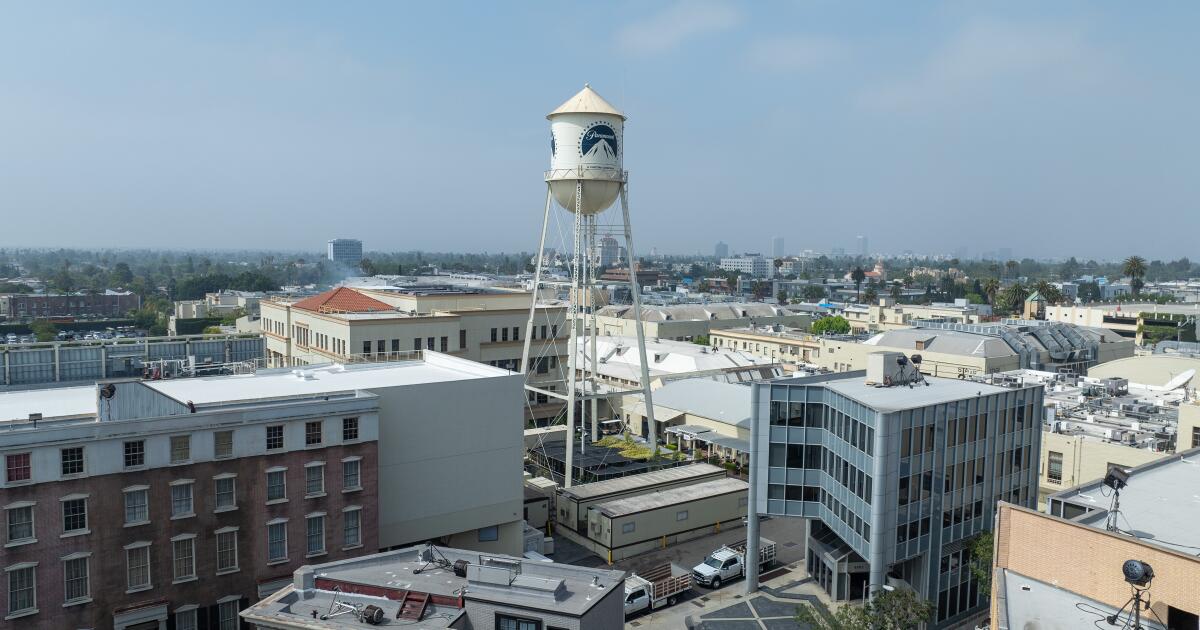
Britain’s culture minister may challenge Paramount Skydance’s takeover of Warner Bros. Discovery — presenting a potential speed-bump to David Ellison’s plan to wrap up his $111-billion deal by September.
Earlier this month, Paramount secured the U.S. Justice Department’s blessing to buy the Warner assets, which include CNN, HBO, Cartoon Network, Animal Planet and the Warner Bros. film and TV studios in Burbank.
Paramount also must win the approval of British and European regulators, who are known for drilling deeply into media matters because of their influence on society.
Britain’s Competition and Markets Authority took a preliminary step this month by opening an investigation into Ellison’s proposed merger.
On Tuesday, Lisa Nandy, Britain’s Secretary of State for Culture, Media and Sport, notified Parliament that she was inclined to intervene in the blockbuster deal.
In a written statement, Nandy cited her ability to weigh in on “public interest grounds,” due to concerns about maintaining a competitive media market in Britain.
“The UK’s move to intervene in the Paramount–WBD deal confirms what we’ve been saying for months. The real regulatory risk was never in the US — it’s in Europe,” Forrester VP Research Director Mike Proulx said Tuesday in a statement.
While Nandy cautioned she has not made “a final decision on intervention at this stage,” she has invited Paramount and Warner Bros. to respond to her concerns by July 6.
June 2026 photo of Culture, Media and Sport Secretary Lisa Nandy arriving at Downing Street for the weekly Government cabinet meeting in London.
(Alishia Abodunde/Getty Images)
Paramount did not offer immediate comment.
The company owns CBS News, children’s channel Nickelodeon and Channel 5, one of the largest over-the-air television broadcasters in the United Kingdom.
Warner Bros. Discovery owns CNN, Cartoon Network and TNT Sports, which broadcasts the Olympics, Champions League and Premier League soccer matches.
“I am conscious that the proposed acquisition is global in nature,” Nandy wrote in her statement. “In reaching this decision, my focus has been, and will remain, on the UK public interest and the range of services available to UK audiences, including Channel 5, TNT Sports, Cartoon Network, Nickelodeon, and CNN International, as well as Paramount+ and HBO Max.”
If Nandy decides to intervene, the Office of Communications, known as Ofcom, would launch an assessment of the deal. Britain’s Competition and Markets Authority also would determine how the merger might reshape the competitive landscape.
Teams from the two companies have been huddling for months to plan for the melding of the two operations as soon as Paramount receives all of its regulatory approvals.
Australia, New Zealand, China, Saudi Arabia, Ukraine, Serbia, France and Italy have already given their approvals to the deal.
Saudi Arabia’s Public Investment Fund is planning to contribute $10 billion to help the billionaire Ellison family pull off the merger, which would make the Saudi royal family a significant, although passive, equity owner. In addition, the royal families of Qatar and Abu Dhabi have agreed to each contribute $7 billion in equity financing.
The Federal Communications Commission must evaluate the foreign ownership stakes due to Paramount’s holding of CBS broadcast licenses. U.S. antitrust regulators already have concluded the combination would not violate federal anticompetition laws.
Approval had been expected because President Trump — who has friendly ties with Ellison and his father, tech billionaire Larry Ellison — favors the deal.
Trump has been eager for changes at CNN.
The U.S. government stopped short of asking Paramount to make concessions or divestitures. Many expect that Paramount may have to reconfigure its children’s television holdings abroad due to the proposed combination of two large players — Nickelodeon and Cartoon Network.
Nandy suggested that Britain also should scrutinize the impact of combining two major streaming services HBO Max, a Warner property, with Paramount+.
HBO programming, including “Game of Thrones,” “Boardwalk Empire,” and “Succession,” has long been popular in Britain.
A coalition of state attorneys general, led by California Atty. Gen. Rob Bonta, also is expected to challenge the deal, in part, due to concerns about news media consolidation. Bonta’s office has said the matter remains under review.
Opposition to the deal has been building in the U.S. for months. A group of Hollywood activists — led by actors Jane Fonda and Mark Ruffalo — have spearheaded a “block the merger” campaign that now has support from more than 5,000 entertainment workers.
The group’s open letter calls on Bonta to take action to thwart the Ellison expansion effort. Paramount’s Chief Legal Officer Makan Delrahim has blasted the campaign, calling it “fear-mongering” and a partisan distortion of antitrust law.
Forrester’s Proulx noted differences in attitudes toward the deal among the various constituencies.
“For US consumers, this merger has become a proxy fight about political influence and control of media,” Proulx said. “In the UK, it’s being treated as a structural competition issue where regulators, not consumers, will decide how this deal plays out and how long it takes.”
-
 Business4 minutes ago
Disneyland to offer $59 evening tickets next month
-
 Entertainment7 minutes ago
After Amazon drops OpenAI movie ‘Artificial,’ film finds new home at Neon
-

 Lifestyle12 minutes ago
ICICLE: Capturing Interest in Chinese Brands
-
Politics19 minutes ago
Newsom signs off on 100% California tax for money from Trump’s $1.8-billion ‘slush fund’
-
 Science21 minutes ago
After bold pledge, EPA shelves microplastics testing in U.S. drinking water
-
 Sports27 minutes ago
Walter Alston, Dave Roberts and everyone in between: The 10 managers in L.A. Dodgers history
-

 World37 minutes ago
World’s oceans experience hottest June ever, scientists say more heat ahead
-
 News1 hour ago
What the Supreme Court did on the final day of its term

