Politics
Column: Trump's hush-money criminal trial could be a cure for 'Trump amnesia'

Before Donald Trump’s hush-money trial in New York got underway, pundits predicted that the proceedings could be a media bonanza for the former president. During this year’s Republican primaries, they noted, Trump’s popularity rose every time he was indicted.
But so far, the trial, on charges that Trump covered up illicit payments to an adult filmmaker and actor to influence the 2016 election, hasn’t made him look like much of a hero.
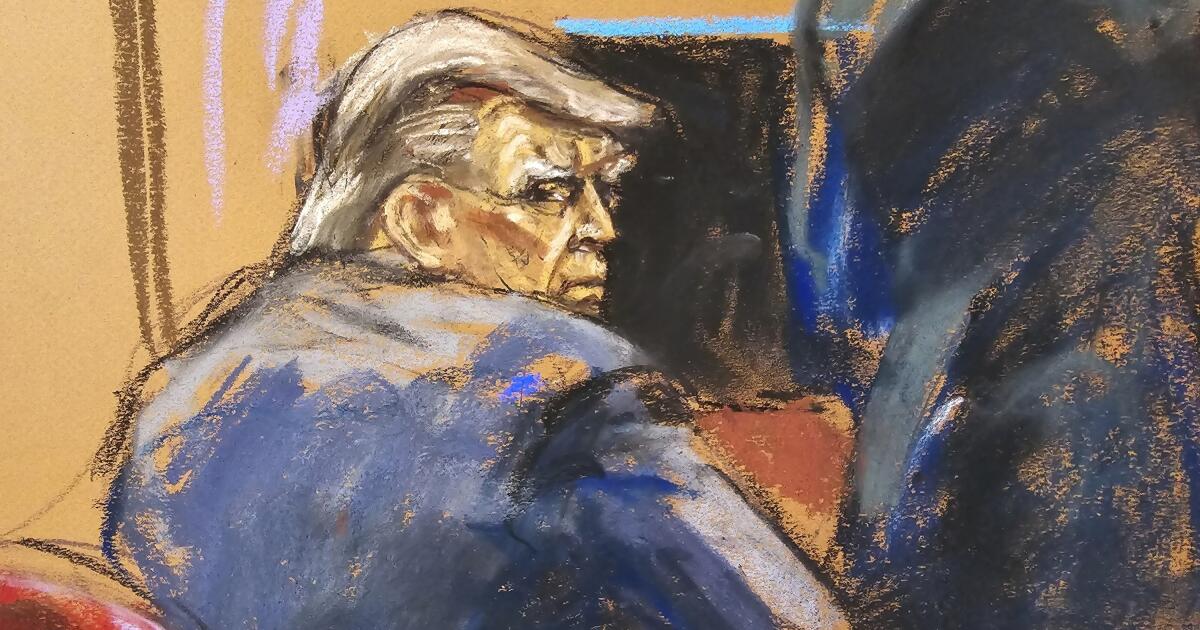
Former President Trump sits in court during the second day of jury selection in his criminal hush-money trial in Manhattan criminal court.
(Christine Cornell / Associated Press)
He’s appeared to fall asleep in the courtroom more than once. He’s grumbled at potential jurors. He’s been reprimanded by the judge. He looks more like an desperately unhappy defendant than a potential commander in chief.
And it’s likely to get worse. Over the next six weeks, the trial may include testimony from Stormy Daniels, the porn performer with whom Trump allegedly had a one-night stand, and Karen McDougal, a former Playboy model who accepted money to conceal another alleged affair.
The tawdry details will produce plenty of tabloid drama — but not the kind Trump reveled in when he was a young, publicity-hungry mogul. (Trump has denied having affairs with the women.)
More important, the trial might begin to cure voters of the affliction known as “Trump amnesia” — the tendency to forget all the reasons they voted against the presumptive Republican nominee in 2020.
Pollsters and campaign consultants who conduct focus groups, organized discussions with voters, say they run into it all the time.
Celinda Lake, one of President Biden’s pollsters, said she discovered the syndrome when she asked voters how they felt about Trump’s impending trial over the events surrounding the violent Jan. 6, 2021, invasion of the Capitol.
“What court case?” one of the voters asked.
“These were swing voters, and about half of them weren’t sure what we were talking about,” Lake recalled. “And I said, ‘Well, you know, the insurrection, and that he was the one who provoked it.’ They go: ‘Oh, yeah, I kind of forgot about that.’ ”
The reasons for the epidemic of memory loss aren’t mysterious. Trump left office more than three years ago — and for the last two years, voters have been focused on rising prices and mortgage rates, problems they blame on Biden.
When Trump left office in 2021 after his followers sacked the Capitol, the Gallup Poll logged his approval rating at a dismal 34%. By last year, with memories no longer so fresh, voters’ views had softened: 46% said they thought his presidency had been pretty good — a phenomenon some have called “Trump nostalgia.”
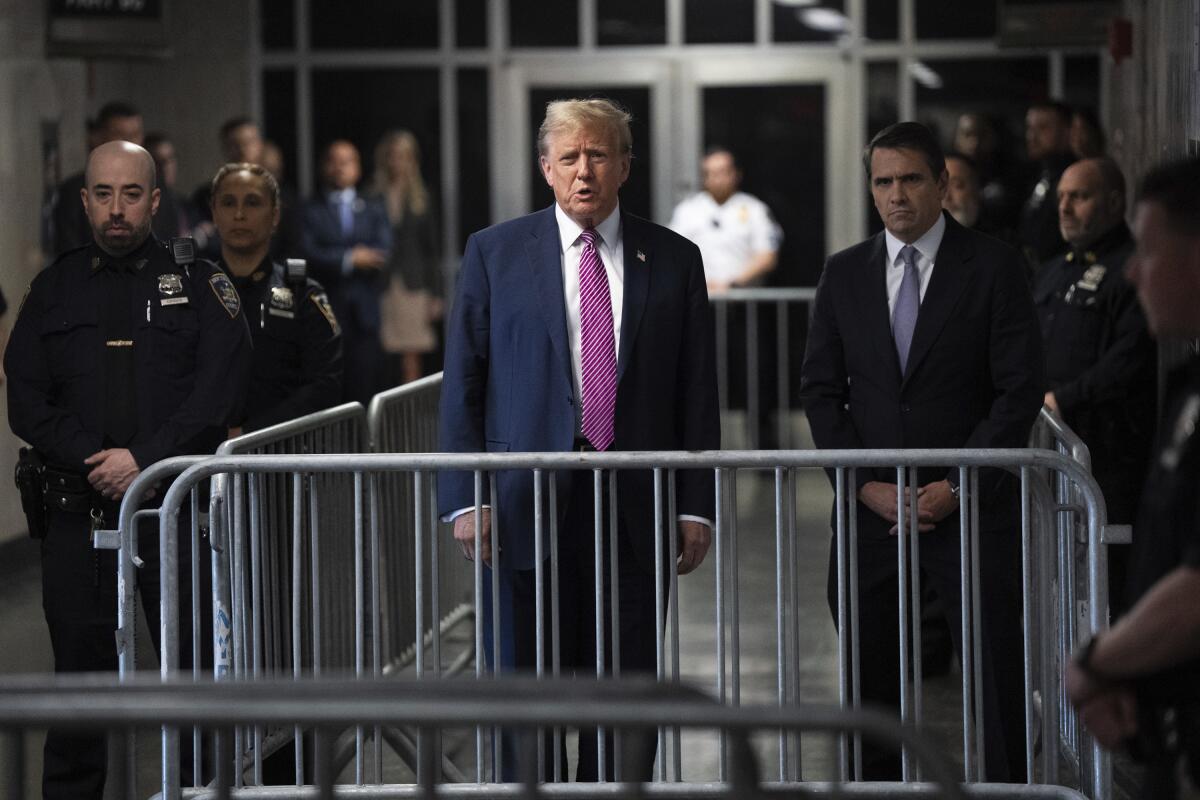
Donald Trump speaks with the media Friday following jury selection in his hush-money criminal trial in Manhattan.
(Maansi Srivastava / Associated Press)
Trump has stoked that trend over the last three years by claiming ceaselessly that he produced “the greatest economy in the history of the world” (it wasn’t) with “no inflation” (also untrue).
Democrats and anti-Trump Republicans hope the trials could dent the former president’s support by changing the focus of news coverage, at least for a time, to his many misdeeds.
Trump is facing four different criminal prosecutions: separate federal and Georgia indictments accusing him of trying to undo the 2020 election, a federal indictment accusing him of illegally holding classified documents, and the New York hush-money case. It’s not certain that any of the other three will reach trial by the election.
If he is convicted in any of the four proceedings, polls suggest that a significant number of voters might well desert him.
A Reuters/Ipsos poll this month reported that 13% of voters who currently favor Trump say they won’t vote for him if he is convicted of a felony.
If even a fraction of those voters carry out their threat, the former president’s apparent lead over Biden could evaporate. In 2020, a vote shift of less than a percentage point in three close-run states would have changed the outcome in the electoral college.
It’s reasonable to ask whether a conviction in the New York case, which legal scholars consider the weakest of the indictments Trump faces, would affect voters’ behavior.
But polls have found that most voters believe the hush-money charges qualify as weighty crimes despite their tawdry origins. In the Reuters/Ipsos poll, 64% of respondents said they consider the New York charges serious, including 40% of Republicans.
Not everyone is convinced.
“I think the Biden campaign is whistling past the graveyard on this,” said Whit Ayres, a veteran Republican pollster who is not working for Trump. “The issue is not whether voters remember Trump’s antics. The issue is that they are accurately remembering the economic differences between the two presidencies.”
All of which is true.
Chances are, the hush-money trial in New York isn’t going to swing the election by itself.
But if Trump is convicted of a felony — especially if he is also convicted in more than one of the four trials he faces — that could change enough votes to make a difference in an election that’s likely to be razor-close.
At the very least, the New York trial isn’t doing Trump any measurable good, despite his daily denunciations of the judge, the prosecutor and the gag order that doesn’t seem to be gagging him.
No wonder he looks so annoyed.


NEWYou can now listen to Fox News articles!
Rep. Diana DeGette, D-Colo., a 30-year incumbent, lost to a Democratic Socialists of America (DSA)-backed challenger in a high-profile primary on Tuesday evening.
Melat Kiros, a 29-year-old socialist, defeated DeGette in a Democratic primary for a deep-blue House seat anchored in Denver, according to The Associated Press, scoring a major victory for the socialist left on Tuesday evening.
The DSA had been aiming to cast DeGette’s loss as evidence of its growing momentum after a slate of socialist candidates won Democratic primaries in New York City last week.
“Today, the East Coast, next week the Mountain West,” the DSA wrote in a social media post last week.
Rep. Diana DeGette speaks during a press conference outside the U.S. Capitol building in Washington, D.C., on Jan. 10, 2024. (Samuel Corum/Getty Images)
SOCIALISTS CHEER ‘SHOCKWAVE’ PRIMARY NIGHT AS DSA-BACKED CANDIDATES WIN, ADVANCE ACROSS THE MAP
If elected in November, Kiros, who was born in Ethiopia, will likely join the ranks of the far-left group known as the Squad and become one of a handful of the House chamber’s outspoken socialists.
The millennial challenger was endorsed by Sen. Bernie Sanders, I-Vt., Rep. Alexandria Ocasio-Cortez, D-N.Y., and the anti-incumbent leftist organization Justice Democrats. Controversial socialist streamer Hasan Piker, who has said Hamas is “a thousand times better” than Israel and praised the Chinese Communist Party, also backed Kiros’ insurgent primary run.
DeGette, a member of the Congressional Progressive Caucus who supports abolishing Immigration and Customs Enforcement (ICE), sought to win a 16th House term by flexing her leftist bona fides. She argued her seniority on an influential House committee would allow her to push for Medicare-for-All legislation — a longtime priority of the party’s far-left flank.
DeGette, who was endorsed by former CPC Chairwoman Pramila Jayapal, D-Wash., also spotlighted her experience as an impeachment manager during Trump’s second impeachment trial in 2021.
Though DeGette and Kiros shared few policy disagreements, they diverged sharply over Israel and antisemitism. Kiros also sharply criticized DeGette for accepting corporate PAC contributions.
Kiros, a PhD student and lawyer, was fired from a New York firm in 2023 after publishing an open letter, arguing that pro-Palestinian student protesters calling for the elimination of Israel were not antisemitic and appearing to defend Hamas.
Melat Kiros participated in a League of Women Voters Congressional District 1 candidate forum at Montview Presbyterian Church in Denver on May 28, 2026. (RJ Sangosti/MediaNews Group/The Denver Post)
WATCH: HOUSE DEMS UNLOAD ON TEXAS DEMOCRAT OVER ‘DEMENTED’ ANTISEMITIC COMMENTS
She has also described the Oct. 7, 2023, attacks against the Jewish state as the “inevitable consequence of apartheid” and declined to characterize the deadly firebombing of protesters in Boulder last year who were urging the release of hostages held by Hamas in Gaza as antisemitic.
“I don’t know what was in the heart of the perpetrator,” Kiros told Colorado’s 9News in a recent television interview. “All I know is that he went and attacked innocent people because of what they might have believed.”
A June 2025 bipartisan resolution condemning the attack as part of a “rise in ideologically motivated attacks on Jewish individuals” won every present lawmaker’s support, except for Reps. Rashida Tlaib, D-Mich., and Thomas Massie, R-Ky., who voted present.
Kiros has also suggested the United States deserved 9/11.
“Inevitable in the sense that we destabilized a lot of the Middle East that forced people to believe that another act of violence was the only response,” Kiros told 9News when asked if she thought the terror attack was “the inevitable consequence of American foreign policy.”
“And again, just like I said before, our responsibility is to get rid of those conditions that lead to violence in the first place,” Kiros continued.
DeGette argued that Kiros’ embrace of Piker and her comments about antisemitism and 9/11 were disqualifying.
“I’m shocked and disgusted that Kiros is doubling down on excusing terrorism and the murder of innocent people,” the 30-year incumbent wrote on Facebook earlier this month.
Streamer and creator Hasan Piker speaks at a press conference during day two of Web Summit Vancouver at the Vancouver Convention Centre in Vancouver, Canada, on May 13, 2026. (Sam Barnes/Web Summit via Sportsfile via Getty Images)
CLICK HERE TO DOWNLOAD THE FOX NEWS APP
Colorado’s 1st Congressional District is the most liberal seat in the state and voted for former Vice President Kamala Harris by 56 points in 2024.
The primary fight was further scrambled by University of Colorado Regent Wanda James, also running for DeGette’s seat. Though James did not pose the same threat as Kiros, her vote share could ultimately have swayed the contest.

Gov. Gavin Newsom has signed off on a 100% state tax on money any Californians receive from Trump’s $1.8-billion “anti-weaponization” fund for his political allies.
Newsom unveiled his proposal in May, after Trump’s Justice Department said it would create a fund to compensate Trump’s allies who claim they have “suffered weaponization and lawfare” under Biden’s Justice Department.
The settlement fund was criticized by politicians on both sides of the aisle, including Sen. Mitch McConnell (R-Ky.), who described it as a “slush fund to pay people who assault cops.”
The fund remains in legal limbo. Earlier this month, a federal judge in Virginia extended a court-ordered block on the plan, which critics warned could be used to pay pardoned Jan. 6 rioters.
Fast-tracked into law as part of Senate Bill 122, Newsom’s plan imposes “a tax on any settlement fund payment from the federal Anti-Weaponization Fund, or any subsequent fund, settlement, or agreement, as provided, at a rate of 100%,” according to the bill text. The tax applies to all tax years between 2026 and 2030.
Newsom signed the bill Tuesday. In a statement, his office said the tax is meant to ensure that, should Trump’s fund proceed, California recipients won’t “receive favorable state treatment on those payments.”
“We believe democracy is worth defending, the rule of law matters, and public dollars should support victims—not those who attacked the very institutions that protect our freedoms,” Newsom said in the statement.
University of Southern California law professor Ariel Jurow Kleiman, an expert on tax law and policy, said that while Newsom’s tax is a “novel legal strategy,” she believes there is “no categorical legal restriction” preventing California from implementing it.
States have a “wide degree of discretion” to design their tax systems — including how they define income — so long as they do not violate their constitutions, Jurow Kleiman said.
If a California resident wanted to challenge the tax in court, they would need to show they were harmed by it to have standing to sue, according to Jurow Kleiman. That would mean receiving a payment from Trump’s settlement fund and then paying the 100% California tax. Unless the settlement fund is established and distributes payments, that scenario is unlikely.
While there have been proposals to levy a 100% tax on income above certain thresholds — Sen. Bernie Sanders (I-Vt.) in 2023 said he supports a 100% tax on income exceeding $1 billion — Jurow Kleiman said she is not aware of any governments that have adopted such a policy.

NEWYou can now listen to Fox News articles!
The House has officially shipped a colossal bipartisan housing package to President Donald Trump, and lawmakers are hoping that, at the very least, he doesn’t veto it.
Trump was supposed to sign the 21st Century ROAD to Housing Act last week, but his last-minute decision to ghost the signing ceremony with House Speaker Mike Johnson, R-La., and Senate Majority Leader John Thune, R-S.D., put into question whether the bill was dead.
His refusal to sign the bill, which passed with overwhelmingly bipartisan support in both chambers, was to leverage the Safeguarding American Voter Eligibility (SAVE) America Act, which doesn’t currently have the votes to succeed in the Senate.
WARREN TELLS TRUMP TO ‘SIGN THE DAMN BILL’ AS BIPARTISAN HOUSING PACKAGE REMAINS STALLED IN WASHINGTON
Trump has refused to sign the 21st Century ROAD to Housing Act. (Shawn Thew/EPA/Bloomberg via Getty Images)
Trump appears to be in no hurry to sign the bill, despite Republicans who are hungry for a win in the affordability fight ahead of the midterm elections.
“It’s so unimportant … compared to the SAVE America Act,” Trump told reporters in the Oval Office on Monday. “I think the SAVE America Act is exactly what it says. It’s saving America from crooked elections.”
“Here’s what I would like to sign, much more than a bill that — big deal, it’s a yawn,” he continued. “Some people say it’s wonderful. To me, compared to the SAVE America Act, just about everything is a big yawn.”
GOP INFIGHTING OVER TRUMP’S VOTER ID BILL ERUPTS AS TOP SENATOR CALLS STRATEGY ‘FANTASY’
It’s legislation that is loaded with nearly 60 provisions from both sides of the aisle in both chambers that’s designed to make it easier for homes to be built and for younger Americans to buy their first home. It also includes a ban on hedge funds buying up housing stock that Trump pushed Congress to include during the State of the Union earlier this year.
Sen. Elizabeth Warren, D-Mass., one of the architects behind the bill in the upper chamber alongside Sen. Tim Scott, R-S.C., charged that Congress handed the bill to Trump “on a silver platter.”
“When you ask me what happens next, if he cared about the American people, he’d have already signed the damned thing, and we’d be underway,” Warren said on WCVB’s “On the Record” on Sunday.
But Trump doesn’t have to put his signature on the bill for it to become law.
IRATE REPUBLICANS ACCUSE TRUMP OF HANDING DEMOCRATS A WIN AFTER BLOWING UP HOUSING PACKAGE
The Senate advanced a massive, Trump-backed housing package geared toward lowering the costs of homes and supercharging the housing supply. Sen. Elizabeth Warren, D-Mass., pitched it as legislation to prevent America from becoming a “nation of renters.” (Jemal Countess/Getty Images for Protect Borrowers; Anna Moneymaker/Getty Images)
The Constitution grants presidents the ability to veto a bill within 10 days of it being transferred over to the White House. In that scenario, Congress could override a veto of the housing package.
It’s happened before under the Trump administration. In early 2021, Congress overrode Trump’s veto of the annual National Defense Authorization Act — a massive Pentagon funding authorization package that some House Republicans are trying to use as a vehicle to pass the SAVE America Act.
But during that 10-day period, if Trump doesn’t sign the bill, it would automatically become law. That’s unless Congress completely adjourns, in which case a “pocket veto” could happen. The Senate is currently in recess and the House is scheduled to leave town by week’s end, but neither count as a full adjournment.
CLICK HERE TO DOWNLOAD THE FOX NEWS APP
Johnson, who spent the last few days meeting with Trump at the White House about the housing bill and the SAVE America Act, said: “I hope he does sign it.”
“If he doesn’t, it’s still law,” Johnson said. “We’ll still celebrate it, but he’s trying to make a point, and I think he’s making it very effectively. And the fact that you all ask me every three steps down the hallway illustrates that he has achieved the desired objective, and that is to make SAVE America the number one thing, because if we don’t get that right, everybody’s concerned about what happens next.”
-

 Colorado6 minutes ago
Where to watch Miami Marlins vs Colorado Rockies: TV channel, start time, streaming for July 1
-

 Connecticut9 minutes ago
Lamont signs law in Norwich to stop pay to contractors violating wages
-

 Delaware14 minutes ago
Delaware has gotten these 15 verbal commitments from football recruits
-
 Florida21 minutes ago
Kids with autism are prone to drowning. Florida is trying to prevent that
-

 Georgia24 minutes ago
Bradenton man wanted for murder is found hiding in Georgia
-

 Hawaii29 minutes ago
Few state bills this year face potential veto – West Hawaii Today
-

 Illinois39 minutes ago
West Suburban hospital sends permanent layoff notices to about 500 furloughed employees
-

 Indiana44 minutes ago
Extreme heat peaks before holiday weekend storms | July 1, 2026

