Politics
Column: Trump flipped on EVs, but he still loathes windmills. That's a problem for California

For a long time, Donald Trump derided electric vehicles as expensive and impractical. “Nobody wants them,” he charged, even though almost 6 million have sold in the U.S. since 2012.
Then Trump met Tesla mogul Elon Musk, who began pouring millions of dollars into pro-Trump campaign advertising — and now the former president says EVs are “great.”
“I’m for electric cars,” Trump said in August. “I have to be, you know, because Elon endorsed me very strongly.”
That was only one of several flip-flops Trump has executed as he scours the business community for campaign donations.
He once derided bitcoin as “based on thin air,” but after crypto investors donated to his campaign he proposed putting federal assets in a “strategic bitcoin stockpile.” As president, he tried to ban TikTok and flavored vapes; as a candidate, he’s backed down.
But there’s one issue on which Trump has remained an unshakable man of principle: his love for fossil fuels and his disdain for renewable energy, especially wind power.
“I hate wind,” he told oil and gas executives at his Mar-a-Lago resort in Florida as he asked for $1 billion in campaign contributions (“a deal,” he reportedly said).
Trump has long dismissed climate change as “a hoax” and attacked programs to promote renewable energy as “a scam.”
But he’s been especially passionate in his opposition to wind power, especially offshore wind farms.
That’s a problem for California, where Gov. Gavin Newsom has launched a massive effort to make the state carbon neutral by 2045, requiring far more reliance on wind, solar and other renewable forms of energy.
Trump’s animus toward wind energy — surpassing even his loathing for California — dates from a losing battle a decade ago, when Scotland’s regional government built an 11-turbine wind farm in Aberdeen Bay near one of his golf courses. Trump complained that the turbines would ruin golfers’ views and “turn Scotland into a Third World wasteland.”
He’s pursued his anti-wind obsession ever since with hurricane-force gusts of exaggeration, misinformation and bizarre untruths.
Wind turbines are viewed along Interstate 10 in Palm Springs.
(George Rose / Getty Images)
“It’s the most expensive energy there is,” he said last year. (Offshore wind farms are expensive to install, but the energy is cheap once they’re up and running.)
“They say the noise causes cancer,” he said in 2020. (There is no evidence that noise from wind turbines causes cancer.)
“Windmills are causing whales to die in numbers never seen before,” he charged last year. “The windmills are driving them crazy.” (The federal government investigated whale deaths off New England and found no evidence that they were caused by wind turbines. Most were caused by boat collisions or abandoned fishing nets.)
Those may sound like sour grapes from a disgruntled golf course owner, but if Trump becomes president they would be premises of his administration’s energy policy.
At his Mar-a-Lago meeting with the oil barons and a later beachfront rally in New Jersey, Trump promised he would stop federal support for wind power. “It’s going to end on Day One,” he said.
So what does that mean for California?
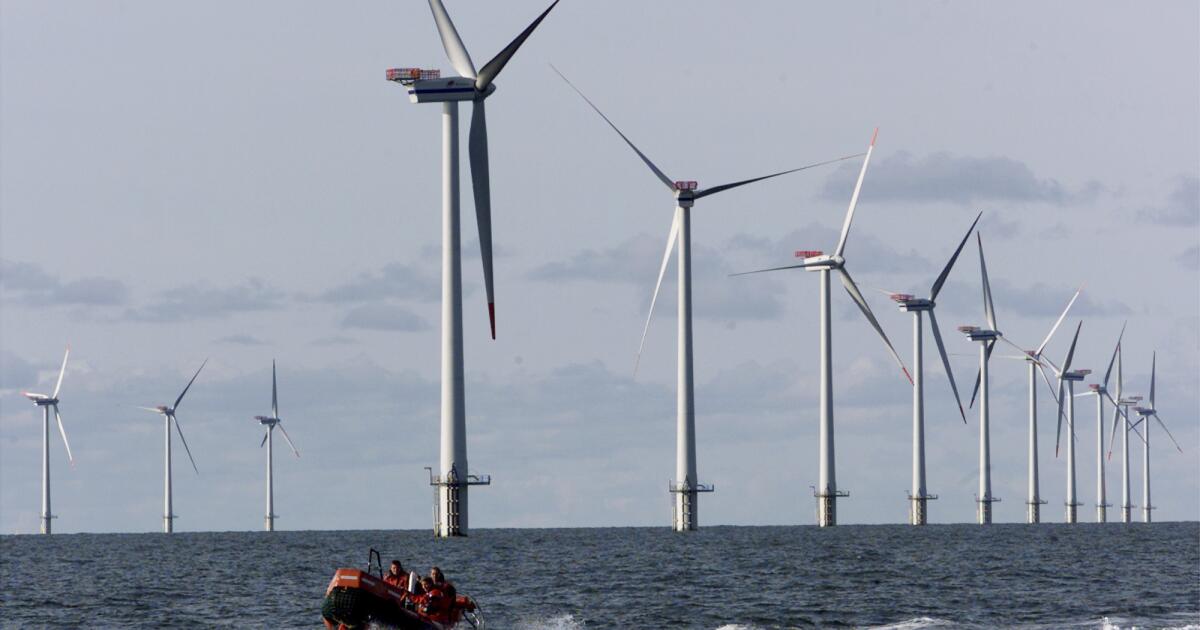
The state already gets about 6% of its electricity from land-based wind farms, but offshore wind is considered more promising over the long run, mostly because ocean winds are more constant and more powerful. (Trump doesn’t like land-based windmills either — in 2016, he said they make Palm Springs “look like a junkyard” — but there isn’t much he can do about turbines that are already in place.)
In July, the California Energy Commission approved a plan for wind development that centers on deepwater wind farms off Morro Bay and Humboldt Bay, supported by new port facilities in Long Beach and Los Angeles.
The wind farms, about 20 miles offshore, would be massive arrays of floating turbines roughly 70 stories tall. They will be designed to produce 25,000 megawatts of electricity, enough to power 25 million homes — about 13% of the state’s projected electricity consumption in 2045.
Proposition 4 on the November ballot, a $10-billion bond act, includes $475 million for wind-related port infrastructure.
But before any turbines are built, the projects will need a daunting array of permits from the federal government examining not only their environmental impact, but their effects on commercial fishing, navigation and national security.
A new administration can’t cancel leases, which are binding contracts that typically run for decades.
And it can’t easily shut down wind farms that are already up and running. (California’s offshore projects are a long way from that stage.)
But federal agencies can easily slow or delay the long permitting process, which typically takes three to five years, for projects that haven’t been built.
“There are a lot of ways they can slow the process down,” said Jim Lanard, president of Magellan Wind, an offshore development firm. “They can slow-walk the approvals. They can change the rules in midstream. … A project can suffer death by a thousand cuts.”
“Projects that haven’t been permitted will go through excruciatingly long review periods,” he predicted. California’s offshore projects are in that category.
Wind developers will face one more hazard in a Trump administration: The GOP candidate has promised to repeal President Biden’s landmark climate law, which includes big tax incentives to entice investors into financing these long-term projects. Repealing the law would be up to Congress, though — not the president.
Neither of those obstacles would necessarily halt all progress on California’s projects off Morro and Humboldt bays. Developers may need as long as five years to identify the sites where they want to build — a timeline that means they might not seek permits until the next presidential administration.
But the prospect of those policy changes has already injected new uncertainty into the marketplace.
“Several developers have already hit the pause button,” said Lanard, who has worked on California’s North Coast but is not involved in the current projects. “We’re not even going to talk to potential partners [for future projects] for the first two years of a Trump administration, until we know what the environment will be like.”
In other words, a Trump administration probably can’t stop work on renewable energy projects entirely, but will almost certainly slow it down.
Unless, that is, a green-energy equivalent of Elon Musk steps forward — a wind-power devotee who wants to contribute millions of dollars to the Trump campaign.
I asked Lanard if he knew of anyone who fit that description. He laughed.



NEWYou can now listen to Fox News articles!
President Donald Trump said on Thursday that he plans to meet with Venezuelan opposition leader Maria Corina Machado in Washington next week.
During an appearance on Fox News’ “Hannity,” Trump was asked if he intends to meet with Machado after the U.S. struck Venezuela and captured its president, Nicolás Maduro.
“Well, I understand she’s coming in next week sometime, and I look forward to saying hello to her,” Trump said.
Venezuelan opposition leader Maria Corina Machado waves a national flag during a protest called by the opposition on the eve of the presidential inauguration, in Caracas on January 9, 2025. (JUAN BARRETO/AFP via Getty Images)
This will be Trump’s first meeting with Machado, who the U.S. president stated “doesn’t have the support within or the respect within the country” to lead.
According to reports, Trump’s refusal to support Machado was linked to her accepting the 2025 Nobel Peace Prize, which Trump believed he deserved.
But Trump later told NBC News that while he believed Machado should not have won the award, her acceptance of the prize had “nothing to do with my decision” about the prospect of her leading Venezuela.
Politics
California sues Trump administration over ‘baseless and cruel’ freezing of child-care funds
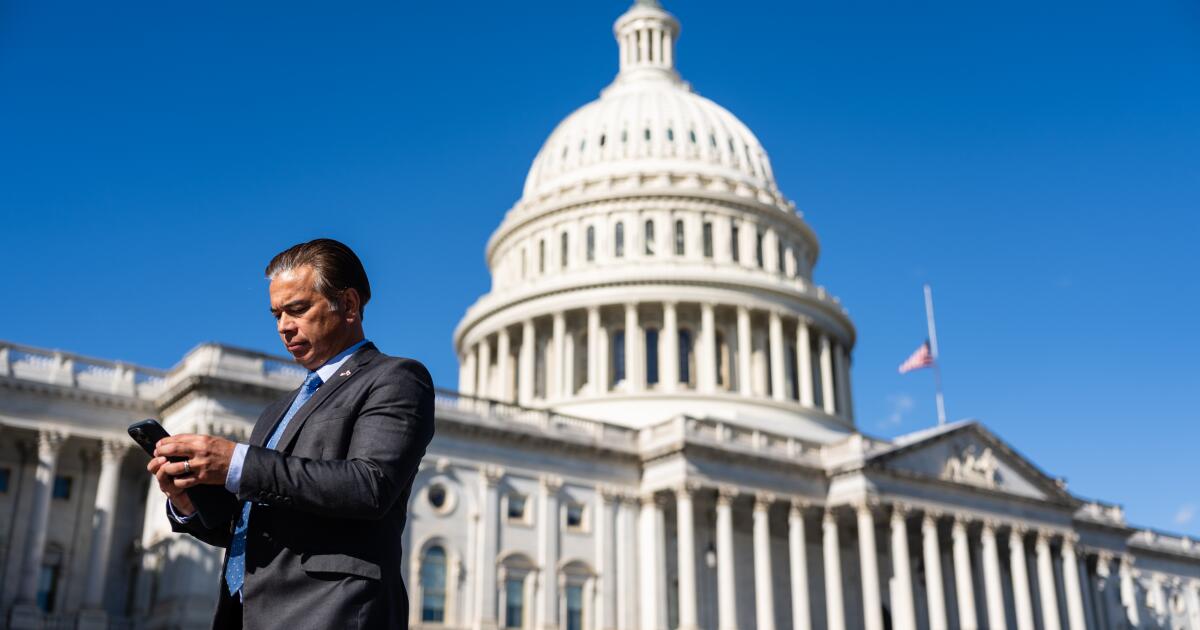
California is suing the Trump administration over its “baseless and cruel” decision to freeze $10 billion in federal funding for child care and family assistance allocated to California and four other Democratic-led states, Atty. Gen. Rob Bonta announced Thursday.
The lawsuit was filed jointly by the five states targeted by the freeze — California, New York, Minnesota, Illinois and Colorado — over the Trump administration’s allegations of widespread fraud within their welfare systems. California alone is facing a loss of about $5 billion in funding, including $1.4 billion for child-care programs.
The lawsuit alleges that the freeze is based on unfounded claims of fraud and infringes on Congress’ spending power as enshrined in the U.S. Constitution. The White House did not immediately respond to a request for comment.
“This is just the latest example of Trump’s willingness to throw vulnerable children, vulnerable families and seniors under the bus if he thinks it will advance his vendetta against California and Democratic-led states,” Bonta said at a Thursday evening news conference.
The $10-billion funding freeze follows the administration’s decision to freeze $185 million in child-care funds to Minnesota, where federal officials allege that as much as half of the roughly $18 billion paid to 14 state-run programs since 2018 may have been fraudulent. Amid the fallout, Gov. Tim Walz has ordered a third-party audit and announced that he will not seek a third term.
Bonta said that letters sent by the U.S. Department of Health and Human Services announcing the freeze Tuesday provided no evidence to back up claims of widespread fraud and misuse of taxpayer dollars in California. The freeze applies to the Temporary Assistance for Needy Families program, the Social Services Block Grant program and the Child Care and Development Fund.
“This is funding that California parents count on to get the safe and reliable child care they need so that they can go to work and provide for their families,” he said. “It’s funding that helps families on the brink of homelessness keep roofs over their heads.”
Bonta also raised concerns regarding Health and Human Services’ request that California turn over all documents associated with the state’s implementation of the three programs. This requires the state to share personally identifiable information about program participants, a move Bonta called “deeply concerning and also deeply questionable.”
“The administration doesn’t have the authority to override the established, lawful process our states have already gone through to submit plans and receive approval for these funds,” Bonta said. “It doesn’t have the authority to override the U.S. Constitution and trample Congress’ power of the purse.”
The lawsuit was filed in federal court in Manhattan and marked the 53rd suit California had filed against the Trump administration since the president’s inauguration last January. It asks the court to block the funding freeze and the administration’s sweeping demands for documents and data.

new video loaded: Trump Says ‘Only Time Will Tell’ How Long U.S. Controls Venezuela
transcript
transcript
Trump Says ‘Only Time Will Tell’ How Long U.S. Controls Venezuela
President Trump did not say exactly how long the the United states would control Venezuela, but said that it could last years.
-
“How Long do you think you’ll be running Venezuela?” “Only time will tell. Like three months. six months, a year, longer?” “I would say much longer than that.” “Much longer, and, and —” “We have to rebuild. You have to rebuild the country, and we will rebuild it in a very profitable way. We’re going to be using oil, and we’re going to be taking oil. We’re getting oil prices down, and we’re going to be giving money to Venezuela, which they desperately need. I would love to go, yeah. I think at some point, it will be safe.” “What would trigger a decision to send ground troops into Venezuela?” “I wouldn’t want to tell you that because I can’t, I can’t give up information like that to a reporter. As good as you may be, I just can’t talk about that.” “Would you do it if you couldn’t get at the oil? Would you do it —” “If they’re treating us with great respect. As you know, we’re getting along very well with the administration that is there right now.” “Have you spoken to Delcy Rodríguez?” “I don’t want to comment on that, but Marco speaks to her all the time.”
January 8, 2026

Pantera Signals 2026 Crypto Breakout After 2025 Quietly De-Risked Markets

Military Troops and Retirees: Here’s the First Financial Step to Take in 2026

Brazilian jiu-jitsu helped me find joy in movement again—here are three of my favorite solo moves you can do at home

Controversy Surrounds ‘The Raja Saab’ as Makers Allegedly Offer Money for Positive Reviews | – The Times of India

‘If it expires, it expires,’ Trump tells NYT about US-Russia nuclear treaty

Florida High School Football Rankings: Top 25 teams – Oct. 21

Cleary's 21 help Le Moyne down Central Connecticut State 69-64 in OT

How old is Bo Nix? What to know about Oregon quarterback ahead of 2024 NFL Draft

99th annual Pony Swim held in Virginia

Video: ‘It Didn’t Have to Happen This Way:’ U.Va. Faculty Call for Review of Police Response to Protests

Trump plans to meet with Venezuela opposition leader Maria Corina Machado next week

Trump says meeting Iran’s ‘Crown Prince’ Pahlavi would not be appropriate

Federal immigration agents shoot 2 people in Portland, Oregon, police say

Video: What Trump Told Us About the ICE Shooting

Trump calls for $1.5T defense budget to build ‘dream military’
-

 Detroit, MI5 days ago
2 hospitalized after shooting on Lodge Freeway in Detroit
-

 Technology3 days ago
Power bank feature creep is out of control
-

 Dallas, TX4 days ago
Defensive coordinator candidates who could improve Cowboys’ brutal secondary in 2026
-

 Health5 days ago
Viral New Year reset routine is helping people adopt healthier habits
-

 Nebraska2 days ago
Oregon State LB transfer Dexter Foster commits to Nebraska
-

 Iowa2 days ago
Pat McAfee praises Audi Crooks, plays hype song for Iowa State star
-
 Nebraska2 days ago
Nebraska-based pizza chain Godfather’s Pizza is set to open a new location in Queen Creek
-
 Entertainment2 days ago
Spotify digs in on podcasts with new Hollywood studios