Politics
Column: Trump and Biden agreed to debates. That's a lot less important than it was made out to be

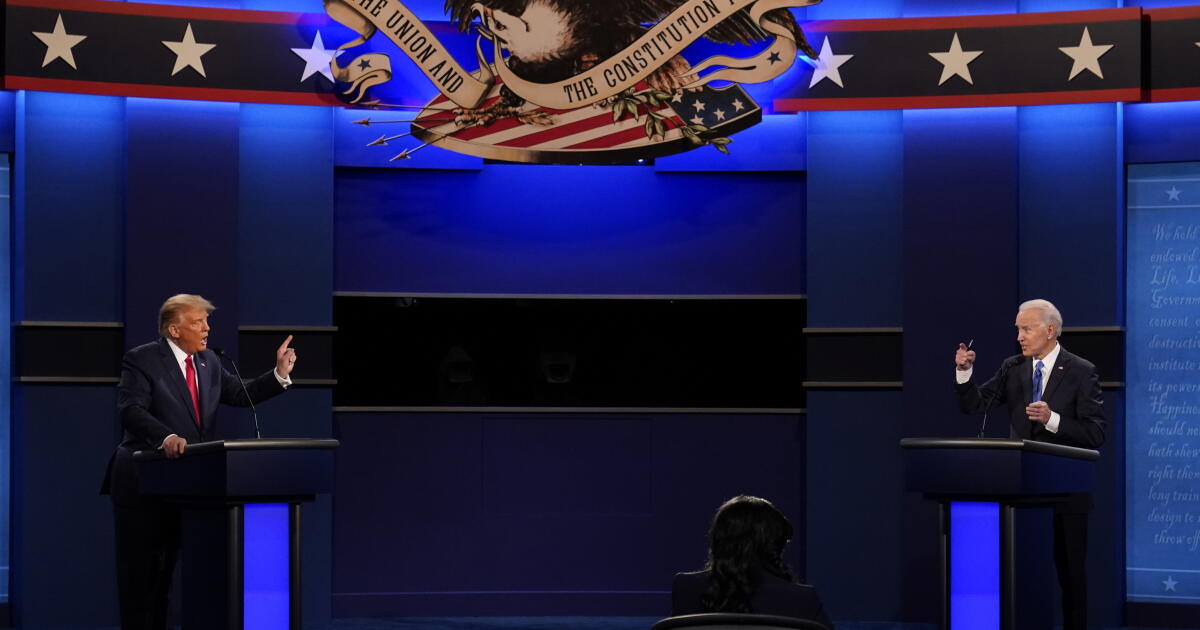
The Biden and Trump campaigns agreed to two presidential debates last week. Who among us can contain our excitement?
Well, it depends on what you mean by “us.” In my corner of the professional world — pundits, commentators, political junkies — there was much rejoicing. Watching the Sunday shows, you could be forgiven for thinking church bells must have rung out to celebrate the news across the nation, as if some medieval queen had given birth to a male heir. The debates are happening! The debates are happening! Huzzah!
Meanwhile, among normal people, that sound you didn’t hear was the great mass of humanity shrugging. A smaller segment of the population likely let out an involuntary groan of the sort you make when you find out you got a middle seat on an airplane.
I don’t have polling to back this up, but I suspect most Americans would regard the prospect of Donald Trump and Joe Biden yelling at each other like two old men squabbling over the check at a Denny’s with resigned exhaustion. Ugh, really? We’re doing this again?
Now, I understand why journalists and junkies are excited. For starters, presidential debates inflate the egos of journalists, giving them ample opportunity to talk grandly about the fourth estate’s important role in democracy. They’re also great for ratings: The first, thoroughly awful 2020 debate was watched by 73 million people.
The drama of politicians offering unscripted — though often rehearsed — answers to complicated questions has a Super Bowl-like quality for political nerds. That listening to either of the current presumptive nominees talk is like watching a race car driver behind the wheel of a vehicle without brakes just adds to the excitement. The prospect of a spectacular crash always has a certain dark appeal, and in a Trump-Biden matchup, crashes are assured.
Lost amid the hoopla over the latest debate agreement is the fact that pretty much all presidential debates are tiresome and counterproductive spectacles.
The arguments for debates are often somewhat tautological. We supposedly need to have presidential debates because we’ve always had presidential debates. But this isn’t true.
The first presidential debates, between John F. Kennedy and Richard Nixon, were in 1960 (when Biden and Trump were, respectively, 17 and 14 years old). All anyone remembers about the Kennedy-Nixon debates is the first one, which Nixon lost, according to lore, because he was without makeup, unshaven and sweaty. Again, according to lore, people who listened to the debate on radio thought Nixon won, while people who watched it on television were so impressed by Kennedy’s suave style and good looks that they thought he won. Nixon, who was underweight and exhausted during his first appearance, got some rest and good makeup and won the next two debates, which nobody remembers.
In other words, the lesson from the beginning was that style was more important than substance. It has ever been thus.
We think, partly because we are told as much over and over again, that televised debates convey important information to voters. But television makes certain information seem more important than it is, often subliminally. For instance, in most presidential elections, the taller candidate wins. Does height in some way correlate with superior policies?
There’s a reason FDR hid his wheelchair from public view. But while I have no end of substantive criticisms of Franklin D. Roosevelt, his having had polio is not among them.
Obviously, television presence is part of modern presidents’ job description. But televised presidential debates magnify that qualification beyond all reason. Yes, yes, presidents need to be good communicators. But at no point during their actual presidencies are they ever expected to bicker with a political foe for 90 minutes in front of millions of people.
The political skills we are testing for are not the political skills the job requires. The candidate who forcefully, confidently or amusingly lies is often rewarded by debates, while the candidate who tells the truth awkwardly, hesitantly or with appropriate complexity is often penalized.
The debate “highlight” reels the networks routinely run are full of one-liners, gaffes and falsehoods often treated as true by sympathetic journalists. But I’ve never seen a really thoughtful explanation of the national debt or another serious problem celebrated as a great moment in debate history.
The prospect of a Biden-Trump rematch is especially deserving of an “Ugh, really?” But the truth is that all presidential debates deserve the same.


new video loaded: How Rubio Is Driving the U.S. Pressure Campaign on Cuba

By Michael Crowley, Nikolay Nikolov, Alexandra Ostasiewicz, Jon Miller and Whitney Shefte
May 20, 2026

NEWYou can now listen to Fox News articles!
A newly active X account bearing former first son Hunter Biden’s name drew mockery from GOP lawmakers and prominent social media personalities after posting its first message Tuesday.
“Your laptop’s reputation precedes you,” Tennessee Sen. Marsha Blackburn wrote in response to the “@HunterBiden” account.
Fox News Digital reached out to X and Hunter Biden’s art gallery to verify if the account belongs to the former president’s son, but did not receive confirmation. The account has garnered thousands of followers and interactions since Tuesday, when it launched its first message.
“I’m Hunter Biden. You’ve never actually heard from me,” the account blaring the former first son’s name posted.
The account’s profile reads: “Artist. Author. Recovery Advocate.”
HUNTER BIDEN HELPED MAKE CAMPAIGN DECISIONS, WAS MAJOR FIXTURE IN FATHER’S ORBIT, AUTHOR SAYS
Hunter Biden posts his first message on X and Substack. (Mandel Ngan/AFP)
Hunter, 56, has re-emerged in the public spotlight as he attempts to rebuild his image following years of controversy involving drug addiction, legal troubles and scrutiny surrounding his personal life.
The X account, @HunterBiden, was first launched in 2013, according to a Fox News Digital review, but posted its first public message on Tuesday. Hunter Biden’s art gallery website is linked to the X account, while the art gallery’s website links to the X account, a YouTube page and a Substack account.
The tweet sparked a wave of mockery aimed at the younger Biden, as well as a handful of accounts quipping that the former first son would allegedly launch a 2028 run.
“We’ve heard plenty,” said Republican Indiana Sen. Jim Banks responded to the account.
“Trust me, we’ve heard and seen ENOUGH from you,” Republican Missouri Rep. Jason Smith chimed in.
Other social media users quickly piled onto the alleged Hunter Biden post, resurfacing past controversies and even floating him as a potential political candidate.
“Oh this oughta be good,” said conservative commentator Nick Sortor in an X response.
“Very real chance he doesn’t remember that we have, in fact, heard from him in hours of podcasting before now,” said Fox News contributor Mary Katharine Ham.
“The 2028 Dark Horse Candidate,” wrote one X user, while another added “He’s running.”
MAMDANI’S WIFE’S ‘STUDENT SKETCHBOOK’ ART IS HUNTER BIDEN EFFECT ALL OVER AGAIN, SAYS US ARTIST
Hunter’s art gallery website links his X account, Youtube, as well as a newly formed Substack which posts the same message. (TheImageDirect.com)
Additionally, Candace Owens tagged the X account in a trailer for her upcoming interview with Hunter Biden, who is continuing a media tour following years of controversy while under the public spotlight.
The @HunterBiden account reposted the video, writing, “She’s got questions. I’ve got answers. Thursday.”
JOE BIDEN POSES WITH HUNTER’S CHINESE BUSINESS ASSOCIATES IN NEWLY SURFACED PHOTOS: ‘INCREDIBLY DAMNING’
Hunter reportedly moved out of the United States amid mounting legal issues, just a year after his father left the presidential office in 2025. (REUTERS/Kevin Lamarque)
HUNTER BIDEN’S FINANCIAL WOES REVEALED IN NEW MOTION TO DROP LAWSUIT: ‘SIGNIFICANT DEBT’
Hunter Biden has been involved in a string of controversies spanning his foreign business dealings, tax and gun charges, and scrutiny tied to his family’s political connections.
Hunter received a pardon from President Joe Biden for any offense he “has committed or may have committed” from Jan. 1, 2014, to Dec. 1, 2024, before his father left office.
In September 2024, Hunter Biden pleaded guilty to nine federal tax charges in California for a scheme evading over $1.4 million in taxes from 2016 to 2019. He was also convicted in Delaware in June 2024 for lying on a federal form about his drug use to purchase a firearm in 2018.
CLICK HERE TO DOWNLOAD THE FOX NEWS APP
Hunter published a memoir titled “Beautiful Things: A Memoir” in 2021 which details his battle with severe substance abuse and family tragedies from his own perspective.

Nearly three months after the United States and Israel launched their large-scale bombing campaign against Iran and about six weeks since the April 8 ceasefire took effect, President Trump faces an inflection point. Does he return to war? Maintain the ceasefire and U.S. blockade on Iranian ports in the hope of cutting a deal on American terms? Or drop his maximalist negotiating stance?
Sen. Lindsey Graham (R-S.C.), an informal foreign policy advisor for the White House, continues to press for more aggressive U.S. military action. Trump’s political advisors would prefer that the war end as soon as possible to minimize political repercussions against the Republican Party in a midterm election year.
Trump seems conflicted. Despite weeks of U.S. bombardment and an ongoing naval blockade, Tehran is as protective of its nuclear program today as it was before the war began. “For Iran, the Clock is Ticking, and they better get moving, FAST, or there won’t be anything left of them,” Trump wrote on Truth Social over the weekend. A day later, Trump took to the social media platform again to announce he suspended planned U.S. attacks on Iran to give talks more time.
Unfortunately for Trump, he’s proved to be his own worst enemy on this subject. Iran’s stockpile of highly enriched uranium and Tehran’s effective control of the Strait of Hormuz, the regime’s two biggest cards, are a byproduct of Trump’s own policy decisions.
The first is a clear indictment of Trump’s first-term order to withdraw the United States from the Obama-era Joint Comprehensive Plan of Action, a highly technical accord that put Iran’s nuclear work in a box by restricting the number and quality of centrifuges it could use, capped the amount of enriched uranium it could produce and compelled Tehran to ship 97% of its stockpile out of the country. When the Trump administration scrapped that hard-won deal, Iran responded by enriching more nuclear material at a faster pace and accumulating the very stockpile the Trump administration is now seeking to neutralize.
The Strait of Hormuz, Iran’s second card, would not even be an issue today if the Trump administration had refrained from going to war in the first place. On Feb. 27, the day before the conflict began, more than 150 tankers and vessels traveled through the strait. The international waterway was open for business.
Not so today. On Thursday, a grand total of three crossings were registered in the waterway. This collapse of commerce is a consequence of Iran’s ability to harass civilian tankers so much that shipping companies no longer view the journey as worth the cost. As Adm. Brad Cooper, the top U.S. commander in the Middle East, testified to the Senate Armed Services Committee on Thursday: “The Iranian capability to stop commerce has been dramatically depleted through the strait, but their voice is very loud. And those threats are clearly heard by the merchant industry and insurance industry.”
By virtue of his own actions, Trump is now left with a series of policy options that range from least bad to terrible. None of them are ideal, and all of them carry some risk.
For starters, Trump could resume the war. Any renewed U.S. bombing campaign would probably expand the U.S. military’s original set of targets to include a portion of Iran’s energy infrastructure, which Trump has threatened repeatedly to hit. A U.S. invasion of Kharg Island, where 90% of Iran’s oil processing takes place, might also be up for discussion. The aim would be to destroy Iran’s remaining military capabilities and further squeeze its oil revenue until Tehran’s strategic calculus on the war shifts to Washington’s liking.
Yet there are no guarantees that doubling down on military force will work. Trump’s entire strategy has relied on a baseline assumption: The more punitive the United States is, the more likely Tehran will be to cave. Yet that simply hasn’t occurred. If anything, Iran is more dug in now than it was in the opening days of the conflict. For the regime, capitulating to Trump is as dangerous as losing the war. Why would more bombing succeed where previous bombing failed?
The risks of additional U.S. military action are considerable as well. Before the ceasefire, Iran was launching ballistic missiles and attack drones across multiple gulf Arab states, hitting Qatar’s largest natural gas processing facility, Saudi Arabia’s east-west oil pipeline and Dubai’s luxurious high-rises. As the Iranians have stated, such attacks will not only resume if Trump orders a resumption of the war but will expand to new targets, including desalination facilities and nuclear power plants. Such strikes would raise global oil and gas prices to even more absurd levels, adding to the extra $40 billion the American people are already paying for fuel since the war began.
What about continuing the status quo? While this contingency would be less costly than another round of bombing or a U.S. ground invasion, it’s unclear whether it would help or hurt negotiations toward a settlement. There’s a possibility that extending the U.S. blockade of Iranian ports could merely reaffirm the regime’s earlier decision to preserve its own shutdown of the strait. Iran is now urging Washington to end its blockade before talks on the nuclear file can be held. And it’s a mystery whether Trump’s blockade is working anyway; the U.S. intelligence community assesses that Iran could withstand this pressure point for three to four more months, which may be too long for Trump to sustain given the oil disruptions that are bound to get worse.
Striking an agreement to end the war, return the strait to open traffic and restrict Iran’s nuclear program would be the most beneficial policy for the United States with the least amount of cost attached — not quite undoing the harm from Trump’s first-term decision to scrap the nuclear deal and his second-term decision to start a war. U.S. and Iranian negotiators are passing proposals back and forth as we speak. But as of now, Trump can’t stomach agreeing to a deal that covers some of Iran’s terms, including but not limited to a shorter suspension of enriched uranium and some kind of Iranian role in the management of the strait. Even if Trump did reassess his position, he would be forced to confront the hawks in his political coalition who would consider anything short of Iran’s total surrender a failure.
In short, Trump is in an unenviable position. He’s got nobody to blame but himself.
Daniel R. DePetris is a fellow at Defense Priorities and a syndicated foreign affairs columnist.
-

 Austin, TX3 minutes ago
GOP Texas attorney general candidates push on despite no Trump endorsement
-

 Alabama9 minutes ago
Alabama gubernatorial candidates focused on November election date just hours after primaries
-

 Alaska15 minutes ago
Gas Pipeline Tax Debate Sends Alaska Lawmakers To Special Session
-

 Arizona21 minutes ago
Giants end difficult series with eye toward future, not past
-

 Arkansas27 minutes ago
Dave Van Horn press conference: Arkansas baseball coach, players recap SEC Tournament win over Tennessee | Arkansas Democrat Gazette
-

 California33 minutes ago
New police video shows deadly standoff after deputy killed in California shooting | Fox News Video
-

 Colorado39 minutes ago
Colorado Supreme Court orders children’s hospital to resume gender-affirming care for minors
-

 Connecticut45 minutes ago
Connecticut state colleges board meets on interim chancellor search

