Politics
Column: There should be no partisan divide about naming Epstein’s fellow abusers

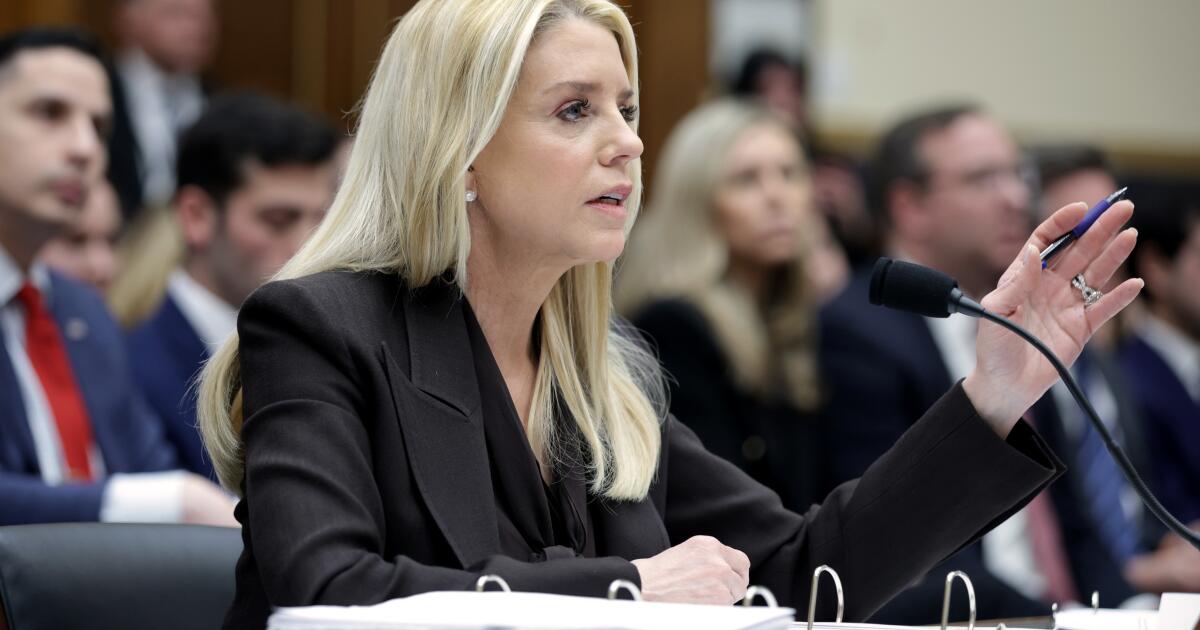
At a House Judiciary hearing on Wednesday, Atty. Gen. Pam Bondi was holding a document labeled “Jayapal Pramila Search History” that included a list of files from the unredacted Epstein archive accessible to lawmakers such as Rep. Pramila Jayapal (D-Wash.).
That means over the course of a year Bondi’s Department of Justice has made time to speak with Ghislaine Maxwell — the New York socialite who helped Jeffrey Epstein run his billion-dollar child-sex-trafficking operation — and it made time to surveil a Democratic lawmaker who conducts oversight as a member of the Judiciary Committee. But it has yet to meet with the victims of Epstein’s crimes who want to talk.
When she took office, Bondi promised us transparency. She didn’t promise we would like what we would see from her.
The general public’s awareness of Epstein’s heinous crimes came with political baggage. However at this point, the question we all should wonder is: How does redacting the names of the men who helped fund Epstein’s operation benefit either political party? It may be good for the rich and powerful men trying to avoid accountability, but it’s not exactly a campaign platform.
Yet here we are as a country, chained to the same vocabulary used during an election, so a conversation that should be about right and wrong is accompanied by poll numbers and analysis about the midterm elections. As if the Justice Department’s refusal to interview rape survivors is an inside-the-Beltway topic and not reflective of a larger moral crisis. We have seen Congress kept out of session to avoid voting on the release of the Epstein files; we have heard equivocation about whether Epstein was a pedophile. We know Epstein’s island was a place where evil resided.
The investigation, or lack of investigation, into Epstein’s fellow abusers should not be seen by anyone as a political quandary in which the object of the game is to keep your party in power. The fact that there is a Republican-vs.-Democrat divide on accountability for sex abuse reveals a national moral crisis. When the abuse of children is viewed through a partisan lens, how else can one describe this period in America?
Fifty years ago, when President Carter was tasked with healing the nation after the Watergate scandal, he told Americans in his inaugural address that he was leaning on his faith, and one prophet in particular.
“He hath shewed thee, O man, what is good; and what doth the Lord require of thee, but to do justly, and to love mercy, and to walk humbly with thy God?,” Carter said, quoting Micah 6:8. “This inauguration ceremony marks a new beginning, a new dedication within our government, and a new spirit among us all. A president may sense and proclaim that new spirit, but only a people can provide it.”
The Hebrew prophet Micah was from a rural area, not born into the wealth of the royal court. He was not being compensated by those who were. Instead, Micah reflected the voice of the people who were forced to live in poor conditions because of corruption. He described the actions of the morally bankrupt judges, political leaders and other elites in graphic, violent terms, condemning those “who hate the good, and love the evil; who pluck off their skin from off them, and their flesh from off their bones.”
This, he said, is what it is like being ruled by those who are not guided by what is good and what is evil, but rather what is most beneficial for themselves in the moment. When Micah spoke, it wasn’t about the latest poll numbers. His warnings about government corruption are not unique to any particular faith, nor are they married to any political party. They embody centuries of human history, a history that tells what happens to a society when power goes unchecked.
And be not mistaken, it was unchecked power — not any party affiliation — that provided Epstein and Maxwell with patronage. It was moral failure, not conservatives or liberals, that provided cover for their child-sex-trafficking ring.
So if for partisan reasons the abusers of children are not held accountable for their crimes, the language of politics fails us. The word for that is simply: evil.
YouTube: @LZGrandersonShow
Insights
L.A. Times Insights delivers AI-generated analysis on Voices content to offer all points of view. Insights does not appear on any news articles.
Viewpoint
Perspectives
The following AI-generated content is powered by Perplexity. The Los Angeles Times editorial staff does not create or edit the content.
Ideas expressed in the piece
-
The Department of Justice under Attorney General Pam Bondi has created a moral crisis by allowing the investigation into Jeffrey Epstein’s fellow abusers to become a partisan political issue rather than a matter of fundamental accountability and justice[3]. The DOJ has monitored a Democratic lawmaker’s access to Epstein files while reportedly meeting with Ghislaine Maxwell but declining to meet with Epstein survivors seeking to discuss their experiences[1][3].
-
Redacting the names of wealthy and powerful men implicated in Epstein’s crimes while exposing victims’ identities serves no legitimate governmental interest and only protects the rich and powerful from accountability regardless of political affiliation[3]. The failure to hold co-conspirators accountable after more than a year in office, combined with refusals to apologize to survivors, demonstrates a troubling prioritization of protecting certain interests over justice[3].
-
When child sexual abuse becomes filtered through partisan politics rather than evaluated on moral grounds, it reflects a fundamental failure of governance and represents a national crisis of conscience[3]. The politicization of this issue obscures what should be a universal principle: that accountability for crimes against children transcends party affiliation and election cycles[3].
Different views on the topic
-
The Department of Justice maintains that it records all searches conducted in its systems specifically to safeguard against the disclosure of victim information, suggesting that monitoring access to sensitive Epstein files serves a protective function rather than partisan surveillance[1]. Attorney General Bondi stated that the department has pending investigations in its office related to potential Epstein conspirators[2], indicating that prosecutorial work continues despite public criticism.
-
The release of Epstein files is an ongoing process requiring careful legal review to protect victims’ privacy and ensure proper handling of sensitive evidence[4]. The DOJ’s approach to redacting certain information may reflect legitimate institutional concerns about victim protection and the complexities of managing millions of declassified documents[1].



NEWYou can now listen to Fox News articles!
Sen. John Fetterman, D-Pa., is continuing his streak of breaking with his party — this time on voter ID legislation gaining momentum in the Senate.
Senate Minority Leader Chuck Schumer, D-N.Y., and Senate Democrats have near-unanimously rejected the Safeguarding American Voter Eligibility (SAVE) Act, election integrity legislation that made its way through the House earlier this week.
Schumer has dubbed the legislation “Jim Crow 2.0,” arguing it would suppress voters rather than encourage more secure elections.
COLLINS BOOSTS REPUBLICAN VOTER ID EFFORT, BUT WON’T SCRAP FILIBUSTER
Sen. John Fetterman, D-Pa., speaks to a reporter as he arrives in the U.S. Capitol for a vote Dec. 3, 2025. (Bill Clark/CQ-Roll Call, Inc via Getty Images)
But Fetterman, who has repeatedly rejected his party’s messaging and positions, pushed back on Schumer’s framing of the bill.
“I would never refer to the SAVE Act as like Jim Crow 2.0 or some kind of mass conspiracy,” Fetterman told Fox News’ Kayleigh McEnany on “Saturday in America.”
“But that’s part of the debate that we were having here in the Senate right now,” he continued. “And I don’t call people names or imply that it’s something gross about the terrible history of Jim Crow.”
The bill would require voters to present photo identification before casting ballots, require proof of citizenship in person when registering to vote and mandate states remove non-citizens from voter rolls.
MURKOWSKI BREAKS WITH GOP ON VOTER ID, SAYS PUSH ‘IS NOT HOW WE BUILD TRUST’
Sen. Susan Collins, R-Maine, announced her support for the SAVE America Act but won’t go as far as to nuke the Senate filibuster. (Tom Williams/CQ-Roll Call, Inc via Getty Images)
Momentum is building among Republicans. Sen. Susan Collins, R-Maine, became the 50th member of the conference to back the legislation. But Senate Democrats have all but guaranteed its demise in the upper chamber, via the filibuster.
Fetterman would not say whether he supports the bill outright. However, he noted that “84% of Americans have no problem with presenting IDs to vote.”
“So it’s not like a radical idea,” Fetterman said. “It’s not something — and there already are many states that show basic IDs. So that’s where we are in the Senate.”
HARDLINE CONSERVATIVES DOUBLE DOWN TO SAVE THE SAVE ACT
Senate Minority Leader Chuck Schumer, D-N.Y., and Senate Democrats are ready to buck the SAVE Act. (Kevin Dietsch/Getty)
Even if Fetterman were to support the bill on the floor, it is unlikely to pass without more significant procedural changes.
There are currently not enough votes to overcome the Senate’s 60-vote filibuster threshold.
Fetterman is also not keen on eliminating the filibuster — a position shared by most Senate Republicans.
CLICK HERE TO DOWNLOAD THE FOX NEWS APP
He noted that Senate Democrats once favored scrapping the filibuster but now want to preserve it while in the minority in a Republican-controlled government.
“I campaigned on it, too,” Fetterman said. “I mean we were very wrong about that to nuke the filibuster. And we should really humble ourselves and remind people that we wanted to eliminate it — and now we love it.”

SACRAMENTO — Gov. Gavin Newsom sat onstage at the Munich Security Conference in Germany on Friday and described one of the primary ways he is responding as the Trump administration shifts federal climate priorities.
“I’m showing up,” he said.
In recent months, that has meant trips to Brazil, Switzerland and now Germany, where he has repeatedly positioned California as a global climate partner. The travel has also revived a recurring question from critics and watchdog groups: Who pays for those trips?
In many cases, the costs are not borne by taxpayers. The governor’s office said his international travel is paid for by the California State Protocol Foundation, a nonprofit that is funded primarily by corporate donations and run by a board Newsom appoints.
For decades, California governors have relied on nonprofits to pick up the tab for official travel, diplomatic events and other costs that would otherwise be paid with taxpayer funds.
“The Foundation’s mission is to lessen the burden on California taxpayers by reimbursing appropriate expenses associated with advancing the state’s economic and diplomatic interests,” said Jason Elliott, a former high-ranking advisor to Newsom whom the governor added to the foundation’s board.
While the arrangement helps the state’s pocketbook, critics say it is another avenue for corporate interests to gain influence. Among the donors to the foundation are healthcare giants like Centene and CVS Pharmacy, while the bulk of revenue stems from separate nonprofits affiliated with the governor made up of power players with business before the state.
“The problem with the protocol foundation and others like it is that donors to these foundations receive access to the politicians whose travel they fund,” said Carmen Balber, executive director of the advocacy group Consumer Watchdog.
When did nonprofits start paying for gubernatorial travel?
The protocol foundation was created as a tax-exempt charity during Republican Gov. Arnold Schwarzenegger’s administration in 2004.
Similar nonprofits have existed since Gov. George Deukmejian created one in the 1980s. In the early 2000s, Gov. Gray Davis dramatically increased the use of nonprofits to cover travel, housing and political events.
When Schwarzenegger left office, his supporters turned the protocol foundation over to Democratic Gov. Jerry Brown’s backers, who in turn handed it over to Newsom’s camp. The foundation describes its mission in federal tax filings as “relieving the State of California of its obligations to fund certain expenditures of the Governor’s Office.”
Newsom appoints members to the foundation board, which then is responsible for determining what expenses to cover in the governor’s office. In its most recent tax filing covering 2024, the foundation lists its board chair as Steve Kawa, who served as Newsom’s chief of staff when he was mayor of San Francisco. The foundation’s secretary in those filings is Jim DeBoo, who was Newsom’s chief of staff in the governor’s office until 2022.
The foundation reported total revenue of $1.3 million in 2024 and, after expenses, had a balance of less than $8,000.
What is the foundation paying for?
The foundation covers the cost of Newsom’s international travel and certain domestic trips, including Climate Week in New York, when he is acting in his role as governor. His staff’s travel is also covered by the foundation. The governor’s office declined to say whether the foundation also pays for Newsom’s security detail.
Publicly available records are vague, but Newsom’s annual financial disclosure forms show the foundation paid more than $13,000 for the governor’s 2024 trip to Italy, where he delivered a speech on climate change at the Vatican.
That same year, the foundation paid nearly $4,000 for his trip to Mexico City to attend the inauguration of Mexico’s first female president, Claudia Sheinbaum. The cost of both trips included flights, hotel and meals for his “official travel,” according to the disclosure records, which are filed with the Fair Political Practices Commission and known as Form 700s.
Newsom has reported receiving $72,000 in travel, staff picnics and holiday events from the protocol foundation since he took office in 2019, according to the disclosures.
The foundation paid $15,200 for the governor’s 2023 trip to China, where he visited five cities in seven days during an agenda packed with meetings, sightseeing and celebrations, including a private tour of the Forbidden City.
In 2020, the foundation paid $8,800 for Newsom to travel to Miami for Super Bowl LIV — where he said he was representing the state as the San Francisco 49ers faced the Kansas City Chiefs.
The governor’s office said it did not yet have the amount picked up by the foundation for Newsom’s travel to Brazil to attend the United Nations climate summit known as COP30 or to Switzerland for the World Economic Summit.
Who are the donors behind the foundation?
In some cases, the well-heeled funders behind the foundation’s cash flow are easy to identify on state websites.
Donations to the foundation that are solicited directly or indirectly by Newsom are recorded with the Fair Political Practices Commission as behested payments. A behested payment occurs when an elected official solicits or suggests that a person or organization give to another person or organization for a legislative, governmental or charitable purpose.
The environmental grantmaker Resources Legacy Fund contributed $100,000 to the protocol foundation last year, a donation which records show came shortly after the organization announced that it had hired Newsom’s former mayoral chief of staff Phil Ginsburg.
Last year, the clean-energy nonprofit U.S. Energy Foundation donated $150,000 for the California delegation to attend COP30 in Belém, Brazil. The William and Flora Hewlett Foundation donated $300,000 in a 2023 behested payment earmarked for the California delegation traveling to China for the meetings on climate change. UC Berkeley gave $220,000 for the governor’s office’s trip to the Vatican in 2024.
Most donations simply indicate that they are directed for “general operating support” of the foundation. That includes two donations from the Amazon-owned autonomous vehicle company Zoox Inc. cumulatively worth $80,000.
Two charities set up to pay for Newsom’s inaugurations in 2019 and 2023 moved more than $5 million to the protocol foundation since 2019. The financial backers behind those inaugural charities include powerful unions, corporations, tribal casino interests, trade associations and healthcare giants — organizations with significant financial stakes in state policy decisions.
Past spending by the foundation has been criticized
During Schwarzenegger’s administration, his office avoided fully disclosing $1.7 million in travel costs paid for by the foundation, instead relying on vague internal memos and, in some cases, oral accounting, according to a 2007 Los Angeles Times investigation.
Schwarzenegger’s expenses picked up by the foundation included leased Gulfstream jets costing up to $10,000 per hour and suites going for thousands of dollars a night. The Times’ investigation found among the costs was $353,000 for a single round trip to China on a private jet in 2005.
The foundation also paid for Schwarzenegger’s travels to Japan, Europe, Canada and Mexico.
At the time, Schwarzenegger’s representatives told The Times the governor did not have to report the travel costs on his annual disclosure forms because the payments for the jets and suites were gifts to his office, not to him.
Newsom’s office said the governor travels commercially, not on private jets.

NEWYou can now listen to Fox News articles!
The federal government has entered its third partial shutdown of the last half-year after Congress failed to reach an agreement on all 12 of its annual spending bills.
Unlike past shutdowns, however, this one just affects the Department of Homeland Security (DHS). It comes after Democrats walked away from a bipartisan deal to fund the department amid uproar over President Donald Trump’s immigration crackdown in Minneapolis.
And while some 97% of the federal government has been funded at this point, a DHS shutdown will still have effects on everyday Americans — effects that will become more apparent the longer the standoff continues.
DHS SHUTDOWN EXPLAINED: WHO WORKS WITHOUT PAY, WHAT HAPPENS TO AIRPORTS AND DISASTER RESPONSE
Homeland Security Secretary Kristi Noem delivers a press conference on Jan. 24, 2026. (Al Drago/Getty Images)
Air travel delays
Disruptions to the TSA, whose agents are responsible for security checks at nearly 440 airports across the country, could perhaps be the most impactful part of the partial shutdown to Americans’ everyday lives.
Acting Administrator Ha Nguyen McNeill told lawmakers at a hearing on Wednesday that around 95% of TSA employees — roughly 61,000 people — are deemed essential and will be forced to work without pay in the event of a shutdown.
“We heard reports of officers sleeping in their cars at airports to save money on gas, selling their blood and plasma, and taking on second jobs to make ends meet,” she said of the last shutdown.
But it would take some time before TSA funding could translate to delays. TSA agents, like other essential federal workers, received back pay once the shutdown was over. Those who did not miss shifts also got a $10,000 bonus for added relief.
FETTERMAN BUCKS DEMOCRATS, SAYS PARTY PUT POLITICS OVER COUNTRY IN DHS SHUTDOWN STANDOFF
TSA paychecks due to be issued on March 3 could see agents getting reduced pay depending on the length of the shutdown. Agents would not be at risk of missing a full paycheck until March 17.
If that happens, however, Americans could see delays or even cancellations at the country’s busiest airports as TSA agents are forced to call out of work and get second jobs to make ends meet.
Passengers wait in line to use automated passport control kiosks set up for international travelers arriving at Miami International Airport. (Joe Raedle/Getty Images)
Natural disaster reimbursement
The Federal Emergency Management Agency (FEMA) is one of the largest and most critical recipients of federal funding under DHS.
Associate Administrator of the Office of Response and Recovery Gregg Phillips told lawmakers on Wednesday that FEMA has enough funds to continue disaster response through a shutdown in the immediate future, but that its budget would be strained in the event of an unforeseen “catastrophic disaster.”
That means Americans hit by an unexpected natural disaster during the shutdown could see delayed federal reimbursement for their homes and small businesses.
Others who have already lived through a natural disaster in the last year but still have not received their checks — FEMA is currently working through a backlog worth billions of dollars — could see that relief delayed even further during the shutdown.
“In the 45 days I’ve been here … we have spent $3 billion in 45 days on 5,000 projects,” Phillips said. “We’re going as fast as we can. We’re committed to reducing the backlog. I can’t go any faster than we actually are. And if this lapses, that’s going to stop.”
People are seen outside a wildfire shelter at the Pasadena Convention Center on Jan. 21, 2025. (Frederic J. Brown/AFP via Getty Images)
Worker visa processing
American business owners who rely on certain types of worker visas could see processing times extended during a DHS shutdown.
That’s because United States Citizenship and Immigration Services (USCIS) programs are run under DHS and are responsible for processing most immigration applications as well as temporary visas.
CLICK HERE TO DOWNLOAD THE FOX NEWS APP
The majority of those programs are funded by fees and are largely untouched. However, areas like e-Verify, the EB-5 Immigrant Investor Regional Center Program, Conrad 30 J-1 doctors, and non-minister religious workers all rely on funding appropriated by Congress, according to the American Immigration Lawyers Association.
USCIS could allow employers to use alternate processes if e-Verify is disrupted during a shutdown, but it’s not clear how much time it would add to business owners’ day-to-day responsibilities to learn a new route for that paperwork.

‘Wait Wait’ for February 14, 2026: With Not My Job guest Arden Cho

Jikipedia turns Epstein’s emails into an encyclopedia of his powerful friends

Global protests call for Iran regime change in major cities worldwide after bloody crackdown

Fetterman slams Democrats’ ‘Jim Crow 2.0’ voter ID rhetoric as party unity fractures

Certain bitter foods may trigger a brain response similar to working out, study finds

Florida High School Football Rankings: Top 25 teams – Oct. 21

Cleary's 21 help Le Moyne down Central Connecticut State 69-64 in OT

How old is Bo Nix? What to know about Oregon quarterback ahead of 2024 NFL Draft

99th annual Pony Swim held in Virginia

Indiana Members Credit Union announced as new anchor tenant at Bottleworks District
Fetterman slams Democrats’ ‘Jim Crow 2.0’ voter ID rhetoric as party unity fractures

Will Warsaw become the seat of a new EU agency? To be decided in March

Four people on NASA’S Crew-12 arrive at the International Space Station

Video: Vermont Made Child Care Affordable. Could It Lead by Example?

Here’s how the DHS shutdown could impact the lives of everyday Americans
-

 Politics1 week ago
White House says murder rate plummeted to lowest level since 1900 under Trump administration
-

 Alabama1 week ago
Geneva’s Kiera Howell, 16, auditions for ‘American Idol’ season 24
-

 Ohio1 week ago
Ohio town launching treasure hunt for $10K worth of gold, jewelry
-

 News1 week ago
The Long Goodbye: A California Couple Self-Deports to Mexico
-

 Science1 week ago
Video: Rare Giant Phantom Jelly Spotted in Deep Waters Near Argentina
-

 Culture1 week ago
Video: Farewell, Pocket Books
-

 News1 week ago
Video: Investigators Say Doorbell Camera Was Disconnected Before Nancy Guthrie’s Kidnapping
-

 Technology1 week ago
Apple might let you use ChatGPT from CarPlay