Politics
Column: Steve Garvey stands out in California Senate debate. Not in a good way

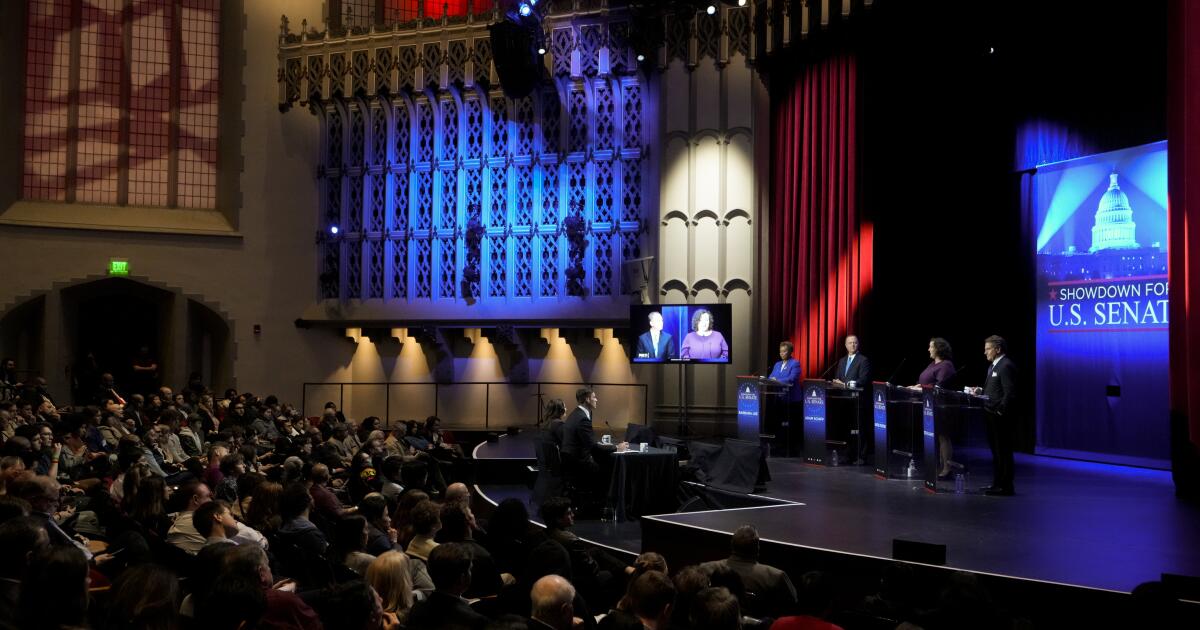
When you agree 90% or more of the time with your political opponents, how do you differentiate yourself?
That was the challenge facing three Democrats who took the stage for the first statewide televised debate of California’s highly competitive, vastly expensive U.S. Senate contest.
The answer: Seize on those relatively few differences and emphasize them loudly and repeatedly. Add a strong overlay of anecdote and personal narrative. Throw an occasional elbow, for good measure.
If you’ve closely followed the Senate race, you would have easily recognized the Democratic contestants who assembled Monday night on a red, white and blue soundstage on the campus of USC.
If you haven’t, it didn’t take long to get their gist.
A deliberate Rep. Adam B. Schiff told how he personally took on former President Trump as a leading congressional tormentor and is a doer, not just a talker.
A passionate Rep. Barbara Lee offered her history as a progressive with a long history in Sacramento and Washington and the lived experience of a single Black mother who was once homeless and raised her children with the help of food stamps.
A vociferous Rep. Katie Porter pressed her case as a scourge of corporate interests who wants to shake up Washington and is not one of those promise-much, achieve-little career politicians. (Like Schiff and Lee, she averred, each with more than 20 years in Congress. Porter was elected in 2018.)
Standing out wasn’t difficult for the lone Republican among them, Steve Garvey, the former baseball great and (it was abundantly clear) a political novice.
Garvey would be irrelevant in the Senate race but for the state’s election system, in which the two top finishers in the March 5 primary advance to November’s general election, regardless of party. That makes the jostling for second place nearly as important as the fight for the top spot.
Garvey has little to no chance of winning the Senate seat, given the enfeebled state of the GOP in California and its poor image among the state’s Democratic-leaning electorate. But by consolidating Republican support — the party has 5 million-plus registered voters in California, more than the population of many states — Garvey could easily reach November’s runoff.
His appearance Monday night was a political debut of sorts, and a shaky one at that.
Garvey is caught in a dilemma, trying to appease the Trump-loving Republican base without alienating the far greater number of Californians who loathe the ex-president. Even the most nimble politician would have a hard time managing that feat, and Garvey proved himself anything but.
He voted twice for Trump and, after being repeatedly pressed Monday night for an answer, strongly intimated he would do so again. Garvey, however, refused to directly say as much, instead offering this: “At the end of the day, it’s all a personal choice. As my personal choice, I will make it in the sovereignty of wherever it is and that’s my personal choice.”
He also stumbled when asked about the abortion issue. Although Garvey personally opposes the procedure, he said he would support reproductive rights as a U.S. senator. “The people of California have spoken and I pledge to support that voice,” he said.
The debate co-moderator, Politico’s Melanie Mason, then followed up by asking whether Garvey would similarly abide by the will of most Californians who strongly support stricter gun laws and oppose Trump’s return to office.
More word salad.
“Well I have my opinions, obviously,” Garvey said. “And with common sense and compassion and ability of consensus. You know, I look at all the issue. I think I’m fair.”
Throughout the night, Garvey was vague on most issues and just plain confusing on others. At one point he suggested the solution to California’s housing affordability crisis was cutting excessive Washington spending and opening up “the pipes of gas and oil” to reduce energy costs.
Will the performance cost Garvey with voters? That’s not clear.
He displayed an affable, aw-shucks style reminiscent of the political hero he name-checked, Ronald Reagan, who easily survived his share of gaffes by delivering them in a similarly soothing, avuncular style.
Will earmarks decide the Senate contest?
It was one of the main points of contention among the Democrats, with Porter forswearing the practice — in which lawmakers direct federal funding to specific, often pet projects — and Lee and Schiff both defending the process.
“Earmarks,” Porter insisted, “is just a fancy word for politicians substituting their personal interest … for what our needs are.”
“I believe in earmarks,” Lee said. “I believe in not being derelict in my duty.”
Will the war between Hamas and Israel prove decisive? (Elections are rarely decided on foreign policy.)
Lee’s early call for a cease-fire in Gaza set her apart from both Schiff and Porter, and she reiterated that Monday night. “The only way to keep Israel secure is through a permanent cease-fire,” Lee said.
Schiff disagreed. Hamas is “still holding over 100 hostages, including Americans. I don’t know how you can ask any nation to cease fire when their people are being held by a terrorist organization.”
“Cease-fire is not a magic word,” Porter said. “You can’t say it and make it so.”
Listen closely, and there were other differences.
Lee and Porter both favored a system of government-run, universal healthcare. Schiff said he favored “Medicare for all,” but allowing those who preferred their private healthcare to keep it.
The debate was the first of three scheduled televised sessions.
Maybe the next two will do more to establish some yawning differences among the leading Democrats. Otherwise, the Senate contest seems likely to be decided more on matters of style than substance.
And, this being California, which candidate has the needed bankroll to reach the millions of voters who won’t pay attention to any of their debates.



new video loaded: Vance Says Pope Should Stay Out of U.S. Affairs
transcript
transcript
Vance Says Pope Should Stay Out of U.S. Affairs
Vice President JD Vance weighed in on the tension between President Trump and Pope Leo XIV as Catholics expressed dismay about Mr. Trump’s attacks.
-
“I certainly think that in some cases, it would be best for the Vatican to stick to matters of morality, to stick to matters of, you know, what’s going on in the Catholic Church and let the president of the United States stick to dictating American public policy.” “I don’t think that the message of the Gospel is meant to be abused in the way that some people are doing. And I will continue to speak out loudly against war, looking to promote peace.” “Pope Leo said things that are wrong. There’s nothing to apologize for. He’s wrong.” “I’m not a big fan of Pope Leo. He’s a very liberal person. I don’t think he’s doing a very good job.” “I did post it, and I thought it was me as a doctor, and it had to do with the Red Cross. There’s a Red Cross worker there, which we support.” “It’s terrible. It’s gross. It’s blasphemous.” “I stand with the pope. I mean, the pope speaks the Gospel. He speaks for peace.”

By Shawn Paik
April 14, 2026

NEWYou can now listen to Fox News articles!
The Justice Department released a report Tuesday alleging the Biden administration weaponized federal law by selectively prosecuting pro-life activists under the Freedom of Access to Clinic Entrances (FACE) Act, following a review of more than 700,000 internal records.
DOJ officials said prosecutors coordinated with abortion-rights groups to track activists, sought harsher sentences for pro-life defendants and, in some cases, withheld evidence or tried to exclude jurors based on religion.
“This department will not tolerate a two-tiered system of justice,” Acting Attorney General Todd Blanche said in a statement. “No Department should conduct selective prosecution based on beliefs. The weaponization that happened under the Biden Administration will not happen again, as we restore integrity to our prosecutorial system.”
PRO-LIFE JOURNALIST ASSAULTED ON STREET ASSIGNS BLAME TO DEMOCRATIC RHETORIC
The Justice Department released a report Tuesday alleging the Biden administration weaponized federal law by selectively prosecuting pro-life activists under the Freedom of Access to Clinic Entrances (FACE) Act, following a review of more than 700,000 internal records. Anti-abortion activists march across the National Mall near the U.S. Capitol during the 50th annual March for Life rally on Jan. 20, 2023 in Washington, DC. (Chip Somodevilla/Getty Images)
The Justice Department’s “Weaponization Working Group” — a review team created under the Trump administration to examine whether federal law was used in a biased or politically motivated way — said it reviewed internal communications, case files and prosecutorial decisions tied to enforcement of the FACE Act, a law intended to protect access to abortion clinics and pregnancy resource centers.
The report found officials under the Biden administration worked closely with groups including Planned Parenthood, the National Abortion Federation and the Feminist Majority Foundation, which helped compile information on pro-life activists used in investigations and prosecutions.
The report said, “The Biden DOJ prosecutors knowingly withheld evidence that defense counsel requested to prepare an affirmative defense.”
In one case, a DOJ official told defense counsel, “I do not keep the kind of records you requested and, as a result, I do not believe that we will provide them to you,” when asked for data to support a selective prosecution defense.
The report said the official had the information “readily available” but declined to share it with the defense.
PLANNED PARENTHOOD APOLOGIZES FOR ‘INADVERTENTLY’ GIVING SEXUALLY EXPLICIT COLORING BOOK TO CHILDREN
Acting Attorney General Todd Blanche said the Justice Department will not tolerate a “two-tiered system of justice.” (Tom Williams/CQ Roll Call)
The report also alleged prosecutors attempted to screen out jurors based on religious beliefs and, in some cases, opted for aggressive arrest tactics rather than allowing defendants to voluntarily surrender.
For instance, the report cited a case involving pro-life activist Mark Houck in which prosecutors declined a request for him to self-surrender and instead authorized an FBI arrest at his home.
DOJ officials further claimed pro-life defendants faced significantly harsher sentencing requests, with prosecutors seeking an average of 26.8 months in prison compared to 12.3 months for defendants accused of violence against pro-life organizations.
The report argued the Biden administration’s enforcement of the FACE Act was uneven, with authorities prioritizing cases involving abortion clinics while failing to adequately pursue attacks on pregnancy resource centers and churches.
The Justice Department said the Trump administration has already taken steps to reverse course, including issuing pardons for some pro-life activists, dismissing several civil cases and limiting future FACE Act prosecutions to “extraordinary circumstances” involving significant aggravating factors.
President Donald Trump also signed pardons for pro-life activists convicted under the prior administration.
CLICK HERE TO DOWNLOAD THE FOX NEWS APP
Merrick Garland headed the Justice Department under the Biden administration. (Tom Williams/CQ-Roll Call, Inc via Getty Images)
Assistant Attorney General Daniel Burrows said the findings raised serious concerns about the conduct of department attorneys.
“The behavior unearthed in this report is shameful,” Burrows said in a statement. “Lawyers who should have known better withheld evidence, worked to keep committed religious people off juries and generally allowed the Department of Justice to be used as the enforcement arm of pro-abortion special interests.”

Prior to the Supreme Court’s 2015 Obergefell decision, opponents raised alarms about the severe and immediate harms that would surely occur if marriages between same-sex couples were recognized nationally. Afterward, when those harms failed to materialize, those voices grew quieter, but some have been returning with renewed vigor, in hopes that the current Supreme Court, after overturning Roe vs. Wade, may be willing to overturn the Obergefell decision as well — though the justices declined to do so in November.
To build public support for rolling back marriage rights, new campaigns have been repeating the claims that legal recognition of same-sex marriages may harm children or even the stability of different-sex marriages. These are some of the same concerns that were raised in the years prior to the Obergefell decision. They were groundless then, and, more than 10 years later, the data confirm these fears to be unfounded.
In 2024, for the 20th anniversary of the first legal marriages of same-sex couples (in Massachusetts), my lab at UCLA joined with a team of researchers at Rand Corp. to review what social scientists learned over those two decades about the consequences of legalizing same-sex marriage.
We addressed this question in two ways. First, we searched through the research literature to find every published study that had examined the consequences of legalizing same-sex marriage. Prior to 2015, states legalized and prohibited same-sex marriage at different times, and social scientists tracked a wide range of outcomes, including the well-being of children, national trends in marriage and divorce, and the physical and mental health of same-sex couples. Opponents of legalizing same-sex marriage predicted, in the strongest terms, that people would suffer after same-sex couples were granted the right to marry.
After 20 years of legalized marriage for same-sex couples, 96 independent studies confirm there is no evidence for the harms critics predicted. Our review identified not a single study that observed significant negative consequences of legalizing same-sex marriage. Instead, the research literature identified many significant positive consequences.
For same-sex couples, legal recognition of their marriages was followed by more stable relationships, increased mental and physical health, greater financial stability, and stronger connections to family. For the children of those couples, our review found no documented negative outcomes, but legal recognition of their parents’ marriages did result in more children obtaining access to health insurance. And what about the rest of the country? States that recognized same-sex marriages prior to Obergefell experienced economic gains and considerable savings in healthcare costs relative to states that did not.
One of the most striking predictions of the opponents of same-sex marriage was that recognizing marriage among same-sex couples would weaken commitment to the institution of marriage among different-sex couples. That did not happen either.
To address this question, our report conducted new analyses, drawing on census data and other sources to determine whether state-level rates of marriage, cohabitation and divorce changed in the states that recognized same-sex marriage, compared with states that did not. No matter how we conducted the analyses, we could find no effects of recognizing same-sex marriage on any of these outcomes. It makes sense: When different-sex couples are making personal decisions about their own relationships, they are not paying much attention to what same-sex couples are doing.
If any harm resulted from allowing same-sex couples to marry, it ought to be well documented by now. The fact that there has been no evidence of harms despite considerable effort to find some suggests that the predictions made by opponents of legalizing same-sex marriage were unwarranted at the time. Now that we have 20 years of research and experience, those predictions remain unwarranted now.
Benjamin Karney is a professor of social psychology at UCLA.
Insights
L.A. Times Insights delivers AI-generated analysis on Voices content to offer all points of view. Insights does not appear on any news articles.
Viewpoint
Perspectives
The following AI-generated content is powered by Perplexity. The Los Angeles Times editorial staff does not create or edit the content.
Ideas expressed in the piece
-
The article argues that research from over two decades demonstrates same-sex marriage legalization produced substantial benefits for same-sex couples, including more stable relationships, improved mental and physical health, greater financial stability, and stronger family connections[1][2].
-
The piece contends that children of same-sex couples experienced no documented negative outcomes following legal recognition of their parents’ marriages, while gaining increased access to health insurance[2].
-
The column suggests that states recognizing same-sex marriages prior to the 2015 Obergefell decision experienced measurable economic gains and considerable healthcare cost savings compared to states that did not recognize such marriages.
-
The article maintains that one of the primary concerns raised by opponents—that legalizing same-sex marriage would weaken commitment to marriage among different-sex couples—failed to materialize, with analyses showing no effects on state-level marriage, cohabitation, or divorce rates.
-
The piece contends that approximately 96 independent studies confirm there is no evidence for the harms critics predicted would result from legalizing same-sex marriage, and that not a single study documented significant negative consequences.
Different views on the topic
-
Historically, some researchers suggested potential concerns about children raised by same-sex parents, with the New Family Structures Study initially concluding that people with same-sex parents faced greater risks of adverse outcomes including unemployment and lower educational attainment[3].
-
Some research has indicated that same-sex couples, particularly female-female couples, experience higher divorce rates compared to different-sex couples, with a 2022 study finding female-female marriages had 29% higher divorce rates relative to female-male marriages, and that lesbian unions demonstrate considerably less stability than gay male unions[4].

A tornado touched down in Taylor County on April 13, NWS confirms

Former four-star Georgia Tech freshman center commits to Big 12 program

TV Show Explores Wyoming’s Strangest House

Deutsche Börse Invests $200 Million in Crypto Exchange Kraken

The Impact of Financial Advisors Since the Uptick in Policy Risk – Center for Retirement Research

Florida High School Football Rankings: Top 25 teams – Oct. 21

How old is Bo Nix? What to know about Oregon quarterback ahead of 2024 NFL Draft

Cleary's 21 help Le Moyne down Central Connecticut State 69-64 in OT

99th annual Pony Swim held in Virginia

Indiana Members Credit Union announced as new anchor tenant at Bottleworks District

Video: How Stephen Miller Is Adjusting Trump’s Immigration Agenda

Biden DOJ weaponized FACE Act against pro-life Americans, 882-report alleges

Mass drone warfare is Europe’s rising security threat
Man accused in Molotov cocktail attack of OpenAI CEO’s home charged with attempted murder

Embattled Rep Tony Gonzales announces plans to resign amid sexual misconduct allegations
-

 Atlanta, GA1 week ago
1 teenage girl killed, another injured in shooting at Piedmont Park, police say
-

 Georgia7 days ago
Georgia House Special Runoff Election 2026 Live Results
-

 Arkansas4 days ago
Arkansas TV meteorologist Melinda Mayo retires after nearly four decades on air
-

 Pennsylvania1 week ago
Parents charged after toddler injured by wolf at Pennsylvania zoo
-
 Milwaukee, WI1 week ago
Potawatomi Casino Hotel evacuated after fire breaks out in rooftop HVAC system
-

 Austin, TX6 days ago
ABC Kite Fest Returns to Austin for Annual Celebration – Austin Today
-

 World1 week ago
Zelenskyy warns US-Iran war could divert critical aid from Ukraine
-

 World1 week ago
Indonesia receives bodies of peacekeepers killed in southern Lebanon