Politics
Column: Kevin McCarthy wants vengeance. Now he's free to pursue it

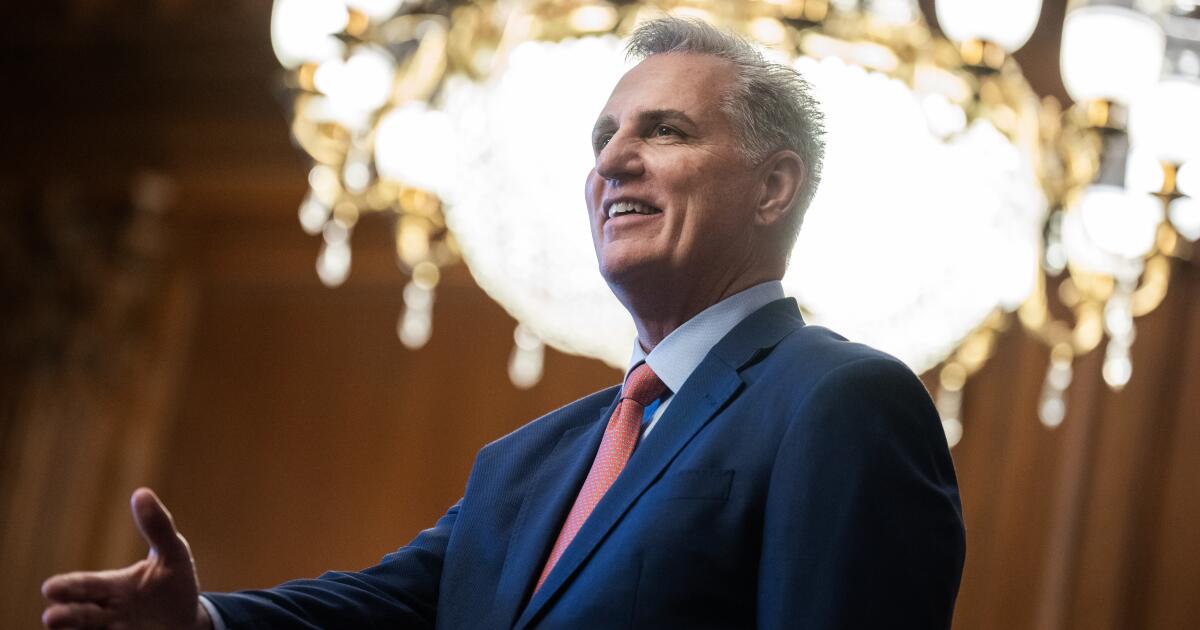
Kevin McCarthy is having a grand old time.
He’s traveling the country giving six-figure speeches, playing pundit and elder statesman on TV, holding forth at high-brow political forums and, not least, plotting vengeance against those behind his unceremonious ouster as House speaker.
Eight Republican lawmakers joined 208 Democrats in toppling the former Bakersfield congressman, the first time in history a House leader has been voted out. Rather than hang on, McCarthy left office at the end of 2023.
Two of the eight Republicans are joining him in retirement. Three others — Bob Good of Virginia, Eli Crane of Arizona and Nancy Mace of South Carolina — face strong primary challenges. McCarthy has been working behind the scenes to end their congressional careers, strategizing and directing money and other resources to their opponents.
“He wants to hold to account those who pushed him out,” said a Central Valley political operative, who has a decades-long relationship with McCarthy.
Like most, the operative asked not to be quoted by name, to preserve his relationship with the ex-speaker. McCarthy declined to be interviewed, perhaps because of the ways — feckless, morally bankrupt — your friendly columnist has described him.
McCarthy’s chief nemesis, according to several who have spoken with him, is Rep. Matt Gaetz, who was the main instigator of McCarthy’s downfall. The pugnacious Florida Republican faces little danger of losing his House seat but may run for governor in 2026.
During an appearance this month at Georgetown University, McCarthy dropped a depth charge on Gaetz, insisting the only reason he lost the speakership is that “one person wanted me to stop an ethics complaint because he slept with a 17-year-old.”
“Did he do it?” McCarthy added, after asserting for all the world he had. “I don’t know.”
The reference was to allegations that Gaetz paid for sex, including relations with an underage girl, while in Congress. The Justice Department investigated the Florida lawmaker and decided not to bring charges. The House Ethics Committee is continuing its probe.
“McCarthy is a liar,” Gaetz shot back on social media. “That’s why he is no longer speaker.”
McCarthy is a political animal down to his marrow and the speakership is a job he coveted much of his career. His tenure — less than nine months — lasted barely long enough to pose for the portrait that will someday hang in the Capitol.
But now, said one political associate, McCarthy feels free. He’s no longer responsible for shepherding a colicky, eyelash-thin Republican majority — over to you, Mike Johnson! — and can fully devote himself to what has long been McCarthy’s forte: campaigns and elections.
He remains close to the many lawmakers he recruited and helped get in office and keeps in touch with a nationwide donor network built during years as one of the GOP’s top congressional strategists.
Keeping Republican control of the House is, of course, a top priority for McCarthy this November. So is reelecting members like Orange County’s Young Kim and Michelle Steel and Oregon’s Lori Chavez-DeRemer, who helped diversify the white-as-snow ranks of the House GOP.
The recent Georgetown seminar, billed as a discussion of the durability of American democracy, put McCarthy’s strength and failings on full display.
He was charming. He was affable. He was self-deprecating, offering to field students’ questions for as long as they liked, seeing as how “I don’t have a job anymore.”
McCarthy broke with former President Trump and many fellow Republicans by supporting U.S. aid for Ukraine and likening Vladimir Putin to Hitler. He said, without the slightest hesitation, that Joe Biden won the 2020 election, shooting down Trump’s persistent lies about his defeat.
He also dodged and deflected.
McCarthy drew false equivalence between the griping of sour-grape Democrats who lost elections and the pernicious legal and tactical fights Trump and his allies waged to overturn Biden’s victory.
He suggested, with a straight face, that Trump is merely “defending due process” when he refers to the violent perpetrators of Jan. 6 as “hostages.”
He said he never heard Trump speak of immigrants “poisoning the blood” of America, which is plausible only if you think McCarthy just arrived on Earth via spaceship from Mars.
The erstwhile speaker, who remains in touch with the ex-president, has been mentioned as a prospective recruit for a second Trump administration. He’s done little to jeopardize his chances.
One thing that McCarthy is apparently not interested in, say several people who have spoken with him, is raking in big bucks an an influence peddler.
While he pulls down $100,000 to $150,000 a speech, according to one political ally, McCarthy could make a good deal more with much less effort by capitalizing on his connections in Washington and Sacramento.
But Cathy Abernathy, a GOP strategist who has known McCarthy for decades, said he’s much happier and better suited to working in the campaign realm.
“There’s plenty of people back there being lobbyists,” said Abernathy, who hired McCarthy in 1987 as an intern in then-Rep. Bill Thomas’ Bakersfield office. “His skills and talent are with people and politics and strategizing on the way to elect a viable Republican majority.”
McCarthy is particularly deft, she said, “understanding the politics of a district, the kind of candidate that fits a district, the kinds of campaigns that work with the voters in that district.”
And now McCarthy has added incentive to ply that knowledge, beyond his lifelong affinity for Republican candidates and causes: Payback.

Politics
Fetterman unleashes on ‘dirtbag’ wing of Dems after far-left victories: ‘Orgy of socialism’

NEWYou can now listen to Fox News articles!
Sen. John Fetterman, D-Pa., unloaded on his own party on Sunday evening, blasting a series of victories for progressives he called “anti-America.”
“Big night for the dirtbag left,” Fetterman said, referring to New York’s recent primaries, where two members of the Democratic Socialists of America (DSA) won primaries.
“I’ve said the party is becoming an orgy of socialism. Clearly anti-America, anti-Western Civilization,” Fetterman said.
Fetterman’s striking calls give a rare look at how some moderates may view the developments on their far-left flank that have dominated the party’s momentum in recent months, sparking concern that their high visibility is dragging the party further and further left.
FETTERMAN WARNS DEMOCRATS ‘DRIFTING FIRMLY INTO COMMUNISM’ AFTER SOCIALIST PRIMARY WINS
Sen. John Fetterman, D-Pa., speaks to reporters outside the Senate Chamber during votes on Nov. 10, 2025, on Capitol Hill in Washington, D.C. (Andrew Harnik/Getty Images)
His comments come on the heels of a handful of key progressive victories.
In Maine, Graham Platner, a controversial Democratic candidate for U.S. Senate, has attracted controversy for denying knowledge of the meaning behind a Nazi-linked tattoo, for off-color comments about race and calling himself a “communist” in a deleted Reddit post.
In New York, one DSA member, Claire Valdez, won a primary on a platform of abolishing ICE and a Green New Deal-style approach to climate change. Similarly, Darializa Avila-Chevalier, another DSA candidate, beat out incumbent Rep. Adriano Espillat, D-N.Y., a high-ranking Democrat and the chair of the Congressional Hispanic Caucus.
WINNERS AND LOSERS EMERGE AFTER SOCIALIST EARTHQUAKE ROCKS NYC PRIMARIES
Graham Platner, Democratic Senate candidate for Maine, speaks at a primary election night event at the Blue Hill YMCA in Blue Hill, Maine, on June 9, 2026. Platner won the party’s Senate primary after a campaign marked by accusations of past misbehavior and voter concerns. (Graeme Sloan/Bloomberg via Getty Images)
Both Chevalier and Valdez had the backing of New York Mayor Zohran Mamdani, himself a socialist.
The wins have captured national attention and drawn criticisms from Republicans who have pointed to their success as emblematic of the direction of the Democratic Party.
Fetterman, who has not shied away from confrontations, has been one of the few Democrats to express alarm about the kind of candidates carrying the party’s banner.
“I mean, you look at some of the things that people have said. Abolish prison, abolish the border, abolish ICE, I mean these crazy people — I have colleagues in my caucus that refuse to even call this out,” Fetterman said.
FETTERMAN REACTS TO MAMDANI’S REFUSAL TO ACCEPT SUPREME COURT’S IMMIGRATION RULING
U.S. Sen. John Fetterman, D-Pa., walks through the Senate Subway during the Senate War Powers vote on April 22, 2026, in Washington, D.C. (Heather Diehl/Getty Images)
CLICK HERE TO DOWNLOAD THE FOX NEWS APP
“Between P-hustle in Maine and some of the other winners in New York, they should form their own party and run on all the things that they’ve had to delete on social media,” Fetterman said, referring to Platner.
“That’s where our party has moved,” he added.
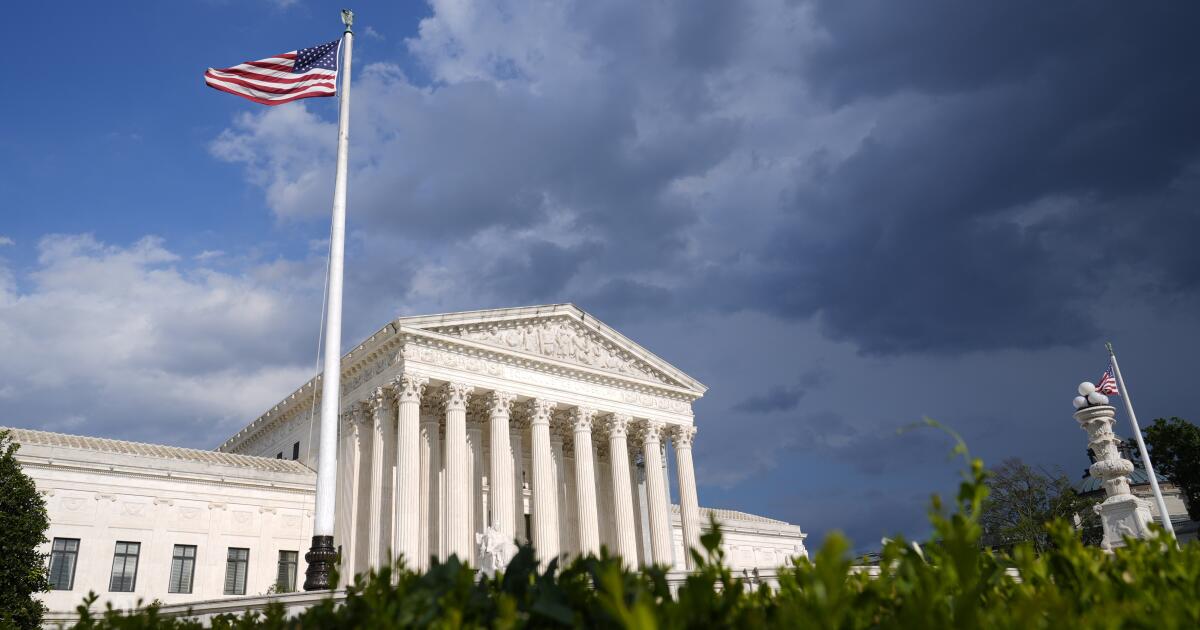
WASHINGTON — The Supreme Court cast doubt Monday on whether police may obtain cellphone data to find crime suspects.
In a 6-3 decision, the justices said this location information showing where a cellphone user has traveled is personal and private and subject to the protection of the 4th Amendment’s ban on unreasonable searches.
Justice Elena Kagan said these “records serve as a personal journal of a user’s movements.”
She said the information “resembles other private materials — think of emails, documents, photographs, or calendars—that even if stored on Google’s servers, a user reasonably views as his own…and reasonably expects to be shielded from the inquisitive eyes of the government.”
Because an “individual has a legitimate expectation of privacy in his cellphone location data,” she said police investigators need a valid search warrant from a magistrate.
The court stopped short of deciding the proper basis for a search warrant in such cases. Instead, the justices sent the case back to judges in Virginia.
But the outcome casts doubt on “geofence warrants.”
In recent years, police have gone to Google and cellphone companies seeking tracking data on cellphones that were at a crime scene. Sometimes, they have had a warrant from a magistrate.
Civil libertarians say the use of this tracking data raises the specter of mass surveillance on innocent people.
Police and government lawyers say no one has a reasonable right to privacy when they are walking on a sidewalk or driving down the street.
The case before the court arose from the armed robbery conviction of a Virginia man who stole $195,000 from a credit union in a small town near Richmond.
By the time police arrived, the robber had fled. But surveillance cameras showed he was carrying a gun and a cellphone.
Lacking other leads, detective Joshua Hilton asked a judge to issue a special type of warrant seeking information from Google.
Referred to as a “geofence warrant,” it seeks data from phones in a particular area at a particular time.
The detective sought data on phones that were within 150 yards of the credit union within one hour of the late afternoon robbery.
After examining and paring down the data, the detective asked for the phone records of Okello Chatrie. Then, with a search warrant of his home, investigators found two robbery-style demand notes, a semi-automatic pistol and about $100,000 in cash.
A judge refused to suppress the evidence from an allegedly unconstitutional search, and Chatrie entered a conditional guilty plea.
The full 4th Circuit Court of Appeals split evenly on the legality of the geofence warrant, and the Supreme Court agreed to decide the issue in Chatrie vs. U.S.
Usually investigators obtain warrants to search the home or vehicle of a known crime suspect.
The new and disputed geofence warrants seek to find a suspect by examining data on the cellphones that were at the scene of a crime.
The FBI used this cellphone data in 2021 to identify suspects who broke through police barricades on Jan. 6, 2021, and pushed their way into the Capitol to disrupt the official counting of electoral votes.
Chief Justice John G. Roberts Jr. and Justices Sonia Sotomayor, Neil M. Gorsuch, Brett M. Kavanaugh and Ketanji Brown Jackson agreed on the outcome in Chatrie vs. U.S.
In a 21-page dissent, Justice Samuel A. Alito Jr. said the court had “carefully set the stage for its planned performance: striking a pose as a great champion of privacy in the digital age. I cannot support this irresponsible escapade.”
Justice Clarence Thomas agreed.
Justice Amy Coney Barrett agreed in a one-paragraph dissent. “Chatrie had no reasonable expectation of privacy in data about his public movements that he voluntarily disclosed to Google,” she said.
The Supreme Court ruled 6-3 that President Trump could fire independent regulators for any reason. But the justices carved out an exception for the Federal Reserve, preventing the immediate removal of Lisa D. Cook, a Federal Reserve governor.
-

 New Mexico3 minutes ago
Did US drug agents allow lethal fentanyl to hit New Mexico’s streets?
-

 North Carolina8 minutes ago
North Carolina budget nears completion with focus on pay raises
-

 North Dakota15 minutes ago
North Dakota water damage expert trains mold detection dog
-

 Ohio18 minutes ago
Central Ohio under extreme heat warning as heat index over 105 expected
-

 Oklahoma30 minutes ago
Oklahoma’s Kyle Dillingham, Peter Markes to perform at Great American State Fair
-

 Oregon33 minutes ago
Baker County was 1st official jurisdiction in Eastern Oregon – La Grande Observer
-

 Pennsylvania38 minutes ago
Editorial: Classrooms reflect Pennsylvania’s demographic reality
-

 Rhode Island45 minutes ago
Rhode Island wins 5 gold medals at 2026 Special Olympics

