Politics
California’s role in shaping the fate of the Democratic Party and combating Trump on full display


California’s potential to lead a national Democratic comeback was on full display as party leaders from across the country recently gathered in downtown Los Angeles.
But is the party ready to bet on the Golden State?
Appearances at the Democratic National Committee meeting by the state’s most prominent Democrats, former Vice President Kamala Harris and Gov. Gavin Newsom, crystallized the peril and promise of California’s appeal. Harris failed to beat a politically wounded Donald Trump in the 2024 presidential race and Newsom, now among President Trump’s most celebrated critics, is considered a top Democratic contender to replace the Republican president in the White House in 2028.
California policies on divisive issues such as providing expanded access to government-sponsored healthcare, aiding undocumented immigrants and supporting LGBTQ+ rights continually serve as a Rorschach test for the nation’s polarized electorate, providing comfort to progressives and ammunition for Republican attack ads.
“California is like your cool cousin that comes for the holidays who is intriguing and glamorous, but who might not fit in with the family year-round,” said Elizabeth Ashford, a veteran Democratic strategist who worked for former Govs. Jerry Brown and Arnold Schwarzenegger and Harris when she was the state’s attorney general.
Newsom, in particular, is quick to boast about California being home to the world’s fourth-largest economy, a billion-dollar agricultural industry and economic and cultural powerhouses in Hollywood and the Silicon Valley. Critics, Trump chief among them, paint the state as a dystopian hellhole — littered with homeless encampments and lawlessness, and plagued by high taxes and an even higher cost of living.
Only two Californians have been elected president, Republicans Ronald Reagan and Richard Nixon. But that was generations ago, and Harris and Newsom are considering bids to end the decades-long drought in 2028. Both seized the moment by courting party leaders and activists during the three-day winter meeting of the Democratic National Committee that ended Saturday.
Harris, speaking to committee members and guests Friday, said the party’s victories in state elections across the nation in November reflect voters’ agitation about the impacts of Trump’s policies, notably affordability and healthcare costs. But she argued that “both parties have failed to hold the public’s trust.”
“So as we plan for what comes after this administration, we cannot afford to be nostalgic for what was, in fact, a flawed status quo, and a system that failed so many of you,” said Harris, who was criticized after her presidential campaign for not focusing enough on kitchen table issues, including the increasing financial strains faced by Americans.
While Harris, who ruled out running for governor earlier this year, did not address whether she would make another bid for the White House in 2028, she argued that the party needed to be introspective about its future.
“We need to answer the question, what comes next for our party and our democracy, and in so doing, we must be honest that for so many, the American dream has become more of a myth than a reality,” she said.
Many of the party leaders who spoke at the gathering focused on California’s possible role in determining control of Congress after voters in November approved Proposition 50, a rare mid-decade redrawing of congressional districts in an effort to boost the number of Democrats in the state’s congressional delegation in the 2026 election.
Los Angeles Mayor Karen Bass rallied the crowd by reminding them that Democrats took back the U.S. House of Representatives during Trump’s first term and predicted the state would be critical in next year’s midterm elections.
Mayor Karen Bass speaks at the Democratic National Committee Winter Meeting at the InterContinental Hotel in downtown Los Angeles on Friday.
(Genaro Molina/Los Angeles Times)
Newsom, who championed Proposition 50, basked in that victory when he strode through the hotel’s corridors at the DNC meeting the day before, stopping every few feet to talk to committee members, shake their hands and take selfies.
“There’s just a sense of optimism here,” Newsom said.
Democratic candidates in New Jersey and Virginia also won races by a significant margin last month which, party leaders say, were all telltale signs of growing voter dissatisfaction with Trump and Washington’s Republican leadership.
“The party, more broadly, got their sea legs back, and they’re winning,” Newsom said. “And winning solves a lot of problems.”
Louisiana committee member Katie Darling teared up as she watched fellow Democrats flock to Newsom.
“He really is trying to bring people together during a very difficult time,” said Darling, who grew up in Sacramento in a Republican household. “He gets a lot of pushback for talking to and working with Republicans, but when he does that, I see him talking to my mom and dad who I love, who I vehemently disagree with politically. … I do think that we need to talk to each other to move the country forward.”

Gov. Gavin Newsom speaks as his wife Jennifer Siebel Newsom looks on during an election night gathering at the California Democratic Party headquarters on November 04, 2025 in Sacramento.
(Justin Sullivan / Getty Images)
Darling said she listens to Newsom’s podcast, where his choice of guests, including the late Charlie Kirk, and his comments on the show that transgender athletes taking part in women’s sports is “deeply unfair” have drawn outrage from some on the left.
Illinois Gov. J.B. Pritzker, another potential 2028 presidential candidate whose family has historically supported Newsom, was also reportedly on site Thursday, holding closed-door meetings. And former Transportation secretary Pete Buttigieg, also a possible White House contender, was in Los Angeles on Thursday, appearing on Jimmy Kimmel’s late-night show and holding meetings.
Corrin Rankin, chair of the California Republican Party, cast the DNC meetings in L.A. as “anti-Trump sessions” and pointed to the homeless encampments on Skid Row, just blocks from where committee members gathered.
“We need accountability and solutions that actually get people off the streets, make communities safer and life more affordable,” Rankin said.
Elected officials from across the nation are drawn to California because of its wellspring of wealthy political donors. The state was the largest source of contributions to the campaign committees of Trump and Harris during the 2024 presidential contest, contributing nearly a quarter of a billion dollars, according to the nonpartisan, nonprofit organization Open Secrets, which tracks electoral finances.
While the DNC gathering focused mostly on mundane internal business, the gathering of party leaders attracted liberal groups seeking to raise money and draw attention to their causes.
Actor Jane Fonda and comedian Nikki Glaser headlined an event aimed at increasing the minimum wage at the Three Clubs cocktail bar in Hollywood. California already has among the highest minimum wages in the nation; one of the organizers of the event is campaigning to increase the rate to $30 per hour in some California counties.
“The affordability crisis is pushing millions of Americans to the edge, and no democracy can survive when people who work full time cannot afford basic necessities,” Fonda said prior to the event. “Raising wages is one of the most powerful ways to give families stability and hope.”
But California’s liberal policies have been viewed as a liability for Democrats elsewhere, where issues such as transgender rights and providing healthcare for undocumented immigrants have not been warmly received by some blue-collar workers who once formed the party’s base.
Trump capitalized on that disconnect in the closing months of the 2024 presidential contest, when his campaign aired ads that highlighted Harris’ support of transgender rights, including taxpayer-funded gender-affirming surgery for inmates.
“Kamala is for they/them, President Trump is for you,” the commercial stated. The ad aired more than 30,000 times in swing states in the fall, notably during football games and NASCAR races.
“Kamala had 99 problems. California wasn’t one of them,” said John Podesta, a veteran Democratic strategist who served a senior advisor to former President Biden, counselor to former President Obama and White House chief of staff for former President Clinton.
He disputed the argument that California, whether through its policies or candidates, will impact Democrats’ chances, arguing there’s a broader disconnect between the party and its voters.
“This sense that Democrats lost touch with the middle class and the poor in favor of the cultural elite is a real problem,” said Podesta. “My shorthand is, we used to be the party of the factory floor, and now we’re the party of the faculty lounge. That’s not a California problem. It’s an elitist problem.”
While Podesta isn’t backing anyone yet in the 2028 presidential contest, he praised Newsom for his efforts to not only buck Trump but the “leftist extremists” in the Democratic party.
The narrative of Californians being out of touch with many Americans has been exacerbated this year during the state’s battles with the Trump administration over immigration, climate change, water and artificial intelligence policy. But Newsom and committee members argued that the state has been at the vanguard of where the nation will eventually head.
“I am very proud of California. It’s a state that’s not just about growth, it’s about inclusion,” the governor said, before ticking off a list of California initiatives, including low-priced insulin and higher minimum wages. “So much of the policy that’s coming out of the state of California promotes not just promise, but policy direction that I think is really important for the party.”


new video loaded: Steve Hilton Holds Slim Early Lead in California Governor’s Race
transcript
transcript
Steve Hilton Holds Slim Early Lead in California Governor’s Race
Steve Hilton, a Republican and former Fox News host, held a narrow lead in early votes over two Democratic opponents in California’s nonpartisan primary for governor. The top two candidates will advance to the general election in November.
-
“Change is coming to California, and it’s long overdue. I want to just say something from my heart to every single person who’s voted for me. We’re not — We’re not there yet, but it’s looking good.” [cheers] “Tonight, the people of the great state of California, in the greatest nation on earth, have spoken. [cheers] Loudly and proudly. [cheers] And while I take nothing for granted, there are lots of ballots left to be counted, it appears that we are on track to advance to November.” [cheers] “It might take some time to figure out where this is going. We’re going to wait until every ballot is counted. We’re going to give democracy a time to work, and we know we finished really strong.” [cheers]
By Axel Boada
June 3, 2026
Politics
Spencer Pratt surges to runoff in LA mayor’s race after angry voters send message to Karen Bass

NEWYou can now listen to Fox News articles!
Reality television personality Spencer Pratt appears on track to clear a key hurdle in Los Angeles’ mayoral race as he seeks to unseat incumbent Mayor Karen Bass in November.
Bass, who has led the city since 2022 amid a turbulent stretch rocked by her response to wildfires, advanced to a runoff after failing to secure a majority of the vote in Tuesday’s primary election. With no candidate surpassing the 50% threshold, the top two finishers will face off in a November runoff.
The anticipated runoff is a symbolic blow to Bass, who was endorsed by Gov. Gavin Newsom, D-Calif., and former Vice President Kamala Harris and has spent decades serving California in a series of elected Democratic offices.
Pratt, a first-time candidate known for the MTV reality show “The Hills,” was running in second place as of Wednesday morning.
Los Angeles Mayor Karen Bass attends the Women for Bass Phone bank event in the Baldwin Hills area of Los Angeles on June 1, 2026. (Louise Barnsley/Splash for Fox News Digital)
REALITY TV STAR SPENCER PRATT TESTS LA VOTERS’ APPETITE FOR POLITICAL OUTSIDER
“Obviously, God wanted five more months of me exposing the failures of our mayor,” Pratt gloated to reporters as the returns came in Tuesday evening.
Pratt has relentlessly hammered Bass on issues that have long plagued the city, including fire recovery, street homelessness and crime. The insurgent candidate holds Bass personally responsible for devastating wildfires that destroyed more than 18,000 structures in the city, including his Pacific Palisades home.
Pratt’s surge appears to have shut out Los Angeles City Council member Nithya Raman, a former ally of Bass who challenged the incumbent from the left and was once viewed as a threat to her bid for a second term. Raman is a member of the Democratic Socialists of America and has argued for steering the city in a more progressive direction.
Raman has not yet conceded despite running well behind Bass and Pratt as of Wednesday morning.
Pratt, a registered Republican, faces an uphill battle to defeat Bass in November if he advances to the runoff election.
Less than 20% of voters in the heavily Democratic city identify with the GOP, though Los Angeles’ mayoral contest is officially nonpartisan.
Media personality and independent candidate Spencer Pratt, left, pictured alongside LA mayor Karen Bass, right. (Robert Gauthier/Los Angeles Times via Getty Images; Justin Sullivan/Getty Images)
KAREN BASS GRILLED OVER BROKEN HOMELESSNESS PROMISE, BLAMES BUREAUCRACY FOR SLOWED PROGRESS
Rep. Darrell Issa, R-Calif., who represents a San Diego-anchored seat, told Fox News Digital that Pratt has won a following in the mayoral contest due to widespread voter discontent with Bass’ leadership.
“He’s catching fire among ardent historic Democrat voters because Karen Bass has been so ineffective,” Issa said in an interview. “And every time she opens her mouth, she’s talking about more of the same to people who have seen their streets, both crime-ridden and in fact … ineffectively managed.”
Bass, conversely, argues that her leadership is leading Los Angeles in the right direction.
“Los Angeles is at a turning point. After decades of rising homelessness, under-built housing and a shrinking police force, it’s Mayor Karen Bass who finally stepped up to change how City Hall works,” Bass’s website reads.
Los Angeles City Councilmember Nithya Raman appears likely to finish in third place, keeping her out of the November runoff. (Eric Thayer/Getty Images)
CLICK HERE TO DOWNLOAD THE FOX NEWS APP
“Homelessness is down, more housing is being built, and the LAPD is hiring new officers,” it also claims.
Fox News Digital’s Leo Briceno contributed reporting.
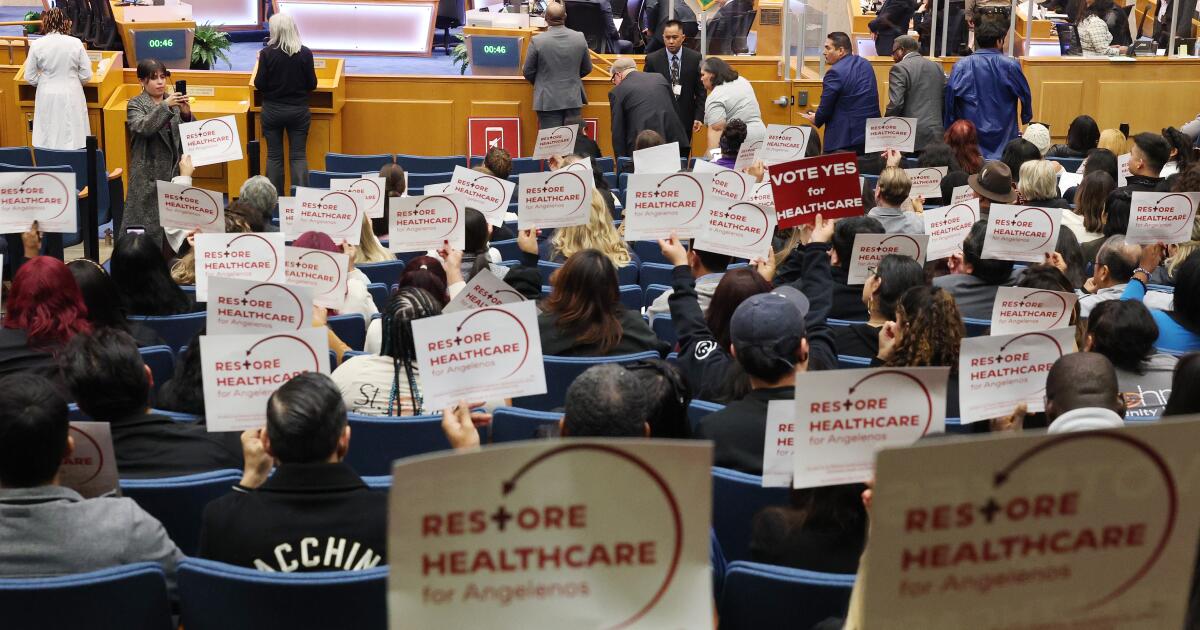
Los Angeles County’s half-cent sales tax to fund healthcare services was trailing Tuesday, with early returns showing a majority of voters rejecting the measure.
The tax — a half-penny of every dollar spent in the county — is meant to prop up local hospitals and clinics that are hemorrhaging funding after recent federal cuts.
The sales tax, which needs a simple majority to pass, would take effect Oct. 1 and last five years. Officials say it would pull in $1 billion annually to help plug the budget holes hitting local hospitals and clinics.
L.A. County health officials anticipate the One Big Beautiful Bill Act, signed into law by President Trump last summer, will slash more than $2 billion from the county’s health services budget within the next three years. Due to eligibility changes, the county will no longer be able to get reimbursements for many Californians who have lost Medi-Cal.
The measure was championed by a coalition of healthcare advocates called Restore Healthcare for Angelenos who warned that mass layoffs and emergency room closures could be imminent if new funding didn’t come fast. The Department of Public Health recently closed seven clinics — a grim sign, supporters said, of service cuts to come.
Voters haven’t rejected a sales tax hike since 2012, when a transportation measure fell just short with 66.1% support. It needed 66.7% to pass.
A majority of county supervisors had supported the new tax proposal, voting 4 to 1 this February to put it on the ballot. But the measure faced significant opposition from local cities, with opponents arguing the sales tax hike would unfairly burden the poorest county residents and encourage people to spend their dollars across the county line.
Supervisor Kathryn Barger, the board’s lone opponent of the tax, said she was concerned it was a “general” tax, meaning the money wouldn’t be earmarked for healthcare costs. Instead, she argued, politicians would have final say over how the money gets spent.
The supervisors have created a plan for spending the tax money, with the largest chunk of the money meant to cover the costs for patients without insurance. The measure also asked voters to sign off on a nine-member oversight committee.
The county currently has a base sales tax rate of 9.75%, and cities impose local taxes on top of that.
-

 Detroit, MI13 minutes ago
Detroit Tigers sweep Tampa Bay Rays in win as Dillon Dingler stays hot
-

 San Francisco, CA23 minutes ago
Retired San Francisco firefighter dies from lung cancer after Blue Shield denies treatment claims
-

 Dallas, TX28 minutes ago
Trackdown: Dallas 7-Eleven robbery suspect wanted
-

 Miami, FL35 minutes ago
This new Italian restaurant in Brickell only has 10 items on the menu
-

 Boston, MA38 minutes ago
Visiting Boston this summer? Here are 8 navigation tips you need to know.
-

 Denver, CO43 minutes ago
Denver-ish Central Market? RiNo food hall vendors claim they’ve been pushed out
-

 Seattle, WA50 minutes ago
New Ben & Jerry’s location opening at Seattle waterfront’s Pier 54
-

 San Diego, CA53 minutes ago
Padres designate Nick Castellanos for assignment

