Politics
California finance agency opposes child sex trafficking bill, cites potential prison inmate costs


A bill that would increase penalties for child sex buyers in California could die before getting a vote amid concerns from state finance officials over the costs of housing additional prison inmates.
California lawmakers last week placed Senate Bill 1414 on “suspense file,” a list of bills that are expected to cost the state a significant amount of money, during an Aug. 7 meeting. The bill will either advance or be killed without public discussion in a special Thursday hearing.
“When we pursued this to prevent children from being trafficked, bought and sold in the state of California, we never thought in a million years it would be this difficult,” Republican state Sen. Shannon Grove, who introduced the legislation and is its primary sponsor, told Fox News Digital.
GOV NEWSOM ORDERS HOMELESS ENCAMPMENTS TORN DOWN ACROSS CALIFORNIA: ‘NO MORE EXCUSES’
California state Sen. Shannon Grove, a Republican, speaks to lawmakers about Senate Bill 1414 during an Aug. 7 hearing. (California Assembly Appropriations Committee)
The bill would allow prosecutors to charge adults charged with soliciting minors with a felony. If the minor is younger than 16, or younger than 18 but a victim of human trafficking, the defendant would face up to three years in prison and a $10,000 fine.
The bill would also require adults convicted multiple times of soliciting a minor at least 10 years younger than them to register annually as a sex offender. Under the current law, soliciting or purchasing a minor for sex is a misdemeanor punishable by a minimum of two days in jail and up to a year or a fine.
During last week’s Assembly Appropriations Committee hearing, a representative for the California Department of Finance spoke in opposition to the bill.
“California has successfully remained below the court-ordered prison population cap and has even made strides towards closing prisons, resulting in hundreds of millions of dollars in annual savings,” Millie Yan, a Finance Department official, told lawmakers. “However, increases to the (prison) population threaten the state’s ability to continue making progress in right-sizing California’s prison system.”
The annual costs associated with increasing the prison population by one inmate can range from $10,000 to tens of thousands of dollars, she said.
“We also note that similar legislation that expands the list of individuals required to register as sex offenders has estimated to result in costs to the Department of Justice in the hundreds of thousands of dollars,” said Yan.
Grove and other lawmakers have dismissed financial concerns, arguing the potential cost pales in comparison to combating a significant problem across the state.
ELON MUSK ANNOUNCES X, SPACEX HQS WILL MOVE FROM CALIFORNIA TO TEXAS AFTER NEW GENDER IDENTITY LAW
California Governor Gavin Newsom speaks during the Milken Institute Global Conference in Beverly Hills, California on May 2, 2023. (PATRICK T. FALLON/AFP via Getty Images)
“We’ve spent $24 billion on the homeless population, and it got worse,” Grove said of California’s efforts to address its growing homeless population. “And they’re worried about spending tens of thousands of dollars on the prison population to lock individuals up who are buying children for sex?”
California Gov. Gavin Newsom supports the bill, his office said. The governor’s office pointed to a Monday social media post when contacted by Fox News Digital.
“It’s standard practice for DOF to oppose bills that have a fiscal impact when not addressed via the budget,” the post states. “It’s NOT a position on policy or merits. The Governor SUPPORTS this bill.”
California state Assembly Republican leader James Gallagher said the issue of child sex trafficking shouldn’t be a “financial question.”
“It should be a right and wrong question,” he told Fox News Digital, while noting the billions of dollars California has spent to fix homelessness and the ballooning costs for a proposed high-speed rail project. “They are funding all of those things fully… but they don’t have money to make sure that johns buying children go to prison. If that’s the case, their priorities are seriously misplaced.”
Millie Yan, a California Finance Department official, spoke in opposition to SB 1414 during an Aug. 7 state Assembly hearing. Gov. Gavin Newsom supports the bill, his office said. (California Assembly Appropriations Committee)
He also urged Newsom to take charge as the executive of the state and push for similar policies.
In addition to financial concerns, Grove said she was forced to make amendments to SB 1414 by the Democratic-controlled Senate Public Safety Committee.
That resulted in the exclusion of 16 and 17-year-olds from the protection provided, she said. These individuals are now required to prove that they are victims of trafficking in order for the perpetrator to be charged.
Fox News Digital has reached out to state Sen. Aisha Wahab, chair of the committee.



NEWYou can now listen to Fox News articles!
President Donald Trump said the U.S. is now in control of Venezuela following the arrest of longtime leader Nicolás Maduro, outlining a plan to run the country, rebuild its economy and delay elections until what he described as a recovery is underway.
Trump made the remarks during a gaggle with reporters as questions mounted about who is governing Venezuela after a U.S. military operation led to Maduro’s arrest early Saturday.
“Don’t ask me who’s in charge because I’ll give you an answer, and it’ll be very controversial,” Trump told a reporter.
He was then asked to clarify, to which Trump replied, “It means we’re in charge.”
US CAPTURE OF MADURO CHAMPIONED, CONDEMNED ACROSS WORLD STAGE AFTER SURGICAL VENEZUELA STRIKES
Venezuela’s Vice President Delcy Rodríguez addresses the media in Caracas, Venezuela, on March 10, 2025. (Leonardo Fernandez Viloria/Reuters)
Trump was also asked whether he had spoken directly with Venezuela’s newly sworn-in Vice President Delcy Rodríguez amid uncertainty about how the new government is functioning and what role the U.S. is playing.
While Trump said he has not personally spoken with Rodríguez, he suggested coordination is already underway between U.S. officials and the new leadership.
During the gaggle, Trump repeatedly portrayed Venezuela as a failed state that cannot immediately transition to democratic rule, arguing the country’s infrastructure and economy had been devastated by years of mismanagement.
TRUMP ISSUES DIRECT WARNING TO VENEZUELA’S NEW LEADER DELCY RODRÍGUEZ FOLLOWING MADURO CAPTURE
Venezuelan President Nicolás Maduro greets his supporters during a rally in Caracas on Dec. 1, 2025. (Pedro Mattey/Anadolu via Getty Images)
He compared Venezuela’s collapse to what he claimed would have happened to the U.S. had he lost the election, using the comparison to underscore his argument for intervention.
“We have to do one thing in Venezuela. Bring it back. It’s a dead country right now,” Trump said. “It’s a country that, frankly, we would have been if I had lost the election. We would have been Venezuela on steroids.”
Trump said rebuilding Venezuela will center on restoring its oil industry, which he said had been stripped from the U.S. under previous governments, leaving infrastructure decayed and production crippled.
UN AMBASSADOR WALTZ DEFENDS US CAPTURE OF MADURO AHEAD OF SECURITY COUNCIL MEETING
A coast guard boat of the Venezuelan Navy operates off the Caribbean coast on Sept. 11, 2025. (Juan Carlos Hernandez/Reuters)
He stressed that American oil companies – not U.S. taxpayers – will finance the reconstruction, while the U.S. oversees the broader recovery.
“The oil companies are going to go in and rebuild this system. They’re going to spend billions of dollars, and they’re going to take the oil out of the ground, and we’re taking back what they sell,” Trump said. “Remember, they stole our property. It was the greatest theft in the history of America. Nobody has ever stolen our property like they have. They took our oil away from us. They took the infrastructure away. And all that infrastructure is rotted and decayed.”
Trump said elections will not take place until the country is stabilized, arguing that rushing a vote in a collapsed state would repeat past failures.
TRUMP REVEALS VENEZUELA’S MADURO WAS CAPTURED IN ‘FORTRESS’-LIKE HOUSE: ‘HE GOT BUM RUSHED SO FAST’
President Donald Trump speaks to reporters aboard Air Force One while traveling from Kuala Lumpur, Malaysia, to Tokyo, Japan, Monday, Oct. 27, 2025. (Mark Schiefelbein/AP)
He said the U.S. will manage Venezuela’s recovery process, including addressing inflation, revenue loss and infrastructure collapse.
“We’re going to run everything,” Trump said. “We’re going to run it, fix it. We’ll have elections at the right time.”
When asked whether the operation in Venezuela was motivated by oil interests or amounted to regime change, Trump rejected both characterizations and instead cast the effort as part of a broader security doctrine.
VENEZUELAN LEADER MADURO LANDS IN NEW YORK AFTER BEING CAPTURED BY US FORCES ON DRUG CONSPIRACY CHARGES
President Donald Trump shared a photo of captured Venezuelan President Nicolás Maduro aboard the USS Iwo Jima after strikes on Venezuela, on Saturday, Jan. 3, 2026. (Donald Trump via Truth Social)
He tied the intervention to long-standing U.S. policy in the Western Hemisphere, invoking historical precedent.
“It’s about peace on Earth,” Trump said. “You gotta have peace, it’s our hemisphere. The Monroe Doctrine was very important when it was done.”
Trump went on to criticize past presidents for failing to enforce that doctrine, arguing his administration has restored it as a guiding principle.
RUBIO DEFENDS VENEZUELA OPERATION AFTER NBC QUESTIONS LACK OF CONGRESSIONAL APPROVAL FOR MADURO CAPTURE
“And other presidents, a lot of them, they lost sight of it,” Trump added. “I didn’t. I didn’t lose sight. But it really is. It’s peace on Earth.”
Agents with the Drug Enforcement Administration arrived at the West 30th Street Heliport for the arrival of captured Venezuelan President Nicolás Maduro, Saturday, Jan. 3, 2026, in New York. (Stefan Jeremiah/AP Photo)
Trump said the U.S. role in Venezuela will ultimately focus on rebuilding the country while caring for Venezuelans displaced by years of economic collapse.
He said that includes Venezuelans currently living in the U.S., many of whom he said were forced to flee.
“We’re gonna cherish a country,” Trump said. “We’re going to take care of, more importantly, of the people, including Venezuelans that are living in our country that were forced to leave their country, and they’re going to be taken very good care of.”
Trump made clear the comments on Venezuela were part of a broader foreign policy outlook, using the gaggle to issue warnings about instability elsewhere in the Western Hemisphere and overseas. He suggested the U.S. is prepared to respond forcefully to threats he said could endanger American security interests.
Trump singled out Colombia, describing the country as a growing security concern and accusing its leadership of enabling large-scale drug trafficking into the U.S.
“Colombia’s very sick too, run by a sick man who likes making cocaine and selling it to the United States, and he’s not going to be doing it very long,” Trump said.
CLICK HERE TO DOWNLOAD THE FOX NEWS APP
When asked whether that meant U.S. action, Trump replied, “It sounds good to me.”
Trump also addressed ongoing protests in Iran, warning that the U.S. is closely monitoring the situation and would respond if the Iranian government uses violence against demonstrators.
“We’re watching it very closely,” he said. “If they start killing people like they have in the past, I think they’re going to get hit very hard by the United States.”
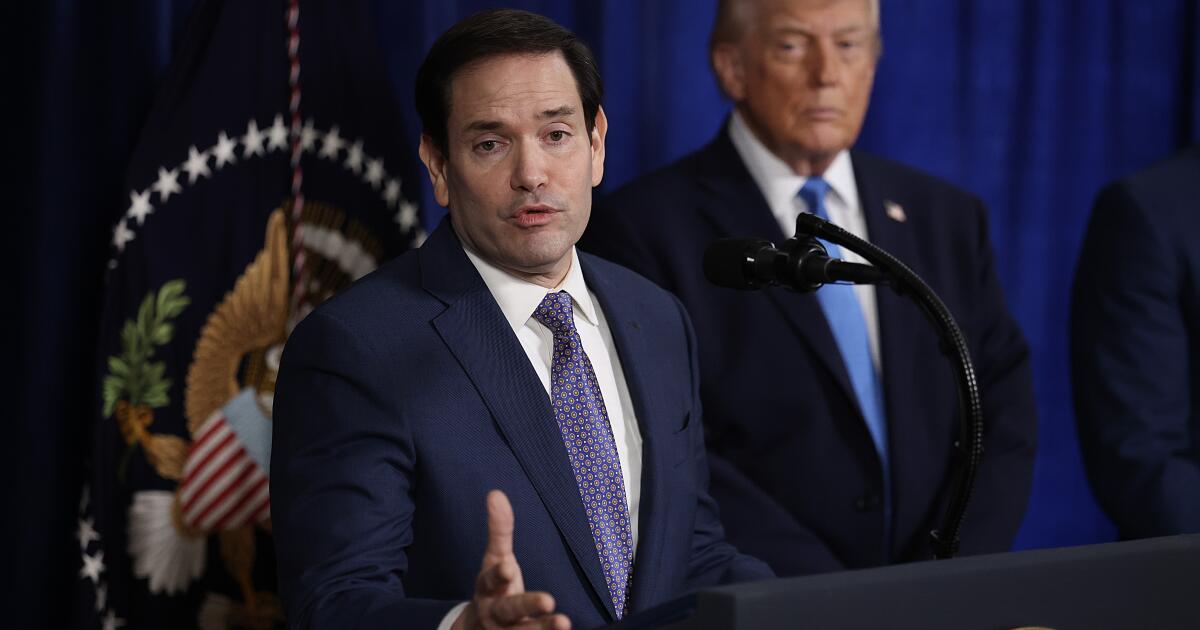
WASHINGTON — Top officials in the Trump administration clarified their position on “running” Venezuela after seizing its president, Nicolás Maduro, over the weekend, pressuring the government that remains in power there Sunday to acquiesce to U.S. demands on oil access and drug enforcement, or else face further military action.
Their goal appears to be the establishment of a pliant vassal state in Caracas that keeps the current government — led by Maduro for more than a decade — largely in place, but finally defers to the whims of Washington after turning away from the United States for a quarter-century.
It leaves little room for the ascendance of Venezuela’s democratic opposition, which won the country’s last national election, according to the State Department, European capitals and international monitoring bodies.
President Trump and his top aides said they would try to work with Maduro’s handpicked vice president and current interim president, Delcy Rodríguez, to run the country and its oil sector “until such time as we can do a safe, proper and judicious transition,” offering no time frame for proposed elections.
Trump, Secretary of State Marco Rubio and Homeland Security Secretary Kristi Noem underscored the strategy in a series of interviews Sunday morning.
“If she doesn’t do what’s right, she is going to pay a very big price, probably bigger than Maduro,” Trump told the Atlantic magazine, referring to Rodríguez. “Rebuilding there and regime change, anything you want to call it, is better than what you have right now. Can’t get any worse.”
Rubio said that a U.S. naval quarantine of Venezuelan oil tankers would continue unless and until Rodríguez begins cooperating with the U.S. administration, referring to the blockade — and the lingering threat of additional military action from the fleet off Venezuela’s coast — as “leverage” over the remnants of Maduro’s government.
“That’s the sort of control the president is pointing to when he says that,” Rubio told CBS News. “We continue with that quarantine, and we expect to see that there will be changes — not just in the way the oil industry is run for the benefit of the people, but also so that they stop the drug trafficking.”
Sen. Tom Cotton (R-Ark.), chairman of the Senate Select Committee on Intelligence, told CNN that he had been in touch with the administration since the Saturday night operation that snatched Maduro and his wife from their bedroom, whisking them away to New York to face criminal charges.
Trump’s vow to “run” the country, Cotton said, “means the new leaders of Venezuela need to meet our demands.”
“Delcy Rodríguez, and the other ministers in Venezuela, understand now what the U.S. military is capable of,” Cotton said, adding: “It is a fact that she and other indicted and sanctioned individuals are in Venezuela. They have control of the military and security forces. We have to deal with that fact. But that does not make them the legitimate leaders.”
“What we want is a future Venezuelan government that will be pro-American, that will contribute to stability, order and prosperity, not only in Venezuela but in our own backyard. That probably needs to include new elections,” Cotton said.
Whether Rodríguez will cooperate with the administration is an open question.
Trump said Saturday that she seemed amenable to making “Venezuela great again” in a conversation with Rubio. But the interim president delivered a speech hours later demanding Maduro’s return, and vowing that Venezuela would “never again be a colony of any empire.”
The developments have concerned senior figures in Venezuela’s democratic opposition, led by Maria Corina Machado, last year’s Nobel Peace Prize laureate, and Edmundo González Urrutia, the opposition candidate who won the 2024 presidential election that was ultimately stolen by Maduro.
In his Saturday news conference, Trump dismissed Machado, saying that the revered opposition leader was “a very nice woman,” but “doesn’t have the respect within the country” to lead.
Elliott Abrams, Trump’s special envoy to Venezuela in his first term, said he was skeptical that Rodríguez — an acolyte of Hugo Chávez and avowed supporter of Chavismo throughout the Maduro era — would betray the cause.
“The insult to Machado was bizarre, unfair — and simply ignorant,” Abrams told The Times. “Who told him that there was no respect for her?”
Maduro was booked in New York and flown at night over the Statue of Liberty in New York Harbor to the Metropolitan Detention Center in Brooklyn, where he is in federal custody at a facility that has housed inmates including Sean “Diddy” Combs, Ghislaine Maxwell, Bernie Madoff and Sam Bankman-Fried.
He is expected to be arraigned on federal charges of narco-terrorism conspiracy, cocaine importation conspiracy, possession of machine guns and destructive devices, and conspiracy to possess machine guns and destructive devices as soon as Monday.
Although few in Washington lamented Maduro’s removal, Democratic lawmakers criticized the operation as another act of ousting a foreign government by a Republican president that could have violated international law.
“The invasion of Venezuela has nothing to do with American security. Venezuela is not a security threat to the U.S.,” said Sen. Chris Murphy, a Democrat from Connecticut. “This is about making Trump’s oil industry and Wall Street friends rich. Trump’s foreign policy — the Middle East, Russia, Venezuela — is fundamentally corrupt.”
In their Saturday news conference, and in subsequent interviews, Trump and Rubio said that targeting Venezuela was in part about reestablishing U.S. dominance in the Western Hemisphere, reasserting the philosophy of President Monroe as China and Russia work to enhance their presence in the region. The Trump administration’s national security strategy, published last month, previewed a renewed focus on Latin America after the region faced neglect from Washington over decades.
Trump left unclear whether his military actions in the region would end in Caracas, a long-standing U.S. adversary, or whether he is willing to turn the U.S. armed forces on America’s allies.
In his interview with the Atlantic, Trump suggested that “individual countries” would be addressed on a case-by-case basis. On Saturday, he reiterated a threat to the president of Colombia, a major non-NATO ally, to “watch his ass,” over an ongoing dispute about Bogota’s cooperation on drug enforcement.
On Sunday morning, the United Nations Security Council held an urgent meeting to discuss the legality of the U.S. operation in Venezuela.
It was not Russia or China — permanent members of the council and long-standing competitors — who called the session, nor France, whose government has questioned whether the operation violated international law, but Colombia, a nonpermanent member who joined the council less than a week ago.
Politics
Dan Bongino officially leaves FBI deputy director role after less than a year, returns to ‘civilian life’

NEWYou can now listen to Fox News articles!
Dan Bongino returned to private life on Sunday after serving as deputy director of the Federal Bureau of Investigation (FBI) for less than a year.
Bongino said on X that Saturday was his last day on the job before he would return to “civilian life.”
“It’s been an incredible year thanks to the leadership and decisiveness of President Trump. It was the honor of a lifetime to work with Director Patel, and to serve you, the American people. See you on the other side,” he wrote.
The former FBI deputy director announced in mid-December that he would be leaving his role at the bureau at the start of the new year.
BONDI, PATEL TAP MISSOURI AG AS ADDITIONAL FBI CO-DEPUTY DIRECTOR ALONGSIDE BONGINO
Dan Bongino speaks with FBI Director Kash Patel as they attend the annual 9/11 Commemoration Ceremony at the National 9/11 Memorial and Museum in New York City on Sept. 11, 2025. (Michael M. Santiago/Getty Images)
President Donald Trump previously praised Bongino, who assumed office in March, for his work at the FBI.
“Dan did a great job. I think he wants to go back to his show,” Trump told reporters.
FBI DIRECTOR, TOP DOJ OFFICIAL RESPOND TO ‘FAILING’ NY TIMES ARTICLE CLAIMING ‘DISDAIN’ FOR EACH OTHER
“After his swearing-in ceremony as FBI Deputy Director, Dan Bongino paid his respects at the Wall of Honor, honoring the brave members of the #FBI who made the ultimate sacrifice and reflecting on the legacy of those who paved the way in the pursuit of justice and security,” the FBI said in a post on X. (@FBI on X)
Bongino spoke publicly about the personal toll of the job during a May appearance on “Fox & Friends,” saying he had sacrificed a lot to take the role.
“I gave up everything for this,” he said, citing the long hours both he and FBI Director Kash Patel work.
“I stare at these four walls all day in D.C., by myself, divorced from my wife — not divorced, but I mean separated — and it’s hard. I mean, we love each other, and it’s hard to be apart,” he added.
The FBI’s J. Edgar Hoover headquarters building in Washington on Nov. 2, 2016. (AP Photo/Cliff Owen, File)
CLICK HERE TO DOWNLOAD THE FOX NEWS APP
Bongino’s departure leaves Andrew Bailey, who was appointed co-deputy director in September 2025, as the bureau’s other deputy director.

Congestion pricing after one year: How life has changed.

Police standoff continues in Ypsilanti neighborhood

Eagles react to facing the San Francisco 49ers in playoffs: ‘It’s going to be good on good’

Defensive coordinator candidates who could improve Cowboys’ brutal secondary in 2026

This Miami Developer Is Leaning Into Miami’s Surging Mansion Market

Florida High School Football Rankings: Top 25 teams – Oct. 21

Cleary's 21 help Le Moyne down Central Connecticut State 69-64 in OT

How old is Bo Nix? What to know about Oregon quarterback ahead of 2024 NFL Draft

99th annual Pony Swim held in Virginia

Video: ‘It Didn’t Have to Happen This Way:’ U.Va. Faculty Call for Review of Police Response to Protests

Trump vows US ‘in charge’ of Venezuela as he reveals if he’s spoken to Delcy Rodríguez

Trump’s abduction of Maduro escalates concerns over potential war with Iran

Cuba says 32 Cuban fighters killed in US raids on Venezuela

Dan Bongino officially leaves FBI deputy director role after less than a year, returns to ‘civilian life’
Hundreds march in silence to honour Crans-Montana fire victims
-

 World1 week ago
Hamas builds new terror regime in Gaza, recruiting teens amid problematic election
-
 Business1 week ago
Google is at last letting users swap out embarrassing Gmail addresses without losing their data
-

 Indianapolis, IN1 week ago
Indianapolis Colts playoffs: Updated elimination scenario, AFC standings, playoff picture for Week 17
-

 Southeast1 week ago
Two attorneys vanish during Florida fishing trip as ‘heartbroken’ wife pleads for help finding them
-

 News1 week ago
Roads could remain slick, icy Saturday morning in Philadelphia area, tracking another storm on the way
-

 Politics1 week ago
Most shocking examples of Chinese espionage uncovered by the US this year: ‘Just the tip of the iceberg’
-
 News1 week ago
Marijuana rescheduling would bring some immediate changes, but others will take time
-

 World1 week ago
Podcast: The 2025 EU-US relationship explained simply