Politics
Brothers of Renee Good describe family’s grief, urge action at Democratic forum on ICE force

WASHINGTON — One of the brothers of Renee Good, the 37-year-old mother of three who was shot and killed by an immigration agent in Minneapolis, told congressional Democrats on Tuesday that he needed their help.
Luke Ganger said their family had taken some consolation in the thought that his sister’s death might spark a change.
“It has not,” he said.
That is why Ganger and people who had been violently detained by immigration agents gathered to share their experiences with U.S. Immigration and Customs Enforcement and to ask the government to rein in an agency they described as lawless.
Tuesday’s forum — not an official hearing because Republicans did not agree to it — was led by Rep. Robert Garcia (D-Long Beach), the top Democrat on the House Oversight Committee, and Sen. Richard Blumenthal (D-Conn.), the top Democrat on the Senate Permanent Subcommittee on Investigations. It was held not in the Capitol, but a nearby Senate office building.
Garcia and Blumenthal convened the forum to gather testimony “on the violent tactics and disproportionate use of force by agents of the Department of Homeland Security.”
All of the incidents referenced in the forum were captured on video.
Democrats heard from three U.S. citizens who are residents of San Bernardino, Chicago and Minneapolis. Also present were Good’s two brothers and an attorney representing their family.
Good’s killing on Jan. 7 has led to a wave of national protests, further inflamed after agents fatally shot ICU nurse Alex Pretti, 37, two weeks later. Protesters have called on federal agents to stop using violence in pursuit of the Trump administration’s mass deportation effort.
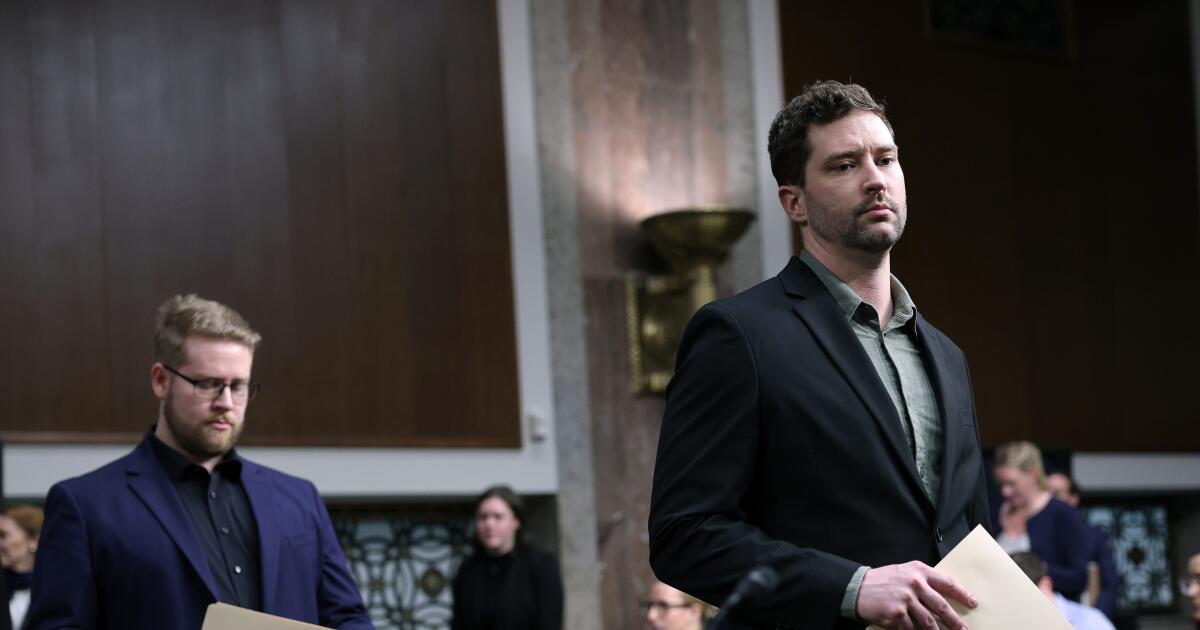
From left, Sen. Richard Blumenthal (D-Conn.), Luke Ganger and Brent Ganger arrive for a public forum on violent use of force by Department of Homeland Security personnel.
(Win McNamee / Getty Images)
“Let’s be very clear: these stories are not just about Minneapolis,” Blumenthal said. “These stories span the country.”
Blumenthal called for a “complete overhaul, a rebuilding” of the Department of Homeland Security and its sub-agencies. Such an overhaul, he said, would require body-worn cameras and that officers wear identification and undergo rigorous use-of-force training. In addition, acts of violence would require full investigations under the supervision of an independent monitor. Without those reforms, he said he wouldn’t support more funding for DHS.
Ganger said the “surreal scenes” taking place in Minneapolis and beyond are not isolated and are changing many lives.
“The deep distress our family feels because of Renee’s loss in such a violent and unnecessary way is complicated by feelings of disbelief, distress and desperation for change,” he said.
Ganger said his family is “a very American blend” that votes differently and rarely agrees fully on the details of what it means to be a citizen of the U.S. Despite those differences, he said, they have always treated each other with love and respect.
“We’ve gotten even closer during this very divided time in our country,” he said. “We hope that our family can be even a small example to others not to let political ideals divide us.”
The panel heard from Martin Daniel Rascon, 23, of San Bernardino, and three others who described harrowing experiences with immigration agents. Rascon was in a truck with two family members last August when they were stopped by more than a dozen federal agents who pointed rifles at them and shot at the car multiple times.
Francisco Longoria, the man driving the truck, was later arrested and charged by federal authorities, who alleged he had assaulted immigration officers with his truck during the incident. Longoria’s attorneys said he drove off because he feared for his safety. The charges were dropped a month later.
Describing the moment the unidentified men shattered the truck’s windows and punched Longoria in the face, Rascon said: “In that moment, the whole world felt like it was the size of the inside of our pickup, and we were sitting in harm’s way with nothing to do but record it.”
Rascon, who cried while giving his testimony, said federal agents returned to his home at 4 a.m. two weeks later, broke the locks and pointed a gun at his then-pregnant fiancee. He said the incidents left him feeling unsafe everywhere, even at home.
Marimar Martinez, 30, of Chicago, was shot five times by a U.S. Customs and Border Protection agent and then charged with assaulting the agent who shot her. Those charges were also later dropped.
Martinez testified that she was on her way to drop off a bag of clothing for donation to her local church when she noticed an SUV with federal immigration agents. She began following the vehicle for the next 20 or so minutes while shouting out “la migra!” to warn immigrant neighbors of their presence.
Eventually, the vehicle with federal agents side-swiped Martinez’s car. She said an agent got out and pointed his gun at her, then she looked down and noticed blood gushing from her arms and legs. She pulled into a mechanic shop and called 911. After her release from a hospital, Martinez saw on the news that she was being called a domestic terrorist.
Rep. Ro Khanna (D-Fremont) told Martinez he was angry on her behalf. “Tell me, what do you want this government to do to apologize to you?” he said.
“Just a sorry, you’re not a domestic terrorist,” she replied. “That’s it. …For them to admit that they were wrong [about] everything that they said about me. I just want accountability.”
Aliya Rahman, of Minneapolis, was dragged from her car on the way to a doctor’s appointment and detained by ICE agents after telling them she has a disability. Rahman has autism and is recovering from a traumatic brain injury.
DHS said Rahman was arrested because she ignored multiple commands. Rahman said it takes time for her to understand auditory commands.
Rahman said agents yelled threats and conflicting instructions that she couldn’t process while watching for pedestrians. As she hit the ground face-first, she said, she felt shooting pain as agents leaned on her back. She thought of George Floyd, who was killed four blocks away.
Rahman said she was never told she was under arrest or charged with a crime. The agents taking her to the federal Whipple Building referred to detainees as “bodies.” She said she received no medical screening, phone call or access to a lawyer, and was denied a communication navigator when her speech began to slur.
Eventually, she became unable to speak.
“The last sounds I remember before I blacked out on the cell floor were my cellmate banging on the door, pleading for a medic and a voice outside saying, ‘We don’t want to step on ICE’s toes,’ ” she said.
Rahman said she later woke up at a hospital, where doctors told her she had suffered a concussion.
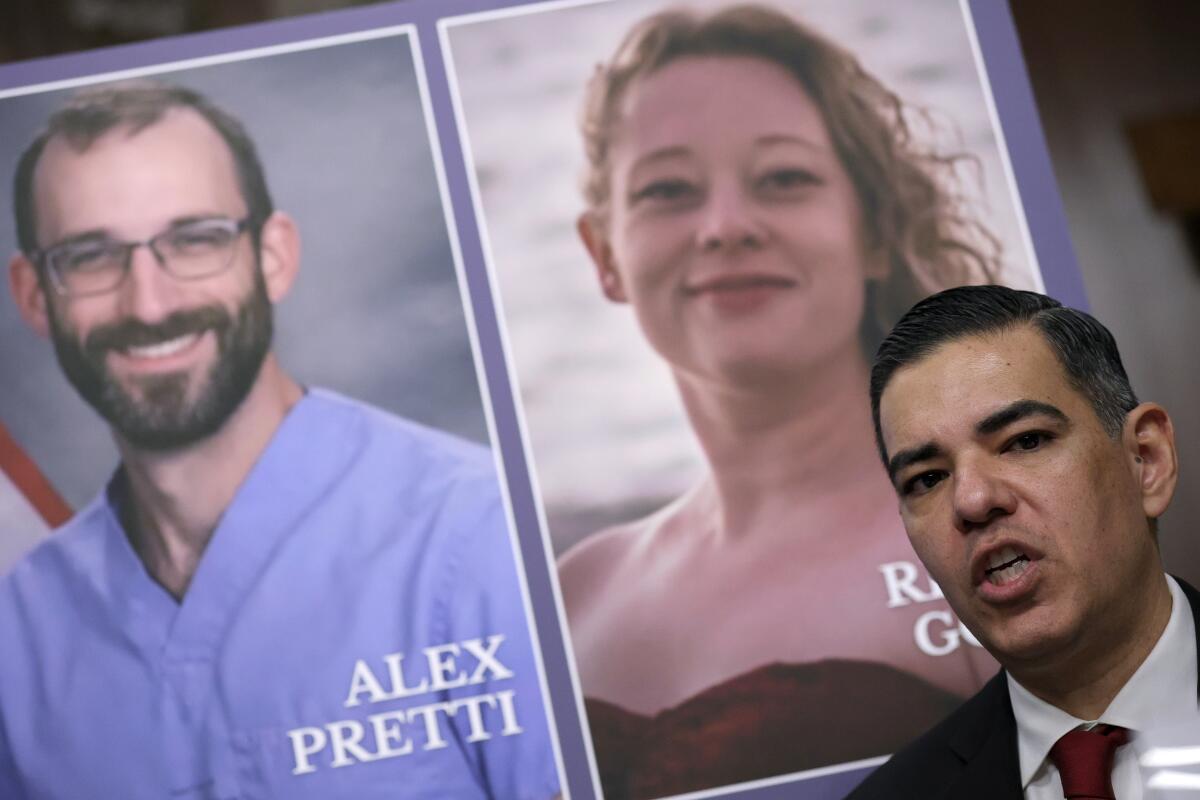
Rep. Robert Garcia (D-Long Beach) speaks during a public forum on violent use of force by Department of Homeland Security personnel.
(Win McNamee / Getty Images)
Garcia called the forum a move toward accountability because Congress has the right to step in when constitutional rights are violated. He said Democrats have tracked at least 186 incidents of problematic uses of force by federal immigration agents.
Antonio Romanucci, the attorney representing Good’s family and who also represented the family of George Floyd, said that while he has handled excessive force cases for decades, “this is an unprecedented and deeply unsettling time.” Floyd was murdered by a Minneapolis police officer in 2020.
“The occupation by ICE and CBP in our cities is way beyond their mission, leading to unnecessary provocation that causes needless harm and death,” he said. “These operations in multiple states have routinely and consistently included violations of the Constitution.”
The current path to hold federal officers accountable is narrow, he said. Congress could pass legislation to add language making it easier for people to file civil lawsuits in cases such as Good’s.
Sen. Alex Padilla (D-Calif.) questioned why the hearing was made up only of Democrats. He said Republicans can’t be let off the hook.
“Under normal circumstances — regardless of who’s in the majority — when tragedies like this happen congressional committees convene to conduct our job to provide that oversight,” he said. “But our Republican colleagues refused to.”



Politics
EXCLUSIVE: FBI adds alleged COVID fraudster accused of taking $5M from kids’ meal program to Most Wanted list

FBI makes first arrest from its ‘most wanted fraudsters’ list
FBI Director Kash Patel announces the first arrest on the “Most Wanted Fraudsters” list. Said Ereg, a Minneapolis man, is accused of stealing over $4.2 million from a federal child nutrition program during the COVID-19 pandemic. Minnesota Senate candidate Michele Tafoya emphasizes the need for accountability for fraudulent activities.
NEWYou can now listen to Fox News articles!
EXCLUSIVE: The FBI is adding Fahad Mohamed Nur to its Most Wanted Fraudsters List, accusing the Minnesota businessman of allegedly stealing more than $5 million that was intended to feed children during the COVID-19 pandemic.
Nur has been on the run since 2022 and is wanted for his alleged role in a fraud scheme that exploited Minnesota’s Federal Child Nutrition Program during the COVID-19 pandemic, according to the FBI. The bureau alleges he owned a vendor and purported food supplier that received more than $5 million in fraudulent program funds by submitting fake invoices before laundering the proceeds.
The Bureau believes Nur has ties to Somalia and may currently be living there.
The FBI is offering a reward of up to $150,000 for information leading to Nur’s arrest and conviction.
OWNER OF DAYCARE IN VIRAL NICK SHIRLEY VIDEO CHARGED IN $4.6M DAYCARE FRAUD SCHEME, PROSECUTORS SAY
Fahad Mohamed Nur has been on the run since 2022 and may be in Somalia, according to the FBI. (Federal Bureau of Investigation)
Nur is the latest addition to the FBI’s Most Wanted Fraudsters List, which officials say has already resulted in the arrests of two fugitives within weeks of its launch.
“Under President Trump’s and Vice President Vance’s leadership with the White House Task Force to Eliminate Fraud, the FBI’s historic ‘Most Wanted Fraudsters list’ has already seen tremendous success – with two subjects brought to justice in a matter of weeks, apprehended out of Somalia and the Philippines,” FBI Director Kash Patel said in a statement to Fox News Digital.
Patel said the early arrests demonstrate that the FBI is aggressively pursuing fugitives accused of stealing from American taxpayers.
FBI ADDS 2 FUGITIVES TO ‘MOST WANTED FRAUDSTERS’ LIST AMID HISTORIC $6.5B HEALTHCARE TAKEDOWN: PATEL
FBI Director Kash Patel conducts a news conference at the Department of Justice on Thursday, December 4, 2025. (Tom Williams/CQ-Roll Call, Inc via Getty Images)
“Our newest subject – Fahad Mohamed Nur – has been on the run since 2022 for allegedly stealing over $5 million from a child nutrition program in Minnesota.”
Patel added: “Collectively, the Task Force has already uncovered more than $13 billion in fraud, and the rapid success of the Most Wanted Fraudsters List should show all Americans that this FBI will [be] at the forefront pursuing the worst of the worst who stole from hardworking American taxpayers.”
DR OZ WARNS MEDICARE SCAMMERS ARE STEALING BILLIONS — AND YOUR PERSONAL INFORMATION COULD BE NEXT
Federal agents enter an office building as a search warrant is executed at Ultimate Home Health Services over potential Medicaid fraud, on December 18, 2025 in Bloomington, Minnesota, United States. (Christopher Juhn/Anadolu via Getty Images)
Federal officials say the investigation is part of a broader government effort targeting pandemic-era fraud.
“The Department’s robust partnership with the FBI and the White House Task Force to Eliminate Fraud has already delivered historic results. That partnership grows even stronger today with the addition of this latest subject to the Most Wanted Fraudsters list,” said Acting Attorney General Todd Blanche. “President Trump has made it clear: Fraudsters no longer have a safe haven in America. Law enforcement will continue to use every tool at its disposal to bring those who steal from American taxpayers to justice.”
The White House Task Force to Eliminate Fraud, led by Vice President JD Vance, has already uncovered more than $13 billion in fraud, according to the FBI.
CLICK HERE TO DOWNLOAD THE FOX NEWS APP
Anyone with information about Nur’s whereabouts is urged to contact the FBI at 1-800-CALL-FBI, their local FBI office, the nearest U.S. Embassy or Consulate, or submit a tip online at tips.fbi.gov.

With the 2026-27 season premiere of “60 Minutes” just two months away, CBS News leadership is getting closer to deciding who will fill the recent departures of longtime correspondents Scott Pelley, Sharon Alfonsi, Cecilia Vega and Anderson Cooper.
Seth Doane, a longtime correspondent based in Italy who is often seen on “CBS Sunday Morning,” is under consideration, along with chief investigative correspondent Jim Axelrod, who currently has a lead role in the “Eye On America” series featured on the “CBS Evening News with Tony Dokoupil.”
Sir Trevor Phillips, a British journalist and former politician who recently joined CBS News as senior global affairs correspondent, is expected to have a role on the program, according to people briefed on the plan. Phillips had a long career in the U.K., producing and writing documentaries and most recently hosted the Sky News program “Sunday Morning with Trevor Phillips.”
Phillips received a knighthood in 2022 for his service to equality and human rights for the U.K. But he also generated controversy over his career for comments about the British Muslim community, which led to a yearlong suspension from the Labour Party in 2020.
A CBS News representative declined comment beyond saying the division is looking at a number of internal and external candidates.
Dokoupil is expected to deliver four “60 Minutes” pieces a season. Major Garrett, the network’s chief Washington correspondent, will also have a contributor role.
Matt Gutman, hired from ABC News last year as national correspondent, is under strong consideration. He is being put in front of test audiences, according to several people at the network.
Holly Williams, a foreign correspondent working out of Istanbul for CBS News since 2012, and Mariana van Zeller, a journalist for National Geographic Channel, are both said to remain in contention.
The newcomers will join Bill Whitaker, Leslie Stahl, Jon Wertheim and Norah O’Donnell, who are all returning as correspondents. O’Donnell will also continue in her role as senior correspondent for the network, occasionally anchoring specials.
The rebuild of the talent line-up comes after the upheaval at the program that has occurred since Bari Weiss joined CBS News as edtior in chief in October.
Longtime correspondent Scott Pelley was fired last month after confronting management about the May 28 dismissal of his colleagues Alfonsi and Vega along with the program’s executive producer Tanya Simon and her second-in-command Draggan Mihailovich.
In February, Cooper decided not to sign a new deal as a “60 Minutes” contributor, as the CNN anchor cited a desire to spend more time with his family. But Cooper has reportedly told colleagues that he does not want to work for Weiss.
The internal disruption at “60 Minutes” followed a highly successful season. In its 57th season, “60 Minutes” was the most watched news program on television with an average of 9.1 million viewers a week according to Nielsen data. The program bucked the overall decline in traditional TV viewing by growing 9 percent over the previous season.
After the dismissal of his “60 Minutes” colleagues, Pelley accused Weiss of trying to “murder” the program and claimed she was putting “her thumb on the scale” for more favorable coverage of the Trump administration. He was fired with cause after confronting management at a June 1 meeting.
Weiss came to CBS when parent company Paramount acquired her digital web site The Free Press, known for its criticism of progressive policies and its strong support of Israel.
Weiss was hired by Paramount Chief Executive David Ellison with a mandate to move the news division to the political center. The pronouncement has created the perception that CBS News is looking to placate the Trump administration as Paramount sought regulatory approval for its $111 billion acquisition of Warner Bros. Discovery, which will also give the company ownership of CNN.
The noise surrounding Weiss has hurt CBS News despite strong reporting that is often far from being pro-MAGA. This past weekend’s “CBS Sunday Morning” featured a segment from national security correspondent David Martin about the Department of Defense interfering with the editorial independence of Stars & Stripes, the military newspaper.
Trump complained vehemently about his last interview with O’Donnell on “60 Minutes,” — conducted the day after a gunman tried to enter the White House Correspondents Assn. dinner in Washington on April 25.
Politics
Abbott orders probe after Texas hospital advertises ‘birth packages’ in Mexico: ‘Citizenship is not for sale’

NEWYou can now listen to Fox News articles!
Texas Gov. Greg Abbott ordered an investigation into a Texas hospital Tuesday after it confirmed to Fox News that it advertised Spanish-language “Birth Packages in South Texas” on billboards in Mexico promoting childbirth services to pregnant foreign nationals near the U.S.-Mexico border.
Mission Regional Medical Center confirmed to Fox News that it was responsible for the advertising campaign, which promoted deliveries starting at $3,950 for a natural birth and $5,525 for a C-section and directed viewers to a website, havemybabyinTEXAS.com, that has since been taken offline.
The billboards also displayed a telephone number beginning with “001,” the country code used to place calls to the United States from Mexico.
‘WEAPONS OF MASS REPRODUCTION’: WATCHDOG UNVEILS ACTION PLAN TO CURB BIRTH TOURISM AFTER SUPREME COURT RULING
Gov. Greg Abbott speaks during a bill signing in the State Capitol on April 23, 2025, in Austin, Texas. (Brandon Bell/Getty Images)
“The marketing materials regarding maternity services are no longer in use due to any unintended misunderstanding,” a hospital spokesperson said in a statement to Fox News. “We do not support or facilitate any unlawful activity and work to comply with all applicable federal and state laws and regulations.”
The spokesperson said the campaign included two billboards located within approximately five miles of the hospital near a U.S.-Mexico border crossing. The hospital said both billboards and the website were removed Monday after images began circulating on social media. The spokesperson also said the campaign began in 2021 but did not specify when the billboards were installed.
Abbott on Tuesday directed Texas Health and Human Services Commission Executive Commissioner Stephanie Muth to investigate Mission Regional Medical Center for potential violations of state law and contractual obligations.
REPUBLICAN ACCUSES SCOTUS OF BETRAYING US, PUSHES BILL RESTRICTING BIRTHRIGHT CITIZENSHIP, PREGNANT VISITORS
A Spanish-language billboard promotes birth packages at Mission Regional Medical Center, advertising pricing for natural deliveries and C-sections in South Texas. (Right Angle News)
Images of the billboard circulated on social media before the hospital said it removed the advertisements Monday.
“Birth tourism’ is an illegal practice that exploits the extraordinary hospitality that the United States and Texas offer to millions of foreign travelers each year,” Abbott wrote in a July 7 letter obtained by Fox News. “Unfortunately, thousands of foreign travelers come to the United States under false pretenses to give birth and secure citizenship for their children.”
TRUMP SUFFERS MAJOR SUPREME COURT DEFEAT AS JUSTICES UPHOLD BIRTHRIGHT CITIZENSHIP
An English-language billboard promotes birth packages at Mission Regional Medical Center, advertising pricing for natural deliveries and C-sections in South Texas. (Right Angle News)
Abbott directed HHSC to “immediately and thoroughly investigate” the hospital and said any violations should be referred to the Texas Attorney General for civil enforcement and to the appropriate district or county attorney for potential criminal prosecution.
“American citizenship is not for sale and Texas will not permit our healthcare system to be used as a magnet for birth tourism,” Abbott wrote.
The governor also said he plans to work with the Texas Legislature during its next session “to strengthen state law and eliminate birth tourism in Texas.”
“Unfortunately, birth tourism operations are not a new phenomenon,” General Counsel of the Oversight Project Kyle Brosnan said to Fox News Digital in a statement. “The Supreme Court’s egregiously wrong decision in the birthright citizenship case is going to open the floodgates to the birth tourism industry. Our country is much more than a pile of magic dirt. The only answer to these type of practices are criminal investigations and the mass deportation of illegal aliens.”
Mission Regional Medical Center also said it intends to cooperate with state officials.
CLICK HERE TO DOWNLOAD THE FOX NEWS APP
“We intend to work cooperatively and transparently with local and state officials,” the hospital said in a statement obtained by Fox News. “Our focus remains on delivering safe, high-quality care to every patient who seeks our services.”
The investigation comes as President Donald Trump’s executive order seeking to limit automatic birthright citizenship for some children born in the United States remains the subject of ongoing legal challenges.
-

 Los Angeles, Ca10 minutes ago
Waymo video could determine charges after teens’ bizarre California ride
-
Detroit, MI28 minutes ago
DPD investigating after human remains found in home on Detroit’s west side
-

 San Francisco, CA43 minutes ago
Bay Area Teen Waymo Riders Nabbed For Allegedly Shooting Projectiles From Robotaxi
-
Dallas, TX48 minutes ago
Role Call: Tyrus Wheat looking to make most of second stint with Cowboys
-

 Miami, FL55 minutes ago
2026 Miami Football Early Opponent Preview, Game 8: North Carolina
-

 Boston, MA58 minutes ago
Boston sues social media companies over ‘addictive’ features, joining nationwide litigation
-

 Denver, CO1 hour ago
Peyton Watson landing spots: Could Nuggets star actually leave Denver?
-

 Seattle, WA1 hour ago
14-year-old dies in Seattle e-bike crash at Colonnade Park after losing control on steep stairs – MyNorthwest.com

