Politics
Biden administration gives California $45 million to help recently arrived migrants

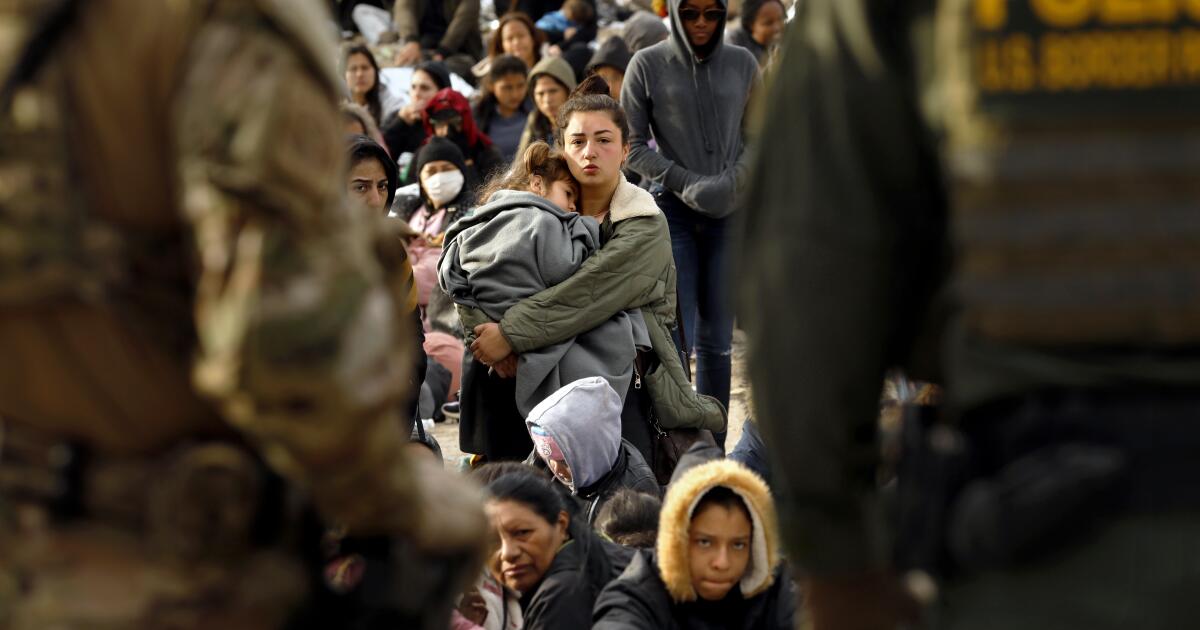
The Biden administration is allocating $45 million to California programs that help migrants who have crossed the southern border.
The money is part of a $300-million national effort announced Friday by the Federal Emergency Management Agency.
Most of the California funding will be split between San Diego County and the Catholic Charities Diocese of San Diego. More than $6 million goes to Riverside County.
An additional $341 million will be used to establish a competitive grant program and allocated before the end of the fiscal year Sept. 30, the administration said.
It’s less funding than programs helping migrants had hoped for, representing an 18% cut from last year’s $780-million total.
But California’s overall share is $3 million higher than last year; San Diego’s allotment rose by $10 million.
Border nonprofits including Jewish Family Service of San Diego are hailing the increase as a win that’s reflective of the recent uptick in migrant arrivals near the California border.
In an announcement Friday, the Department of Homeland Security called on Congress to pass a stalled bipartisan national security bill that included more border funding and other assistance.
California Gov. Gavin Newsom praised the administration and blamed House Republicans for failing to provide enough money to deal with the crisis.
“Let’s be clear: President Biden is doing all he can to fund border security and humanitarian efforts while Republicans in Congress are choosing border chaos for political gain,” Newsom said in a statement.
Republicans blame Biden for mishandling the border and argue that FEMA resources should be spent on American families struggling with homelessness, not arriving migrants.
Interior states including Illinois, Colorado and New York also got funding. Texas, Florida and Arizona leaders have spent millions transporting migrants to Democratic strongholds since 2022 in an effort to force places with more welcoming immigration policies to share the responsibility of caring for recent arrivals.
California has funded humanitarian services for migrants released from federal custody at the border, including $150 million last year. But, with the state facing a massive deficit, no border funding has been budgeted this year.
“California cannot maintain its efforts without federal support and has continued to advocate to Congress to provide federal funding to local communities that are receiving new arrivals,” California Health and Human Services Agency officials wrote in their January budget summary.
Jewish Family Service has operated a shelter for recently arrived migrants for nearly six years. The vast majority of migrants who arrive near San Diego don’t stay long-term, said Kate Clark, the organization’s director of immigration services. The shelter has space for around 1,000 and provides the most vulnerable migrants — those with young children, or who are sick or injured, or are LGBTQ — time to rest, charge their phones, call loved ones and coordinate travel plans.
Clark said the organization relies heavily on funding funneled through Catholic Charities.
State funding, which has served as a “critical backstop during periods of uncertainty” about federal funding, runs out June 30, Clark said. Altogether, funding hasn’t been enough to sustain recent migration levels, she said.
In March, federal agents arrested nearly 34,000 migrants in the San Diego region, up from 23,000 a year ago, according to Customs and Border Protection figures released Friday. San Diego remains the No. 2 region for arrivals, after Tucson, since stepped-up enforcement by the Mexican government led migrants to shift away from the Texas border.
As migrant arrivals at the California-Mexico border have increased, Customs and Border Protection has turned to street releases and holding migrants between border walls to reduce the number of people in its short-term facilities. Organizations at the border have been stretched thin, and the San Diego migrant welcome center closed in February after funding dried up.
“It’s important for us to have all levels of government be part of the solution,” Clark said. “Immigration is within the federal government’s purview, but at the end of the day California is a border state.”



new video loaded: Trump Says ‘Only Time Will Tell’ How Long U.S. Controls Venezuela
transcript
transcript
Trump Says ‘Only Time Will Tell’ How Long U.S. Controls Venezuela
President Trump did not say exactly how long the the United states would control Venezuela, but said that it could last years.
-
“How Long do you think you’ll be running Venezuela?” “Only time will tell. Like three months. six months, a year, longer?” “I would say much longer than that.” “Much longer, and, and —” “We have to rebuild. You have to rebuild the country, and we will rebuild it in a very profitable way. We’re going to be using oil, and we’re going to be taking oil. We’re getting oil prices down, and we’re going to be giving money to Venezuela, which they desperately need. I would love to go, yeah. I think at some point, it will be safe.” “What would trigger a decision to send ground troops into Venezuela?” “I wouldn’t want to tell you that because I can’t, I can’t give up information like that to a reporter. As good as you may be, I just can’t talk about that.” “Would you do it if you couldn’t get at the oil? Would you do it —” “If they’re treating us with great respect. As you know, we’re getting along very well with the administration that is there right now.” “Have you spoken to Delcy Rodríguez?” “I don’t want to comment on that, but Marco speaks to her all the time.”
January 8, 2026

NEWYou can now listen to Fox News articles!
President Donald Trump called for defense spending to be raised to $1.5 trillion, a 50% increase over this year’s budget.
“After long and difficult negotiations with Senators, Congressmen, Secretaries, and other Political Representatives, I have determined that, for the Good of our Country, especially in these very troubled and dangerous times, our Military Budget for the year 2027 should not be $1 Trillion Dollars, but rather $1.5 Trillion Dollars,” Trump wrote on Truth Social on Thursday evening.
“This will allow us to build the “Dream Military” that we have long been entitled to and, more importantly, that will keep us SAFE and SECURE, regardless of foe.”
The president said he came up with the number after tariff revenues created a surplus of cash. He claimed the levies were bringing in enough money to pay for both a major boost to the defense budget “easily,” pay down the national debt, which is over $38 trillion, and offer “a substantial dividend to moderate income patriots.”
SENATE SENDS $901B DEFENSE BILL TO TRUMP AFTER CLASHES OVER BOAT STRIKE, DC AIRSPACE
President Donald Trump called for defense spending to be raised to $1.5 trillion, a 50% increase over this year’s record budget. (AP Photo/Evan Vucci)
The boost likely reflects efforts to fund Trump’s ambitious military plans, from the Golden Dome homeland missile defense shield to a new ‘Trump class’ of battleships.
The Committee for a Responsible Federal Budget found that the increased budget would cost about $5 trillion from 2027 to 2035, or $5.7 trillion with interest. Tariff revenues, the group found, would cover about half the cost – $2.5 trillion or $3 trillion with interest.
The Supreme Court is expected to rule in a major case Friday that will determine the legality of Trump’s sweeping tariff strategy.
CONGRESS UNVEILS $900B DEFENSE BILL TARGETING CHINA WITH TECH BANS, INVESTMENT CRACKDOWN, US TROOP PAY RAISE
This year the defense budget is expected to breach $1 trillion for the first time thanks to a $150 billion reconciliation bill Congress passed to boost the expected $900 billion defense spending legislation for fiscal year 2026. Congress has yet to pass a full-year defense budget for 2026.
Some Republicans have long called for a major increase to defense spending to bring the topline total to 5% of GDP, as the $1.5 trillion budget would do, up from the current 3.5%.
The boost likely reflects efforts to fund Trump’s ambitious military plans, from the Golden Dome homeland missile defense shield to a new ‘Trump class’ of battleships. (Lockheed Martin via Reuters)
Trump has ramped up pressure on Europe to increase its national security spending to 5% of GDP – 3.5% on core military requirements and 1.5% on defense-related areas like cybersecurity and critical infrastructure.
Trump’s budget announcement came hours after defense stocks took a dip when he condemned the performance rates of major defense contractors. In a separate Truth Social post he announced he would not allow defense firms to buy back their own stocks, offer large salaries to executives or issue dividends to shareholders.
“Executive Pay Packages in the Defense Industry are exorbitant and unjustifiable given how slowly these Companies are delivering vital Equipment to our Military, and our Allies,” he said.
“Defense Companies are not producing our Great Military Equipment rapidly enough and, once produced, not maintaining it properly or quickly.”
U.S. Army soldiers stand near an armored military vehicle on the outskirts of Rumaylan in Syria’s northeastern Hasakeh province, bordering Turkey, on March 27, 2023. (Delil Souleiman/AFP via Getty Images)
He said that executives would not be allowed to make above $5 million until they build new production plants.
CLICK HERE TO DOWNLOAD THE FOX NEWS APP
Stock buybacks, dividends and executive compensation are generally governed by securities law, state corporate law and private contracts, and cannot be broadly restricted without congressional action.
An executive order the White House released Wednesday frames the restrictions as conditions on future defense contracts, rather than a blanket prohibition. The order directs the secretary of war to ensure that new contracts include provisions barring stock buybacks and corporate distributions during periods of underperformance, non-compliance or inadequate production, as determined by the Pentagon.

SACRAMENTO — Gov. Gavin Newsom on Thursday unveiled a sweeping proposal to overhaul how California’s education system is governed, calling for structural changes that he said would shift oversight of the Department of Education and redefine the role of the state’s elected schools chief.
The proposal, which is part of Newsom’s state budget plan that will be released Friday, would unify the policymaking State Board of Education with the department, which is responsible for carrying out those policies. The governor said the change would better align education efforts from early childhood through college.
“California can no longer postpone reforms that have been recommended regularly for a century,” Newsom said in a statement. “These critical reforms will bring greater accountability, clarity, and coherence to how we serve our students and schools.”
Few details were provided about how the role of the state superintendent of public instruction would change, beyond a greater focus on fostering coordination and aligning education policy.
The changes would require approval from state lawmakers, who will be in the state Capitol on Thursday for Newsom’s last State of the State speech in his final year as governor.
The proposal would implement recommendations from a 2002 report by the state Legislature, titled “California’s Master Plan for Education,” which described the state’s K-12 governance as fragmented and “with overlapping roles that sometimes operate in conflict with one another, to the detriment of the educational services offered to students.” Newsom’s office said similar concerns have been raised repeatedly since 1920 and were echoed again in a December 2025 report by research center Policy Analysis for California Education.
“The sobering reality of California’s education system is that too few schools can now provide the conditions in which the State can fairly ask students to learn to the highest standards, let alone prepare themselves to meet their future learning needs,” the Legislature’s 2002 report stated. Those most harmed are often low-income students and students of color, the report added.
“California’s education governance system is complex and too often creates challenges for school leaders,” Edgar Zazueta, executive director of the Assn. of California School Administrators, said in a statement provided by Newsom’s office. “As responsibilities and demands on schools continue to increase, educators need governance systems that are designed to better support positive student outcomes.”
The current budget allocated $137.6 billion for education from transitional kindergarten through the 12th grade — the highest per-pupil funding level in state history — and Newsom’s office said his proposal is intended to ensure those investments translate into more consistent support and improved outcomes statewide.
“For decades the fragmented and inefficient structure overseeing our public education system has hindered our students’ ability to succeed and thrive,” Ted Lempert, president of advocacy group Children Now, said in a statement provided by the governor’s office. “Major reform is essential, and we’re thrilled that the Governor is tackling this issue to improve our kids’ education.”

Tarik Skubal, Tigers can’t agree on 2026 salary. Here’s what happens

San Francisco celebrates drop in traffic deaths

Anti-ICE protest outside Dallas City Hall follows deadly shooting in Minneapolis

Ole Miss S Nick Cull’s targeting call reversed vs Miami in Peach Bowl

Boston nightclub where woman suffered medical emergency and died has license reinstated

Florida High School Football Rankings: Top 25 teams – Oct. 21

Cleary's 21 help Le Moyne down Central Connecticut State 69-64 in OT

How old is Bo Nix? What to know about Oregon quarterback ahead of 2024 NFL Draft

99th annual Pony Swim held in Virginia

Video: ‘It Didn’t Have to Happen This Way:’ U.Va. Faculty Call for Review of Police Response to Protests

Video: What Trump Told Us About the ICE Shooting

Trump calls for $1.5T defense budget to build ‘dream military’
Belgium open to housing foreign prisoners in other countries, minister says

Community reacts to ICE shooting in Minnesota. And, RFK Jr. unveils new food pyramid

Video: Minnesota Governor Condemns ICE Shooting
-

 Detroit, MI5 days ago
2 hospitalized after shooting on Lodge Freeway in Detroit
-

 Technology2 days ago
Power bank feature creep is out of control
-

 Dallas, TX4 days ago
Defensive coordinator candidates who could improve Cowboys’ brutal secondary in 2026
-

 Health4 days ago
Viral New Year reset routine is helping people adopt healthier habits
-

 Nebraska2 days ago
Oregon State LB transfer Dexter Foster commits to Nebraska
-

 Iowa2 days ago
Pat McAfee praises Audi Crooks, plays hype song for Iowa State star
-
 Nebraska2 days ago
Nebraska-based pizza chain Godfather’s Pizza is set to open a new location in Queen Creek
-
 Entertainment1 day ago
Spotify digs in on podcasts with new Hollywood studios