Politics
At Supreme Court, steady wins for conservative states and Trump's claims of executive power

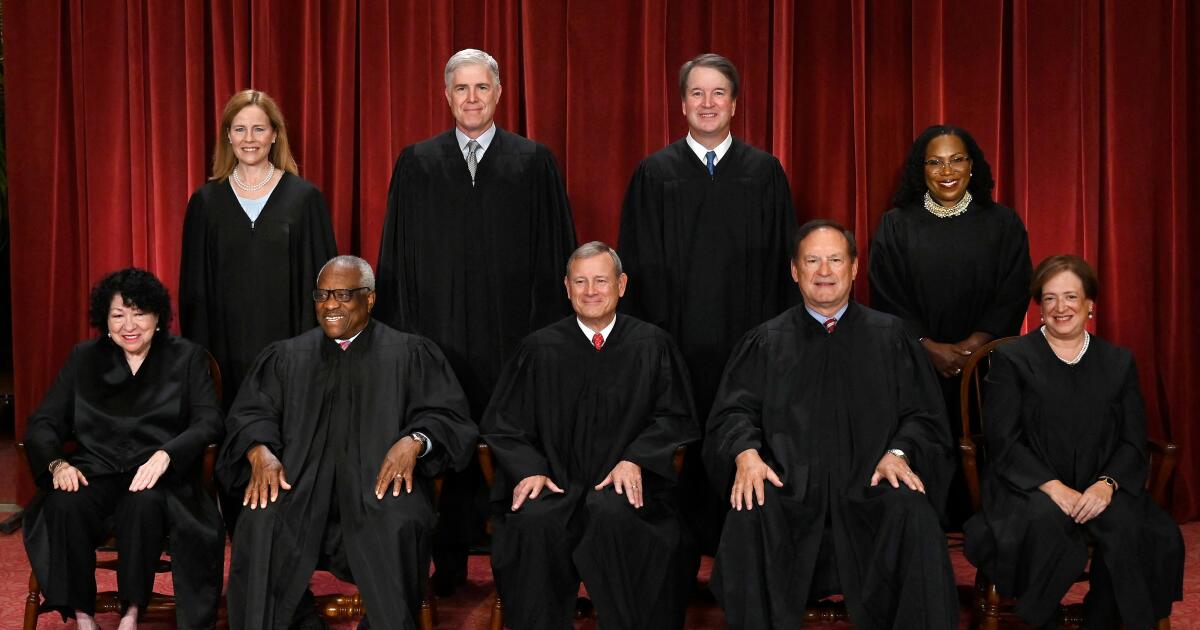
WASHINGTON — The Supreme Court term that ended Friday will not be remembered for blockbuster rulings like those recent years that struck down the right to abortion and college affirmative action.
The justices scaled back their docket this year and spent much of their energy focused on deciding fast-track appeals from President Trump. His administration’s lawyers complained too many judges were standing in the way of Trump’s agenda.
On Friday, the court’s conservatives agreed to rein in district judges, a procedural victory for Trump.
What’s been missing so far, however, is a clear ruling on whether the president has abided by the law or overstepped his authority under the U.S. Constitution.
On the final two days of the term, the court’s conservative majority provided big wins for Republican-leaning states, religious parents and Trump.
The justices gave states more authority to prohibit medical treatments for transgender teens, to deny Medicaid funds to Planned Parenthood clinics and to enforce age-verification laws for online porn sites.
Each came with the familiar 6-3 split, with the Republican appointees siding with the GOP-led states, while the Democratic appointees dissented.
These rulings, while significant, were something short of nationwide landmark decisions — celebrated victories for the Republican half of the nation but having no direct or immediate effect on Democratic-led states.
California lawmakers are not likely to pass measures to restrict gender-affirming care or to prohibit women on Medicaid from obtaining birth control, pregnancy testing or medical screenings at a Planned Parenthood clinic.
The new decisions echoed the Dobbs ruling three years ago that struck down Roe vs. Wade and the constitutional right to abortion.
As the conservative justices noted, the decision in Dobbs vs. Jackson Women’s Health did not outlaw abortion nationwide. However, it did allow conservative states to do so. Since then, 17 Republican-led states in the South and Midwest have adopted new laws to prohibit most or all abortions.
On this front, the court’s decisions reflect a “federalism,” or states-rights style of conservatism, that was dominant in decades past under President Reagan and two of the court’s conservative leaders, Chief Justice William Rehnquist and Justice Sandra Day O’Connor.
Both were Arizona Republicans (and in O’Connor’s case, a former state legislator) who came to the court with that view that Washington holds too much power and wields too much control over states and local governments.
With the nation sharply divided along partisan lines, today’s conservative court could be praised or defended for freeing states to make different choices on the “culture wars.”
The other big winner so far this year has been Trump and his broad claims of executive power.
Since returning to the White House in January, Trump has asserted he has total authority to run federal agencies, cut their spending and fire most of their employees, all without the approval of Congress, which created and funded the agencies.
He has also claimed the authority to impose tariffs of any amount on any country and also change his mind a few days later.
He has dispatched National Guard troops and Marines to Los Angeles against the wishes of the governor and the mayor.
He has asserted he can punish universities and law firms.
He has claimed he can revise by executive order the 14th Amendment and its birthright citizenship clause.
So far, the Supreme Court has not ruled squarely on Trump’s broad assertions of power. But the justices have granted a series of emergency appeals from Trump’s lawyers and set aside lower court orders that blocked his initiatives from taking effect.
The theme has been that judges are out of line, not the president.
Friday’s ruling limiting nationwide injunctions set out that view in a 26-page opinion. The conservatives agreed that some judges have overstepped their authority by ruling broadly based on a single lawsuit.
The justices have yet to rule on whether the president has overstepped his power.
Justice Amy Coney Barrett summed up the dispute in a revealing comment responding to a dissent from Justice Ketanji Brown Jackson. “Justice Jackson decries an imperial Executive while embracing an imperial Judiciary,” she wrote.
Missing from all this is the earlier strain of conservatism that opposed concentrated power in Washington — and in this instance, in one person.
Last year offered a hint of what was to come. A year ago, the court ended its term by declaring the president is immune from being prosecuted for his official acts while in the White House.
That decision, in Trump vs. United States, shielded the former and soon-to-be president from the criminal law.
The Constitution does not mention any such immunity for ex-presidents charged with crimes, but Chief Justice John G. Roberts Jr. said a shield of immunity was necessary to “enable the the President to carry out his constitutional duties without undue caution.”
Since returning to the White House, Trump has not been accused of exercising “undue caution.”
Instead, he appears to have viewed the court’s opinion as confirming his unchecked power as the nation’s chief executive. Trump advisors say that because the president was elected, he has a mandate and the authority to put his priorities and policies into effect.
But the Supreme Court’s conservatives did not take that view when President Biden took office promising to take action on climate change and to reduce the burden of student loan debt.
In both areas, the Roberts court ruled that the Biden administration had exceeded its authority under the laws passed by Congress.
Away from Washington, the most significant decision from this term may be Friday’s ruling empowering parents.
The six justices on the right ruled parents have a right to remove their children from certain public school classes that offend their religious beliefs. They objected to new storybooks and lessons for young children with LGBTQ+ themes.
In recent years, the court, led by Roberts, has championed the “free exercise” of religion that is protected by the 1st Amendment. In a series of decisions, the court has exempted Catholic schools and charities from laws or regulations on, for example, providing contraceptives to employees.
Friday’s ruling in a Maryland case extended that religious liberty right into the schools and ruled for Muslim and Catholic parents who objected to new LGBTQ+-themed storybooks.
At first, the school board said parents could have their young children “opt out” of those classes. But when too many parents took the offer, the school board rescinded it.
The clash between progressive educators and conservative parents reached the court when the Becket Fund for Religious Liberty appealed on behalf of the parents.
Justice Samuel A. Alito Jr. said the parents believed the books and stories offended their religious beliefs, and he ordered school authorities to “to notify them in advance whenever one of the books in question is to be used … and allow them to have their children excused from that instruction.”
This decision may have a broader impact than any from this term because it empowers parents nationwide. But it too has limits. It does not require the schools to change their curriculum and their lessons or remove any books from the shelves.
The conservatives fell one vote short in a case that could have brought about a far-reaching change in American schools. Split 4 to 4, the justices could not rule to uphold the nation’s first publicly funded, church-run charter school.
In the past, Roberts had voted to allow students to use state tuition grants in religious schools, but he appeared uncertain about using tax money to operate a church-run school.
But that question is almost certain to return to the court. Barrett stepped aside from the Oklahoma case heard in April because friends and former colleagues at the Notre Dame Law School had filed the appeal. But in a future case, she could participate and cast a deciding vote.


NEWYou can now listen to Fox News articles!
“Two down and two to go” blared the new wanted poster targeting the two remaining fugitive sons of infamous Mexican cartel kingpin Joaquin “El Chapo” Guzman-Loera, who is serving life-plus-30-years in Colorado’s federal supermax prison.
On Monday, ICE posted a new wanted poster for two members of “Los Chapitos” — Ivan Archivaldo Guzman Salazar and Jesus Alfredo Guzman Salazar, two of El Chapo’s sons with his first wife, Alejandrina Maria Salazar-Hernandez.
After El Chapo’s final capture in 2016, control of the powerful Sinaloa Cartel shifted to Ismael “El Mayo” Zambada. Following Zambada’s arrest during the Biden administration, leadership passed to Guzman’s four sons.
MEXICAN SENATOR ACCUSES SHEINBAUM OF SHIELDING ‘NARCO-POLITICIANS’ AFTER US CARTEL INDICTMENT
Both the Trump administration in the U.S. and the Sheinbaum administration in Mexico have said they are focused on cracking down on cartel’s new leadership.
“Two down and two to go with $10 million reward,” the wanted poster read, with Xs over the faces of the already captured Joaquin Guzman Lopez and Ovidio Guzman Lopez.
The two captured Chapitos are reportedly cooperating with authorities and have not yet been sentenced, but Ivan and Jesus remain “armed and dangerous,” according to ICE.
ICE NABS ACCUSED MS-13 KILLER HIDING IN NORTHERN VIRGINIA SUBURB
El Chapo Guzman arrives in the United States after his capture in Mexico. (AP File)
The two fugitives are charged with conspiracy to distribute a controlled substance and operating a continuing criminal enterprise.
Two of Guzman’s four sons have already been captured through Operation Take Back America, an initiative seeking the “total elimination of cartels and transnational criminal organizations” in order to protect U.S. communities from violent crime.
U.S. Attorney for the Northern District of Illinois Andrew Boutros said in a recent statement that efforts to capture El Chapo’s sons are the latest steps “in our efforts to bring to justice drug lords and other dangerous criminals who poison the American public with illegal and harmful drugs and who otherwise engage in violence and corruption to carry out their and their enterprises’ wide-reaching criminal activities.”
US MILITARY KILLS TWO ALLEGED NARCO-TERRORISTS IN LATEST EASTERN PACIFIC STRIKE ON DRUG-TRAFFICKING VESSEL
Joaquin “Shorty” Guzman, center, is escorted by soldiers during a presentation at the Navy’s airstrip in Mexico City. (Reuters/Edgard Garrido)
SIGN UP TO GET THE POLITICS NEWSLETTER
In his plea agreement, Guzman Lopez admitted that he and his cartel associates committed violence against law enforcement officials, rival drug traffickers and members of their own organization to protect the Sinaloa Cartel’s trafficking operations.
CLICK HERE TO DOWNLOAD THE FOX NEWS APP
Fox News Digital reached out to ICE and DHS for additional comment and information on the mission to capture the two at-large Chapitos.

WASHINGTON — President Trump said Monday that he called the president of FIFA to dispute a red card that would have barred the American striker Folarin Balogun from playing in Monday’s elimination game with Belgium, acknowledging an extraordinary intervention by a head of state in the sport’s disciplinary process.
“I asked for a review because I didn’t think it was a foul,” Trump told reporters during an event in the Oval Office. “I am good at this stuff. I didn’t think it was a foul. I thought it was two great athletes that crashed into each other and got entangled.”
FIFA subsequently rescinded Balogun’s suspension, the first time the governing body has reversed a red-card penalty during a World Cup in 64 years. Belgium has protested the decision, and a hearing is scheduled for Monday to determine whether Balogun’s reinstatement will stand.
Trump said it would be a “stain” on the World Cup to let the penalty stand, and even called the referee who issued the card “suspect” with a questionable past, though he did not provide evidence to support the accusation.
While many in the United States joined the president in celebrating the reversal, others blasted its adverse impact on the integrity of the sport.
The Belgium team has protested the penalty reversal, with the country’s soccer federation saying it was “astonished” by the ruling.
“We are not defending the national team or federation. We are defending football,” Belgian coach Rudi Garcia said.
The episode has drawn attention to Trump’s close relationship with Gianni Infantino, the president of FIFA. In December, Infantino presented Trump with the inaugural FIFA Peace Prize, an award the governing body created after Trump was passed over for the Nobel Peace Prize. That decision is now the subject of an ethics complaint, backed by members of the European Parliament, who argue it compromised FIFA’s political neutrality.
Trump appeared to downplay the significance of his call to Infantino.
“I can’t tell him what to do, and I don’t believe he made the decision,” Trump said. “I think it was a committee that made the decision, and they made the right decision, because number one, it wasn’t a foul, and you want to see a game with your best players.”
But he said it would be “very unfair” and “terrible” to not let Balogun play. He said it would be the equivalent of barring Argentina’s Lionel Messi or Portugal’s Cristiano Ronaldo — both global superstars — because they “ran” or “bumped” into someone on the field.
“We have to have our best players, and they have to have their best players. And if we win or we lose, it’s fair,” Trump said. “Let’s say we lost [Balogun] and we lose the game — it would be a terrible thing.”

Secretary Burgum condemns vandalism targeting National Mall amid new threats
Interior Secretary Doug Burgum reacts to a disturbing pattern of vandalism targeting the National Mall, including the Lincoln Memorial Reflecting Pool, which suffered significant damage. Burgum details the restoration efforts, the deployment of security and the arrest of seven individuals involved. He stresses that such acts are an attack on the country and will be prosecuted to the full extent of the law.
NEWYou can now listen to Fox News articles!
President Donald Trump and his Interior Department are declaring an America 250 victory over algae in the Lincoln Reflecting Pool.
Trump shared photos on Truth Social on Sunday showing the pool and the reflection of the Washington Monument appearing clear and blue, and made a call out with a “Wanted” poster for vandals.
“The U.S. Park Police is seeking the public’s assistance in identifying the individual in the notice below in connection with a Destruction of Government Property investigation related to the Reflecting Pool,” Trump wrote Sunday on Truth Social.
Trump also shared an Interior Department statement crediting “advanced nanobubbler technology” and National Park Service cleanup work.
FORMER US OLYMPIAN DAVID HEARN INDICTED IN ALLEGED REFLECTING POOL VANDALISM
President Donald Trump is touting the algae cleanup and the prosecution of vandals from the Lincoln Reflecting Pool, with the water proving clear and refective in this July 3 photo. (Finn Gomez/Getty Images)
“The advanced nanobubbler technology very effectively killed the algae that has plagued every Lincoln Reflecting Pool reopening — most infamously Obama’s reopening — since 1922,” Dei Gratia Minerals founder Greg Wischer, Interior’s deputy assistant secretary for land and minerals management, wrote in a letter shared with Interior Secretary Doug Burgum and Trump.
“The Reflecting Pool water is crystal clear, and our National Park Service team is now vacuuming up the dead algae resting on the bottom of some parts of the Reflecting Pool — just like the destroyed Iranian Navy resting on the bottom of the Persian Gulf.”
The photos shared by Trump show the Reflecting Pool stretching toward the Washington Monument under blue skies. One image appears to show the pool from the Lincoln Memorial end, while a second closer view shows the Washington Monument reflected in the water.
Trump also shared a U.S. Interior Press social media post hailing the technological success, quoting that Wischer memo.
YOSEMITE, GRAND CANYON LEAD NOTABLE LIST OF NATIONAL PARK CAMPGROUNDS FOR AMERICA’S 250TH
Pete Folch carries an American flag during a morning run past the Reflecting Pool as the city prepares for July 4th festivities on July 3, 2026, in Washington, D.C. (Joe Raedle/Getty Images)
“The vacuuming is the final maintenance step after refilling the pool, and it will be complete in a few days,” his memo continued. “Already, the section of the Reflecting Pool closest to the Lincoln Memorial has been vacuumed up, and the beautiful American Flag Blue coating on the bottom of the pool can be seen clearly.”
Trump’s Interior Department has praised the technology for overcoming past challenges in keeping the pool clear, including dunking on former President Barack Obama.
“Previous administrations — most notably under Obama — failed to maintain the Reflecting Pool, and after refilling the pool, the water would quickly become murky and thick with massive clumps of algae floating on the surface,” the memo concluded.
INTERNAL EMAILS EXPOSE HOW JULY 4TH BASH IS BEING DERAILED BY DEM-RUN COUNTY: ‘OFFENSIVE’
Police said the incident happened on Friday at around 3:36 p.m. at the Reflecting Pool on the grounds of the Lincoln Memorial in the nation’s capital. (U.S. Park Police)
“The photos below show how the nanobubbler technology and vacuuming have been incredibly effective, making the water crystal clear with the American Flag Blue coating shining brightly on the bottom of the pool.
“As our National Park Service team noted, the Reflecting Pool is now so ‘blue’ that the Fake News Media, which has been staked out at the Reflecting Pool for weeks, has fled!”
The 6.75 million-gallon pool has been targeted by Trump critics and leftist anti-Trump activists for attacks both verbally and physical, Burgum discussed with ABC’s “This Week” on Sunday.
“The Reflecting Pool has been a big success,” he said. “And we’ve got 340 million people in this country that are celebrating 250. We did have a few vandals, but all that’s going to be repairable, and that’ll all be fixed in the coming weeks as we go forward.”
People look out at the Reflecting Pool and Washington Monument from the steps of the Lincoln Memorial ahead of July 4 festivities on July 03, 2026, in Washington, D.C. (Joe Raedle/Getty Images)
Burgum now believes that the pool might not require a full draining after its “multiple gashes that add up to 350 feet,” he added.
“We don’t know if we need to drain the whole thing or not because, you know, the cutting happened on the edge, and, of course, it slopes from the edge,” according to Burgum.
“We may be able to partially drain it and do the repair. To be able to fix it, we may not have to drain the whole thing, but it could go very quickly.”
CLICK HERE TO DOWNLOAD THE FOX NEWS APP
While the media and Trump critics are pointing to added costs of the reflecting pool refurbishment, Burgum pointed to the vandalism causing that.
“We weren’t expecting that we were going to have a small group of people that wanted to try to destroy effectively what is part of the Lincoln Memorial,” Burgum told ABC. “There’s plenty of cameras around the Lincoln statue and around the memorial, but the Reflecting Pool had gone for, you know, decades without vandalism.”
-

 Colorado6 minutes ago
Showers and thunderstorms forecast for Colorado’s high country as wildfires rage across the state
-

 Connecticut9 minutes ago
Eversource crews work to restore power nearly 48 hours after Independence Day storm
-

 Delaware14 minutes ago
Delaware County commissioners criticize Marion County prosecutor
-

 Florida21 minutes ago
Deadly July 4th shooting arrest; South Florida man accused of Miami stabbing attack
-

 Georgia24 minutes ago
Poll shows Georgia Democrats ahead in senate, gubernatorial races
-

 Hawaii29 minutes ago
$5 deal for National Fried Chicken Day
-
Idaho36 minutes ago
An Idaho mother who said her toddler twins died after vaccinations has been charged with murder
-

 Illinois39 minutes ago
Severed arm in Illinois lake: Court records say body parts found in freezer, half-brother claimed self-defense


