Politics
‘Abolish ICE’ messaging is back. Is it any more likely this time?


WASHINGTON — “Abolish ICE.”
Democratic lawmakers and candidates for office around the country increasingly are returning to the phrase, popularized during the first Trump administration, as they react to this administration’s forceful immigration enforcement tactics.
The fatal shooting of 37-year-old Renee Nicole Good by an Immigration and Customs Enforcement agent this month in Minneapolis sparked immediate outrage among Democratic officials, who proposed a variety of oversight demands — including abolishing the agency — to rein in tactics they view as hostile and sometimes illegal.
Resurrecting the slogan is perhaps the riskiest approach. Republicans pounced on the opportunity to paint Democrats, especially those in vulnerable seats, as extremists.
An anti-ICE activist in an inflatable costume stands next to a person with a sign during a protest near Legacy Emanuel Hospital on Jan. 10 in Portland, Ore. The demonstration follows the Jan. 7 fatal shooting of Renee Nicole Good in Minneapolis as well as the shooting of two individuals in Portland on Jan. 8 by Immigration and Customs Enforcement (ICE) agents.
(Mathieu Lewis-Rolland / Getty Images)
“If their response is to dust off ‘defund ICE,’ we’re happy to take that fight any day of the week,” said Christian Martinez, a spokesperson for the National Republican Congressional Committee. The group has published dozens of press statements in recent weeks accusing Democrats of wanting to abolish ICE — even those who haven’t made direct statements using the phrase.
Rep. Ken Calvert (R-Corona) amplified that message Wednesday, writing on social media that “When Democrats say they want to abolish or defund ICE, what they are really saying is they want to go back to the open borders policies of the Biden administration. The American people soundly rejected that idea in the 2024 election.”
The next day, Rep. Shri Thanedar (D-Mich.) introduced the “Abolish ICE Act,” stating that Good’s killing “proved that ICE is out of control and beyond reform.” The bill would rescind the agency’s “unobligated” funding and redirect other assets to its parent agency, the Department of Homeland Security.
Many Democrats calling for an outright elimination of ICE come from the party’s progressive wing. Rep. Ayanna Pressley (D-Mass.) said in a television interview the agency should be abolished because actions taken by its agents are “racist” and “rogue.” Jack Schlossberg, who is running for a House seat in New York, said that “if Trump’s ICE is shooting and kidnapping people, then abolish it.”
Other prominent progressives have stopped short of saying the agency should be dismantled.

A pair of protesters set up signs memorializing people who have been arrested by ICE, or have died in detention, at a rally in front of the Federal Building in Los Angeles on Friday.
(Genaro Molina/Los Angeles Times)
Sen. Alex Padilla, (D-Calif.) who last year was forcefully handcuffed and removed from a news conference hosted by Homeland Security Secretary Kristi Noem, joined a protest in Washington to demand justice for Good, saying “It’s time to get ICE and CBP out,” referring to U.S. Customs and Border Protection.
“This is a moment where all of us have to be forceful to ensure that we are pushing back on what is an agency right now that is out of control,” Rep. Robert Garcia, the top Democrat on the House Oversight Committee, said on social media. “We have to be loud and clear that ICE is not welcome in our communities.”
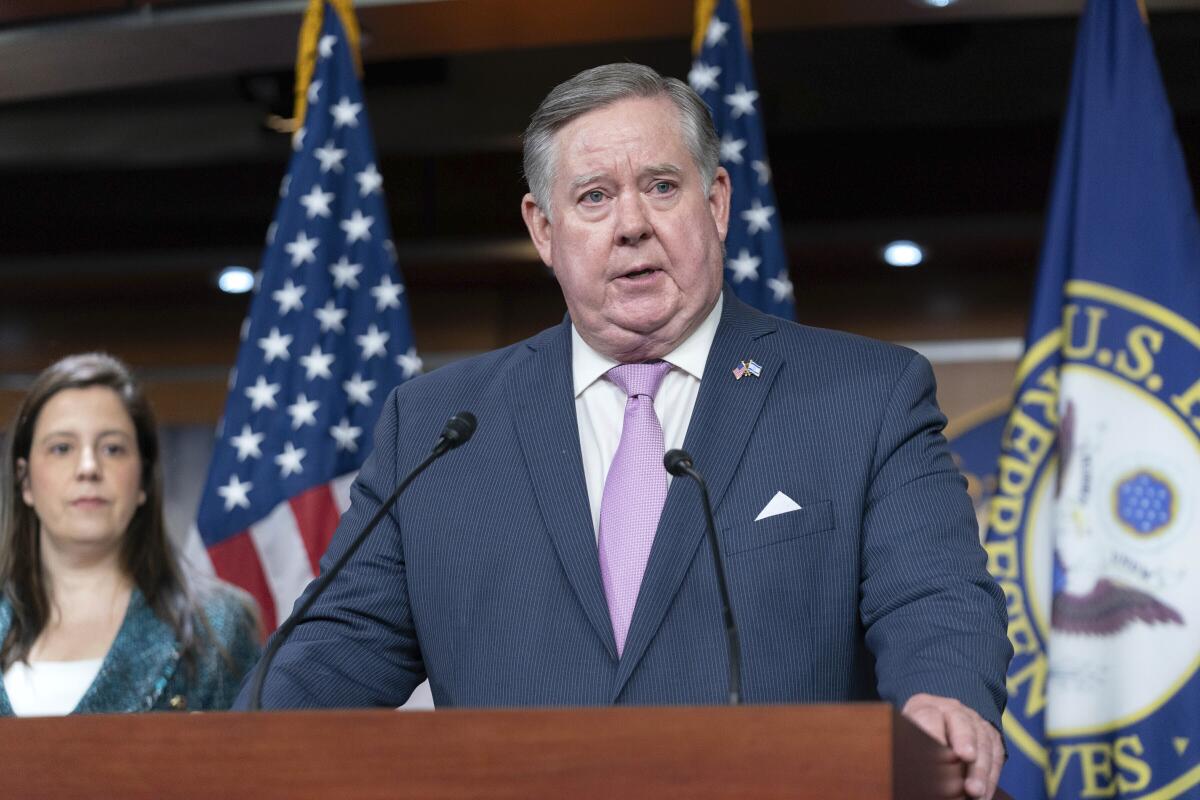
Rep. Ken Calvert (R-Corona) said Democrats seeking to abolish ICE “want to go back to the open borders policies of the Biden administration.”
(Jose Luis Magana / Associated Press)
Others have eyed negotiations over the yearly Homeland Security budget as a leverage point to incorporate their demands, such as requiring federal agents to remove their masks and to turn on their body-worn cameras when on duty, as well as calling for agents who commit crimes on the job to be prosecuted. Seventy House Democrats, including at least 13 from California, backed a measure to impeach Noem.
Rep. Mike Levin (D-San Diego), who serves on the House Committee on Appropriations, said his focus is not on eliminating the agency, which he believes has an “important responsibility” but has been led astray by Noem.
He said Noem should be held to account for her actions through congressional oversight hearings, not impeachment — at least not while Republicans would be in control of the proceedings, since he believes House Judiciary Committee Chairman Jim Jordan (R-Ohio) would make a “mockery” of them.
“I am going to use the appropriations process,” Levin said, adding that he would “continue to focus on the guardrails, regardless of the rhetoric.”
Chuck Rocha, a Democratic political strategist, said Republicans seized on the abolitionist rhetoric as a scare tactic to distract from the rising cost of living, which remains another top voter concern.
“They hope to distract [voters] by saying, ‘Sure, we’re going to get better on the economy — but these Democrats are still crazy,’” he said.

Dozens of Angelenos and D.C.-area organizers, along with local activists, rally in front of the Federal Building in downtown Los Angeles on Friday. Democrats have for years struggled to put forward a unified vision on immigration — one of the top issues that won President Trump a return to the White House.
(Genaro Molina/Los Angeles Times)
Democrats have for years struggled to put forward a unified vision on immigration — one of the top issues that won President Trump a return to the White House. Any deal to increase guardrails on Homeland Security faces an uphill battle in the Republican-controlled Congress, leaving many proposals years away from the possibility of fruition. Even if Democrats manage to block the yearly funding bill, the agency still has tens of billions of dollars from Trump’s One Big Beautiful Bill Act.
Still, the roving raids, violent clashes with protesters and detentions and deaths of U.S. citizens and immigrants alike increased the urgency many lawmakers feel to do something.
Two centrist groups released memos last week written by former Homeland Security officials under the Biden administration urging Democrats to avoid the polarizing language and instead channel their outrage into specific reforms.
“Every call to abolish ICE risks squandering one of the clearest opportunities in years to secure meaningful reform of immigration enforcement — while handing Republicans exactly the fight they want,” wrote the authors of one memo, from the Washington-based think tank Third Way.
“Advocating for abolishing ICE is tantamount to advocating for stopping enforcement of all of our immigration laws in the interior of the United States — a policy position that is both wrong on the merits and at odds with the American public on the issue,” wrote Blas Nuñez-Neto, a senior policy fellow at the new think tank the Searchlight Institute who previously was assistant Homeland Security secretary.
Roughly 46% of Americans said they support the idea of abolishing ICE, while 43% are opposed, according to a YouGov/Economist poll released last week.
Sarah Pierce, a former policy analyst at U.S. Citizenship and Immigration Services who co-wrote the Third Way memo, said future polls might show less support for abolishing the agency, particularly if the question is framed as a choice among options including reforms such as banning agents from wearing masks or requiring use of body cameras.
“There’s no doubt there will be further tragedies and with each, the effort to take an extreme position like abolishing ICE increases,” she said.
Laura Hernandez, executive director of Freedom for Immigrants, a California-based organization that advocates for the closure of detention centers, said the increase in lawmakers calling to abolish ICE is long overdue.
“We need lawmakers to use their power to stop militarized raids, to close detention centers and we need them to shut down ICE and CBP,” she said. “This violence that people are seeing on television is not new, it’s literally built into the DNA of DHS.”
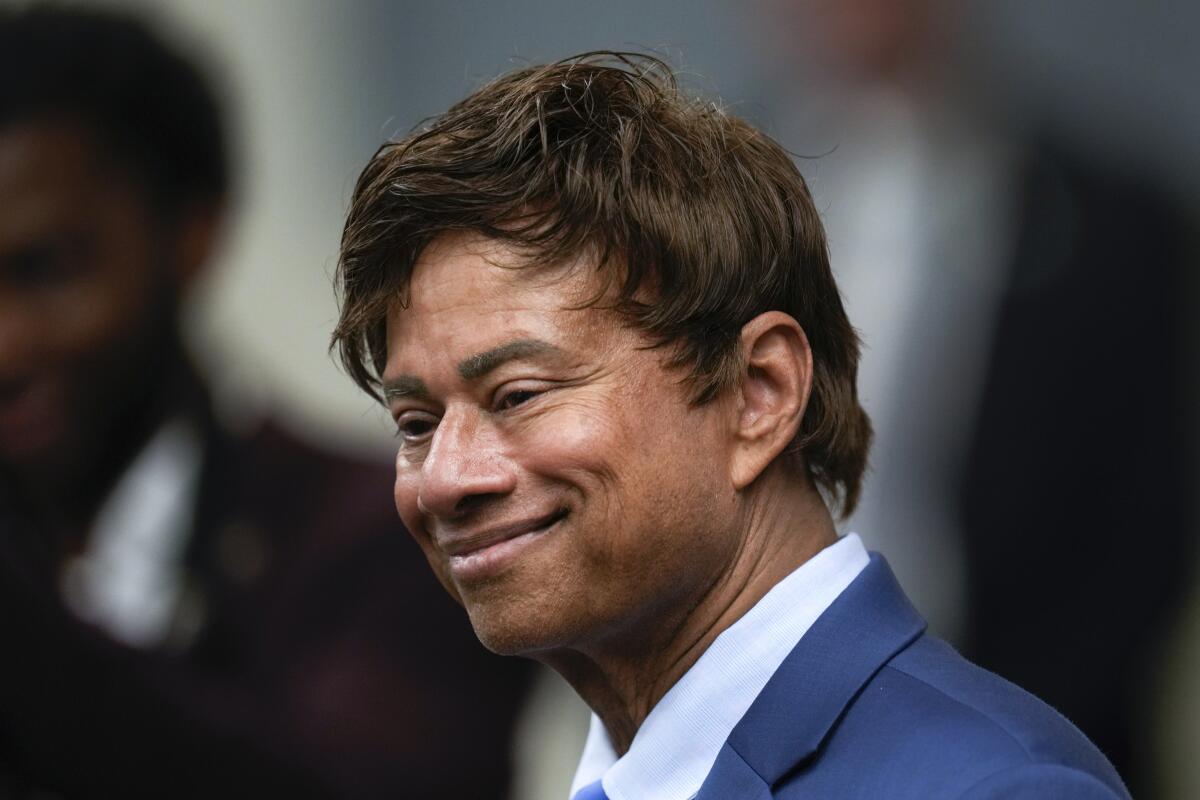
Rep. Shri Thanedar (D-Mich.) introduced the “Abolish ICE Act.”
(Paul Sancya / Associated Press)
Cinthya Martinez, a UC Santa Cruz professor who has studied the movement to abolish ICE, noted that it stems from the movement to abolish prisons. The abolition part, she said, is watered down by mainstream politicians even as some liken immigration agents to modern-day slave patrols.
Martinez said the goal is about more than simply getting rid of one agency or redirecting its duties to another. She pointed out that alongside ICE agents have been Border Patrol, FBI and ATF agents.
“A lot of folks forget that prison abolition is to completely abolish carceral systems. It comes from a Black tradition that says prison is a continuation of slavery,” she said.
But Peter Markowitz, a law professor and co-director of the Immigration Justice Clinic at the Cardozo School of Law, said the movement to abolish ICE around 2018 among mainstream politicians was always about having effective and humane immigration enforcement, not about having none.
“But it fizzled because it didn’t have an answer to the policy question that follows: If not ICE, then what?” he said. “I hope we’re in a different position today.”


NEWYou can now listen to Fox News articles!
Sen. Ron Wyden, D-Ore., suddenly found himself on the defensive at a budget hearing on Wednesday when, amid levying accusations of the Trump administration’s “corrupt” dealings, Treasury Secretary Scott Bessent fired back by bringing Wyden’s son’s investments into the exchange.
“We would like to hear what Adam Wyden and Jeffrey Epstein talked about,” Bessent said, referring to unearthed emails drawing a connection between the senator’s son and the disgraced financier.
“Did your son and Jeffrey Epstein talk about pole dancing as he begged him for money?”
The moment continues the political fallout for the many names associated with Epstein that — despite not amounting to proof of wrongdoing — continue to prompt embarrassment and scandal at even the smallest mention.
TOP FIERY MOMENTS AS DEMOCRATS CLASH WITH TREASURY SECRETARY BESSENT IN CHAOTIC HILL HEARINGS
Treasury Secretary Scott Bessent, left, pictured along Sen. Ron Wyden, D-Ore, right. (Aaron Schwartz/Bloomberg via Getty Images; Chip Somodevilla/Getty Images)
Epstein, a former financier, died while in prison on charges of sex trafficking minors in 2019, leaving behind questions of whether he facilitated illegal sexual encounters for his vast network of rich and powerful figures.
Amid public demands for transparency on the matter, the Department of Justice released troves of documents on Epstein late last year, unveiling a slew of new names with all manner of ties to the infamous figure ranging from purely innocuous to alarming.
Among them, emails surfaced indicating that Adam Wyden, Ron Wyden’s son, went to Epstein, hoping to gain his support for a business venture.
UNEARTHED EMAILS REVEAL DEM SENATOR’S SON WANTED EPSTEIN TO JOIN HIS FUND: ‘ENJOYED OUR CONVERSATION’
Sen. Ron Wyden leaves a Senate Democratic meeting at the U.S. Capitol Building in Washington, D.C., on Oct. 3, 2025, as the federal government shuts down after Congress and the White House failed to reach a funding deal. (Kevin Dietsch/Getty Images)
“Jeffrey, I wanted to thank you for taking the time to meet with me. I thoroughly enjoyed our conversation and hope my passion and dedication for my business came through in the meeting. I live and breathe this business and take my returns, integrity and reputation quite seriously,” the younger Wyden said in an email in April 2016.
“I intensely appreciate like-minded individuals and would very much look forward to having you join us at the fund.”
The emails came after Epstein pleaded guilty to soliciting a minor for prostitution in Florida in 2008.
It’s unclear what the business venture discussed by Adam Wyden and Epstein may have been or what, specifically, had been discussed in their conversations.
Even so, Bessent reminded viewers that the younger Wyden had a history of investing in off-color markets at Wednesday’s hearing.
DEMOCRATS ARE HAMMERING REPUBLICANS ON EPSTEIN, BUT ONE SENATOR BRUSHED OFF THE ISSUE YEARS AGO
Treasury Secretary Scott Bessent addresses a press conference in Rosenbad after trade talks between the U.S. and China concluded in Stockholm, Sweden, on July 29, 2025. (Magnus Lejhall/TT News Agency/AFP via Getty Images)
CLICK HERE TO DOWNLOAD THE FOX NEWS APP
“Your son’s largest investment position was Rick’s Cabaret,” Bessent said, referring to a series of strip clubs.
Wyden, who has widely panned the Trump administration and its many officials for their own connections to Epstein, didn’t respond to Bessent’s jabs.

As election officials continued tallying ballots Wednesday, Republican Steve Hilton and Democrat Xavier Becerra continued to lead in the unsettled race to replace termed-out Gov. Gavin Newsom, with billionaire Democrat Tom Steyer hoping for a surge in late-arriving votes to push him into one of the top-two spots to advance to the November general election.
Hilton, a British immigrant and former Fox News commentator, told reporters outside the state Capitol in Sacramento Wednesday morning that he was “very encouraged” by the latest results, though he stopped short of declaring victory.
“It does look as if change is coming to California, and that is good news for everyone, every small business, every working family, everyone who wants to see our state set back on track,” he said.
Becerra and Steyer did not hold public events as of Wednesday afternoon.
Election data analyst Paul Mitchell said it would be nearly mathematically impossible for Steyer to close the gap.
“As we start to get more data, the runway is going to get shorter and shorter,” he said.
He said Steyer, to finish in the top two in the primary, would have to get about 30% of the remaining uncounted votes while Becerra would need to be limited to 15%. The self-funded billionaire has “a very high hill to overcome, and the challenge gets steeper and steeper as we get more data from the counties,” Mitchell said.
Once mired near the bottom of a crowded pack of Democrats in opinion polls, Becerra, a former Biden administration cabinet member, rocketed ahead of his rival candidates after former Rep. Eric Swalwell dropped out of the race in April amid allegations of sexual assault and misconduct. The scandal triggered an upswing of voter interest in California’s once sluggish governor’s race and in Becerra, who seized the moment.
“Here in Hollywood’s hometown, we love a good underdog story,” Becerra told cheering supporters at his election night party at La Plaza de Cultura y Artes in downtown Los Angeles.
Becerra spoke about his Mexican immigrant parents and becoming the first in his family to attend college. Though a longtime California politician, Becerra said that his campaign for governor was outspent and that he faced calls to drop out of the race.
“The underdog stayed in the fight,” he said. “Like my parents, I never gave up. … Never stopped believing in the beacon-light goodness of California and thankfully, neither did you.”
Steyer, who spent more than $216 million of his wealth on the race, has not conceded defeat.
His campaign manager, Heather Hargreaves, wrote in a letter to supporters Wednesday that “we’re going to give democracy time to work. County election officials are still counting ballots and don’t expect to know how many people voted in total until” Thursday, when officials are required to report the estimated number ballots left to process.
The billionaire former hedge fund owner campaigned against the corporate and special interests that have a powerful presence in Sacramento and often spend heavily in elections, including this year against Steyer.
Billionaires “do everything they can to hoard their wealth and avoid paying taxes, and we see corporations continue to rig the system for themselves — raising your prices to juice their profits. Screw that,” Steyer said at his election watch party at the Regency Ballroom in San Francisco.
Other candidates in the race included Republican Riverside County Sheriff Chad Bianco and Democrats including former Rep. Katie Porter, San José Mayor Matt Mahan, former Los Angeles Mayor Antonio Villaraigosa and state Supt. of Public Instruction Tony Thurmond.
Villaraigosa, Mahan and Porter conceded the race Tuesday night.
California’s 2026 race for governor started slow but ended with a flourish, including the demise of a scandal-ridden Democratic favorite, the anointing of a Republican by Trump and Becerra’s unexpected rise from the depths of the candidate field.
Unlike gubernatorial elections in the last quarter of a century, this year’s race lacked a clear crowd-pleasing front-runner able to win over voters, such as movie star Arnold Schwarzenegger or Jerry Brown, a sage of the California electorate and scion of a storied political family. But it unfolded at a time when the state’s residents are overwhelmed by high housing costs, steep gas prices and overall unaffordability that threatens the “California dream” that once drew millions of people to the state.
“Normal people are not living and breathing politics on a daily basis,” said Tim Rosales, a strategist who ran Republican John Cox’s unsuccessful 2018 gubernatorial campaign. In today’s information-saturated environment, Rosales said, the race and its roster of “extremely milquetoast candidates” didn’t break through until the Swalwell scandal grabbed voters’ attention.
The 2026 gubernatorial primary has been one of the most unpredictable and expensive in decades and a race that was shaped early on by a number of heavyweight Democrats staying on the sidelines.
Though supporters urged them to run, former Vice President Kamala Harris, Sen. Alex Padilla and Atty. Gen. Rob Bonta passed on the race. It was in a state of limbo for months last year as Harris, one of the state’s most high-profile politicians, weighed whether to jump in.
“I don’t ever recall a playing field that looks like this one. Usually there’s a clear front-runner,” said veteran Democratic strategist Darry Sragow. “It’s easy to say that it reflects a lack of talent [but] that’s absolutely not true. Almost any of the candidates running could make a good governor.”
Still, candidates struggled for months to break through to voters.
In February, polls showed the crowded field of Democrats splitting liberal voters and opening a statistical possibility that the party would be boxed out of November under California’s open, top-two primary, which places all candidates on the same ballot. Only the first- and second-place finishers in the primary advance to the general election, regardless of their party affiliation.
Just when Swalwell appeared on the cusp of becoming the Democratic front-runner the San Francisco Chronicle and CNN published allegations that he sexually assaulted a former staffer and acted inappropriately with other women. Swalwell suspended his campaign.
It was Becerra who benefited the most. In less than two months, he vaulted from polling in the low single digits to the top of the field of candidates, according to surveys conducted by UC Berkeley’s Institute of Governmental Studies that were co-sponsored by the Los Angeles Times.
“Becerra caught lightning in a bottle,” Rosales said. “It could have easily gone to any of the other candidates,” but many had baggage. Videos of Porter losing her temper hurt her image, the source of Steyer’s wealth and his unbridled campaign spending weighed on voters’ minds, and Villaraigosa and Mahan were “more centrist than what most Democrats wanted, and so Xavier Becerra was really the safe choice,” Rosales said.
Before Democratic voters began to narrow down their choices, Trump endorsed Hilton in early April. It helped the former Fox News host break away from Bianco, his main GOP rival.
In the days before the primary election, the race solidified into a three-way contest involving Becerra, Steyer and Hilton.
Steyer stepped up his fight in the remaining days, seeking to squeeze into one of the top two spots by battering Becerra in ads and at campaign rallies as a politician propped up by corporate special interests.
“We cannot afford to have a governor who’s been bought off by Big Oil. Period,” he said at a Sunday rally in Los Angeles.
Corporations, along with labor unions and interest groups including the California Assn. of Realtors, had spent more than $18.7 million to boost Becerra, according to the election spending tracker California Target Book. Many of the same groups also gave money to a committee intended to attack Steyer.
As the election neared, Becerra sharpened his attacks against Steyer, calling the billionaire a “liar” and accusing him of trying to buy the election.
“We are not going to let a billionaire or Trump’s handpicked candidate take over this state,” he said during a Sunday rally in Long Beach.
If Becerra faces off with Hilton in November he’ll have a distinct advantage. Democratic voters outnumber Republicans nearly 2 to 1 in left-leaning California.
Winning the general election would make the 68-year-old Becerra the first elected Latino governor of California. At roughly 40% of the state’s population, Latinos are California’s largest ethnic group but have not been represented in the governor’s mansion since 1875, when then-Lt. Gov. Romualdo Pacheco was elevated to fill a 10-month vacancy.
Times staff writers Iris Kwok, Susanne Rust, Andrew Khouri and Christopher Goffard contributed to this report.

new video loaded: Steve Hilton Holds Slim Early Lead in California Governor’s Race
transcript
transcript
Steve Hilton Holds Slim Early Lead in California Governor’s Race
Steve Hilton, a Republican and former Fox News host, held a narrow lead in early votes over two Democratic opponents in California’s nonpartisan primary for governor. The top two candidates will advance to the general election in November.
-
“Change is coming to California, and it’s long overdue. I want to just say something from my heart to every single person who’s voted for me. We’re not — We’re not there yet, but it’s looking good.” [cheers] “Tonight, the people of the great state of California, in the greatest nation on earth, have spoken. [cheers] Loudly and proudly. [cheers] And while I take nothing for granted, there are lots of ballots left to be counted, it appears that we are on track to advance to November.” [cheers] “It might take some time to figure out where this is going. We’re going to wait until every ballot is counted. We’re going to give democracy a time to work, and we know we finished really strong.” [cheers]
By Axel Boada
June 3, 2026
-

 Hawaii44 seconds ago
Gov. Green responds to lawsuit challenging Hawaiian Homes program | Maui Now
-

 Idaho6 minutes ago
Idaho State Police: Driver runs stop sign, hits hay-stacker truck in Twin Falls
-
 Illinois13 minutes ago
Consumer advocacy groups oppose Illinois American Water $142.4M rate hike and potential major acquisition
-

 Indiana16 minutes ago
PHOTOS | Restored fountains at Garfield Park Sunken Garden
-

 Iowa21 minutes ago
Waukee Northwest beats Urbandale in Iowa boys soccer state semifinal
-
 Kansas28 minutes ago
Kansas City, Missouri, police searching for missing 11-year-old girl
-

 Kentucky31 minutes ago
Kentucky Lottery Cash Ball, Pick 3 Evening winning numbers for June 3, 2026
-

 Louisiana36 minutes ago
DHS watchdog finds use-of-force issues and safety and sanitation concerns at Louisiana ICE center

