Politics
A Los Angeles man was denied a green card over his tattoos. The Supreme Court might take up his case

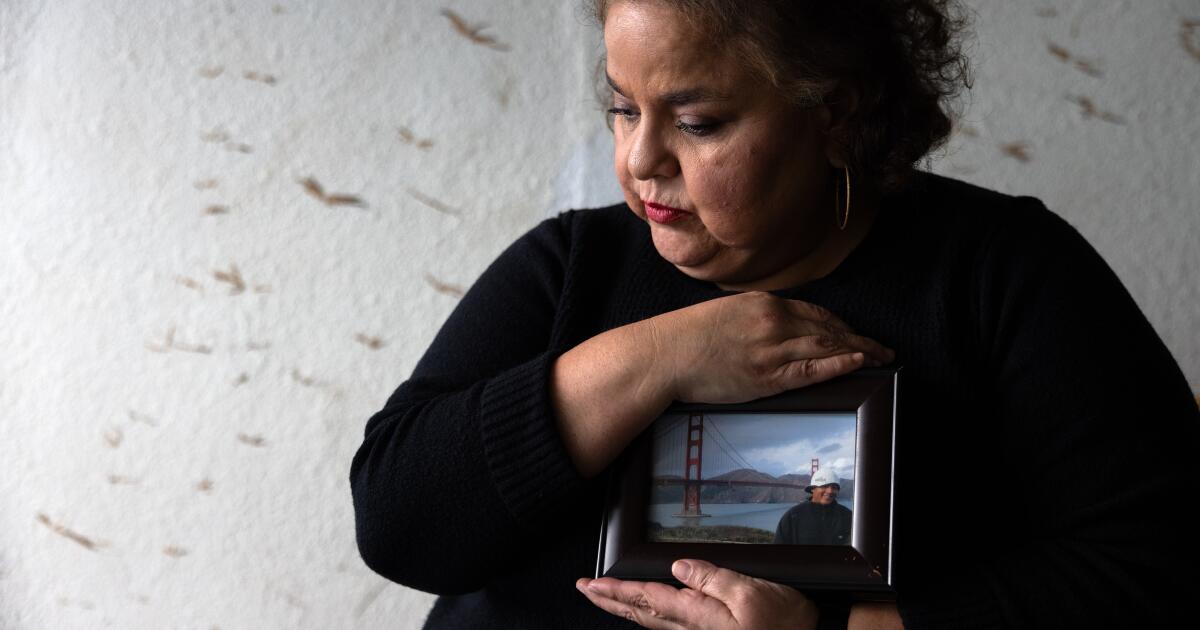
Prominent Los Angeles civil rights attorney Sandra Muñoz spent her eighth Christmas countries apart from her husband, Luis Acensio Cordero, after the federal government denied him a visa, in part, over his tattoos.
The black ink images of La Virgen de Guadalupe, theater masks, a pair of dice and Ace playing cards were throwbacks to his high school days. But to government officials conducting a body search, the tattoos showed he was an MS-13 gang member.
Sandra Muñoz holds a photo of her husband Luis Acensio Cordero.
(Francine Orr / Los Angeles Times)
The couple sued, securing a victory in California’s 9th Circuit Court of Appeals, only to have that decision challenged by the Biden administration. Now the case is headed to the Supreme Court.
On Friday, justices are scheduled to review the case and decide whether to take it up. If they decline, the appeals court decision would stand and Acensio’s lawyers believe he would likely be allowed to return to live in the U.S. for the first time in nine years.
The outcome of the case could have ripple effects for immigrants like Acensio because it’s so rare to win challenges to the government’s visa denials. But his attorneys fear that if the Supreme Court sides with the Biden administration, former President Trump, if reelected, would use the decision, and the underlying authority, to justify blanket bans of people from certain countries, as he did during his first term.
Acensio, now 47, was undocumented when he met Muñoz in 2008 at a wedding. They married two years later and in 2013 he filed for a green card.
In 2015, Acensio returned to El Salvador for what the couple believed was the final security screening and an interview at the U.S. consulate. He expected to be in El Salvador only a few weeks, so Muñoz met him there and booked their return flights back home to L.A. together.
He remembers vividly the day of the interview, being asked to take his clothes off, having photos taken of his tattoos and being asked why he got them. On his chest, one features comedy and tragedy theater masks with a set of dice and three Ace cards. The others are of La Virgen de Guadalupe, a profile of Sigmund Freud and a tribal design with a paw print.
A consular officer asked about his criminal history, and Acensio said he described the only time he’d been arrested, when he and a friend got into a fight. They spent three days in jail and were released without charge.
After the interview, Muñoz spent the rest of the week desperately checking her email. “That email never came and I had to come back alone,” she said. “The first of many trips back alone.”
The government’s denial arrived six months later, saying Acensio would likely engage in unlawful activity if allowed back in the U.S.
A State Department spokesperson declined to comment to The Times because of pending litigation.
In court proceedings, consular officials argued they didn’t owe the family an explanation and there was no way to appeal because of the doctrine of consular non-reviewability, which prevents judicial reviews of visa determinations made by consular officers as long as the decision is “facially legitimate and bona fide.”
Sandra Muñoz is a civil rights attorney in Los Angeles.
(Francine Orr / Los Angeles Times)
In certain cases, a U.S. citizen who proves they were harmed by the denial can challenge the doctrine. Immigration attorney Alan Diamante, Muñoz’s friend from law school, took on the case.
They filed a lawsuit in 2017 in U.S. District Court for the Central District of California challenging the constitutionality of Acensio’s denial. Humberto Guizar, a lawyer and court-approved gang expert who has testified in 50 cases, submitted a declaration stating that he is intimately familiar with gang tattoos and that Acensio had none.
The couple learned in 2018 that the federal government believed Acensio was a member of MS-13, the Salvadoran criminal gang that started in Los Angeles in the ’80s, according to court documents. That determination, lawyers wrote, was based on the in-person interview, a criminal review and a review of his tattoos. Reviews of the visa denial by the consulate and State Department had not “revealed any grounds to change the finding of inadmissibility.”
Eric Lee, their lead attorney, said tattoos are a common reason for visa denials. In Acensio’s case, Lee said he isn’t sure whether the consular officer acted based solely on the tattoos or whether foreign databases had provided erroneous information about his background.
As the case made its way through the courts, Acensio and Muñoz settled into separate lives. He started a business in El Salvador giving electric four-wheeler bike tours. She was named California Lawyer of the Year by the Daily Journal after helping secure a $23-million settlement against Walmart and other companies on behalf of warehouse workers.
She bought a house in Montebello and decorated it with photos of her and Acensio, vowing that one day it would be his home, too.
Acensio was separated not only from his wife, but also from his young daughter, who lives in Las Vegas and whom he would frequently visit. She is now 17, and he has missed seeing her grow up.
Muñoz, 54, has also faced difficulties. She got COVID-19 and suffered from brain fog and fatigue for several months. Her sister and her best friend died in 2021. She fell and tore a quad tendon in 2022, was hospitalized for weeks and still uses a cane to walk. Then her mother’s health began to deteriorate; she died a week before Christmas.
“It was so sad because I had built my life there with her,” Acensio said. “And I’ve never been there as her husband to help her in the most difficult moments. I feel helpless.”
Still, the couple found ways to stay connected. They text throughout the day and frequently do video calls. They traveled to Barcelona together, and her visits to El Salvador deepened her relationship with his family.
Muñoz visited Acensio at least three times a year until the pandemic started. In 2022, he received a Mexican visitor visa and they were able to meet in Tijuana. Their last trip was in May.
El Salvador’s President Nayib Bukele launched a sweeping crackdown against the country’s powerful street gangs, netting more than 70,000 arrests since 2022. Muñoz feared her husband would get caught in the dragnet.
Acensio said police stopped him last year at a checkpoint, looked over his body and let him go. If they believed he was involved with gangs, he said, they would have jailed him.
In October 2022, the 9th Circuit Court of Appeals agreed that the federal government had violated Muñoz’s fundamental right to marriage and due process as a U.S. citizen by denying her husband’s visa without providing an explanation for three years. That decision marked the first time a federal judge had rejected the government’s initial effort to dismiss a lawsuit by citing consular non-reviewability, Lee said.
Lee said he has since advised on similar cases, including four that have resulted in family reunification. Earlier this year, a judge in Arkansas cited Muñoz’s case in a ruling ordering the federal government to provide a better explanation for denying the visa of a U.S. citizen’s foreign husband.
After the appeals court ruling, Acensio applied for humanitarian parole, a form of temporary legal entry, to reunite with his wife. The State Department informed Muñoz’s lawyers that they would not oppose the application. Even so, it was denied last month.
In its petition to the Supreme Court, Biden administration lawyers echoed previous circuit court decisions in arguing that Muñoz’s right to marriage has not been violated because the government “has done nothing more than to say that the residence of one of the marriage partners may not be in the United States.”
Government lawyers argued the 9th Circuit ruling “represents a serious encroachment on the separation of powers. If allowed to stand, it will cause considerable disruption in U.S. consulates.”
Heidi Altman, policy director at the National Immigrant Justice Center, which is co-counsel on the Supreme Court case, said that Acensio and Muñoz’s case is an example of the Biden administration walking away from its commitment to immigrants. It also shows how central family separation is to the U.S. immigration system, she said.
“Fighting this case means really digging in on one particular way that family separation is regularly effectuated by immigration officers,” who ensure there is “no way to correct those mistakes, so that the family separation becomes permanent,” Altman said.
A similar case made its way to the Supreme Court in 2015. A man who had been employed in Afghanistan’s welfare department when the Taliban ruled the country was denied a green card after marrying a U.S. citizen, because the government reasoned he was engaged in terrorist activity.
In that case, the 9th Circuit had also ruled that the government didn’t offer a legitimate enough reason for the denial. But the Supreme Court ultimately ruled against the couple.
The notion that Acensio is a gang member is offensive, Muñoz said. As an attorney, she said, she’s naturally skeptical. And as an officer of the court, she’s sworn to uphold the Constitution.
“It just breaks my heart that this country — that my country — has taken so much from my husband and me,” she said.
Muñoz thinks back to a discrimination case she litigated in which she represented a Latino Los Angeles Sheriff’s deputy who was referred to by supervisors as the “Mexican Mafia.” The county responded by claiming he was in a deputy gang based solely on his tattoo, she recalled.
“A tattoo in and of itself doesn’t mean that somebody is a bad cop, a bad person,” she said. “You can’t simplify it that much. We went to trial in that case. We won.”


NEWYou can now listen to Fox News articles!
A coalition of blue states and jurisdictions is suing the Trump administration over new Medicaid work requirements designed to prevent fraud, arguing the policy unlawfully restricts access to health care coverage.
The lawsuit, filed by at least 25 states and the District of Columbia, alleges the newly implemented Interim Final Rule (IFR) — issued by the Centers for Medicare & Medicaid Services (CMS) — violates federal law and departs from Congress’ original intent and early CMS guidance.
The IFR requires certain individuals to provide documentation proving they are exempt from Medicaid rules requiring enrollees to work, volunteer or attend school due to severe medical conditions.
Before the rule was issued in early June, highly vulnerable Medicaid recipients were set to be automatically exempt from such requirements. Agencies would have granted those exemptions by reviewing existing health records, without requiring individuals to complete additional paperwork ahead of the requirements taking effect in January 2027.
DR. OZ UNVEILS MEDICAID OVERHAUL, CLAMPS DOWN ON $2B FOR ILLEGAL IMMIGRANTS AND MANDATES WORK FOR ABLE-BODIED
Dr. Mehmet Oz, administrator of the Centers for Medicare & Medicaid Services, discussed a number of healthcare topics during a news conference with reporters on Tuesday, June 2, 2026. (Aaron Schwartz/CNP/Bloomberg via Getty Images)
The lawsuit names Dr. Mehmet Oz, administrator of the Centers for Medicare & Medicaid Services (CMS), which issued the IFR, and Robert F. Kennedy Jr., secretary of Health and Human Services (HHS), as defendants.
Oz previously argued that such guardrails are designed to prevent programs from being “defrauded into a turmoil,” adding that able-bodied enrollees receiving American tax dollars should contribute to society.
“If you can work, you should get up and work,” Oz said.
“If we put guardrails around these programs, we’ll allow them to thrive. I’m here because I love Medicaid. The president has already said he loves and cherishes Medicaid and Medicare. … We cannot allow these programs to be defrauded into a turmoil that they cannot pull up from. If we love these programs, we will make the difficult decisions.”
The new rule would require able-bodied individuals to work 20 hours a week, volunteer, or pursue education while enrolled in free healthcare coverage.
Fox News reached out to the White House and HHS for comment.
FED AUDIT, EMERGENCY MEDICAID UNDERCUT DEMS ON ILLEGAL IMMIGRANT HEALTH COVERAGE
Health and Human Services Secretary Robert F. Kennedy Jr. speaks during an interview. ((Photo by Jason Mendez/Getty Images))
The plaintiffs involve California, Connecticut, Delaware, the District of Columbia, Hawaii, Illinois, Maine, Maryland, Massachusetts, New Jersey, New York, Oregon, Rhode Island, Vermont, Washington, Arizona, Colorado, Michigan, Minnesota, Nevada, New Mexico, North Carolina, Pennsylvania, Virginia, Wisconsin and Kentucky.
“People with disabilities, patients in the middle of cancer treatment, or those struggling with another serious or complex health condition, shouldn’t be at risk of losing the care that helps maintain their health,” the suit stated.
REPUBLICANS PRAISE ‘BIG, BEAUTIFUL BILL’S’ WORK REQUIREMENT FOR MEDICAID: ‘WE’VE GOT TO GET BACK TO WORK’
According to the suit, CMS’s own projections estimate that 2.3 million enrollees will lose Medicaid coverage in the first year alone.
The agency also estimates that 7% of enrollees who are working or qualify for an exemption will lose coverage due to confusing paperwork requirements, strict deadlines or missing documentation, according to the document.
Beginning in 2028, enrollees who do not have immediate medical records on file would be limited to a single opportunity to submit a “self-attestation” form declaring, under penalty of perjury, that they are too sick to work.
Under previous guidance, enrollees were allowed to use self-attestation multiple times as their medical needs evolved.
An examination bed sits inside a medical clinic. (AP Photo/Matt York)
CLICK HERE TO DOWNLOAD THE FOX NEWS APP
In addition, plaintiffs said the new rules would force states to abandon automated systems they have already invested in and instead build more complex and costly manual review processes.
As the Aug. 31 deadline to mail notices to Medicaid enrollees approaches, the plaintiffs are seeking a temporary stay and a preliminary injunction to block CMS and HHS from enforcing the rules.

California Democratic senators failed to advance a proposal Tuesday that would have barred registered sex offenders from running for office.
State Sen. Scott Wiener (D-San Francisco) voted against Assembly Bill 2753, while fellow Sens. Tom Umberg (D-Santa Ana) and Ben Allen (D-Santa Monica) abstained from a vote that ultimately failed 2-1-2 in the Senate Elections and Constitutional Committee.
The committee’s lone Republican, Steve Choi (R-Irvine), and Sen. Sabrina Cervantes (D-Riverside) voted in favor of the bill, which is likely dead because it failed to get support from a majority of the five-member panel.
AB 2753 could be reviewed in a floor session Thursday, but staff from the office of Assemblywoman Esmeralda Soria (D-Fresno), who authored the bill, are conceding that’s unlikely.
The defeat comes on the heels of unanimous support, including a 60-0 vote in favor on the Assembly Floor on May 7.
“I am deeply disappointed and disheartened after the Senate Elections Committee has failed to advance AB 2753, a bill that would have prohibited any registered sex offender in the State of California from running for local or state public office,” Soria said in a statement.
The bill’s wording said the legislation would “prohibit a person from being a candidate for, or elected to, any state or local elective office if the person has ever been required to register as a sex offender.”
Inquiries to the offices of Sens. Wiener, Umberg and Allen were not immediately returned.
Sex offenses in California are broken up into three tiers. First-tier offenses call for a minimum of 10 years placement on the sex offender registry. Second-tier offenses call for a minimum of 20 years and third tier crimes could result in a lifetime on the registry.
The types of offenses for each tier vary. Tier 1 offenses range from indecent exposure to misdemeanor child pornography and sexual battery. Tier 2 includes incest and penetration with a foreign object, and Tier 3 includes felony possession of child pornography, rape and pimping and pandering of a minor.
Wiener asked for amendments to the bill during the bill’s review and in the committee meeting, including that the lifetime ban only be applied to Tier 3 members.
He pointed to committee analysis of the bill that could affect so-called “Romeo and Juliet” couples — those close in age, for instance with one partner being 19 and the other being 17. If the younger partner sent sexually explicit digital content to the older partner (a misdemeanor), this law could ban the older partner from public office for life.
There were also concerns listed in the analysis that the registry, which dates back to 1947, could include LGBTQ+ offenders from decades ago who were convicted of offenses that are no longer crimes.
Wiener mentioned in the committee meeting civil rights strategist and fighter Bayard Rustin being placed on the California sex offender’s registry list after being arrested by Pasadena Police for having consensual sex with another man in 1953.
“Without the amendment contained in the analysis, I will be voting ‘no’ on this bill and recommending that the committee vote ‘no,’” Wiener said at the committee hearing.
He added that the sex offender list was “not punishment,” but instead “a tool for law enforcement to monitor who may potentially cause a risk.”
While Soria agreed to one bill amendment, she did not accept other provisions, including the elimination of lifetime bans on Tier 1 or 2 offenses.
“The bottom line is this: I was not willing to make additional amendments to this bill,” she said. “I made a promise to my community that I would do everything in my power to ensure they would never have to go through something like this again. Accepting additional amendments to this bill would have jeopardized that promise.”
Some of the impetus behind her bill revolved around the June 2 Fresno City Council election. Registered sex offender Rene Campos fell short of the necessary votes in his bid to run for Central Valley Council.
He was charged with possession of child pornography in 2018 and hosted his campaign kickoff in front of an elementary school.
Nelson Esparza, Fresno City Council President, spoke at the Senate Elections and Constitutional Committee meeting in favor of AB 2753.
“My office received dozens of calls from our residents asking how this could be allowed,” Esparza said of Campos’ candidacy. “AB 2753 closes this loophole.”
It’s unclear if this bill will be reintroduced next year at least at the Assembly level, as Soria is running for the state senate in November.
Politics
Mamdani ripped for claiming victory over capitalism after NYC’s multi-billion dollar taxpayer funded bailout

NEWYou can now listen to Fox News articles!
New York City’s mayor is again under fire after spewing outlandish claims that his socialist policies are to credit for a balanced budget in the Big Apple, just after the city received a multi-billion dollar bailout from the state.
“In January, our administration inherited a $12 billion budget deficit — a fiscal crisis greater than the Great Recession,” Mayor Zohran Mamdani said in a Tuesday post on X announcing that the debt had been cleared.
“We balanced the budget by taxing the rich and making government more efficient,” Mamdani continued. “We did not balance this budget on the backs of working people, and we never will.”
New York City Mayor Zohran Mamdani speaks during a primary-night watch party for NYC Congressional candidate Claire Valdez at 99 Scott Studio on June 23, 2026 in the East Williamsburg neighborhood of the Brooklyn borough in New York City. (Michael M. Santiago/Getty Images)
MAMDANI ALLOCATES $500K FOR REPARATIONS TALKS AS NYC FACES $5.4B DEFICIT
But the real reason the budget it balanced is because the city was handed $1.5 billion by the state of New York in January — funded by working class taxpayers across the state — as part of a multi-year plan to bail out the fiscally-challenged city. In late May, the city received another $4 billion.
Of the combined $8 billion provided to the city’s bailout fund under former Mayor Eric Adams’ tenure and now Mamdani’s mayorship, $5 billion was directly earmarked for the city to address fiscal measures. This includes allowing city government to defer pension contributions to close the budgetary gap.
Mamdani’s claims about socialist policies producing results — and his failure to mention the massive bailouts provided by taxpayer dollars — did not fly on social media.
New York Gov. Kathy Hochul holds media availability press conference and makes an announcement on abortion rights at the office on 633 3rd Avenue. (Lev Radin/Pacific Press/LightRocket via Getty Images)
MAMDANI ALLOCATES $500K FOR REPARATIONS TALKS AS NYC FACES $5.4B DEFICIT
“This is a lie,” independent journalist Nick Shirley said in a reply to the mayor.
“You balanced the budget by borrowing billions from the NY state government which pushed back pension payments, so you literally took money from ‘the backs of hardworking people.’ Don’t get it twisted,” he added.
Commentator and journalist Nick Sortor also flamed the mayor over the loan and his classification of the bailout.
“Are you saying New Yorkers can ‘balance their budgets’ by taking out massive credit card loans?” he asked sarcastically.
Independent journalist Nick Shirley sat down for an interview with Riley Gaines as part of the launch of Outkick’s “The Riley Gaines Show.” (OutKick)
BROADCAST NETWORKS TOUT MAMDANI’S VICTORIES, PROCLAIM SOCIALISM IS ‘RESONATING’
“Mamdani balanced the budget by taking money from Albany, who in turn taxed Rochester and Buffalo” another social media user said. “That’s who is paying for all of Mamdani’s free crap.”
In a press conference earlier in the day, Mamdani claimed victory over capitalism.
“Throughout this process I have been reminded of the words of the Austrian economist Friedrich Hayek: ‘if socialists understood economics, they wouldn’t be socialists.’”
A man sleeps on the E train, one of the subway lines most utilized by homeless New Yorkers for shelter, in Queens, New York, on Monday, April 7, 2025. (Victor J. Blue for The Washington Post/Getty Images)
After the Republican National Convention (RNC) posted that clip, Mamdani also faced ridicule for that.
“It always looks good at first until the chickens come home to roost,” one person replied.
CLICK HERE TO DOWNLOAD THE FOX NEWS APP
“He’ll soon ‘deliver’ bread lines instead,” said another.
Mamdani’s office did not return Fox News Digital’s request for comment.
-

 News46 seconds ago
Newsom’s office responds to SCOTUS ruling on women’s sports as California faces ongoing trans athlete wave
-

 Los Angeles, Ca1 hour ago
Family of boy, 8, killed by falling tree branch at Calabasas park to get $14.6M
-

 Detroit, MI2 hours ago
The worst Detroit sports uniform from every pro team
-

 San Francisco, CA2 hours ago
Discovery Bay driver arrested for San Francisco fatal vehicle collision | Contra Costa Herald
-

 Dallas, TX2 hours ago
Erling Haaland’s Dallas Western wear purchase goes viral
-

 Miami, FL2 hours ago
Miami’s FIFA Fan Fest draws thousands to Bayfront Park to watch Team USA win World Cup match against Bosnia
-

 Boston, MA2 hours ago
2026 Yukon Denali Ultimate gets pricey, but tops the charts
-

 Denver, CO2 hours ago
Nuggets Sign Marvin Bagley to 1-Year Deal: What It Means

