Politics
'A course correct': How Biden resets his campaign since he's likely not going anywhere

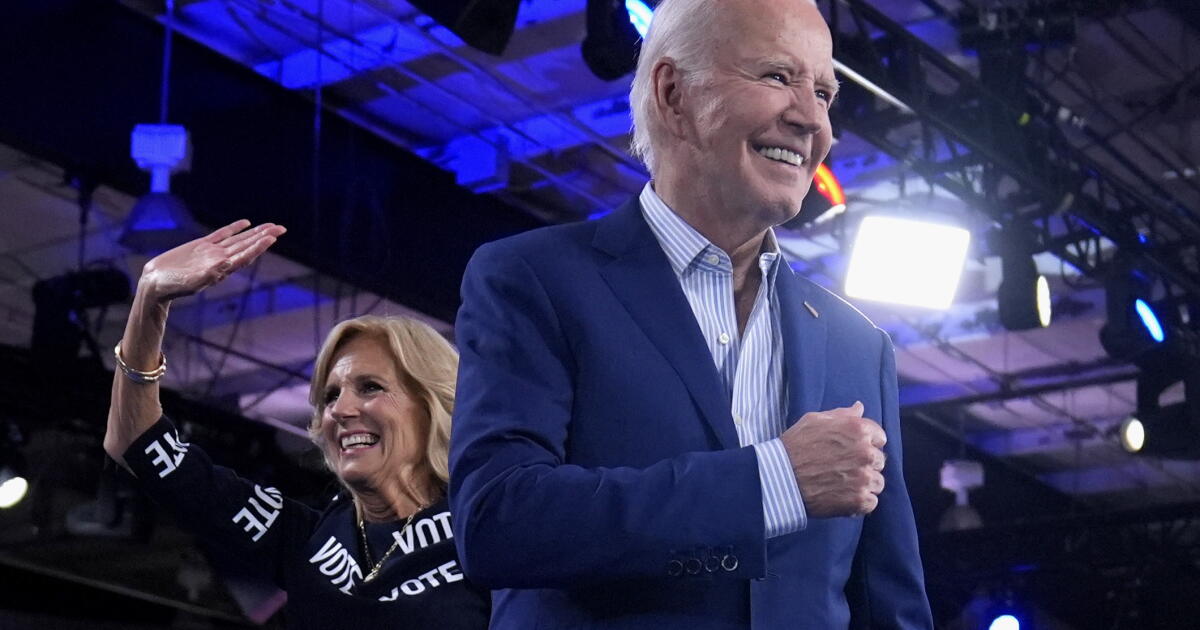
President Biden’s widely panned debate performance Thursday night in Atlanta has many prominent Democrats asking a simple question:
What do we do now?
Swapping out Biden for someone else is likely not possible — unless he quits the race himself. He’s won the requisite number of delegates to capture the Democratic nomination, and Biden said Friday at a rally that he was in the race to win. So now strategists and donors are mulling how the 81-year-old can reset his campaign and take the fight to former President Trump.
Some said the president needed to take a moment to survey the damage. Others said it was important that he increase his campaign travel schedule, do more media availabilities and emphasize how he’s always been an underdog. Some added that he needed to acknowledge his years and what Father Time has wrought rather than act as though age weren’t an issue.
Finally, there was broad agreement that Biden needs to home in on a message that contrasts his values and those of Trump, whom they describe as vain and vindictive.
“Bad debate nights happen,” former President Obama wrote on X. “Trust me, I know. But this election is still a choice between someone who has fought for ordinary folks his entire life and someone who only cares about himself.”
Biden missed a chance to hit that note Thursday, several strategists said. They had wanted him to pick an issue such as reproductive rights or the economy, for example, and stay far more focused on how Americans would be worse off if Trump returned to the White House. They want him to do the same moving forward.
The president’s campaign “definitely needs more to offer clarity on the larger message they’re trying to convey with respect to Trump and how horrible he is,” Democratic strategist Bill Carrick said.
Rep. Ro Khanna (D-Fremont) said Biden remained best positioned to lead the Democratic Party and that his past ability to overcome setbacks, tragedy and adversity offers a guide for how he should approach this moment.
Khanna, a frequent Biden surrogate on the campaign trail, suggested that the president stage a rally on the steps of the Philadelphia Museum of Art to evoke the image of Sylvester Stallone running up them in the iconic moment from the movie “Rocky.”
Biden has always styled himself as an underdog, and that shouldn’t change now, Khanna said. Thursday night’s debate was not Biden’s best showing, the congressman said, but doesn’t define him.
“Rocky wasn’t the most eloquent, but he was a fighter, and his eloquence was his character. I think that’s the line that we need to use: that Biden’s eloquence is his character,” Khanna told The Times.
“He needs to embrace the role of an underdog. He needs to embrace his role as having gotten knocked down in life and gotten back up,” Khanna said. “He’s not going to be a John F. Kennedy. He’s not going to be an Obama. He’s not going to be a Reagan. But he can be a Truman. He can be a Johnson. He can be a fighter.”
Being out among Americans right now is essential, Khanna added, suggesting that Biden barnstorm through the Midwest and meet with blue-collar workers and small-business owners.
Biden has done very few sit-down interviews or news conferences since taking office. He skipped the traditional Super Bowl halftime interview this year. In his first three years in office, Biden held 33 news conferences — half as many as Obama and fewer than Trump’s 52 over the same period, according to The American Presidency Project at UC Santa Barbara.
A patron watches President Biden debate former President Trump during a watch party Thursday in Scottsdale, Ariz.
(Ross D. Franklin / Associated Press)
On Thursday night, the reviews of President Biden flowing in after the 90-minute were generally bad, with one accompanied by seven head-exploding emojis. Even allies have acknowledged he appeared off his A-Game.
It was “Bad night for Trump — but worse night for Biden,” Christine Pelosi, a Democratic National Committee delegate and daughter of former House Speaker Nancy Pelosi, said in a text message.
Biden “needs a course correct and a timely, long unscripted interview to show that this was a terrible debate — as Obama and Reagan both had with their first re-elect debates — and not an ongoing condition,” she said.
One surprising element about Biden’s performance Thursday was how it differed from his energetic and forceful State of the Union Address in March. Biden was so strong that Trump and other Republicans suggested the president had been “jacked up” on drugs to perform so well.
But in the debate, Biden sounded hoarse and and at times struggled to complete sentences. Trump also spoke incoherently at times and, as fact-checkers pointed out, lied repeatedly. But Trump also spoke with more confidence, and the contrast in energy — Trump revved up, Biden halting — was startling to many viewers.
CNN announced that the debate averaged 51.3 million television viewers Thursday. The data do not include online viewing.
“I am very fond of ‘Joey Biden.’ But I believe he may well have done himself and those of us who understand what an effective president he has been existential damage,” said Joey Kaempfer, a real estate developer who has donated heavily to Democrats through the years. He has given close to $1 million to groups supporting Biden’s reelection and has dined with the president.
“We must be patient and see how the next week or two shakes out,” he said. “But yes, I am very concerned.”
At a rally Friday in North Carolina, Biden appeared to heed some of this advice, particularly from those who said he needed to more fulsomely address the fact that he’d be the oldest president in history by the end of his second term. He delivered his points with more gusto and clarity than the night before and sounded more cogent.
Biden continued to attack the lies and lack of empathy Trump espoused at the debate — pointing to his comments on abortion, immigration and respecting democracy — and contrasting them with the accomplishments of his administration’s first term. He also addressed his age.
“I know I’m not a young man, to state the obvious,” Biden said Friday. “I don’t walk as easy as I used to. I don’t speak as smoothly. I don’t debate as well as I used to. But I know what I do know. I know how to tell the truth. I know right from wrong, and I know how to do this job.
“I know, like millions of Americans know,” he said, “when you get knocked down, you get back up.”
Biden at one point trumpeted his relationships with every world leader, “because I’ve been around, as you kind [of] have noticed,” which prompted laughs from the crowd. Exuding energy and not being defensive appeared to endear him to the supporters, and would it put him on a good path forward after the disastrous debate.
“Even with a great speech today — which I think is a good start — he needs many, many, of those, and he needs many many surrogates in the course of this,” former Republican strategist Matthew Dowd said on MSNBC.
There are 75 days until the next debate, he added, which means it will be a long time before many people tune into politics again. That’s a problem for Biden, Dowd said.
As if to address concerns about his stamina, Biden also attended two events Friday in New York City. The Associated Press reported that he joined Elton John in inaugurating a visitor center at the Stonewall National Monument, then attended a Pride Month fundraiser.
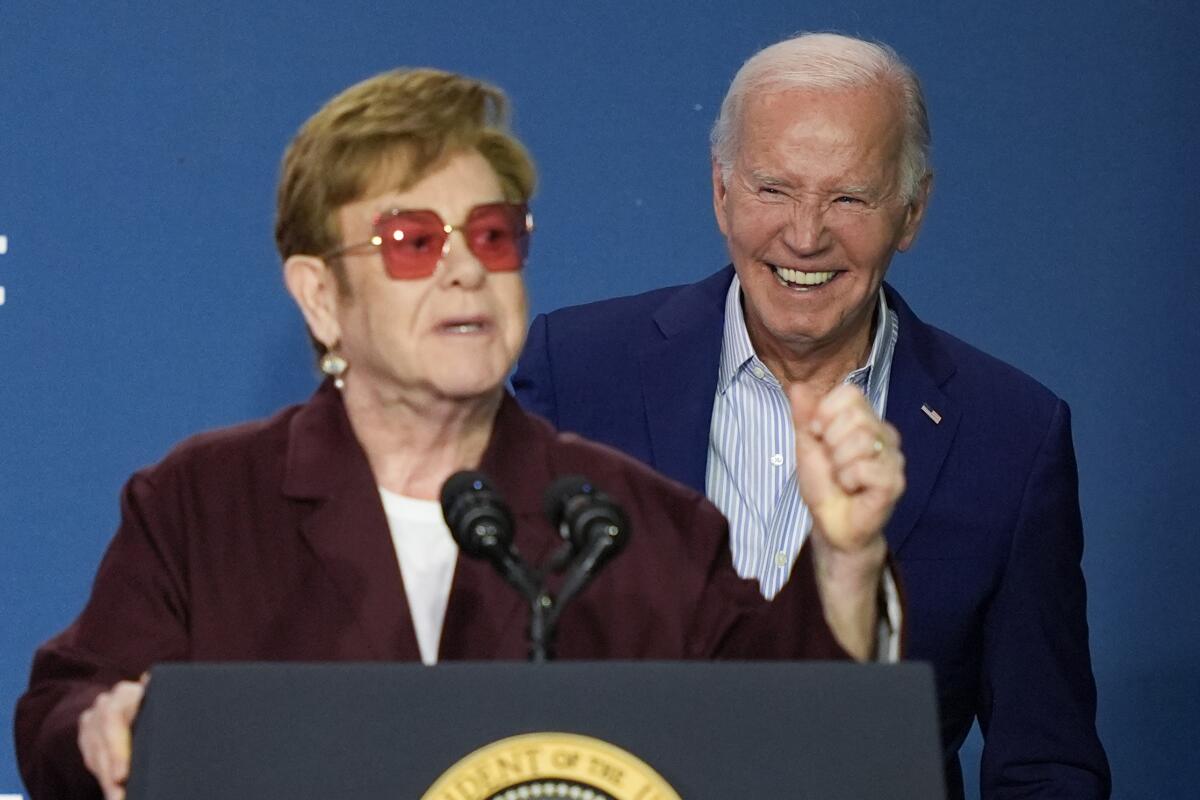
President Biden listens as Elton John speaks Friday at the grand opening ceremony for the Stonewall National Monument Visitor Center in New York City’s Greenwich Village.
(Julia Nikhinson / Associated Press)
This was one of the earliest presidential debates in recent political history. Many analysts said it would focus voters’ attention on the race earlier and offer Biden a chance to shake up the trajectory.
Analysts had theorized that the Biden campaign also wanted an early debate because it would give him more time to repair any damage from a poor outing. That will now be put to the test.
Times staff writers Seema Mehta and Noah Bierman contributed to this report.

Politics
WATCH: Trump’s Energy chief reveals what escalating Iran tensions could mean for gas prices

NEWYou can now listen to Fox News articles!
Energy Secretary Chris Wright is telling Americans not to be concerned about the possibility of another surge of sharp increases in gasoline prices as tensions with Iran have started to escalate once again.
Asked whether Americans should worry about higher prices at the pump and how the Trump administration is preparing to keep the economy stable if the conflict continues to worsen, Wright told Fox News Digital: “It has not been any good behavior from Iran that’s allowed oil to flow. It’s been the United States military.”
“That’s not changing,” he assured, speaking from the Great American State Fair on the National Mall this week.
US CLAWS BACK KEY CONCESSION TO IRAN AFTER FRESH ATTACKS ON COMMERCIAL SHIPS IN STRAIT OF HORMUZ
(Mario Tama/Getty Images) (Mario Tama/Getty Images)
With Iran striking three commercial vessels transiting the Strait of Hormuz on Monday and Tuesday, Wright doubled down in urging citizens to not credit Iran for the U.S. military’s work to ensure oil shipments continue flowing through the strait.
“Look, the U.S. Military has been the key asset here,” he said. “They have assured the flow of oil and gas through the Strait of Hormuz throughout. Not at the beginning of this conflict, but through the last six weeks.”
Wright said the administration is closely monitoring global oil supplies as the tentative ceasefire with Iran seemingly came to come to a halt, with President Donald Trump telling Secretary-General Mark Rutte the call for peace with Iran is “over” at the NATO Summit in Turkey on Wednesday.
But, he pointed to the continued shipping through the Strait as evidence that markets should remain stable.
TRUMP SAYS IRAN CEASEFIRE IS ‘OVER’ AFTER IRANIAN ATTACKS TRIGGER MASSIVE US RESPONSE
President Donald Trump speaks at the White House on Tuesday, April 22. (AP/Alex Brandon)
“We’re of course constantly watching the supply of oil, the supply of refined products and what’s going on there,” Wright said. “And I think still all positive trends.”
Beyond geopolitical concerns, Wright also praised the new chain of discounted gas stations across Pennsylvania and New Jersey, Freedom Fuel, which promises customers prices below the national average.
The Trump administration, though not involved with the network, has heavily endorsed the new chain and its 25 locations.
“We love it,” Wright said when asked about Freedom Fuel. “I mean, look, any mechanism we can to lower energy costs for Americans of all kinds, we’re all in on.”
“With Freedom Fuels, they’re just lowering it down to their wholesale price of gasoline,” Wright said. “So they’re not making any money selling gasoline, but they’ve got convenience stores. That’s how most gas stations make money.”
NEWSOM UNDER FIRE AS CALIFORNIA GAS TAX HIKE SENDS PUMP PRICES EVEN HIGHER
Gasoline costs are a known concern for many Americans, and amid surging prices there has been a considerable increase in those opting to purchase electric vehicles to save money long-term at the pump — with Tesla dominating the market for these types of models.
Wright argued one of the benefits to living in America is having the option to choose what type of vehicle you drive.
CLICK HERE TO DOWNLOAD THE FOX NEWS APP
“We just want people to buy what they would prefer,” he told Fox News Digital when asked his thoughts on increasing calls for support of the electrification of cars. “Consumer choice — you wanna buy an electric car, you wanna buy a gas powered car, diesel powered car, buy a big truck. That’s the choice.”
“That’s why you live in America. You get the choice of all those.”

In 2023, California regulators levied more than $100,000 in fines against the private operator of a federal immigration facility, kicking off a three-year battle over whether detainees who do work at the facilities should be considered employees.
The question went beyond semantics: If considered employees, the detainees would be subject to state worker protection laws.
A legal settlement announced this week now affirms that private immigrant detention facilities are subject to California’s workplace safety and health requirements.
“Every worker deserves a safe and healthy workplace and should be able to report workplace hazards without fear of retaliation,” said Denisse Gómez, spokesperson for the California Division of Occupational Safety and Health or Cal/OSHA.
“Individuals who perform work in these facilities are entitled to workplace safety protections, and this settlement reinforces Cal/OSHA’s commitment to enforcing those protections and safeguarding vulnerable workers,” she added.
Under the settlement between California and the GEO Group, a Florida-based private prison company, the company recently withdrew its legal challenges and agreed to pay more than $100,000 in the fines.
The GEO Group did not respond to requests for comment.
Back in 2023, Cal/OSHA issued $104,510 in fines against the GEO Group. The agency had found six violations of state code by the company after detainees complained about a lack of protective equipment and proper training while cleaning the facility for $1 per day.
Detainees alleged they routinely wiped black mold off shower walls at the facility, saw black dust spew from air vents and used cleaning solutions that lacked instructions during the COVID-19 pandemic.
The biggest fine levied against the GEO Group was for failure to establish and maintain “effective written procedures to reduce employee risk of exposure to aerosol transmissible disease.”
Advocates viewed Cal/OSHA’S recognition of the detainees as workers as a victory that could pave the way for future labor rights fights at other detention centers in the state.
But the GEO Group appealed, arguing that detainees participating in ICE’s voluntary work program make their own schedules and aren’t employees, so hazard exposure couldn’t be “as a result of assigned duties,” as California law states. Plus, the company argued, there wasn’t enough evidence that detainees were exposed to any hazard.
Early last year, the state’s Occupational Safety and Health Appeals Board rejected the GEO Group’s argument and found that detainees should be considered “affected employees.”
The GEO Group sued, but three days before a California Superior Court hearing in May, the company and Cal/OSHA reached the settlement.
Along with paying the fines, the GEO Group agreed to draft plans for avoiding aerosol transmissions at 12 secure and reentry facilities in California, including five detention centers that hold immigrants.
“GEO ensures detainees are afforded the necessary tools, equipment, and personal protective equipment … to safely and effectively perform any necessary tasks,” the settlement states.
Gómez said the settlement also leaves intact the appeals board’s ruling that civil immigration detainees who participate in work programs can participate in proceedings anonymously, “acknowledging the potential for retaliation when individuals raise workplace safety concerns.”
But the question of whether detainees are employees and deserve certain protections isn’t entirely resolved — at least not for the federal government.
Last month, U.S. Immigration and Customs Enforcement released new standards for detention facilities across the country. The revised guidelines “emphasize that detainee volunteers participating in the voluntary work program are not considered facility and/or government employees” and thus not entitled to labor regulations.
Attorney Mariel Villarreal said the timing of the new detention standards made her question whether the GEO Group had asked ICE to specify in its standards that detainees are not workers in response to its battle with Cal/OSHA.
“To me, it’s a reaction to this very settlement,” she said. Villarreal works for the California Collaborative for Immigrant Justice, which filed the original complaint on behalf of detainees who said they worked in unsafe conditions.
Villarreal pointed to a Washington Post report that GEO Group executives privately asked ICE to specify that detainees are not employees of the facilities where they work. Two top Trump administration officials, border czar Tom Homan and acting ICE director David Venturella, previously worked for the GEO Group.
New versions of ICE detention standards take effect as contracts are established or modified, so this year’s rules won’t immediately apply to every facility.
An ICE spokesperson did not comment about the settlement. The spokesperson, who did not provide their name in an emailed statement Wednesday, said the agency has begun transitioning detention facilities to meet the 2026 standards, “building on its longstanding commitment to safe, secure, and professional detention operations.”
“ICE has consistently implemented many of these best practices independently, reinforcing its role as the leader in detention operations,” the spokesperson added.
The GEO Group and other immigrant detention center operators have faced other legal battles over workers’ rights, including lawsuits in Washington, Colorado and California over the $1-per-day payment.
Villarreal said she’s confident that the Cal/OSHA settlement would continue to hold even if California facilities incorporated the new standards. But she said she believes the statements are an attempt by the GEO Group to “sidestep responsibility” and avoid the possibility of being fined under similar circumstances in other states.
“These statements in the new standards are a way for them to try and preserve profits as much as possible,” she said. “GEO and ICE are so intertwined at this point that they have the same motives.”
Politics
Israel shares intelligence warning Iran plotted new assassination attempt against Trump: report

NEWYou can now listen to Fox News articles!
Israel recently shared intelligence with the United States indicating Iran had developed a fresh plan to assassinate President Donald Trump, according to a Wall Street Journal report Thursday citing people familiar with the matter.
The reported intelligence would mark an escalation in the longstanding threats against Trump, who Iran has repeatedly vowed to retaliate against over the 2020 U.S. strike that killed Islamic Revolutionary Guard Corps Gen. Qassem Soleimani.
The White House referred Fox News Digital to Trump’s remarks Wednesday when asked about the report.
TRUMP FACES UNPRECEDENTED THIRD ASSASSINATION ATTEMPT
President Donald Trump speaks during a news conference at the NATO Summit in Ankara, Turkey, July 8, 2026. Trump addressed threats against his life after a report said Israel shared intelligence with the United States about an alleged new Iranian assassination plot. (Kerem Uzel/Bloomberg via Getty Images)
“They want to take out the U.S. leader — me. I’m on whatever list. I saw this morning I’m on every single one of their lists,” Trump said. “And, so far, I guess I’ve been a bit lucky, but maybe that doesn’t last very long. These are evil, sick people. And we have to root out that cancer. That cancer. You know what you do? You’ve got to cut out cancer early. And that’s the way I feel.”
Fox News Digital has also reached out to Israel’s Embassy in Washington and Iran’s Mission to the United Nations for comment.
The Journal reported the intelligence surfaced as Trump and Israeli Prime Minister Benjamin Netanyahu have diverged in recent weeks over how to proceed after last month’s conflict with Iran. Netanyahu has advocated for continuing military pressure on Tehran, while Trump has sought to preserve a fragile ceasefire after U.S. strikes on Iranian nuclear sites.
NETANYAHU REJECTS REPORTS OF A RIFT WITH PRESIDENT TRUMP, SAYS THE TWO REMAIN ALIGNED ON IRAN
President Donald Trump, left, and Israeli Prime Minister Benjamin Netanyahu at the White House March 25, 2019. The leaders spoke Thursday after The Wall Street Journal reported Israel had shared intelligence with the United States about an alleged new Iranian plot targeting Trump. (AP Photo/Susan Walsh, File)
Trump and Netanyahu spoke Thursday and agreed to continue coordination between the two countries, according to a statement from Netanyahu’s office, which said Trump also updated the Israeli leader on recent U.S. activity in the Gulf.
Prime Minister Benjamin Netanyahu during his conversation with U.S. President Donald Trump. (Avi Ohayon/GPO)
CLICK HERE TO DOWNLOAD THE FOX NEWS APP
Iranian mourners at the funeral for Supreme Leader Ali Khamenei chanted for Trump’s death and displayed a banner that said, “We Will Kill Trump,” according to the Journal.
Iran has publicly vowed for years to retaliate against Trump over the U.S. operation that killed Soleimani, the former commander of the Islamic Revolutionary Guard Corps’ Quds Force, in Baghdad in January 2020.
-
 Lifestyle1 minute ago
‘The Invite’ is a marriage comedy with sex and heart
-

 Technology13 minutes ago
I spent a week using the Trump phone — it sucks
-

 World16 minutes ago
With US unleashing attacks, Iranian official threatens that the Islamic Republic will deliver a ‘hard slap’
-

 Politics21 minutes ago
WATCH: Trump’s Energy chief reveals what escalating Iran tensions could mean for gas prices
-

 Health28 minutes ago
Coffee may have powerful effect on liver health, major study suggests
-

 Sports31 minutes ago
Oba Femi vs Brock Lesnar at SummerSlam is a ‘generational matchup,’ WWE legend JBL says
-
 Business43 minutes ago
Billionaire exodus? California drew 10 times more venture capital than any other state this year
-
 Entertainment46 minutes ago
Disney Channel maximalism to pop-star glam: What fans wore to Hilary Duff’s L.A. show

