Northeast
Wealthy Maryland school district PTA trains parents in how to disrupt ICE enforcement operations
NEWYou can now listen to Fox News articles!
Parent Teacher Association officials in one of the wealthiest school districts in the country hosted a training session last month instructing families on how to respond to Immigration and Customs Enforcement (ICE) activity.
The virtual PTA session in Montgomery County, Maryland, was held on Jan. 20 and was headed by Councilwoman Kristin Mink. The meeting was titled “ICE Response & Organizing Tools for PTAs, Parents & Guardians.”
According to the National Review, Mink has previously hosted multiple sessions on ways schools can equip themselves with “tools to slow ICE down and protect each other.” The training guided parents on how to escort students with illegal immigrant parents, and encouraged volunteers to monitor ICE activity during drop‑off and pickup, and introduced ways to support families affected by ICE arrests and deportations.
During the session, Mink reportedly presented comprehensive “rapid response” guidance she had created and shared publicly three days earlier.
In one slide, Mink outlined how “White allies” could assist and support the community, advising them not to use whistles to counter “ICE violence,” which has become a widespread form of community resistance. She argued that White individuals should avoid using a tool that, in her view, reinforces authority associated with Whiteness.
THE FAR-LEFT NETWORK THAT HELPED PUT ALEX PRETTI IN HARM’S WAY, THEN MADE HIM A MARTYR
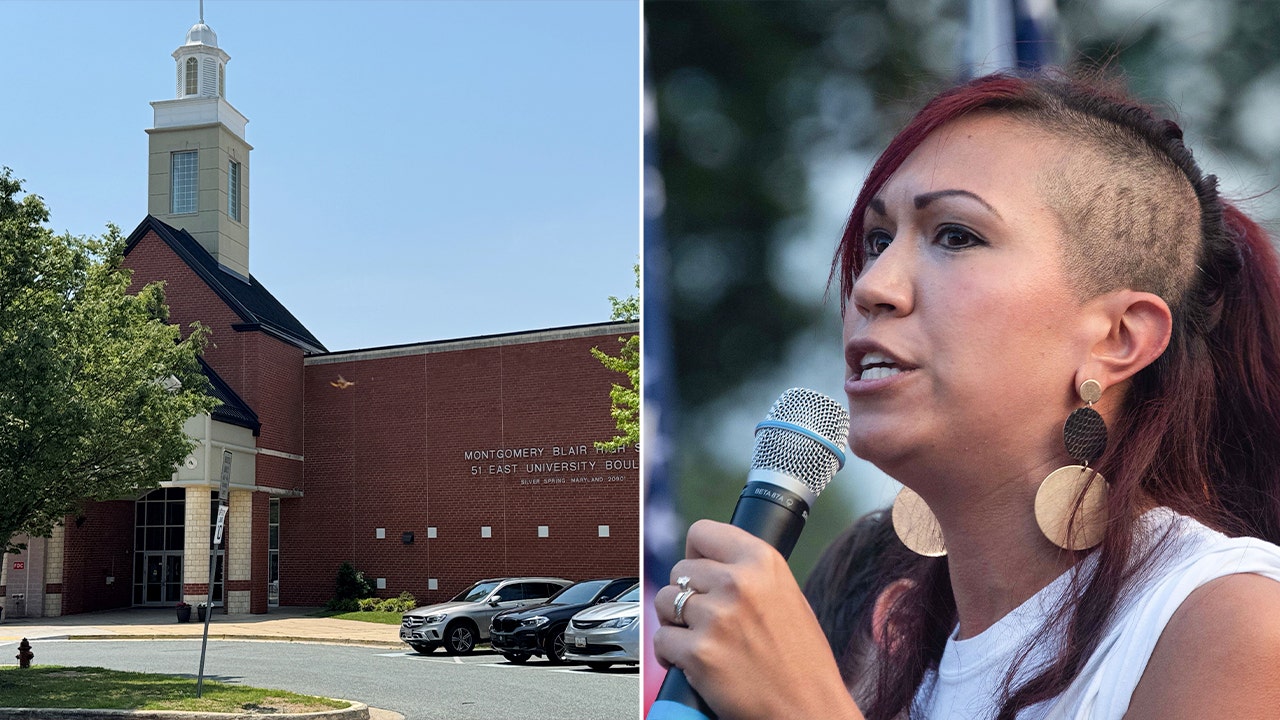
Kristin Mink addresses a protest against President Donald Trump in front of the White House in Washington, D.C., on August 6, 2018. (Nicholas Kamm/AFP via Getty Images)
“Especially for White allies, whistles can represent a subconscious desire for authority, protection, or control in moments of crisis,” the slide said.
“But rapid response is not about assuming authority. . . . When we question decisions made by those impacted, we risk centering our own comfort instead of impacted people.”
She added that “What feels ‘activating’ or empowering to some can cause stress to others,” noting that “Black and Brown communities are already overexposed to chronic noise pollution due to racist zoning, redlining, and disinvestment.”
She further addressed, in the slide, how certain characteristics — such as gender, sexuality, and education — align with positions of power or marginalization.
‘WHITE SAVIORS’ USE OF WHISTLES CAUSES BITTER INTERNAL RIFT INSIDE ANTI-ICE MOVEMENT
Cars park outside Montgomery Blair High School in Silver Spring, Maryland, on June 12, 2025. (Robb Hill/The Washington Post via Getty Images)
Last September, the Department of Homeland Security clarified that, contrary to what it described as “fearmongering” by sanctuary politicians, “ICE is not conducting enforcement operations at, or ‘raiding,’ schools.”
Mink’s presentation aligns with a recent wave within the anti-ICE movement, where immigrant-led organizations clashed with predominantly White “rapid response” activists over the use of whistles during immigration raids. Groups like the Washington Immigrant Solidarity Network (WAISN) and Maryland-based coalitions argue that blowing whistles is a “White Savior” tactic that creates unnecessary panic and escalates tension.
The Jan. 20 meeting sparked further controversy, with critics arguing that parent-teacher organizations should prioritize academic success rather than engaging in political activism.
“It goes without saying, PTAs should focus on their original intent: students — not injecting inflammatory and divisive political rhetoric into the community,” Kendall Tietz, investigative reporter at Defending Education, told the National Review.
Kristin Mink at the Montgomery County Council Office Building in Rockville, Maryland on January 14, 2025. (Michael S. Williamson/The Washington Post via Getty Images)
CLICK HERE TO DOWNLOAD THE FOX NEWS APP
The online presentation was promoted by, and advertised on, the Montgomery County Council of PTAs’ social media. According to the online sign-up sheet, several agencies supported the information session, including education associations, labor unions and immigration advocacy organizations.
Many local PTAs also promoted the session on their official platforms, including those at Gaithersburg Middle School, Laytonsville Elementary School and Stedwick Elementary School.
Read the full article from Here
Boston, MA
Editorial: With Boston’s World Cup win, could we host Olympics?
The World Cup economic windfall boosting Boston gives rise to a question: Could the Hub host the Olympics?
Certainly Bostonians have more than risen to the occasion in terms of welcoming international visitors to our city and showing them a good time (and vice versa, Tartan Army). But it takes more than great hosts and a convivial atmosphere to pull off an epic sporting event.
It takes money, lots of it, political transparency, and a process open to public scrutiny and feedback. In other words, no, we couldn’t.
Public reception to the 2014 Olympics bid was tepid at best, as it would entail multiple construction projects. And when big construction projects are presented in Boston, taxpayers get suspicious. Big Dig, anyone?
Boston 24 announced it estimated the Games would produce at least $4.8 billion in revenues from television broadcast rights, ticket sales, corporate sponsorships and other revenues, the Associated Press reported. They assumed nearly $4.6 billion in costs, including $176 million for a temporary Olympic Stadium, $90 million for the athletes’ village, about $754 million to build other Olympic venues and another $132 million to rent other locations.
They reportedly announced all this to answer critics who said the privately funded Boston 2024 withheld details of the bid to prevent the public from assessing whether the Games could be staged, as promised, without the need for taxpayer money.
We learned the answer to that soon enough.
In this case, as the Herald reported that year, details from Boston 2024’s so-called bid book indicated that plans sent to the U.S. Olympic Committee called for the Hub to fund “land acquisition and infrastructure costs” at Widett Circle, where a temporary Olympic stadium was being proposed. It came after months of promises that the group planned to run a privately funded Olympics.
“They’ve been saying for months, ‘No taxpayer (money),’ ” said Evan Falchuk, a vocal bid critic who pushed for a statewide ballot question on hosting the games. “Then you read what they told the USOC. … It’s a devastating blow to their credibility. There’s a reason why voters don’t trust what they’ve heard and (Boston 2024 has) got a lot of work to do to earn that trust.”
And all this talk of money came before any cost overruns made an appearance. London’s budget for the 2012 Summer Games escalated by about 300%, ending somewhere in the $14 billion range. What were the chances we’d fare any better?
No wonder Bostonians gave the Olympics idea the cold shoulder.
But what of the city’s World Cup success story? For starters, Gillette Stadium is already built, and the only large element requiring a cash infusion was the MBTA, which shelled out $35 million to upgrade Foxboro Station in advance of the Cup. They’ll make a nice chunk of that back, as the T spiked round-trip Commuter Rail ticket prices between South Station and Gillette Stadium for fútbol fans to $80.
In this case, Bostonians are on the winning side, reaping benefits from free-spending (and thirsty) visitors, and reveling in the good vibes.
It would be great for the city if megaprojects, or even minor ones, came with the guarantee of financial transparency before shovels hit the dirt. Optimists should look at White Stadium before calling it a day.
Pittsburg, PA
Pittsburgh among best U.S. cities in 2026 rankings. Here’s why
Pittsburgh ranks among the top 25 best places to live, work and visit in the U.S., according to a new report.
The 2026 “America’s Best Cities” report from Resonance, an international business consulting company, ranks the top 100 U.S. metro areas overall based on factors such as economic data, quality of living and public perception. Pittsburgh scored in the top quarter of cities nationwide.
Here’s a breakdown of how Pittsburgh ranks.
Pittsburgh ranks among top U.S. cities
Overall, Pittsburgh scored at No. 25 among U.S. cities.
Top-scoring cities almost all “made the visitor and resident experience a strategic priority,” according to the report. Rankings were also further broken down based on each key scoring components.
Pittsburgh has put a focus on its cultural amenities and food scene, as well as in revitalizing its neighborhoods, the report noted. While other similarly sized cities in the ranking have fallen, Pittsburgh climbed by five spots in 2026.
Pittsburgh among best cities for livability
Pittsburgh scored at No. 24 among U.S. cities for its livability.
The report’s livability scores were ranked in accordance to the quality of daily life in a city based on factors such as walkability, transit access, air quality, climate risk, green space, housing costs relative to income, broadband connectivity, healthcare access and life expectancy, as well as if the location is somewhere people would want to live.
Pittsburgh ranks in top 30 cities for lovability, prosperity
Pittsburgh ranked among the top 30 U.S. cities for both its lovability and its prosperity, scoring at No. 26 for lovability and No. 28 for prosperity.
Lovability was scored based on factors like the quality and quantity of venues such as restaurants, arts and entertainment sites, museums, outdoor experiences and nightlife. Digital data such as search trends, social media activity and other user-generated content was also considered.
Prosperity rankings were based on factors such as gross domestic product per capita, labor force participation, innovation capital intensity, educational attainment, unemployment and poverty rates, the presence of major corporate headquarters, university quality and the number of direct air connections.
Philadelphia ranked just a few spots above Pittsburgh at No. 20 overall.
Top 10 cities in 2026 ‘Best Cities’ ranking
The top 10 cities in the ranking are:
- New York, NY
- Los Angeles, CA
- Chicago, IL
- Miami, FL
- San Francisco, CA
- Seattle, WA
- Las Vegas, NV
- Dallas, TX
- Houston, TX
- Boston, MA
Finch Walker is the Pittsburgh Connect Reporter for the USA TODAY Network. Contact Walker at FWalker@usatodayco.com. Instagram: @finchwalker_. X: @_finchwalker.
Connecticut
Report: CT schools among the most segregated in the U.S.
-
Fitness3 minutes agoAngela Rippon, 81, reveals the one exercise she never skips for strong legs: ‘I do it every morning without fail’
-
Movie Reviews18 minutes ago‘Mr. Reset And The Society Of Turnbuckle And Bone’ – Movie Review – PopHorror
-
World27 minutes agoParamount+ Sets Tulisa Docuseries About Shamed ‘X Factor’ Judge From Dorothy Street Pictures
-
Lifestyle1 hour agoNPR staffers share their favorite fiction reads of 2026 so far
-
Education1 hour agoThe Itinerant Preacher Who Helped Secure the Separation of Church and State
-
Technology1 hour agoHoto’s 25-bit electric screwdriver is 40 percent off during Prime Day
-
World1 hour agoTrump gets major win against China in African rare earth minerals race
-
Politics2 hours agoSocial media erupts over Mamdani’s silence after Brooklyn coffee shop bans Jewish congressman