Vermont
In Danville, a petition seeks to close the local high school
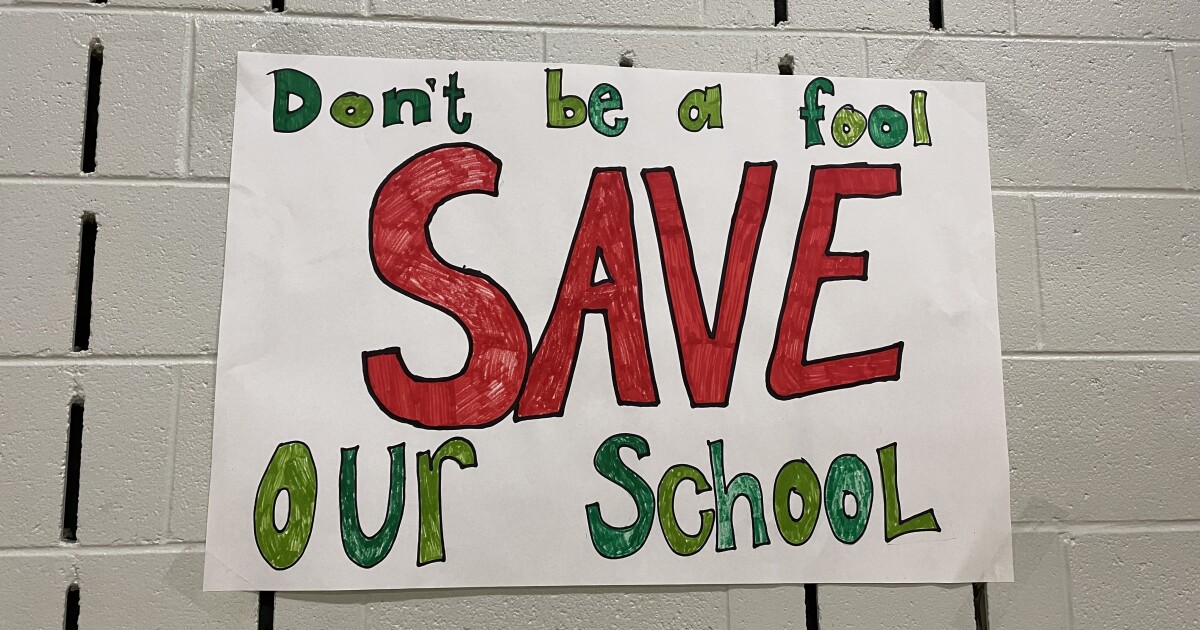
A bitter debate in Danville about whether to close the town’s high school underscores the uncertainty many Vermont schools face as the state prepares to overhaul its education system.
The Danville school board reluctantly announced this week that they would hold a special town-wide referendum on Dec. 6 on whether to close the school and instead offer families vouchers to the school of their choice. It comes after a local parent submitted a petition requesting the vote.
But within days after that petition was submitted, the town clerk reported that more than a dozen people asked for their signatures to be withdrawn. Michelle Leclerc, the Danville treasurer, told Vermont Public on Thursday that people had written to her office saying they had been “misinformed” and given “false information.”
For now, the petition still has enough signatures to require the vote. But more still could ask to remove their names before Nov. 4, she said, when the school board is scheduled to sign a warrant for the referendum.
The contention in Danville has been prompted by a sweeping education reform effort Gov. Phil Scott signed into law this July that could usher in widespread consolidation. A special task force is now at work on proposals for new school district maps, which lawmakers will consider when they return to the Statehouse this winter.
What’s afoot in Montpelier has left local school officials bracing for impact, but also unsure of what reform could mean for them. And Danville, which operates one of the last remaining public high schools in the Northeast Kingdom, also faces a unique set of circumstances.
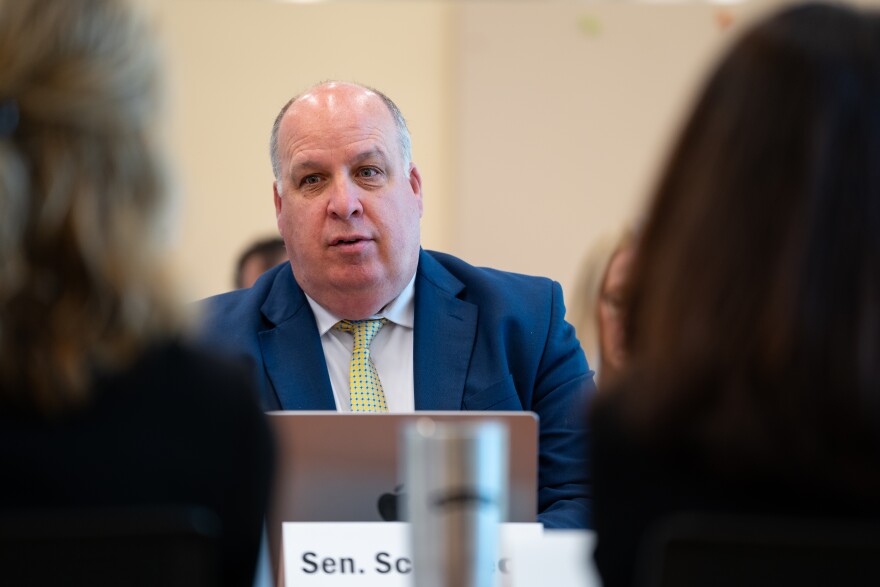
The closest alternative, St. Johnsbury Academy, is private, and the role that one of its teachers — Vermont Senate Minority Leader Scott Beck — has had in encouraging the vote to close has prompted outcry among the Danville School’s supporters.
“It’s reprehensible, and I think the voters are going to see that right away,” one resident, Eric Hutchins, told the school board during a raucous meeting Tuesday evening.
Lola Duffort
/
Vermont Public
Small schools like Danville, where the high school enrollment hovers around 80 pupils, are deeply fearful the law, known as Act 73 could force them to close. And in recent weeks, Beck has warned school officials in Danville, as well as nearby Cabot — whose high school is even smaller — that it may be now or never if they want to decide their own fate.
Beck, a Caledonia County Republican, has told local school board members that it’s likely lawmakers will pass a measure in the upcoming legislative session that could remove a district’s ability to turn to school choice in the event that it closes a school. Instead, he’s said, a community might be required to select three public schools to send their children. For Danville, where the nearest large high schools are all private, that could be a problem.
But other lawmakers have pushed back, saying it would be unwise for communities to act in haste based on conjecture.
“Trying to predict the future of Act 73 is a fool’s errand,” Peter Conlon, the chair of the House Education Committee, told Seven Days.
In Cabot, school officials have since decided to take a wait-and-see approach. The board shelved a survey last week it had planned to send to residents, which included Beck’s warning that school choice could go away for good unless communities make the switch now. But in Danville, the petition — which was organized by a local parent who also happens to be a St. Johnsbury Academy teacher — has tied the board’s hands.
On Tuesday evening, Danville school board members told a crowded gymnasium of residents they had no desire to close the high school.
Clayton Cargill, the school board chair, nodded in agreement as residents filed up to the microphone to accuse Beck of fearmongering in an attempt to funnel more students to St. Johnsbury Academy, his employer.
“I feel lied to,” Cargill said at one point.
Brian Stevenson
/
Vermont Public
Beck, in an interview after the meeting, said that he had offered the advice in good faith. He noted that a measure that would have disallowed districts from turning to choice was included in earlier drafts of Act 73, and only removed during end-stage negotiations.
Besides, he said, the school he teaches at has more than 900 pupils, so it doesn’t need Danville’s students to stay afloat.
“They’re not critical to St. Johnsbury Academy. I mean, if they wanted to come, we’d certainly welcome them, but the school has been around for a long time,” he said.
Peter Mantius, the Danville parent who organized the petition, also works as a teacher at St. Johnsbury Academy. And while he said he didn’t ask for the vote to benefit his employer, he said his experience there had allowed him to see first-hand what the school offers.
“This is something that I think I have a front row seat to, and I sometimes wish that the friends and community that my children are with had the same opportunities,” he said.
Overwhelmingly, speakers at Tuesday’s board meeting were there to argue for Danville high school’s continued existence.
David Warren, a veteran teacher at Danville, said it should be noted that nearby Lyndon Institute and St. Johnsbury Academy are both private.
“They don’t have to take your kids,” he said. “And how do I know that? Because we’ve been giving kids from those two schools here at Danville a second chance — a first chance — because they couldn’t make it at a bigger school for the 27 years I’ve been here.”
Several students said they liked Danville’s small size.
“I am not a student who struggles academically, but the thought of a newer and bigger classroom setting makes me question my academic future,” Jordan Sullivan-Stevens, an eighth grader, told the board.
Lisa Rathke
/
Associated Press File
But there were dissenters. Sophomores Bella Stebbins and Ash Bedard filed up to the microphone together. Stebbins complained about behavioral problems at Danville, and Bedard followed after to say the school was limited in what it could provide.
Bedard said she knew they were both “disagreeing with everybody here.” But “other schools have more to offer in educational and extracurricular activities,” she said.
Most people left the Danville gymnasium Tuesday evening after they had said their piece. But Danville’s school board members remained, workshopping a letter to the state’s redistricting task force.
“We are at risk of making a very reactionary decision that will change this town considerably in unforeseen ways,” they wrote in their letter.
“Beholden to the whims of your Task Force, and more broadly, the State Legislature,” the letter continued, “…we are forced to assume and plan for the worst case scenario, and do everything in our power to prevent it.”
“And so our ask to you,” they added, “is to give us clarity.”
Vermont
WCAX Investigates: Police participation in border program draws scrutiny
BURLINGTON, Vt. (WCAX) – Vermont police officers are working overtime shifts along the Canadian border under a federal program that critics say could violate the state’s anti-bias policing laws.
“Up here, we’re so small we rely on our partner agencies,” said Swanton Village Police Chief Matthew Sullivan.
On a recent frosty Friday, Sullivan was patrolling along the Canadian border as part of Homeland Security’s Operation Stonegarden. The chief and other local officers work overtime shifts for the U.S. Border Patrol.
“It acts as a force multiplier because we’re able to put more officers out in these rural areas in Vermont,” Sullivan said.
During an exclusive ride-along, Sullivan showed us a field where, as recently as last fall, migrants were smuggled across the border. “These people are really being taken advantage of,” he said.
From 2022 to 2023, U.S. Border Patrol encountered just shy of 7,000 people entering the country illegally in the region, more than the previous 11 years combined.
In several instances, police say cars have tried to crash through a gate in Swanton along the border. Others enter from Canada on foot and get picked up by cars with out-of-state plates.
The chief says the illegal crossings strike fear among local parents. “They didn’t feel safe allowing their kids outside to play, which is extremely unfortunate,” Sullivan said.
Through Operation Stonegarden — which was created in the wake of 9/11 — Sullivan and his officers get overtime pay from the feds. “We’re kind of another set of eyes and ears for border patrol,” Sullivan said. His department also gets equipment and training.
Six agencies in Vermont participate in Stonegarden: The Vermont State Police, Chittenden County Sheriff’s Department, Essex County Sheriff’s Department, Orleans County Sheriff’s Department, Newport City Police Department, and the Swanton Village Police Department. Some three dozen across New England participate in Stonegarden. These agencies collect relatively small amounts from the feds — $760,000 in Vermont, $190,000 in New Hampshire, and $1 million in Maine.
But amid the Trump administration’s immigration crackdown, Stonegarden is under scrutiny.
“This has become quite relevant to a lot of people once again,” said Paul Heintz, a longtime Vermont journalist who now writes for the Boston Globe. “These three states have dramatically different policies when it comes to local law enforcement working with federal law enforcement.”
Vermont has some of the strictest rules about police assisting federal immigration officials. The Fair and Impartial Policing Policy limits cooperation with the feds and says immigration status, language, and proximity to the border cannot be the basis of an investigation.
“Vermonters have made clear through their elected representatives that they want state and local law enforcement to be focusing on state and local issues,” said Lia Ernst with the ACLU of Vermont. She says Stonegarden is crossing the line. “They don’t want their police to be a cog in the mass deportation machinery of any administration but particularly the Trump administration,” Ernst said.
The ACLU and other critics are concerned that Stonegarden creates a cozy relationship between local police and immigration officials that can be used to enforce the president’s immigration crackdown.
Heintz says the distinction between civil and criminal immigration enforcement can be fluid. In most civil cases in which the feds seek to deport, Vermont law enforcement can’t play a role because it’s against the law. In criminal cases, which local police can enforce, immigrants can be detained and charged.
“An operation may start out appearing to focus on a federal criminal immigration issue and may turn into a civil one over the course of that investigation,” Heintz said.
“There is a lot of nuance to it,” admitted Sullivan. He insists his department is not the long arm of federal law enforcement and is instead focused on crime, including guns, drugs, and human trafficking. However, if someone is caught in the act of crossing the border illegally, that constitutes a crime, and the chief said he calls for federal backup. Though he said that rarely happens.
“It’s a criminal violation to cross the border outside of a port of entry, and technically, we could take action on that. But again, we’re not here to enforce civil immigration while working Stonegarden,” Sullivan said.
Copyright 2025 WCAX. All rights reserved.
Vermont
Vermont Catholic Church receives bankruptcy court’s OK to sell Rutland property – VTDigger
Vermont’s Roman Catholic Diocese, now seeking to reorganize its depleting finances in U.S. Bankruptcy Court, has received permission to sell its former Loretto Home senior living facility in Rutland.
In a ruling this week, Judge Heather Cooper said she’d allow the state’s largest religious denomination to accept a $1 million offer from Rutland’s nonprofit Cornerstone Housing Partners, which wants to transform the Meadow Street building into transitional and long-term affordable apartments.
“The proposed sale represents the highest and best offer for the property,” church lawyers argued in court papers, “and the proceeds of the sale will assist the diocese in funding the administration of this bankruptcy case and ultimately paying creditors.”
Cornerstone said it had a $3.9 million commitment from the state Agency of Human Services to help it buy and rehabilitate the 20,000-square-foot facility.
The nonprofit could immediately launch its first-phase plan for 16 units of emergency family housing under a new state law that expands locations for shelters. But the $1 million sale is contingent on receiving a Rutland zoning permit for a second-phase plan for at least 20 long-term apartments.
“We’re not going to purchase the building if we can’t create affordable apartments there,” Mary Cohen, the nonprofit’s chief executive officer, told VTDigger. “The goal is to create permanent housing.”
Cornerstone already has heard questions from neighbors as it seeks a zoning permit from Rutland’s Development Review Board.
“I think it’s a lack of understanding,” Cohen said. “We’re good landlords. We house people and take good care of our property. The application process will allow a public conversation about what our plans are.”
The Vermont Catholic Church filed for Chapter 11 protection a year ago after a series of clergy misconduct settlements reduced its assets by half, to about $35 million. Since then, 119 people have submitted new child sexual abuse allegations — almost double that of an earlier 67 accusers who previously settled cases over the past two decades.
To raise money, the diocese enlisted Pomerleau Real Estate to market the Loretto Home after the facility closed in 2023. The property, under the control of the church since 1904, was initially listed at $2.25 million before being reduced to $1.95 million and, by this year, $1.3 million, court records show. The diocese received an unspecified number of offers before accepting Cornerstone’s $1 million bid this summer.
Under the Chapter 11 process, the Vermont church must receive court approval for all major purchases and sales until a judge decides on its call for a reorganization plan.
Vermont
Vermont soccer’s Rob Dow reportedly eyeing move to Big Ten program
Vermont soccer head coach Rob Dow appears to be headed to a bigger conference.
The longtime Catamounts head coach who guided Vermont to the 2024 NCAA championship in historic fashion is reportedly set to be hired by Penn State, according to Jon Sauber of Centre Daily Times. Shortly before Sauber’s online report on Wednesday, Dec. 11, WCAX-TV’s Jack Fitzsimmons and Michael Dugan broke news that Dow and the Nittany Lions were in “deep negotiations.”
UVM athletics officials declined to comment until there is an official announcement.
Dow’s ninth season at Vermont ended with an upset loss to Hofstra in the second round of the NCAA Tournament at Virtue Field. The Catamounts had entered this year’s tournament unbeaten and as the top overall seed. They also started 2025 as the top-ranked team in the nation in the United Soccer Coaches preseason poll.
Under Dow, the Catamounts have advanced to the NCAA Tournament in five straight seasons (2021-2025). They reached the NCAA quarterfinals in 2022, the third round in 2023 and then last year’s unseeded run to capture their first national championship with an overtime victory over Marshall at the College Cup in Cary, North Carolina.
Through his nine seasons at Vermont, Dow has gone 109-41-21 with four America East tournament crowns and three conference regular-season titles. His 11 NCAA Tournament wins are a program record. He stands five wins shy of matching Cormier and Ron McEachen for most victories in program history.
Dow spent five seasons as an assistant coach at Vermont before earning a promotion to head coach in 2017 following the departure of Jesse Cormier.
According to UVM’s salary records online, Dow’s current base salary is $200,000. In 2017, in his first year at the helm, it was $80,000.
If hired, Dow would be taking over at Penn State following Jeff Cook’s exit. Cook stepped down in November after an eight-year run and three NCAA Tournament appearances. The Nittany Lions went 5-8-4 this past season.
Penn State’s operating budget for the 2024 fiscal year for men’s soccer was 10th in the country at $2,099,653, according to data collected by Matt Brown of Extra Points. Vermont was slotted 28th in Brown’s story.
Rob Dow: Season-by-season record with Vermont soccer
2025: 14-1-5 (NCAA second round)
2024: 16-2-6 (national champions)
2023: 13-6-2 (NCAA third round)
2022: 16-4-2 (NCAA quarterfinals)
2021: 13-5-2 (NCAA first round)
2020-21: 5-2-1 (America East final)
2019: 11-6-1 (America East semifinals)
2018: 11-7-1 (America East quarterfinals)
2017: 10-8-1 (America East semifinals)
Total: 109-41-21
Contact Alex Abrami at aabrami@freepressmedia.com. Follow him on X, formerly known as Twitter: @aabrami5.
-
Alaska6 days agoHowling Mat-Su winds leave thousands without power
-
Politics1 week agoTrump rips Somali community as federal agents reportedly eye Minnesota enforcement sweep
-
Ohio1 week ago
Who do the Ohio State Buckeyes hire as the next offensive coordinator?
-
Texas6 days agoTexas Tech football vs BYU live updates, start time, TV channel for Big 12 title
-
News1 week agoTrump threatens strikes on any country he claims makes drugs for US
-
World1 week agoHonduras election council member accuses colleague of ‘intimidation’
-
Washington3 days agoLIVE UPDATES: Mudslide, road closures across Western Washington
-
Iowa5 days agoMatt Campbell reportedly bringing longtime Iowa State staffer to Penn State as 1st hire