Vermont
Burlington Free Press writer Dan D’Ambrosio wins regional award for immigration story


Burlington Free Press reporter Dan D’Ambrosio won a first place award Saturday in the 2024 New England Better Newspaper Competition in Portland, Maine, for his April 2024 story about an undocumented farm worker in Vermont who was deported to Guatemala last year, despite threats of criminal violence against him.
D’Ambrosio won first place in the Social Issues Feature Story category for his story about Bernardino Suchite Canan. The competition is sponsored by the New England Newspaper & Press Association (NENPA).
Canan had been working on an Irasburg dairy farm for seven years before his deportation, quickly rising to a management position and exhibiting the traits of a “natural-born leader,” according to the farm owner. Canan also had a pathway to a green card, allowing permanent residence in the United States, because he had been the victim of a violent break-in to his home on the farm in 2022, and was cooperating with the state’s attorney to prosecute the perpetrator.
All of that went away when Canan and his partner were detained by U.S. Immigration and Customs Enforcement (ICE) after visiting friends at a farm in New York, just across Lake Champlain. Canan was subsequently arrested for a DUI in the Northeast Kingdom.
Canan and his partner testified he had never driven drunk before, but was feeling the stress of his interaction with ICE, compounded by the anniversary of a violent attack on his mother in 2021, which ultimately resulted in her death. Canan himself had fled Guatemala at 16 to escape criminal violence.
‘Lifting up the voices and the stories of Vermont residents’
An immigration court judge in Boston deported Canan despite the state of Vermont agreeing to put him into a diversion program on his pending DUI charges, which means the charges would not have gone on his record once he completed the program. The owner of the Irasburg farm also provided a glowing letter of recommendation for Canan to the immigration court, to no avail.
Canan was represented in immigration court by Vermont Law & Graduate School Professor Brett Stokes and a team of student lawyers in the school’s immigration clinic.
“Lifting up the voices and the stories of Vermont residents is what the reporters at the Free Press strive to do each day,” said Caitlyn Kelleher, New England Group Editor. “It is an honor to receive recognition for this work from our peers and the professional organization of NENPA. Additionally, we appreciate the courage that it took Bernardino Suchite Canan to tell his story to Dan. The stories of migrants are not just one for the U.S. southern border communities or big cities. Dan’s reporting shows the daily struggles of the undocumented immigrants living and working in Vermont.”
Lifting up the voices of Indigenous people
D’Ambrosio also won a first-place award last year in the History Reporting category for his story about Saswa and Conauda, two Potawatomi boys, ages 17 and 15, respectively, who were brought to Vermont in 1827 by a Baptist missionary to study at Castleton Medical College, the first private medical school in the nation.
Within four years, by 1831, both boys would be dead from tuberculosis, and their stories would recede into obscurity for nearly two centuries, until an investigation of Indian Boarding Schools by the U.S. Department of the Interior was published in May 2022. The report included a brief reference to two Indian students in Castleton, which led to the Free Press investigation.
“This look at two teenage boys’ brief time in Vermont nearly two centuries ago does a masterful and nuanced job of telling the broader story of the country’s treatment of Indigenous people,” the competition judges wrote last year about D’Ambrosio’s story.



Powerball, Mega Millions jackpots: What to know in case you win
Here’s what to know in case you win the Powerball or Mega Millions jackpot.
Just the FAQs, USA TODAY
The Vermont Lottery offers several draw games for those willing to make a bet to win big.
Those who want to play can enter the MegaBucks and Lucky for Life games as well as the national Powerball and Mega Millions games. Vermont also partners with New Hampshire and Maine for the Tri-State Lottery, which includes the Mega Bucks, Gimme 5 as well as the Pick 3 and Pick 4.
Drawings are held at regular days and times, check the end of this story to see the schedule.
Here’s a look at July 8, 2026, results for each game:
Winning Powerball numbers from July 8 drawing
12-29-37-43-55, Powerball: 18, Power Play: 4
Check Powerball payouts and previous drawings here.
Winning Gimme 5 numbers from July 8 drawing
01-05-23-36-38
Check Gimme 5 payouts and previous drawings here.
Winning Pick 3 numbers from July 8 drawing
Day: 0-1-3
Evening: 2-4-0
Check Pick 3 payouts and previous drawings here.
Winning Pick 4 numbers from July 8 drawing
Day: 3-9-5-9
Evening: 9-2-0-9
Check Pick 4 payouts and previous drawings here.
Winning Megabucks Plus numbers from July 8 drawing
12-15-23-27-40, Megaball: 03
Check Megabucks Plus payouts and previous drawings here.
Winning Millionaire for Life numbers from July 8 drawing
16-18-43-48-50, Bonus: 01
Check Millionaire for Life payouts and previous drawings here.
Feeling lucky? Explore the latest lottery news & results
Are you a winner? Here’s how to claim your lottery prize
For Vermont Lottery prizes up to $499, winners can claim their prize at any authorized Vermont Lottery retailer or at the Vermont Lottery Headquarters by presenting the signed winning ticket for validation. Prizes between $500 and $5,000 can be claimed at any M&T Bank location in Vermont during the Vermont Lottery Office’s business hours, which are 8a.m.-4p.m. Monday through Friday, except state holidays.
For prizes over $5,000, claims must be made in person at the Vermont Lottery headquarters. In addition to signing your ticket, you will need to bring a government-issued photo ID, and a completed claim form.
All prize claims must be submitted within one year of the drawing date. For more information on prize claims or to download a Vermont Lottery Claim Form, visit the Vermont Lottery’s FAQ page or contact their customer service line at (802) 479-5686.
Vermont Lottery Headquarters
1311 US Route 302, Suite 100
Barre, VT
05641
When are the Vermont Lottery drawings held?
- Powerball: 10:59 p.m. Monday, Wednesday, and Saturday.
- Mega Millions: 11 p.m. Tuesday and Friday.
- Gimme 5: 6:55 p.m. Monday through Friday.
- Lucky for Life: 10:38 p.m. daily.
- Pick 3 Day: 1:10 p.m. daily.
- Pick 4 Day: 1:10 p.m. daily.
- Pick 3 Evening: 6:55 p.m. daily.
- Pick 4 Evening: 6:55 p.m. daily.
- Megabucks: 7:59 p.m. Monday, Wednesday and Saturday.
- Millionaire for Life: 11:15 p.m. daily
What is Vermont Lottery Second Chance?
Vermont’s 2nd Chance lottery lets players enter eligible non-winning instant scratch tickets into a drawing to win cash and/or other prizes. Players must register through the state’s official Lottery website or app. The drawings are held quarterly or are part of an additional promotion, and are done at Pollard Banknote Limited in Winnipeg, MB, Canada.
This results page was generated automatically using information from TinBu and a template written and reviewed by a Vermont editor. You can send feedback using this form.
Vermont
Poll: Most young Vermonters say they’re likely to leave state amid affordability concerns – VTDigger

Theo Wells-Spackman is a Report for America corps member who reports for VTDigger.
Nearly two-thirds of Vermonters ages 18 to 34 say they’re likely to leave the state within five years in search of adventure or a cheaper place to live, according to a poll from the University of New Hampshire.
Overall, the poll estimated that 86% of Vermonters find the state at least somewhat unaffordable.
“The issue of affordability has been a very important thing across New England,” said UNH political science professor Andrew Smith, who runs the institution’s survey center. The poll, released Tuesday, includes response data for five New England states, excluding Maine.
In general, the survey found, most residents say Vermont is a good place to live — or even a great one.
Nevertheless, about 40% of Vermonters of all ages want to leave the state, according to the report from Smith’s team. Housing prices and other cost-of-living concerns are the foremost drivers of the trend, researchers found, followed by tax rates. Connecticut and Rhode Island showed similar overall rates of desired departure.
Among young people, though, Vermont’s numbers stand out.
Smith’s research found that 63% percent of Vermonters between 18 and 34 say they’re somewhat or very likely to move out of the state in the next five years. That’s a much higher rate of planned departure than in any other state surveyed. Responses varied from 28% in New Hampshire to 44% in Connecticut.
But according to Smith, New England often sees a beneficial “boomerang effect”: former residents eventually returning to their home states, often as higher earners.
In a Wednesday press conference, Gov. Phil Scott said that although he hadn’t seen the poll, he wasn’t surprised by reports that many Vermonters are considering a move.
“I think there’s a lot of frustration out there,” he said. “We have a lot of work to do to make Vermont the affordable state that these folks need.”
About half of young Vermonters who said they want to move away cited the cost of living as a primary reason, while roughly as many said they were looking for a “new adventure or more excitement.” By contrast, less than a quarter of those older than 64 foresee leaving, according to the poll.
Outmigration of young people could worsen the state’s existing workforce shortage, according to Kevin Chu, who leads the research nonprofit the Vermont Futures Project. Scott’s administration has made workforce development a priority in light of what his office called a “growing demographic crisis.”
Chu added that by design, services such as public education and healthcare are supported disproportionately by working households that tend to pay higher taxes and insurance premiums. When the base of income earners shrinks, the problem can then intensify for those bearing the brunt of rising costs, he added.
“There’s a demographic reality in which the economic burden is being shouldered by a small and shrinking pool of young working-age people,” Chu said.
Tuesday’s poll also indicated that Vermonters who have completed more education say they’re less likely to leave the state. For Chu, that’s likely because such households tend to earn more — and also because they tend to be older.
Julie Lowell, deputy director of the Montpelier research nonprofit Public Assets Institute, offered a grain of salt in relation to Tuesday’s report. While migration is crucial to keep track of, Vermont’s overall population turnover tends to be about 5% or less each year, she said. And although the state does have an unusual number of young people intending to leave, that age group is always the most mobile in any study, she said.
In recent years, more of Vermont’s older population has possessed more wealth to contribute to public services, Lowell added. For example, she said, her organization has found that more Vermonters aging out of the workforce has not appeared to decrease state tax revenues in recent years.
But it’s true that many Vermonters are struggling to make ends meet, she said. The state’s lowest earners have seen low wage growth in relation to other New England states, she said, and basic needs are getting harder to cover.
“We’re seeing prices, in large part driven by housing and healthcare, really outpacing our increases in household incomes,” Lowell said. “Many people are feeling insecure.”

Vermont officials are offering $5.9 million in funding to help replace older diesel-powered vehicles and equipment with electric alternatives across the state.
The Vermont Department of Environmental Conservation is accepting applications for the funding through the Volkswagen Environmental Mitigation Trust, according to a community announcement. The program aims to reduce emissions by supporting conversions to all-electric equipment used in transportation and industry.
The new funding is open to a wide range of vehicle and equipment types, including class 4–8 trucks, school buses, transit buses, forklifts weighing more than 8,000 pounds, airport ground support equipment, freight switchers and certain marine engines.
Eligible applicants include federal, state, regional and municipal agencies, along with public institutions and private businesses whose vehicles operate in Vermont at least 80% of the time.
Public entities can receive up to 85% of project costs, while private businesses may qualify for up to 75%, according to the announcement.
The opportunity may be particularly relevant for farms, food producers, food hubs and distributors that rely on diesel-powered trucks or heavy equipment.
Applications are accepted on a rolling basis, with submissions due by the last day of each month until December 2026 or until funding runs out.
Applicants can review full details at https://dec.vermont.gov/air-quality/vw-environmental-mitigation-funds/vw-request-applications.
This story was created with the assistance of Artificial Intelligence (AI). Journalists were involved in every step of the information gathering, review, editing and publishing process. Learn more at cm.usatoday.com/ethical-conduct.
-

 Health20 seconds ago
Dr Oz links obesity to chronic disease surge, says GLP-1s can ‘jumpstart’ better health
-

 Sports3 minutes ago
Pirates star pitcher makes unfortunate history after being taken out in middle of perfect game bid
-

 Technology8 minutes ago
Medical identity theft follows you into the doctor’s office
-
 Business15 minutes ago
California soccer fans sue StubHub after it fails to deliver expensive World Cup tickets
-
 Entertainment18 minutes ago
Lucas Museum to give free annual passes to South L.A. neighbors, host community preview day
-
 Lifestyle23 minutes ago
Meow Wolf taps famed L.A. animation house for its new Los Angeles venue
-
Politics30 minutes ago
Column: Trump decries ‘communism’ while his government takes ownership of companies
-
 Science33 minutes ago
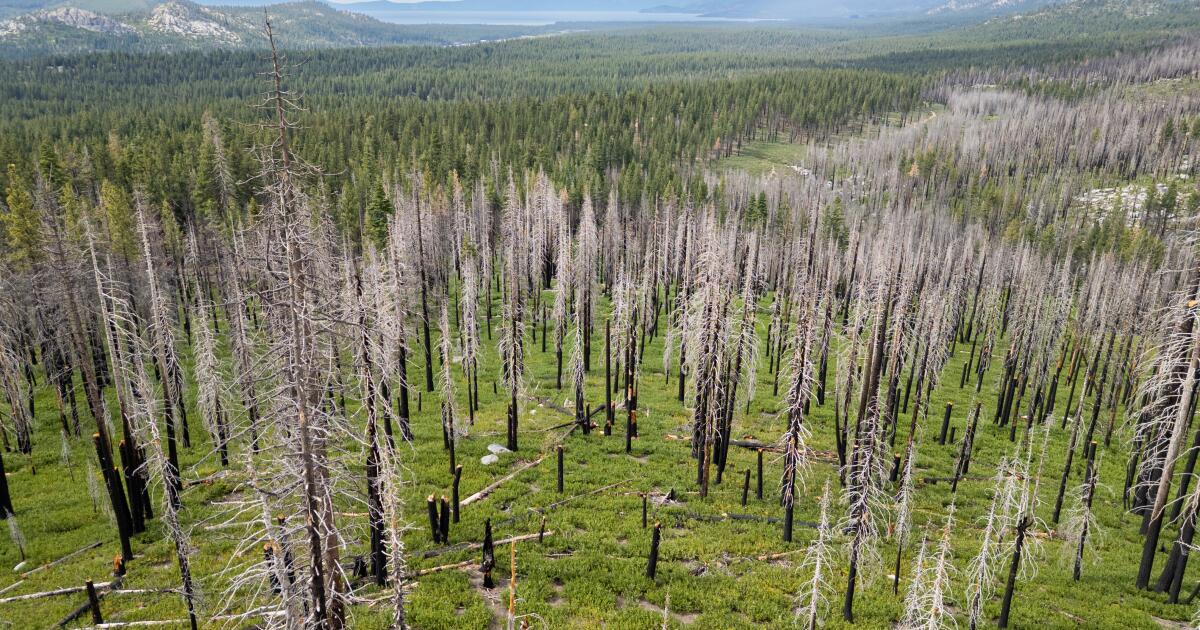
‘I’d rather my house burn down than get cancer’: Herbicide use upends California’s fight to save forests


