Northeast
Trump hush money trial: Meet the jurors who will hear Bragg's case against the 2024 presidential candidate

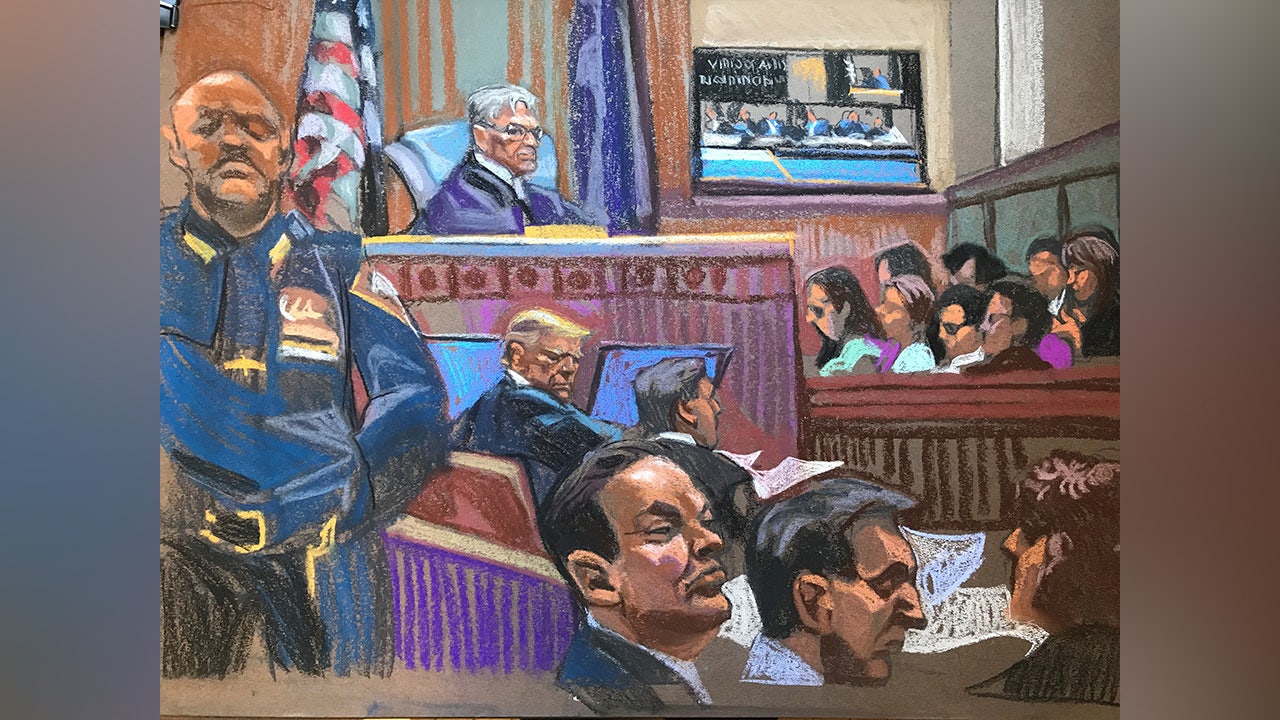
Twelve jurors have been selected and sworn in to serve on the jury for former President Donald Trump’s historic and unprecedented first criminal trial.
Trump, the presumptive Republican presidential nominee, has been charged by Manhattan District Attorney Alvin Bragg with 34 counts of falsifying business records in the first degree. The charges are related to alleged hush money payments made to adult film actress Stormy Daniels ahead of the 2016 presidential election.
TRUMP SAYS CRIMINAL TRIAL IS HAVING A ‘REVERSE EFFECT,’ AS HE CAMPAIGNS AT NEW YORK BODEGA, VOWS TO SAVE CITY
Trump has pleaded not guilty to all counts. He has blasted the trial as pure politics, a “political persecution” and maintains his innocence. The former president is expected to testify during his trial.
A court sketch depicts the second day of former President Donald Trump’s criminal trial in Manhattan Criminal Court on Tuesday. (Christine Cornell)
By the end of jury selection on Thursday, the third day of jury selection, 12 jurors had been selected and sworn in. The jury pool so far includes four men and three women, all living in New York City. Their professions included work in law, finance, technology and more.
BRAGG FILES MOTION TO HOLD TRUMP IN CONTEMPT FOR ALLEGED GAG ORDER VIOLATIONS, THREATENS 30 DAYS OF JAIL TIME
“We have our jury,” Judge Juan Merchan said when the 12th juror was picked Thursday afternoon. “Let’s pick our alternates.”
Merchan dismissed the remaining prospective jurors and asked that they return to court Friday so that alternate jurors could be selected.
Former President Donald Trump awaits the start of proceedings on the second day of jury selection at Manhattan criminal court in New York on Tuesday. (AP Photo/Mary Altaffer, Pool)
Here is a look at each of the jurors so far.
Juror #1 and the foreperson
Juror #1 lives in New York City. He has no children and enjoys doing anything outdoorsy. He gets his news from The New York Times, Daily Mail, Fox News and MSNBC.
When asked by Trump defense attorney Todd Blanche if he was aware Trump is charged in other cases and jurisdictions, and how that affects him, the man said, “I don’t have an opinion.”
Juror #2
Juror #2 is a man who said he follows Trump’s former lawyer Michael Cohen on “X,” formerly known as Twitter, as well as other “right wing” accounts, including former Trump adviser Kellyanne Conway.
The reason, he said, he follows those figures was so he could be plugged in to “anything that might move the markets I might need to know about.”
When asked if he would unfollow Cohen, as he may be a witness in the trial, the man said: “Absolutely.”
The man also said he has “not seen any evidence” relating to the case.
“I will try to keep an open mind,” he said.
Responding to questions from Trump lawyer Susan Necheles about his feelings about the former president, the man said that Trump has done some good for the country.
“It’s ambivalent,” he said. “It goes both ways.”
The first person who was labeled juror #2 was excused Thursday morning after saying she could not be a fair juror.
Juror #3
Juror #3 is a young to middle-aged man who lives in Manhattan. The man said he grew up in Oregon and has been an attorney for five years practicing corporate law. The man said he enjoys hiking and running, and gets his news from The New York Times and Google.
Juror #4
Juror #4 is originally from California, but has lived in New York City for 15 years. The man said he has been a security engineer for 25 years and holds a high school diploma, with some college education.
The man is married with three children. His wife is a teacher.
During his spare time, he enjoys being with his children, woodworking and metal working.
The man said he has served on a jury before — on both a grand jury and a jury in a criminal trial.
The man said he gets his news from “a smattering” of news sources. As for social media, he said he doesn’t use it.
Former President Donald Trump appears in Manhattan criminal court in New York City on Monday. (Jabin Botsford/The Washington Post/Bloomberg via Getty Images)
The man said he has a relative who works in finance and brothers-in-law that work as lawyers.
The man said he has no feelings about how Trump is being treated in this case.
TRUMP HUSH MONEY TRIAL: JUROR EXCUSED AFTER SAYING SHE DOES NOT THINK SHE CAN BE FAIR
The person who was first labeled as Juror #4 was excused Thursday morning after it was revealed that he had been previously arrested in Westchester, New York, for tearing down right-wing political advertisements.
Juror #5
Juror #5 is a young and a New York native who has been a teacher of English Language Arts for eight years.
The woman was previously a caseworker at a juvenile detention center. She said she has a masters’ degree in education.
“I’m creative at heart,” she said, adding that she enjoys photography.
The woman said that she is not married and does not have children. Her mother was an administrative aide for a police department, and her godfather was a homicide detective.
The woman said she gets her news from Google and TikTok.
She was asked if Trump chose not to testify, whether she would hold that against him.
“I won’t hold that against him,” she said.
Former President Donald Trump appears with his legal team Todd Blanche, left, and Emil Bove ahead of the start of jury selection at Manhattan Criminal Court in New York City on Monday. (Jabin Botsford-Pool/Getty Images)
She explained that she has friends who have strong opinions on the former president but said she is not a political person and tries to avoid political conversations.
She did say, however, that she appreciates Trump’s candor.
“President Trump speaks his mind, and I’d rather that than someone who’s in office who you don’t know what they’re thinking,” she said.
When jurors were asked if they were aware Trump was charged in other cases than Bragg’s, most jurors were. However, juror #5 raised her hand to indicate that she was learning of additional charges for the first time.
Former President Donald Trump appears in Manhattan criminal court in New York City on Tuesday. Trump’s first criminal trial got off to a plodding start on Monday, with the proceedings stalling over disagreements about evidence and other last-minute arguments, leaving even the former president looking bored and resting his eyes at times. (Justin Lane/EPA/Bloomberg via Getty Images)
Juror #6
Juror #6 is a young woman who lives in Manhattan. She described herself as a New Yorker.
The woman is a software engineer and said she likes to dance.
Juror #7
Juror #7 is originally from North Carolina and works as an attorney and civil litigator.
The man said he is married with two children, and his wife works in risk management for a bank. He said he enjoys spending time outdoors and with his family.
The man said he gets his news from The New York Times, The Wall Street Journal, the New York Post and The Washington Post.
Manhattan District Attorney Alvin Bragg arrives at Manhattan criminal court in New York on Tuesday. (AP Photo/Yuki Iwamura)
When asked if his career as a lawyer would impact his ability to serve fair and impartially, or whether his opinions would get in his way, the man said that he does have “political views as to the Trump presidency” and said there were likely Trump administration policies he disagreed with.
“I don’t know the man and I don’t have any opinions about him personally,” he said.
As for his career as a lawyer, he said he does not have any opinions about Trump’s character.
“I certainly follow the news,” he said. “I’m aware there are other lawsuits out there. But I’m not sure that I know anyone’s character.”
Juror #8
Juror #8 is a man who lives on the Upper East Side, and has since 1980. The man is originally from Lebanon. He said he is retired, bu had worked for a major financial firm as a wealth manager. He said he currently consults and holds a Masters of Business Administration.
The man said he is married with two children–a son and a daughter. He said he enjoys skiing, yoga, meditation, and does not participate in any organizations.
The man said he has served on a jury, but said the case was held before the trial began.
The man said he reads The New York Times, Wall Street Journal, CNBC, BBC, and said he does not listen to talk radio.
The man said he does not have any friends who are victims of crime. He also said he has many friends in the financial field and said his brother is an attorney.
The man said he can be a fair and impartial juror. He also said he does not have any opinions or beliefs about Trump that would prevent him from being fair or impartial.
Juror #9
Juror #9 is a woman who lives in Manhattan. She is originally from New Jersey and works as a speech therapist.
The woman is not married and does not have children. She said she likes to spend time with friends, go to restaurants and go on walks.
The woman said she has never served on a jury before, and does not watch the news or follow current events too closely. The woman said she did, though, have email subscriptions to CNN and The New York Times. She said she follows social media accounts, listens to podcasts and enjoys reality television.
The woman said she does not listen to talk radio.
The woman said she can be fair and impartial. She said she does have opinions about Trump, but said she believes she can put them aside and be fair and impartial.
Juror #10
Juror #10 is a man who lives in Manhattan. He was born and raised in Ohio and works in commerce for a large company. The man has a college degree.
The man said he is not married and has no children, but lives with another adult who works in accounting.
The man said he enjoys being outdoors and loves animals.
The man said he does not really follow the news, but listens to podcasts on behavioral psychology.
The man said he has no strong opinions on how Trump is being treated in this case.
Juror #11
Juror #11 is a woman who lives in upper Manhattan. The woman is originally from California. She is not married.
Her hobbies include traveling.
The woman said that she doesn’t really follow the news, but does watch late night news.
The woman said that her apartment has been robbed before.
She says she can be fair and impartial.
Juror #12
Juror #12 is a woman living on Manhattan’s Upper East Side. She previously lived in South Carolina and North Carolina.
The woman is a physical therapist for 15 years and holds both a Bachelors and Doctorate degree. She is married and does not have children. Her husband is a coach for a professional sports team.
The woman said she enjoys running, playing tennis, and listening to live music.
The woman said she reads The New York Times, USA Today, and CNN. She said she listens to podcasts related to sports and faith.
She said she has two brother-in-laws and three sister-in-laws who are attorneys, but said none of them practice criminal law.
She said she can be fair and impartial.
Fox News’ Grace Taggart contributed to this report.
Read the full article from Here



Maine could face up to $50 million in penalties next year due to errors in its payments for federal food benefits under the Supplemental Nutrition Assistance Program.
Newly released data from the U.S. Department of Agriculture find that Maine’s error rate last year was nearly 11%, the bulk of which were overpayments. That’s in line with the U.S. average. But starting in October of next year, states with error rates above 6% must cover a portion of the SNAP benefits.
Anna Korsen, executive director of Full Plates, Full Potential, said the overpayments aren’t fraud — they’re human error. She said this new cost-shifting policy enacted last year under the Trump administration further complicates the SNAP application process.
“Instead, we could make this program more accessible and more efficient,” Korsen said. “And that would reduce the number of errors and also ensure that Mainers who are eligible for SNAP have access to it.”
She’s urging Congress to delay or reverse the policy under the farm bill that’s currently under consideration.
Maine’s Department of Health and Human Services said it’s taking steps to reduce the error rate, including modernizing its systems and hiring an additional 40 eligibility specialists.
This story appears through a media partnership with Maine Public.

Write to us at startingpoint@globe.com. To subscribe, sign up here.
I’ve been writing for years about immigrants filling jobs that Americans don’t want. Haitians in particular have stepped into the void where the work is hard and the pay is low – cleaning, groundskeeping, preparing food, caring for elderly and developmentally disabled people.
When an influx of migrants flooded into the United States a few years ago, a number of savvy Massachusetts employers opened their doors to them. Thrive Support and Advocacy, a developmental disabilities provider in Marlborough, hired 41 newly arrived Haitians, filling all its full-time direct-care jobs for the first time in a decade.
With the Supreme Court last week siding with the Trump administration’s attempts to end Temporary Protected Status for Syrians and Haitians as part of its continued immigration crackdown, Massachusetts stands to lose 10,000 Haitian TPS holders in the workforce. A decision on Trump’s executive order to end birthright citizenship, which grants automatic citizenship to nearly everyone born on US soil, is expected today.
But it isn’t just a numbers game. Employers continually cite Haitian migrants’ loyalty, hard work, and devotion to the people they’re helping — many of them elderly. Not to mention the ripple effects of losing these valued employees as the aging population skyrockets.
“At some point, many people will be rehab patients,” Adam Scott, CEO of Hebrew SeniorLife told me. “At some point, many people will be long-term care patients. And this impacts all of them.”
When the TPS ruling is implemented, 10,000 Massachusetts residents will be out of a job and expected to leave the country. But many of them have nowhere to go. A pharmacy tech I’ve been talking to over the past few months knew this day was coming, and she has a detailed plan in place that will allow her 14-year-old US-born son, who has autism, to stay. But she has no plan for herself. She can’t go back to Haiti, where she was kidnapped by gangs as a teenager. So she’s hoping to keep working until her employer tells her she has to go.
To where, though, she doesn’t know.
—
Read: Who will care for the elderly and developmentally disabled?
Also: More than 100 Venezuelans deported from the United States just hours before the deadly earthquakes are missing. Seven children were among the group, which was taken to a hotel that was destroyed in the quake. (AP)
🧩 6 Across: Bookstore category | ☀️ 88° Hotter Wed.
World Cup: Can the US soccer team beat a European national team for the first time in 11 matches and make it into the Group of 16? We’ll know tomorrow night. In a thrilling upset, Paraguay sent four-time champion Germany home at Foxborough.
Five in a row: Don’t get too excited yet, but the Red Sox followed their four-game sweep of the Yankees with a 6-3 victory over the Nationals last night. They were led by Wilton Contreras, who has been struggling with the news of the deadly earthquakes in his native Venezuela.
Cannabis rollback: If Mass. voters repeal marijuana legalization, would that put you in danger of being arrested? We answer your questions here.
Heat wave: An Extreme Heat Watch has been declared for Wednesday through the Fourth of July. Here’s how hot it will get.
Wellesley killing: The 24-year-old man charged with fatally stabbing his father had suffered serious mental health issues and battled “to contain his demons,” family friends say.
Hiya, neighbor! Cambridge wants to build “social housing.” What is it?
What now? More people are surviving cancer than ever before. Now health providers are helping people navigate the next step.
Duck Boat accident: Questions about equipment quality and decision-making are being raised about the accident Saturday that injured 11 people when the craft flipped in East Cambridge.
Beaches, shellfish areas closed: A sewer line break in Haverhill dumped millions of gallons of wasterwater into the Merrimack River.
He’s No. 1: Yes, but what made AJ Dybantsa the NBA’s top pick? He’s the exact type of player NBA teams are looking for.
By David Beard

📺 Best TV so far: A whip-smart Italian import. A New England horror comedy. A gay Lutheran minister and his sister stumble across a criminal. Check out our faves.
🏰 Home of the Week: Hail, Victorian! Brookline’s regal Webber-Bouve Mansion has hit the market for $4.3 million. Take a peek. Plus, see the 1976 home for sale that has a Revolutionary War touch.
🍕 Riverside eats: Years in the making, the $24 million Esplanade pavilion project with a café nears the finish line.
🎻 Music as a focusing tool: The jury is out on whether music helps you study or work better or takes away focus, However, instrumental music may help more than those jumping lyrical workout tunes. (The Conversation)
🏴 Tartan adventure: A Globe reporter went to Scotland to find family history, Highland culture — and a wee dram of whisky.
Thanks for reading Starting Point.
This newsletter was edited by David Beard and produced by Ryan Orlecki.
❓ Have a question for the team? Email us at startingpoint@globe.com.
✍🏼 If someone sent you this newsletter, you can sign up for your own copy.
📬 Delivered Monday through Friday.
Katie Johnston can be reached at katie.johnston@globe.com. Follow her @ktkjohnston.
-

 California20 seconds ago
Southern California residents say HOA made them take down American flags
-

 Colorado7 minutes ago
Colorado’s Most Beautiful State Parks, Ranked By A Colorado Local
-

 Connecticut10 minutes ago
CT poised to invest again in childcare, pay down pension debt
-

 Delaware15 minutes ago
Delaware on Main Street Program Grows as 17 Communities Earn National Designations – State of Delaware News
-

 Florida22 minutes ago
Fast-growing South Florida wildfire consumes over 4,000 acres
-

 Georgia25 minutes ago
Aleks Arwood named runner-up at Miss Georgia – Thomasville Times-Enterprise
-

 Hawaii25 minutes ago
Maunakea Access Road proposals include toll booth, cultural center | Honolulu Star-Advertiser
-

 Illinois35 minutes ago
Serial Springfield Township sex offender faces public indecency charge

