Northeast
Routine school day turns tragic as staffer dies after student allegedly boots her in chest: DA


NEWYou can now listen to Fox News articles!
A 53-year-old staff member at a Massachusetts school died Thursday after being struck in the chest by a 14-year-old student during an incident inside a dormitory, according to the Bristol County District Attorney’s Office.
The district attorney’s office confirmed to Fox News Digital that on Wednesday at 6:55 p.m., a 14-year-old student attempted to leave her dorm building at the Meadowridge Academy in Swansea, Massachusetts, without permission.
As staff, including 53-year-old Amy Morrell, and other employees intervened to stop her, the student allegedly kicked Morrell in the chest.
The staffer collapsed and staff immediately performed CPR and called 911, the DA’s office said. Swansea EMS transported her to a hospital, where she remained overnight in critical condition. The following afternoon, Morrell was pronounced dead. Authorities have not yet released an official cause of death.
Meadowridge Academy staff member Amy Morrell died after a 14-year-old student allegedly kicked her in the chest. (Amy Morrell / Facebook)
VICTIM’S GIRLFRIEND AMONG 9 TEENS ARRESTED IN 16-YEAR-OLD’S BEACH TOWN MURDER
The unidentified 14-year-old student was charged with assault and battery causing serious bodily injury and arraigned Thursday in Fall River Juvenile Court. The investigation is being handled by Swansea Police and the Massachusetts State Police Detective Unit assigned to the Bristol County DA’s office.
According to Meadowridge Academy, the school is a residential therapeutic school in Swansea serving youths ages 12 to 21 with behavioral, mental health or trauma-related challenges. It’s located about 50 miles south of Boston.
The Massachusetts State Police Detective Unit assigned to the Bristol County District Attorney’s Office is investigating Amy Morrell’s death. (John Tlumacki/The Boston Globe via Getty Images)
911 CALLS, POLICE REPORT DETAILS DARK TIMELINE TO ARIZONA GIRL’S TRAGIC DEATH
In earlier years, Meadowridge garnered scrutiny in a report by the Disability Law Center, which found substantiated incidents of abuse and neglect between 2014 and 2016. However, the report concluded that the school had taken extensive corrective actions, such as increasing surveillance video placement, revising reporting protocols and enhancing staff training.
A spokesperson for Meadowridge Academy told Fox News Digital the community is “deeply saddened” by Morrell’s passing, and that support services are being made available for both students and staff.
“We extend our heartfelt condolences to Amy’s family during this difficult time,” they said.
Bristol County District Attorney Thomas M. Quinn III speaks during a media event held on July 22, 2025, at the Bristol County District Attorney’s Office. (David L. Ryan/The Boston Globe via Getty Images)
Friends and family described Morrell as deeply committed to her role, someone who “loved her job.”
“It never crossed my mind. Never thought of it. I couldn’t believe it when I got the call today,” Andrew Ferruche told WCVB-TV.
Read the full article from Here



Connecticut
Between NYC And New Haven Is One Of Connecticut’s Oldest State Parks With Scenic Beaches And Fishing – Islands

The state of Connecticut is blessed with over 600 miles of intricate shoreline fronting the idyllic Long Island Sound; however, 80% of it is privately owned. Therefore, Connecticut’s waterfront state parks, such as Sherwood Island State Park, are rare gems that allow public access to the state’s scenic coast. Sherwood Island State Park is also unique, as it is one of Connecticut’s oldest state parks, dating to 1914. However, it took nearly 30 years to officially open to the public, because wealthy residents wanted to keep the coastline private. Today, the park measures 235 acres, and it’s tucked just outside of Westport, a hidden town with sandy shoreline strolls and a cute downtown. Westport is a train stop between New Haven and Manhattan’s Grand Central Station, so in less than 90 minutes, New Yorkers can trade towering skyscrapers for blissful beach days and outdoor adventures.
Sherwood Island State Park is flanked by two scenic beaches, the longer East Beach and the cove-like West Beach, which are both lapped by the cool and calm waters of the Long Island Sound. The park is also a popular fishing spot to hook saltwater species that dwell in the Sound. Further inland, visitors can traverse nature trails or visit the park’s 9/11 Living Memorial and Nature Center.
Sherwood Island State Park is open daily from 8 a.m. to sunset year-round. However, the best time to visit the state park for swimming is between Memorial Day and Labor Day, when lifeguards monitor the coastline. Entry to the state park is free for Connecticut-registered vehicles, but out-of-state drivers will have to pay a fee, ranging from $7 to $22 (at the time of writing), depending on the time of year and day of the week.
Scenic beach days at Sherwood Island State Park

Sherwood Island State Park’s two scenic beaches are the park’s main draw, promising about 1.5 miles of prime waterfront footage. Both beaches have a unique array of shells, sea glass, and pebbles that are deposited along the water. The East Beach is the larger crescent, and it’s just steps from the park’s main parking lot, bathrooms, and concession stand. During the summer, lifeguards are on duty here from 10 a.m. to 6 p.m. “The water was calm with some small waves, and while shallow, you could swim without going too far out,” wrote a Tripadvisor reviewer, who also recommended bringing water shoes, as the sand bed can be rocky. Active travelers can launch kayaks and paddleboards from the eastern end of the beach to explore the Sound and the park’s shoreline from a new perspective. Set back from East Beach is the park’s Nature Center, where you can learn more about the park’s flora and fauna.
For a quieter escape, head to the smaller West Beach, which is accessed by the beachfront path along the shoreline. Marking Sherwood Point between the East and West Beach is the 9/11 Living Memorial, where a stone memorial is carved with the names of Connecticut residents who lost their lives on September 11, 2001. In the distance, you can see the skyline of New York City rising over the water, if the weather is right. Continuing along the path, you’ll reach West Beach, flanked by a basalt jetty. There are also bathrooms here, and picnic tables are nearby for group gatherings. For more beaches in the area, head 5 miles east to Fairfield, a thriving Connecticut beach town that offers plenty of recreation.
Fishing at Sherwood Island State Park
Anglers can fish anywhere off of Sherwood Island State Park’s Long Island Sound shoreline, except for the designated swimming areas at the beaches between April 15 and September 30. Outside of those months, surf fishing is permitted anywhere on the beach. One of the most popular spots for anglers to congregate is along the park’s Sherwood Point jetty that juts into the Sound in between the two beaches. The waters of the Long Island Sound are brackish — a combination of saltwater and freshwater — due to its location between Connecticut’s rivers and the Atlantic Ocean. These waters support over 100 species of fish, and from the park’s shore, you can catch a number of saltwater species, including bluefish, flounder, and striped bass. “I fished the last couple of weeks over at the west beach but changed it up today and went over to the Far East side near the channel,” wrote a Reddit reviewer. “Beautiful spot, feel so lucky to have Sherwood island to explore.”
Fishing is only allowed at Sherwood Island State Park with a Connecticut fishing license, which costs $32 for residents and $63 for non-residents (at the time of writing). However, there are a few free fishing days offered throughout the year when you can get a free one-day license. For a more adventurous Long Island Sound fishing trip, venture to the uninhabited Shea Island, Connecticut’s hidden island retreat with rustic camping and serene sunsets, which is about 8 miles west of the state park off the coast of Norwalk.

BRUNSWICK — A eighth grade student from Washington County returned for a second crack at the Maine State Spelling Bee Saturday and booked a ticket to the 2026 Scripps National Spelling Bee in May. He’s also headed somewhere else special — his school’s spring dance.
“It feels really awesome, especially since I made the biggest bet on winning,” winner Tristan Singh said following the bee. “There’s a spring dance coming up at my school next week, and I said I would only (go) if I won.”
Singh, a student at Rose M. Gaffney Elementary School in Machias, beat out 13 other spellers from all over the state at Bowdoin College and took the final prize with the word “stratosphere.” Each student had won bees at the school and county level to win a spot at the state competition.
The bee, which was presented by the Maine Trust for Local News, went on for 18 rounds. It came down to Singh and the student representing Androscoggin County, Turner Elementary School sixth grader Grace Morris.
Spectators were biting their nails as Morris and Singh went back and forth spelling words for six rounds.

At round 14, Singh misspelled “cognizant,” giving Morris the chance to win. Then, Morris misspelled “millennial” — sending the final two into more rounds until a misspelling of “philosophize” ultimately took Morris out of contention.
The heated competition was all in good fun as spellers high-fived each other on stage and celebrated each others’ wins.
“We ended up chatting a lot, (and) cheering each other on,” said sixth grader Harmony Hoyt, the speller from Aroostook County.
And families in the audience were waiting with congratulatory hugs no matter their students’ place in the standings.
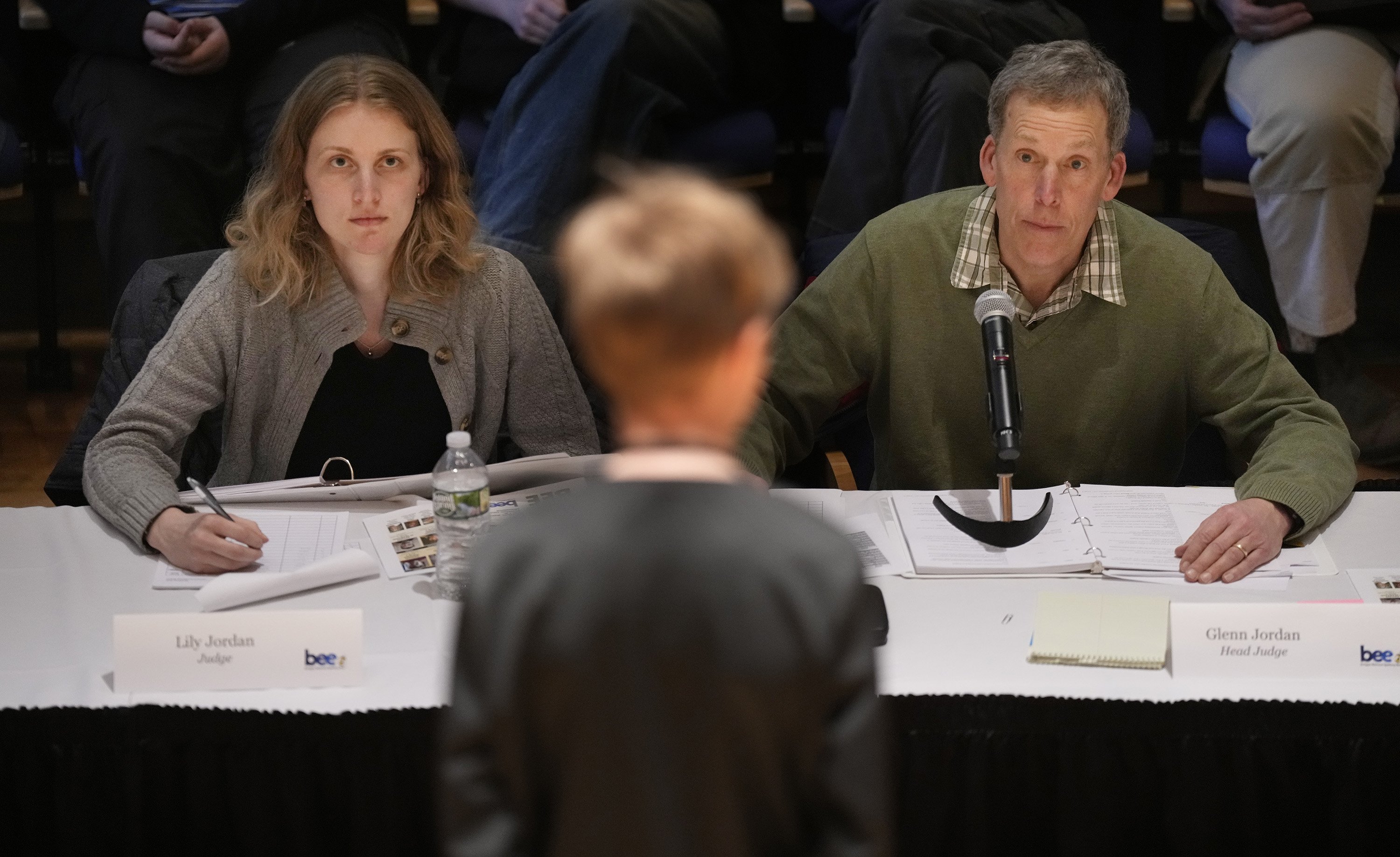
“(We’re) so proud of him. He’s worked really hard; he’s done a lot of hours of studying,” said Elizabeth Singh, Tristan’s mom.
Three members of a spelling bee family and the president of Thomas College made up the judging team for the state bee. For each word, students could ask the judges for its definition, origin, part of speech and to use it in a sentence.
Lily Jordan, of San Francisco, returned to her home state to judge this year’s bee after winning it twice as a middle schooler. Her dad, Glenn Jordan, a retired Press Herald sports writer, and her mom, Nancy Jordan, the lead content developer at National Geographic Learning, were also at the judges’ table. Meanwhile, their dog, Webster — like the dictionary — took a nap under the table.
“It almost feels like being a kid again, and feeling the nervousness of the moment, but it’s a lot of fun,” Lily Jordan said.
Jeannine Uzzi, the president of Thomas College, served as the word pronouncer Saturday, a role she’s been coming back to for more than 15 years.

“It’s a great way to reinforce academics in the state,” Uzzi said.
A bee afficionado, Singh plans on competing in the Maine State Civics Bee at Colby College in June — that is, after he appears at the nation’s largest spelling competition.

Keeping open records in the dark is costing taxpayers in Massachusetts
As Sunshine Week comes to a close this week, government officials across the country will once again talk about transparency and accountability. In Massachusetts, however, a series of recent transparency failures shows just how far we have to go here in the Bay State.
For years, watchdog groups, journalists, and ordinary citizens have warned that Massachusetts has one of the weakest public records systems in the country. Deadlines are ignored. Fees are inflated. Enforcement is weak. And when state or local officials would rather keep information hidden, the burden too often falls on private citizens to drag those records into the light.
This is hardly a partisan critique.
On this point, even groups that rarely agree politically can see the same problem. Journalists have been forced to sue for access. Citizens have waited months or years for information that should have been produced promptly. Transparency should not be a left or right wing issue, it should be the bare minimum in a functioning democracy.
The recent examples are hard to ignore. One police department demanded $1.8 million for license-plate-reader records before that fee was later reduced. In Lexington, a school employee was caught discussing whether production costs could be inflated in hopes that a requester would give up. In Somerville, public officials spent years fighting over parking-permit data.
And then there is the state’s climate litigation against Exxon Mobil.
Massachusetts sued Exxon for allegedly misleading the public about climate change. Whatever one thinks of that lawsuit, the state put honesty, disclosure, and accountability at the center of its case. Yet when Exxon sought records related to Massachusetts’ own climate regulations and enforcement, officials resisted disclosure and triggered a separate legal battle over access to those documents.
What surfaced from that fight was incredibly troubling.
A regulation adopted under Massachusetts climate law requires state agencies with large vehicle fleets to track emissions and submit annual compliance reports. Those reports were supposed to begin in 2019. But according to sworn testimony from state environmental officials, not a single agency has submitted them. None. Regulators also acknowledged they had not conducted inspections or taken enforcement actions to verify compliance.
So, while Massachusetts was accusing Exxon of climate deception, the state was also fighting a records request that exposed its own failure to comply with one of its own climate rules.
That hypocrisy should concern everyone.
These reporting requirements exist to measure whether the state is actually doing what it says it is doing. If agencies are not filing required reports, and regulators are not enforcing the rule, then the public has every right to ask whether Massachusetts is serious about the climate commitments it promotes so aggressively.
Taxpayers also have every right to ask how much public money is being spent to keep that failure hidden.
That was the focus of Massachusetts Fiscal Alliance’s recent letter to Energy and Environmental Affairs Secretary Rebecca Tepper. According to state spending records, since last April, EEA paid a Boston law firm over $534,000, which includes $417,620 from “Climate Adaptation and Preparedness” funds and over $117,000 from funds labeled as “Environmental Affairs Administration.” When underlying payment records were requested, both DEP and the Comptroller reportedly said they had no responsive records.
Ironically, the money spent defending the state’s failure to comply with open records laws could have gone toward actual climate compliance or easing the burden on ratepayers and taxpayers. Instead, it appears to have been simply wasted on lawyers to allegedly cover up the state’s non-compliance on its own climate mandates.
That concern is even more urgent because the Healey administration recently estimated that their climate agenda could cost an eye-popping $130 billion by 2050, while an independent study by the Fiscal Alliance Foundation estimated the cost to be over $400B for the state. While Massachusetts clearly cannot afford more burdensome regulations that will drive businesses out of the state, if taxpayers are being asked to shoulder massive new climate costs the public should at least be able to trust that the laws already on the books are being followed.
Massachusetts officials are often quick to demand transparency from corporations and the Trump administration. But transparency cannot be a one-way demand.
Our elected leaders at Beacon Hill must hold themselves to the same standard they impose on the public. It is the foundation of public trust and a problem that Massachusetts has ignored for far too long.
Paul Diego Craney is the Executive Director of Massachusetts Fiscal Alliance

Between NYC And New Haven Is One Of Connecticut’s Oldest State Parks With Scenic Beaches And Fishing – Islands

Suspect on the run after armed robbery at Christiana Mall in Newark: Police

From the Archives: Hospital has 70-year history in Southwest Florida

Texas A&M drops series vs. Georgia after 8-2 Game 2 loss

Kokua Line: Will smaller airports close in Hawaii? | Honolulu Star-Advertiser

Florida High School Football Rankings: Top 25 teams – Oct. 21

How old is Bo Nix? What to know about Oregon quarterback ahead of 2024 NFL Draft

Cleary's 21 help Le Moyne down Central Connecticut State 69-64 in OT

99th annual Pony Swim held in Virginia

Indiana Members Credit Union announced as new anchor tenant at Bottleworks District

Video: Former F.B.I. Director Robert Mueller Dies at 81

Trump gives Iran 48-hour ultimatum to reopen Strait of Hormuz or face strikes on power plants

Macron pushes tougher EU digital action ahead of key votes

Airport security lines are long. Here’s what to know if you’re flying

Schumer gambit fails as DHS shutdown hits 36 days and airport lines grow
-

 Detroit, MI3 days ago
Drummer Brian Pastoria, longtime Detroit music advocate, dies at 68
-

 Oklahoma1 week ago
Family rallies around Oklahoma father after head-on crash
-

 Nebraska1 week ago
Wildfire forces immediate evacuation order for Farnam residents
-

 Georgia6 days ago
How ICE plans for a detention warehouse pushed a Georgia town to fight back | CNN Politics
-

 Alaska1 week ago
Police looking for man considered ‘armed and dangerous’
-
 Science1 week ago
Federal EPA moves to roll back recent limits on ethylene oxide, a carcinogen
-
 Science1 week ago
H5N1 bird flu spreads to sea otters and sea lions along San Mateo coast, wildlife experts say
-

 Movie Reviews3 days ago
‘Youth’ Twitter review: Ken Karunaas impresses audiences; Suraj Venjaramoodu adds charm; music wins praise | – The Times of India