Rhode Island
Senate rejects two impeachment articles against DHS Secretary Mayorkas • Rhode Island Current

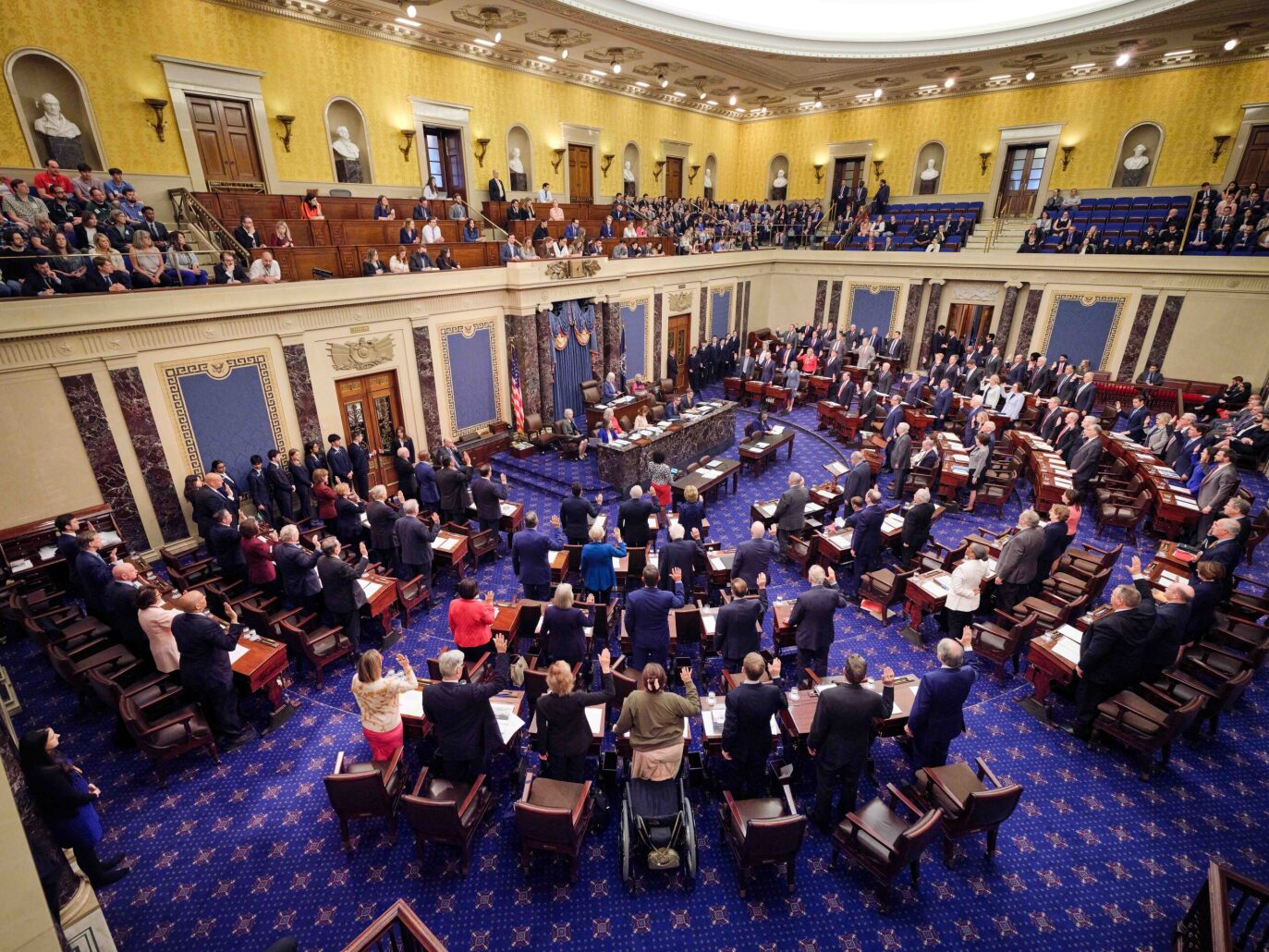
WASHINGTON — The U.S. Senate on Wednesday dismissed two articles of impeachment against Homeland Security Secretary Alejandro Mayorkas.
The Democrat-controlled chamber voted, 51-49 along party lines, to adjourn the impeachment trial after finding that the impeachment articles accusing Mayorkas of not complying with federal immigration law and breaching the public trust did not rise to the level of high crimes and misdemeanors and were therefore unconstitutional.
“The charges brought against Secretary Mayorkas fail to meet the high standard of high crimes and misdemeanors,” Senate Majority Leader Chuck Schumer said on the Senate floor before a series of votes. “To validate this gross abuse by the House would be a grave mistake and could set a dangerous precedent for the future.”
The adjournment vote followed successful votes to drop the two House-passed articles of impeachment against Mayorkas, as well as a series of Republican motions to adjourn the court of impeachment or enter closed session, which all failed.
Sen. Lisa Murkowski of Alaska was the only senator to break party ranks during an afternoon vote series. She voted “present” on a motion to drop the first article of impeachment.
Senators were sworn in Wednesday as jurors after House Republican impeachment managers delivered the two articles of impeachment the day before, starting the proceedings. House Republicans voted to impeach Mayorkas, on their second try, in February.
Republicans have demanded a trial, while Senate Democrats indicated they planned to either dismiss the articles or table the trial because they argued the charges against Mayorkas did not reach the constitutional threshold required of impeachment, which is “high crimes and misdemeanors.”
“To validate this gross abuse by the House would be a grave mistake and could set a dangerous precedent for the future,” Schumer, a New York Democrat, said.
Republicans blast process
Following the vote, Republicans slammed Democrats, arguing the move to avoid a trial set a precedent.
“They created a new precedent saying you don’t even have to vote on the articles (of impeachment),” Republican Sen. Josh Hawley of Missouri told reporters off the Senate floor.
Missouri Republican Eric Schmitt warned that voters would remember the Senate’s decision in the November elections.
“They see what a disaster the border’s been,” he said to reporters.
Congressional Democrats and the White House have criticized Republicans’ efforts to impeach Mayorkas as political and campaign fodder for the November elections. Congressional Republicans and the Biden administration have clashed over immigration policy for years.
Senate Minority Leader Mitch McConnell argued Wednesday it was senators’ constitutional duty to hold a trial.
“It is the job of this body to consider the articles of impeachment brought before us and to render judgment,” the Kentucky Republican said on the Senate floor.
Even if a trial had been held, it’s unlikely that the two-thirds majority in the Senate required to remove Mayorkas could have been reached.
In an email, a spokesperson for the Department of Homeland Security said House Republicans have not provided the necessary evidence to warrant an impeachment effort.
“Secretary Mayorkas spent months helping a bipartisan group of Senators craft a tough but fair bill that would give DHS the tools necessary to meet today’s border security challenges, but the same House Republicans playing political games with this impeachment chose to block that bipartisan compromise,” the spokesperson said.
“Congressional Republicans should stop wasting time with unfounded attacks, and instead do their job by passing bipartisan legislation to properly fund the Department’s vital national security missions and finally fix our broken immigration system.”
Amid the impeachment proceedings in the Senate, Mayorkas has been making his rounds on Capitol Hill to defend the president’s fiscal year 2025 budget for the Department of Homeland Security.
White House Spokesperson for Oversight and Investigations Ian Sams praised the Senate’s decision in a statement.
“Once and for all, the Senate has rightly voted down this baseless impeachment that even conservative legal scholars said was unconstitutional,” he said.
Several votes
Washington state Democrat Sen. Patty Murray presided over the impeachment proceedings, which included several votes Wednesday afternoon.
Schumer tried to approve by unanimous consent a structure for the trial, including debate time and the number of points of order senators could make, but Schmitt objected.
“I will not assist Sen. Schumer in setting our Constitution ablaze,” he said.
Schumer then raised a point of order declaring that the first article of impeachment did not rise to high crimes under the constitution, leading to a series of Republican senators demanding votes on proposals to delay a vote on Schumer’s motion
Sen. Ted Cruz, Republican of Texas, moved to go to closed session and debate the articles of impeachment but Schumer objected. GOP Sen. Mike Lee of Utah made the same motion. Senators voted on both motions and rejected them 49-51.
Sen. John Kennedy, Republican of Louisiana, made a motion to adjourn the court of impeachment and begin impeachment proceedings on April 30 at noon.
Kennedy’s motion failed 49-51.
GOP Sen. Rick Scott of Florida made the same motion to adjourn, which also failed 49-51.
They went back to the point of order Schumer made that declared the first article of impeachment was unconstitutional. The Senate voted, 51-48, to reject the first article of impeachment on the grounds that it did not rise to the constitutional standard for impeachment, with Murkowski voting present.
Schumer made an identical point of order on the second article of impeachment.
Kennedy again filed a motion to adjourn to May 1, 2004 for impeachment proceedings. He corrected his request to 2024. It again failed 49-51.
GOP Sen. Roger Marshall of Kansas then made a motion to adjourn until Nov. 6 until after the election and “before this body disrespects the Constitution.” It failed 49-51.
Sen. John Thune of South Dakota, the No. 2 Republican, moved to table Schumer’s second point of order that the second article of impeachment is unconstitutional. It failed 49-51.
Senators then approved Schumer’s second motion, 51-49.
House action
Georgia’s Rep. Marjorie Taylor Greene has been at the forefront of impeachment efforts against Mayorkas, first introducing the measure in September.
Greene is also a House impeachment manager, along with GOP Reps. Mark Green of Tennessee, Michael McCaul of Texas, Andy Biggs of Arizona, Ben Cline of Virginia, Andrew Garbarino of New York, Michael Guest of Mississippi, Harriet Hageman of Wyoming, Clay Higgins of Louisiana, Laurel Lee of Florida and August Pfluger of Texas.
Two of the impeachment managers, Biggs and Higgins, came to the Senate Wednesday to watch that chamber’s proceedings.
The two articles of impeachment charged Mayorkas with not complying with federal immigration law and breaching the public trust.
The first article of impeachment accused Mayorkas of contributing to myriad problems, including rising profits for smuggling operations, a high backlog of asylum cases in immigration courts, fentanyl-related deaths and migrant children found working in dangerous jobs. Republican state legislatures have moved to roll back child labor laws in industries from the food industry to roofing.
Republicans argued that the first article of impeachment would hold Mayorkas accountable for the large number of migrants that have traveled to the southern border to claim asylum. The Biden administration is dealing with the largest number of migrant encounters at the U.S.-Mexico border in 20 years.
The second article of impeachment charged Mayorkas with breaching public trust by making several statements in congressional testimony that Republicans argue are false, such as Mayorkas telling lawmakers that the southern border is “secure.”
The second article also charged Mayorkas with not fulfilling his statutory duty by rolling back Trump-era policies such as terminating contracts that would have continued construction of the border wall and ending the Migrant Protection Protocols, also known as the “Remain in Mexico” policy that was ended after it went up to the Supreme Court.
GET THE MORNING HEADLINES DELIVERED TO YOUR INBOX



The Rhode Island Lottery offers multiple draw games for those aiming to win big.
Here’s a look at March 23, 2026, results for each game:
Winning Powerball numbers from March 23 drawing
12-18-47-56-63, Powerball: 01, Power Play: 10
Check Powerball payouts and previous drawings here.
Winning Numbers numbers from March 23 drawing
Midday: 1-6-3-3
Evening: 5-0-7-4
Check Numbers payouts and previous drawings here.
Winning Wild Money numbers from March 23 drawing
01-12-27-28-31, Extra: 37
Check Wild Money payouts and previous drawings here.
Winning Millionaire for Life numbers from March 23 drawing
01-14-19-29-35, Bonus: 03
Check Millionaire for Life payouts and previous drawings here.
Feeling lucky? Explore the latest lottery news & results
Are you a winner? Here’s how to claim your prize
- Prizes less than $600 can be claimed at any Rhode Island Lottery Retailer. Prizes of $600 and above must be claimed at Lottery Headquarters, 1425 Pontiac Ave., Cranston, Rhode Island 02920.
- Mega Millions and Powerball jackpot winners can decide on cash or annuity payment within 60 days after becoming entitled to the prize. The annuitized prize shall be paid in 30 graduated annual installments.
- Winners of the Millionaire for Life top prize of $1,000,000 a year for life and second prize of $100,000 a year for life can decide to collect the prize for a minimum of 20 years or take a lump sum cash payment.
When are the Rhode Island Lottery drawings held?
- Powerball: 10:59 p.m. ET on Monday, Wednesday, and Saturday.
- Mega Millions: 11:00 p.m. ET on Tuesday and Friday.
- Lucky for Life: 10:30 p.m. ET daily.
- Millionaire for Life: 11:15 p.m. ET daily.
- Numbers (Midday): 1:30 p.m. ET daily.
- Numbers (Evening): 7:29 p.m. ET daily.
- Wild Money: 7:29 p.m. ET on Tuesday, Thursday and Saturday.
This results page was generated automatically using information from TinBu and a template written and reviewed by a Rhode Island editor. You can send feedback using this form.
Rhode Island
Mott & Chace Sotheby’s Announces Listing of Narragansett Landmark “Broadmoor” After Extraordinary Relocation and Luxury Transformation – Newport Buzz

150 Boston Neck Road | Narragansett, RI | 6 Beds, 5 Full Baths, 3 Half Baths | 5,785 Sq Ft | 0.97 Acres | Offered by Janet Kermes of Mott & Chace Sotheby’s International Realty for $5,995,000.
At 150 Boston Neck Road, Broadmoor offers one of the most compelling preservation stories on the Rhode Island coast. Originally built circa 1896, the iconic shingle-style estate was carefully relocated in 2022, lifted onto steel beams and moved nearly 1,000 feet down the road in a remarkable effort to save it from demolition.

What followed was a full-scale transformation. Now set on a new foundation with entirely updated systems, the nearly 6,000-square-foot home blends historic character with the ease of modern construction. State-of-the-art HVAC, a high-efficiency furnace, and five-zone heating and cooling bring a level of comfort rarely found in a home of this era.
Inside, original wood floors and a grand central staircase anchor three light-filled levels. The residence includes six bedrooms, five full baths, and three half baths, with four ensuite bedrooms designed for hosting. A dramatic chef’s kitchen features a six-burner double-oven range, dual Sub-Zero refrigerators, three sinks, two dishwashers, and an oversized island, complemented by multiple living and entertaining spaces throughout.

Ocean views from nearly every room on the upper floors, along with a screened-in patio, second-floor deck, and bluestone fire pit patio, create a seamless connection to the coastal setting. Located directly across from the Dunes Club and just steps to Narragansett Town Beach, Broadmoor captures the best of the Pier lifestyle.

A rare offering that honors the past while living entirely in the present.
LEARN MORE, SEE MORE PHOTOS, AND SCHEDULE A SHOWING

Like Newport Buzz? We depend on the generosity of readers like you who support us, to help with our mission to keep you informed and entertained with local, independent news and content. We truly appreciate your trust and support!


Related

Kathleen Mary Mosher (née Martin), age 63, passed away on January 22, 2026, in Valdosta, Georgia, after a courageous nearly two-year battle with cancer that she fought with remarkable strength and determination.
Kathleen was born on November 6, 1962, at the Newport Naval Base to Mary Del Chapels Martin and Herbert Arden Martin, both of whom preceded her in death. She grew up in Newport, Rhode Island, and graduated from Rogers High School in 1981.
Kathleen shared a lifelong love story with her husband, Richard Harvey Mosher, who also preceded her in death. The two were truly inseparable, rarely seen apart and always hand in hand. Kathleen had admired the boy next door for years, and when she turned eighteen she finally told him there were no more excuses and that he was hers. They were married on January 16, 1982, at St. Paul’s United Methodist Church in Newport, beginning a marriage built on devotion, love, and partnership.
Kathleen spent much of her life caring for others. She was a loving mother, grandmother, sister, and friend who always put family first. While raising her children, she was a devoted stay-at-home mother until her youngest began school. She later worked as a teacher’s aide and eventually took over her own children’s Newport Daily News paper routes, continuing to deliver newspapers until the paper discontinued home carriers.
She was also a proud and active member of St. Paul’s United Methodist Church in Newport, where she served and helped in many ways over the years. Her faith and dedication to her church community were an important part of her life.
Kathleen is survived by her loving children, Heather Johnson, Marydel Hall, and Richard Mosher II, as well as Tina Couture, whom she loved and treated as a third daughter. She also leaves behind her cherished grandchildren, Joshua, Gracelynn, Isabella, and bonus grandson Zavyair.
She is also survived by her siblings Sheila Robertson, Michael Martin, Terralinda Winchenbach, Sara Iafrate, and Butch Martin, along with many extended family members and friends who will miss her dearly.
Kathleen will be remembered for her strength, devotion to family, and the countless ways she cared for others throughout her life. She spent much of her time looking after the people she loved, and the kindness and love she shared will continue to live on through those whose lives she touched.
A memorial service will be held on March 22 at 3:00 PM at
St. Paul’s United Methodist Church
12 Marlborough Street
Newport, Rhode Island 02840
Family and friends are invited to gather following the service to celebrate Kathleen’s life and share memories.

Like Newport Buzz? We depend on the generosity of readers like you who support us, to help with our mission to keep you informed and entertained with local, independent news and content. We truly appreciate your trust and support!


Related

‘I’m back’: Tiger Woods to play in TGL championship match with Masters status still unclear

Iran names successor to security chief killed in US-Israeli attack

Motown Museum in Detroit to Premiere New Psychedelic Soul Exhibit

Pain at the pump: One gas station in S. San Francisco near $7 a gallon

H-E-B plans new store on the eastern side of Dallas-Fort Worth

Florida High School Football Rankings: Top 25 teams – Oct. 21

How old is Bo Nix? What to know about Oregon quarterback ahead of 2024 NFL Draft

Cleary's 21 help Le Moyne down Central Connecticut State 69-64 in OT

99th annual Pony Swim held in Virginia

Indiana Members Credit Union announced as new anchor tenant at Bottleworks District
Iran names successor to security chief killed in US-Israeli attack

See How the LaGuardia Plane Crash Unfolded

Mullin confirmed as DHS chief as lawmakers near solution on shutdown standoff

Von der Leyen clinches Australia trade deal

Trump administration places Christopher Columbus statue on White House grounds
-

 Detroit, MI6 days ago
Drummer Brian Pastoria, longtime Detroit music advocate, dies at 68
-

 Oklahoma1 week ago
Family rallies around Oklahoma father after head-on crash
-

 Georgia1 week ago
How ICE plans for a detention warehouse pushed a Georgia town to fight back | CNN Politics
-

 Alaska1 week ago
Police looking for man considered ‘armed and dangerous’
-

 Movie Reviews5 days ago
‘Youth’ Twitter review: Ken Karunaas impresses audiences; Suraj Venjaramoodu adds charm; music wins praise | – The Times of India
-

 Education1 week ago
Video: Turning Point USA Clubs Expand to High Schools Across America
-
 Science1 week ago
Long COVID leaves thousands of L.A. county residents sick, broke and ignored
-

 Sports3 days ago
IOC addresses execution of 19-year-old Iranian wrestler Saleh Mohammadi