Rhode Island
Parents tote toddlers to D.C. to press for expanded child tax credit, child care funds • Rhode Island Current


WASHINGTON — Families gathered outside the U.S. Capitol Tuesday to “make a fuss for babies,” who they believe are being left behind by lawmakers who direct only a fraction of U.S. resources to young children.
Parents and kids representing 50 states and the District of Columbia convened for the eighth annual “Strolling Thunder.” Moms and dads pushing strollers decked out in state license plates rallied on the Capitol’s East Lawn to lobby lawmakers to fund child care, establish national paid family leave, and permanently expand the child tax credit.
Matthew Melmed, executive director of ZERO TO THREE, the organization behind the event, rallied parents to tell their representatives that the 11 million babies in the U.S. “make up 3.4% of our population, but 100% of our future.”
“You’re here with the pork producers and the insurance lobby and the pharmaceutical industry. Members of Congress don’t normally see real people, and they rarely see babies and toddlers, particularly babies and toddlers who need to have their diapers changed on their desks. And that’s what I encourage you to do if you need to have that happen,” Melmed told the crowd.
The nonprofit ZERO TO THREE bases its advocacy on health and developmental research findings in infants up to age 3, the years the group describes as “the most important for lifelong mental health and well-being.”
Melmed praised top Democratic appropriators Sen. Patty Murray of Washington and Rep. Rosa DeLauro of Connecticut for achieving a $1 billion increase for child care block grants and Head Start in this year’s government funding bills.
DeLauro, who spoke to the crowd, said “families deserve better.”
“The cost of living has increased year after year, and more and more Americans simply do not get paid enough to live on, let alone to raise a family,” the Connecticut lawmaker said, promising to advocate for the reinstatement of a fully refundable child tax credit.
‘Diapers, child care, formula’
Candace Winkler, a former Alaska resident and current ZERO TO THREE leader, sat on the Capitol lawn next to Sabrina Donnellan who traveled to D.C. from Girdwood, Alaska, with her 13-month-old Blakely to advocate for lower child care costs and paid family leave.
Winkler, the organization’s chief development and strategy officer, said the group of families would divide up in the halls of Congress Tuesday to meet with their representatives about six key policy issues, including permanently expanding the child tax credit to pandemic levels.
“We’ve seen that time and time again that families are using those resources for diapers, child care, formula and things their babies and their family needs. And it’s really critical for their success,” WInkler said.
The current child tax credit is $2,000 a year after tax liability, but the amount a parent could receive per child under 17 in a refund check is capped at $1,600 in 2023. The credit phases in at 15% on every dollar after earnings of $2,500.
As the U.S. was digging out from under the COVID-19 economic crisis, Congress approved a one-year expansion of the tax credit to $3,000 per child under age 18, and $3,600 for those under age 6 — including for families who made $0 in income. Lawmakers made the entire amount refundable, and a portion of it was sent to families in monthly installments.
Advocates hailed the research findings that showed the temporary move was a game changer for lifting children from poverty in the U.S.
A current bipartisan proposal, widely supported by U.S. House lawmakers, to temporarily expand the child tax credit until 2025 — though not to pandemic levels — is currently stalled by U.S. Senate Republicans who liken aspects of the bill to a welfare program.
The proposal, as passed by the House, would increase the credit’s refundable portion to $1,800 in 2023, $1,900 in 2024 and $2,000 in 2025. The legislation would also increase the phase-in rate to 15% per child, simultaneously — in other words, 30% for a family with two children, 45% for a family with three, and so on.
Credit card debt for child care
Cruz Bueno, a parent from Warwick, Rhode Island, shared her story of racking up credit card debt to enroll her 11-month-old Rosie in child care, along with her 2-year-old sister Amalia.
“Putting Rosie into daycare means that we must put a halt to our dream of buying a home,” said Bueno, an economist who lives in Warwick with her husband, Xhuljan Meta.
“One of the stipulations of our mortgage pre-approval was to keep our credit card balances low. Even so, we remain hopeful that one day in the not-so-distant future we will be able to buy a home to raise our girls and pass on wealth to them,” she said.
When asked about the Strolling Thunder event at Tuesday morning’s regularly scheduled House Republican press conference, House Speaker Mike Johnson of Louisiana said, “There’s lots of ideas out there. What we stand for, what our party stands for, is support of families. We support infants and children, and there’s an appropriate role to play in that.”
“The devil’s always in the details on legislation, so I’m not sure exactly what they’re proposing, but all of us are looking at those avenues. We want to support families. That’s good public policy,” Johnson said. “In our view, the best way often for the government to do that is to step back and allow the local and state officials to handle their business at that local level.”
Rep. Elise Stefanik, House Republican Conference Chair, said the GOP is “proud to be a pro-family conference.”
“There are many of our members who have proposed innovative solutions — one is rural child care. Home-based child care, that’s an issue I’ve worked with many of my colleagues on the Education and Workforce Committee,” Stefanik, of New York, said. “But the economy, the border, crime, these issues, these crises caused by Joe Biden, they impact every family.”
GET THE MORNING HEADLINES DELIVERED TO YOUR INBOX


(WJAR) — Rhode Island Attorney General Peter Neronha endorsed Democrat Helena Foulkes in her bid for Rhode Island Governor on Thursday.
Neronha spoke at a campaign event with Foulkes.
The term-limited Attorney General says he hadn’t been comfortable endorsing people because of his position.
Neronha said he had gotten to know Foulkes after she reached out to him about health care, an issue Neronha has been vocal about.
“I found Helena to be a great listener, a great thought partner, a person of integrity and character, and that is foremost why I’m endorsing her today,” he said.
“What Rhode Island needs today and into the future is strong capable leadership,” he said. “This is not a state that can afford to keep muddling around in the four, eight, ten, fifteen years.”
He said Foulkes could offer bold leadership.
Neronha has publicly admitted to having a strained relationship with Gov. Dan McKee.
JOIN THE CONVERSATION (1)
This story will be updated.
The Rhode Island Lottery offers multiple draw games for those aiming to win big.
Here’s a look at March 4, 2026, results for each game:
Winning Powerball numbers from March 4 drawing
07-14-42-47-56, Powerball: 06, Power Play: 4
Check Powerball payouts and previous drawings here.
Winning Numbers numbers from March 4 drawing
Midday: 2-7-4-4
Evening: 7-6-0-2
Check Numbers payouts and previous drawings here.
Winning Wild Money numbers from March 4 drawing
08-11-12-18-24, Extra: 15
Check Wild Money payouts and previous drawings here.
Winning Millionaire for Life numbers from March 4 drawing
12-13-36-39-58, Bonus: 03
Check Millionaire for Life payouts and previous drawings here.
Feeling lucky? Explore the latest lottery news & results
Are you a winner? Here’s how to claim your prize
- Prizes less than $600 can be claimed at any Rhode Island Lottery Retailer. Prizes of $600 and above must be claimed at Lottery Headquarters, 1425 Pontiac Ave., Cranston, Rhode Island 02920.
- Mega Millions and Powerball jackpot winners can decide on cash or annuity payment within 60 days after becoming entitled to the prize. The annuitized prize shall be paid in 30 graduated annual installments.
- Winners of the Millionaire for Life top prize of $1,000,000 a year for life and second prize of $100,000 a year for life can decide to collect the prize for a minimum of 20 years or take a lump sum cash payment.
When are the Rhode Island Lottery drawings held?
- Powerball: 10:59 p.m. ET on Monday, Wednesday, and Saturday.
- Mega Millions: 11:00 p.m. ET on Tuesday and Friday.
- Lucky for Life: 10:30 p.m. ET daily.
- Millionaire for Life: 11:15 p.m. ET daily.
- Numbers (Midday): 1:30 p.m. ET daily.
- Numbers (Evening): 7:29 p.m. ET daily.
- Wild Money: 7:29 p.m. ET on Tuesday, Thursday and Saturday.
This results page was generated automatically using information from TinBu and a template written and reviewed by a Rhode Island editor. You can send feedback using this form.

When it comes to expressing ourselves, Rhode Islanders have elevated license plates to an art form. You might not be able to get a new vanity plate — the state suspended applications in 2021 after a judge ruled a Tesla owner could keep his FKGAS plates — but you can still express your Rhody pride with one of seventeen state-approved charity plates. The program has funded ocean research, thrown parades, saved crumbling lighthouses and even provided meals for residents. About half of the $43.50 surcharge goes to the associated charity, while the other half covers the production cost.
________________________
License plate images courtesy of the Rhode island division of motor vehicles.
Atlantic Shark Institute
Year first approved: 2022
Plates currently on road: 7,007
Total raised: $269,530
________________________
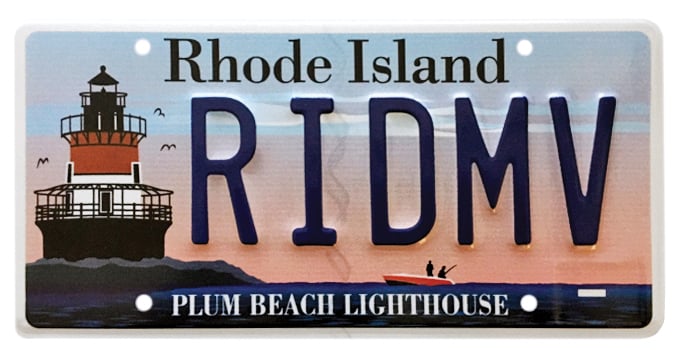
License plate images courtesy of the Rhode island division of motor vehicles.
Friends of Plum Beach Lighthouse
Year first approved: 2009
Plates currently on road: 5,024
Total raised: $336,890
________________________

License plate images courtesy of the Rhode island division of motor vehicles.
Wildlife Rehabilitators Association of Rhode Island
Year first approved: 2013
Plates currently on road: 2,102
Funds raised: $32,080
________________________

License plate images courtesy of the Rhode island division of motor vehicles.
Rocky Point Foundation
Year first approved: 2016
Plates currently on road: 1,616
Funds raised: $50,450
________________________

License plate images courtesy of the Rhode island division of motor vehicles.
Rhode Island Community Food Bank
Year first approved: 2002
Plates currently on road: 765
Funds raised since 2021: $11,060*
*Prior to 2021, customers ordered plates directly through the food bank, and total revenue numbers are not available.
________________________

License plate images courtesy of the Rhode island division of motor vehicles.
New England Patriots Charitable Foundation
Year first approved: 2009
Plates currently on road: 1,472
Funds raised: $136,740
________________________

License plate images courtesy of the Rhode island division of motor vehicles.
Audubon Society of Rhode Island and Save the Bay
Year first approved: 2006
Plates currently on road: 1,132
Funds raised: $61,380 for each organization (proceeds split evenly)
________________________

License plate images courtesy of the Rhode island division of motor vehicles.
Boston Bruins Foundation
Year first approved: 2014
Plates currently on road: 1,125
Funds raised: $36,880
________________________

License plate images courtesy of the Rhode island division of motor vehicles.
Beavertail Lighthouse Museum Association
Year first approved: 2023
Plates currently on road: 1,105
Funds raised: $37,610
________________________

License plate images courtesy of the Rhode island division of motor vehicles.
Bristol Fourth of July Committee
Year first approved: 2011
Plates currently on road: 1,104
Funds raised: $17,640
________________________

License plate images courtesy of the Rhode island division of motor vehicles.
Red Sox Foundation
Year first approved: 2011
Plates currently on road: 860
Funds raised: $88,620
________________________

License plate images courtesy of the Rhode island division of motor vehicles.
Gloria Gemma Breast Cancer Resource Foundation
Year first approved: 2012
Plates currently on road: 1,510
Funds raised: $33,360
________________________

License plate images courtesy of the Rhode island division of motor vehicles.
Providence College Angel Fund
Year first approved: 2016
Plates currently on road: 693
Funds raised: $23,220
________________________

License plate images courtesy of the Rhode island division of motor vehicles.
Rose Island Lighthouse and Fort Hamilton Trust
Year first approved: 2022
Plates currently on road: 383
Funds raised: $10,640
________________________

License plate images courtesy of the Rhode island division of motor vehicles.
Friends of Pomham Rocks Lighthouse
Year first approved: 2022
Plates currently on road: 257
Funds raised: $7,580
________________________

License plate images courtesy of the Rhode island division of motor vehicles.
Day of Portugal and Portuguese Heritage in RI Inc.
Year first APPROVED: 2018
Plates currently on road: 132
Funds raised: $3,190

Capitals Acquire a Conditional First-Round Pick in Either 2026 or 2027 and a 2027 Third-Round Pick from Anaheim for John Carlson | Washington Capitals

Wisconsin Lottery Pick 3, Pick 4 results for March 5, 2026

University, Ripley out to early leads at state wrestling – WV MetroNews

Wyoming 3A and 4A Boys Basketball Regionals Tip Off Postseason Play

1 Cryptocurrency Set to Rebound in 2026

Florida High School Football Rankings: Top 25 teams – Oct. 21

Cleary's 21 help Le Moyne down Central Connecticut State 69-64 in OT

How old is Bo Nix? What to know about Oregon quarterback ahead of 2024 NFL Draft

99th annual Pony Swim held in Virginia

Indiana Members Credit Union announced as new anchor tenant at Bottleworks District

DOJ continues Biden autopen probe despite former president unlikely to face charges
Fact check: Did French border guards mock influencers returning from Dubai amid Iran war?

Iran’s fight for survival / The widening war / Trump’s nebulous goals : Sources & Methods

Map: 4.9-Magnitude Earthquake Shakes Louisiana

Paxton vows he’s ‘staying in this race’ even if Trump backs Cornyn in Texas GOP clash
-

 World1 week ago
Exclusive: DeepSeek withholds latest AI model from US chipmakers including Nvidia, sources say
-

 Wisconsin4 days ago
Setting sail on iceboats across a frozen lake in Wisconsin
-

 Massachusetts1 week ago
Mother and daughter injured in Taunton house explosion
-

 Maryland5 days ago
AM showers Sunday in Maryland
-

 Massachusetts3 days ago
Massachusetts man awaits word from family in Iran after attacks
-

 Florida5 days ago
Florida man rescued after being stuck in shoulder-deep mud for days
-

 Denver, CO1 week ago
10 acres charred, 5 injured in Thornton grass fire, evacuation orders lifted
-

 Oregon7 days ago
2026 OSAA Oregon Wrestling State Championship Results And Brackets – FloWrestling