The Colorado Rockies (28-47) had the day off Thursday after an uneven road trip that took them from Las Vegas to Wrigley Field. They dropped two of three to the Athletics, with the lone win coming in a wild 23-9 game, then went to Chicago and again lost two of three.
Northeast
Philly DA warns ‘anybody who thinks it’s time to play militia’ on Election Day: ‘F around and find out’

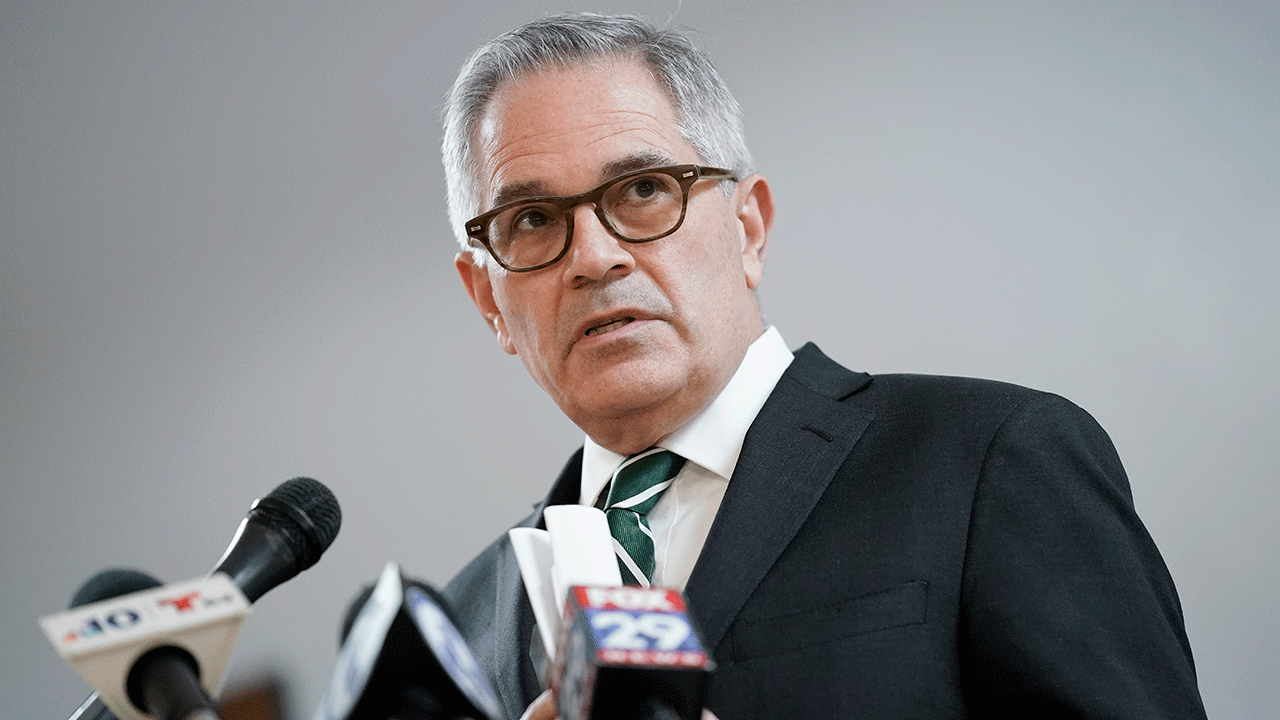
Philadelphia District Attorney Larry Krasner issued a warning to anyone who might think about interfering in Election Day activities.
During a press conference on Monday, Krasner highlighted voter protection efforts made by the election task force on the eve of Election Day.
“We are here on a very important day before a very important election. We are here more than anything to speak about protection of an election, making sure that the election that will occur tomorrow will be free. It will be fair, and it will be final,” Krasner said.
Krasner said they have no “deep, abiding fears or concerns” surrounding safety and reassured the community that when they get up to vote tomorrow, they would be protected.
IN BATTLE AGAINST TRUMP, HARRIS CRISSCROSSES BIGGEST OF THE BATTLEGROUNDS ON ELECTION EVE
Philadelphia District Attorney Larry Krasner (AP Photo/Matt Rourke/File)
“I also want to be clear. Anybody who thinks it’s time to play militia, F around and find out,” Krasner said. “Anybody who thinks it’s time to insult, to mistreat, to threaten people, F around and find out.”
“We got a pair of handcuffs, we got a jail cell, and we got a Philadelphia jury,” Krasner said, promising to prosecute anyone who tries to interfere in the vote.
“So if you’re going to try to turn an election into some form of coercion, if you’re going to try to bully people, bully votes or voters, you’re going to try to erase votes, you’re going to try any of that nonsense. We’re not playing. F around and find out,” Krasner said.
Krasner said he is hopeful that they won’t have any issues, but he also said they do have a concern that there may be people either working in the polls or close to the polls who are going to bring frivolous, bogus challenges to voters.
‘PAINSTAKING PROCESS’: PA. COUNTY GIVES UPDATE ON PROBE OF SUSPICIOUS BATCH OF VOTER FORMS
Philly DA Larry Krasner said “F around and find out” to “anybody who thinks it’s time to play militia” on Election Day. (iStock)
“This is the bottom line,” Krasner said. “Anybody who thinks you’re going to play those games in Philadelphia, you’re going to do it in bad faith, I’ve got no problem with doing it in good faith, but if you do it in bad faith, there is an election court, there are judges, they have orders.”
During the last presidential election, two men, 61-year-old Antonio LaMotta and 42-year-old Joshua Macias of Chesapeake, Va., were arrested in Philadelphia with weapons and ammunition outside the Pennsylvania Convention Center where votes were being counted that eventually won President Biden the White House.
Krasner acknowledged that they are all aware of the controversy facing elections in the U.S. and are making sure every vote is counted.
PENNSYLVANIA SUPREME COURT SIDES WITH GOP IN LAST-MINUTE MAIL-IN BALLOT DISPUTE
A voter fills out a mail-in ballot at the Board of Elections office in the Allegheny County Office Building on Nov. 3, 2022 in Pittsburgh, Pennsylvania. (Jeff Swensen/Getty Images)
“But this is my nonpartisan hat. We do not care who gets your vote. We care that you get to vote. That is the most important thing,” Krasner said.
The FBI Philadelphia field office said it is also bringing in additional support and adding election command posts. The agency said it will enable each FBI field office across the country to streamline communication and response and ensure the safety and security of the elections and public.
“The FBI works closely with our federal, state and local partners to identify and stop any potential threats to public safety. We gather and analyze intelligence to determine whether individuals might be motivated to take violent action for any reason, including due to concerns about the election. It is vital the FBI, our law enforcement partners and the public work together to protect our communities as Americans exercise their right to vote. We encourage members of the public to remain vigilant and immediately report any suspicious activity to law enforcement.” — FBI Philadelphia Special Agent in Charge Wayne A. Jacobs
Pennsylvania is expected to play a crucial role in the outcome of the presidential election, having 19 electoral college votes up for grabs.
“Pennsylvania is the one state that it’s hard to see someone losing and then still winning the presidential race,” Mark Harris, a Pittsburgh-based longtime Republican national strategist and ad maker, told Fox News. “It’s clearly ground zero.”
Both Trump and Harris are spending part of their last full day of campaigning in the Keystone State.
Harris will close her election eve swing through Pennsylvania with two star-studded rallies: an evening one in Pittsburgh and a late-night one in Philadelphia by the famed “Rocky Steps” outside the Philadelphia Museum of Art.
Trump, who is also making stops Monday in battlegrounds North Carolina and Michigan, is holding two rallies in Pennsylvania: in the afternoon in Reading followed by an evening one in Pittsburgh. And he held a rally Sunday in Lititz, outside Lancaster.
Fox News Digital’s Paul Steinhauser contributed to this report.
Read the full article from Here

Continue Reading

new video loaded: Fans Show Up to the Parade in Their Best Knicks-Themed Attire
transcript
transcript
Fans Show Up to the Parade in Their Best Knicks-Themed Attire
New York Knicks fans showed up in droves to a ticker-tape parade in Manhattan in their best orange and blue outfits to honor the N.B.A champions.
-
“Patrick Ewing. He didn’t get a ring. But I wear your sneakers, bro. When I was in high school, back in the ’90s, Patrick Ewing, John Starks, they were the team that I rooted for in the ’90s. They didn’t make it. So as a tribute to him because this is where I started at being a fan, Patrick Ewing. Knicks hat in denim — I’m a denim fanatic. So I love denim — Knicks hat. And yeah, that’s it.” “This is my style. I usually dress like this every day. But I did a special Knicks edition. It’s all really fun. I start with my makeup. I did really cute flames on my eyes because the Knicks are fire. I don’t really know what I’m going to do before I put it on. I just figure it out along the way. Like, this is a piece of fabric and I just layer in stuff.” “This is from my online boutique and the hat I just bought on the way to the parade because I wanted to match the jumpsuit, and that’s how I came up with the outfit.” “She was ready to go, man.” “Can you show your fingernail?” “She’s been sleeping in her Jalen Brunson jersey for the last 10 weeks. We’ve been watching all the games. You want to tell them who’s your favorite player?” “Jalen Brunson.” “I’m pretty sure this jersey was actually made for a human baby. But they’re selling them around the block. And we threw it on Chester and everyone started clapping. So — he wears it well.” “Blue and orange.” “So I did blue and orange.” “It had to be orange and blue. “Orange and blue. Orange and blue.”
New York Knicks fans showed up in droves to a ticker-tape parade in Manhattan in their best orange and blue outfits to honor the N.B.A champions.
By Meg Felling, Jeremy Raff, Ang Li and David Cheung
June 18, 2026
Boston, MA
MBTA, state transportation chief apologizes for ‘insensitive’ employee hair-pulling incident

Gov. Maura Healey’s Transportation Secretary and MBTA General Manager Phillip Eng said he has apologized “fully” to the subordinate T employee he’s been accused of pulling the hair of at a work dinner two years ago.
Eng has come under fire for the late 2024 incident this week and admits that it was a “mistake” that has forced him to reflect upon his actions.
“My goal is always to lead with respect and inclusivity,” Eng said in a statement. “I know that this was a mistake, and I own that. I have apologized to this employee fully and have reflected on my actions.
“I am committed to learning from this experience and upholding the highest standards of professionalism in all my interactions as secretary and general manager,” Eng added.
The MBTA said the incident, first reported by Contrarian Boston, occurred in November 2024 at a restaurant where T employees and their spouses were having a team dinner.
WCVB-TV reported that the MBTA employee has told people the interaction with Eng was not welcome and highly inappropriate.
The station described Eng as being accused of committing the hair-pulling faux pas while saying good-bye to the T employee after a work function at a brewery.
The MBTA confirmed that an “insensitive” interaction occurred between Eng and an employee, but downplayed the incident as occurring in the context of a larger conversation about hair from earlier in the evening that included multiple people.
Eng was poking fun at his own baldness when the alleged interaction occurred, according to the MBTA.
“The MBTA is committed to fostering a respectful, inclusive workplace environment,” MBTA spokesperson Joe Pesaturo said in a statement. “Leadership plays a critical role in that. Two years ago, General Manager Eng had an insensitive interaction with one of his direct reports. He subsequently apologized directly to this employee.
“Any claims of harassment, discrimination or retaliatory behavior are completely without merit,” Pesaturo added.
Sources have told WCVB-TV that the T employee is involved in negotiations to leave their job with the agency.
Eng is the state’s top transportation official. Healey appointed him as general manager of the MBTA in 2023, and interim transportation secretary in late 2025.
He was paid $509,114 last year, which includes a $30,000 retention payment he is eligible for each year he remains with the T, per his contract and state payroll records. He does not get additional pay for working dual roles in Massachusetts, but continues to take in a roughly $185,000 pension from New York.
Eng, former president of the Metropolitan Transportation Authority’s Long Island Rail Road, came out of retirement to work for the MBTA, but remains retired with the New York State and Local Employees’ Retirement System, which is paying him a gross monthly pension of $15,357.39, according to the New York State Comptroller’s office.
Eng, who stepped down from his MTA post in February 2022, retired from New York’s ERS the following month, March 31, 2022, the comptroller’s office said. His monthly pension equates to $184,288 in annual compensation, which he can continue to collect while working at the MBTA, where he is one of the highest-paid transit leaders in the country.
Eng has been credited by state officials for helping to get the MBTA back on track following a federal probe for a number of safety lapses that culminated with a fatality, when a 39-year-old man was dragged to death by a Red Line train in April 2022.
He is under contract with the T through April 10, 2028, with an option for a one-year extension. His base pay for 2026 is $484,206, per state payroll records.
By comparison, Eng was paid $285,254 in his final year leading the Long Island Rail Road, per the New York State Comptroller’s office.
Pittsburg, PA
Colorado Rockies vs. Pittsburgh Pirates game discussion: Bubba Chandler vs. Kyle Freeland

That leaves the Rockies at 6-9 in June with a -7 run differential. Even that number is softened by the 23-run outburst against the Athletics. Colorado has been pesky and more competitive, which is an improvement from last month, but the results are still the results: they enter tonight with the worst record in baseball — if only by a game.
Cole Carrigg has brought energy since arriving, and Sterlin Thompson is coming off a two-homer game at Wrigley. There are plenty of reasons to keep watching. The problem is that the old bad-team tropes are still there: blown leads, rocked starters, missed chances, defensive mistakes, and poor execution. The Rockies have been in more games, but they are still too often finding ways to let winnable games get away.
Now they get the Pirates at home.
The Pittsburgh Pirates (38-37) arrive at Coors Field in fourth place in the competitive NL Central — and only 1.5 games out of a wild card spot. Pittsburgh gets plenty of attention for its hyped rotation, led by Paul Skenes, but the offense has been much improved. The Pirates rank third in MLB in batting average, third in on-base percentage, fourth in OPS, fifth in runs scored, and sixth in stolen bases.
Kyle Freeland takes the mound to open the homestand for the Rox. The left-hander enters at 1-7 with a 7.98 ERA, 49 strikeouts, and a 1.70 WHIP over 58.2 innings.
The fastball has been the biggest issue. Freeland is leaving too many four-seamers over the middle of the plate, and hitters have punished it. Opponents are slugging .794 against the pitch, which is especially damaging because he still throws it roughly 27-29% of the time.
That continued in his last start, when Freeland allowed six runs on 10 hits over 5.2 innings. He gave up 12 hard-hit balls, with both the cutter and four-seamer taking damage. The cutter was his most-used pitch in that outing, but it did not solve the contact problem. His sweeper has been his best pitch, holding hitters to a .171 batting average and .371 slugging percentage with a 32.8% whiff rate.
The Rockies do not need Freeland to be perfect tonight, but they need him to avoid the middle-middle mistakes that have turned innings quickly this season.
Pittsburgh will counter with Bubba Chandler, a 23-year-old right-hander who enters at 2-7 with a 4.76 ERA, 68 strikeouts, and a 1.38 WHIP over 68.0 innings.
The record is not pretty, but the stuff is real. Chandler averages 98.5 mph with his four-seam fastball and topped out over 101 mph in his last start. He has used the fastball nearly half the time this season, pairing it most often with a changeup and slider.
The slider has been his best bat-missing pitch, generating a 37.9% whiff rate on the season. The changeup has also been effective, holding hitters to a .186 batting average and .288 slugging percentage. Chandler has walked 43 batters, so the Rockies’ best chance may be making him work instead of chasing their way out of innings.
Kyle Karros has been swinging it well lately, hitting .370/.442/.565 over his last 15 games and raising his season wRC+ to 90. Willi Castro has two home runs, nine RBI, and a .680 slugging percentage over his last seven games, while T.J. Rumfield is hitting .321 with a .750 slugging percentage and two home runs in his last seven games.
For Pittsburgh, Bryan Reynolds has been especially hot, hitting .414/.469/.828 with three home runs over his last seven games. Brandon Lowe leads the team with 18 home runs and 49 RBI while slugging .511, and Endy Rodríguez has played well from behind the plate while posting a 149 wRC+ in 76 plate appearances since returning to the lineup in mid-May.
For Colorado, the task is straightforward: get a steadier start from Freeland, make Chandler throw strikes, and turn the recent flashes from the lineup into enough sustained pressure to win a winnable game.
First Pitch: 6:40 p.m. MDT
Radio: KOA 850 AM/94.1 FM; KNRV 1150
Pirates SB Nation Site: Bucs Dugout
- Fewer ads
- Create community posts
- Comment on articles, community posts
- Rec comments, community posts
- New, improved notifications system!
Please keep in mind our Purple Row Community Guidelines when you’re commenting. Thanks!
-
 Science5 minutes ago
Here’s why the Lincoln Memorial Reflecting Pool went green so fast
-
 Sports8 minutes ago
Shohei Ohtani out of Dodgers’ lineup vs. Orioles for birth of his second child
-

 World20 minutes ago
Lebanese influencer organises World Cup event amid Israel’s attack on Leban
-
 News43 minutes ago
Air Force One, gifted to Trump from Qatar, arrives at Joint Base Andrews
-

 New York2 hours ago
Video: Fans Show Up to the Parade in Their Best Knicks-Themed Attire
-

 Los Angeles, Ca2 hours ago
Victims sought after man allegedly points gun at passing cars in Santa Clarita Valley
-

 Detroit, MI2 hours ago
Best barbershop in Metro Detroit: Finalists for this year’s Vote 4 The Best
-

 San Francisco, CA3 hours ago
How to watch San Francisco Giants vs. Miami Marlins

