Pennsylvania
Pa. election 2024: A complete guide to the primary candidates for auditor general


This story originally appeared on Spotlight PA.
During the April 23 primary election, Pennsylvania Democrats and Republicans will pick their parties’ candidates for state auditor general, one of the commonwealth’s three elected row officers.
The winners will face each other during the Nov. 5 general election.
This year, incumbent Tim DeFoor is the only candidate on the Republican ballot. Democrats will choose between two candidates — Philadelphia state Rep. Malcolm Kenyatta and Lehigh County Controller Mark Pinsley.
Pennsylvania’s primaries are closed, so only registered Democrats and Republicans can vote for candidates in their parties’ respective races during these spring contests. (Unaffiliated and third-party voters can vote on statewide ballot questions, local referenda, and special elections; all voters can participate in candidate elections in November.)
The auditor general monitors how public dollars are spent, to catch fraud and graft if they occur. The office does this by conducting financial audits, and monitoring whether state-funded programs are doing what they’re supposed to.
The auditor general is elected for a four-year term, and an individual can hold the role for a maximum of two terms.
Pennsylvania created the position as a politically appointed office in 1809. In 1850, it became an elected position. There have been 50 auditors general in Pennsylvania history, and this year’s incumbent was the 41st chosen by popular vote.
Since the office’s creation, 25 Republicans and 22 Democrats have held the position (the three other officeholders belonged to now-defunct third parties).
This guide may be updated with additional information as the primary election approaches.
Table of Contents
What does Pennsylvania’s auditor general do?
An auditor general — also called a comptroller, state auditor, or auditor of public accounts in other states — monitors the spending of public funds. In Pennsylvania, the department describes itself as the “chief fiscal watchdog of the commonwealth.”
The agency performs financial and performance audits of everything from district courts and municipal pension plans, to state-owned universities and commonwealth departments. The reports it regularly releases detail its findings and recommend fixes and policies.
The auditor general’s office accepts reports of “suspected misuse, fraud, or waste” of state tax dollars through an official hotline. It also provides financial literacy resources across the state through the Be Money Smart initiative to promote financial independence.
Democratic candidates
Malcolm Kenyatta
Website
A native of Philadelphia, Kenyatta graduated from Temple University and Drexel University before working as a community activist and on diversity and inclusion efforts at the Chamber of Commerce for Greater Philadelphia.
He was elected to his North Philly-based seat in 2018 and became the first openly LGBTQ person of color to serve in the General Assembly. Elected at 28, he was also one of the state’s youngest-ever representatives.
Since taking office, Kenyatta has been an outspoken progressive, giving fiery speeches that often go viral. He supports a higher minimum wage, stricter gun laws, and LGBTQ nondiscrimination protections. He’s been a chief proponent of nondiscrimination legislation in particular, sponsoring a long-sought bill that would add sexual orientation and gender identity to the list of protected classes under Pennsylvania’s Human Relations Act.
He’s also sponsored legislation on less high-profile issues, such as establishing a state cybersecurity board or adding clawback language to all state grant contracts. However, in the divided General Assembly, few of these issues have won bipartisan support, and none have yet become law.
In addition to running for auditor general, Kenyatta is seeking reelection to the state House.
Kenyatta has dabbled in national politics, serving as a surrogate for President Joe Biden’s 2020 campaign. In 2023, Biden appointed Kenyatta the chair of the Presidential Advisory Commission on Advancing Educational Equity, Excellence, and Economic Opportunity for Black Americans.
Kenyatta was the first openly LGBTQ person of color to seek a U.S. Senate seat — a bid he lost in the 2022 primary election to U.S. Sen. John Fetterman.
On his website, Kenyatta says he wants to be auditor general “because it’s time for the underdog to be the watchdog for Pennsylvania’s working families. To ask the tough questions, to help reimagine and streamline government, and to build the coalitions to fix what’s wrong.”
According to his campaign website, Kenyatta would do the following if elected:
- Create a Bureau of Labor and Worker Protections to investigate “wage theft and union busting,” and ensure businesses follow labor laws concerning independent contractors.
- Take back responsibility for annual school compliance audits from the Pennsylvania Department of Education, a change the current auditor general made in 2022.
- Ensure hospital nonprofits and long-term care providers disclose their use of state dollars.
- Review the state’s approach to reducing gun violence.
Kenyatta has accused his Democratic auditor general opponent, Lehigh County Controller Mark Pinsley, of racism — a claim Pinsley said is without merit.
In a Ring video that circulated on social media, Kenyatta is seen telling a constituent, “There’s the guy Mark Pinsley, who I told you don’t like Black people.”
The video was recorded inside the home of the mother-in-law of one of Kenyatta’s former state House challengers, according to the Pennsylvania Capital-Star. That candidate, Jon Hankins, was recently removed from the primary ballot following a residency challenge.
In a statement to news outlets, Kenyatta did not explain the basis for the accusation, instead calling the video “dirty political tricks.” Pinsley said the accusation is false and told Lehigh Valley News that it “doesn’t show good temperament.”
Endorsements: Pennsylvania Democratic Party; unions including the state chapter of the American Federation of Teachers and the Pennsylvania State Building and Construction Trades Council; the Working Families Party; Pittsburgh Mayor Ed Gainey; seven members of Pennsylvania’s congressional delegation; and members of the state legislature, including House Speaker Joanna McClinton of Philadelphia.
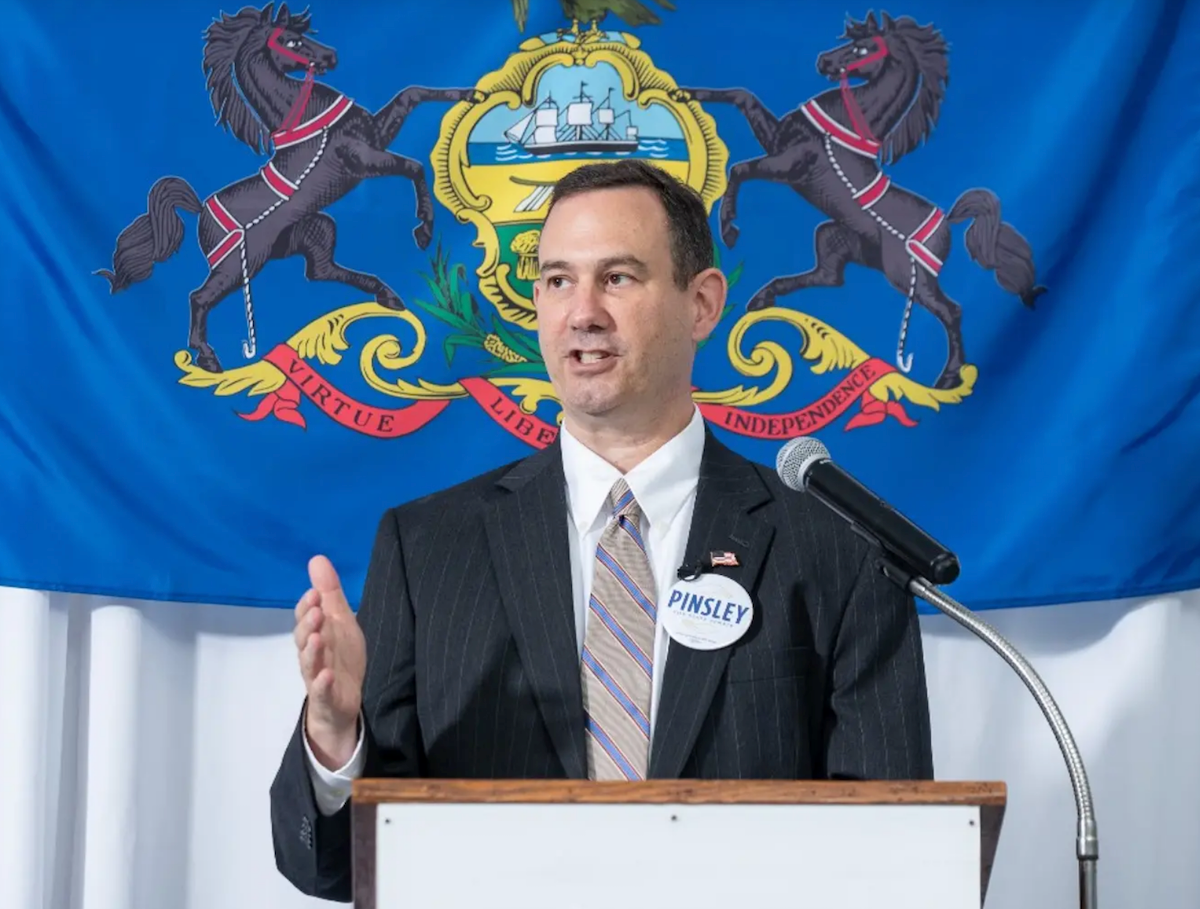
Mark Pinsley
Website
Pinsley graduated from Northeastern University and the Kelley School of Business at Indiana University. He is a U.S. Army Reserve veteran who has owned and run businesses for three decades.
He served as a commissioner in South Whitehall Township, and unsuccessfully ran for state Senate in 2018 and 2022.
Pinsley is currently Lehigh County controller, a position he won for the first time in 2019. He won reelection last year before announcing his campaign for state office on Dec. 1.
In that role, Pinsley has developed a reputation as a progressive. For example, he pitched moving county money out of Wells Fargo because its political action committee donated to anti-abortion candidates. (In an email, Pinsley said the county released a request for proposals but none of the vendors “had both the necessary insurance coverage and abstained from political donation.” The county is still banking with Wells Fargo, though Pinsley said, “We managed to reduce our fees by approximately $100,000.”)
Pinsley provides other highlights of his tenure as county controller on his campaign website, including an investigation into what he called the “systemic overdiagnosis” of medical child abuse (formerly known as Munchausen syndrome by proxy) in the area.
“My resume and my record are beyond question, and the Republican Party won’t be able to paint me as extreme or unqualified,” Pinsley told the Pennsylvania Capital-Star. “… I am the only candidate who knows the job, has done the job, and can win the job.”
As Pennsylvania’s auditor general, Pinsley says he will “audit for impact,” which he defines as helping citizens, enforcing policy, and eliminating waste, in addition to acting as a financial watchdog.
Pinsley says his top goals as auditor general include:
- Conducting a “sweeping, comprehensive audit” of the Pennsylvania public education system, which he called “terribly underfunded.”
- Evaluating county election departments and the support they receive from the state to “ensure Pennsylvania invests in and rigorously defends democracy.”
- Looking at the effectiveness of the state’s workforce development programs.
- Finding savings in state health care spending.
Pinsley has said that as auditor general he wants to prevent state money from being spent at companies that support anti-abortion causes, audit wage theft, and study the economic impact of gun violence.
In February, the Morning Call and The Inquirer reported that Pinsley’s campaign had submitted nominating petitions that contained allegedly forged signatures, including those of several elected officials.
In an email to Spotlight PA, Pinsley said no objections had been raised with the Department of State.
“Certain individuals have chosen alternative avenues to voice their concerns, seemingly bypassing the formal process and using the media as their primary source to issue complaints,” he said. “The deviation from formal procedures raises questions regarding the genuine intent behind these actions, leading us to believe their motivations may extend beyond a sincere desire to address the issues. Instead, garnering media attention may be the primary objective.”
His Democratic opponent, state Rep. Malcolm Kenyatta, has accused Pinsley of racism — a claim Pinsley said is without merit.
In a Ring video that circulated on social media, Kenyatta is seen telling a constituent, “There’s the guy Mark Pinsley, who I told you don’t like Black people.”
The video was recorded inside the home of the mother-in-law of one of Kenyatta’s former state House challengers, according to the Pennsylvania Capital-Star. That candidate, Jon Hankins, was recently removed from the primary ballot following a residency challenge.
In a statement to news outlets, Kenyatta did not explain the basis for the accusation, instead calling the video “dirty political tricks.” Pinsley said the accusation is false and told Lehigh Valley News that it “doesn’t show good temperament.”
Endorsements: VoteVets; Parents’ Medical Rights Group.



The chorus for the song “Primary Colors” was something Walsh wrote years ago, with the song’s outro originally being used as a verse.
“And something just wasn’t quite clicking, and everything that I tried felt kind of forced,” Walsh said. “We were all just like, ‘Yeah, there’s something here, but it’s not quite doing what I think it has the potential to do.’”
The band then started toying with the dynamics between the verses and the chorus.
“It just unlocked something for me in the idea where I was like, ‘Wow, this kind of quiet, loud, quiet, loud format really works well with this song,’” Walsh said. “So yeah, it just transformed it instantly into an idea that felt a lot stronger.”
The album was recorded with Grammy-winning producer Will Yip, a relationship still budding from their 2014 album, “Charmer.” Collins said the new album’s sound is “as true as we could be to playing the record live.”
“I wasn’t as tied to the tones that have classically been Tigers Jaw because I think at this point, I’ve just come to this realization that no matter what, if we’re making it, it is Tigers Jaw,” Collins said.
The new album has a “palpable energy” that shares the same spirit as their earlier records, Walsh said. And while “tastes evolve,” the band followed “what feels good.”
“This is the best representation of the band at the time, and it’s almost like a snapshot of us as artists, as people, as a creative entity over this time in our career,” he said.
“Lost On You” is out now through Hopeless Records and is available on vinyl, CD and various streaming platforms.
On April 16, Tigers Jaw will perform at Union Transfer at 8 p.m. They will be supported by Hot Flash Heat Wave and Creeks, the solo project of Balance and Composure vocalist and guitarist Jon Simmons, who is from Doylestown, Pennsylvania.
Pennsylvania
Pennsylvania court upends mandatory use of life-without-parole for second-degree murder

What to Know
- Pennsylvania’s Supreme Court says the state cannot automatically give life without parole for felony murder without weighing each defendant’s culpability in the killing.
- The high court on Thursday ordered a new sentencing hearing for Derek Lee over a second-degree conviction, but paused it for four months to give state lawmakers time to consider legislation in response.
- Pennsylvania law has made people liable for second-degree murder if they participated in an eligible felony that led to death. Life with no possibility of parole has been the only possible sentence.
- The court says the current rule treats a lookout the same as the person who kills.
Pennsylvania’s high court on Thursday overturned the use of automatic life sentences without parole for people convicted of second-degree murder, saying it violates the state’s constitutional ban on cruel punishment when imposed without a closer look at the defendant’s specific role and culpability.
The court majority ordered resentencing in the case of Derek Lee, convicted of a 2014 killing in Pittsburgh, but the decision also has implications for others among the roughly 1,000 other inmates currently serving similar second-degree murder sentences.
The court’s order was put on hold for four months to give the General Assembly time to “consider appropriate remedial measures.” In a footnote, the justices said they were ruling on Lee’s sentence and not addressing “questions of retroactivity.”
Prison reform groups hailed it as a landmark decision, while the Allegheny County district attorney’s office said it will follow the court’s order.
Pennsylvania law has made people liable for second-degree murder if they participated in an eligible felony that led to death, and life without parole has been the only possible sentence.
“The mandatory penalty scheme of life without parole for all offenders convicted of second degree murder fails to assess individual culpability regarding the intent to kill, and mandates the same punishment regardless of that culpability,” wrote Chief Justice Debra Todd in the lead opinion. She characterized it as not distinguishing “between the lookout, and the killer who pulls the trigger.”
The state high court’s decision comes after years of advocacy to undo mandatory life without parole sentences both in Pennsylvania and nationally. Nazgol Ghandnoosh of the Washington-based Sentencing Project said she counts 11 states and the federal system as having such laws for that kind of crime, sometimes called felony murder. Several states — California, Colorado and Minnesota — have moved away from that sentencing framework in recent years, she said.
Justice Kevin Dougherty noted in a separate opinion that unlike those convicted of first-degree murder, defendants serving life without parole for second-degree murder have “never been found by a judge or jury to have harbored the specific intent to kill” and may not have had “any involvement whatsoever with the actual killing. He or she does not even have to expect or foresee that a life may be taken.”
Lee’s lawyers had wanted the court to rule that life without parole sentences are unconstitutional for all second-degree murder convictions in Pennsylvania, said Quinn Cozzens, a staff attorney for the Abolitionist Law Center, which helped represent Lee. Instead, the court ruled that trial judges must examine the individual circumstances of a defendant’s case to decide which sentence is most appropriate, including the potential of life without parole.
The state’s public defenders’ association said the ruling will generate new post-conviction litigation and require them to do more investigation as well as develop “strategic litigation” to get the decision to apply retroactively.
A jury convicted Lee of second-degree murder but acquitted him of first-degree murder in 44-year-old Leonard Butler’s shooting death. Butler was shot in a struggle over a gun with Lee’s codefendant, Paul Durham.
Prosecutors argued it should be up to state lawmakers and the executive branch to address the policy issues surrounding second-degree murder sentences. Todd wrote that while the district attorney’s office “acknowledges that there may be persuasive arguments why a non-slayer should not be held to the same degree of culpability as the slayer, it stresses that these are policy decisions for the General Assembly.”
Cozzens urged lawmakers to “address this constitutional violation, given that the court granted them the opportunity to do so.”
Rep. Tim Briggs, a suburban Philadelphia Democrat who chairs the state House Judiciary Committee, said he planned to engage with Senate Republicans on potential legislation in response.
Briggs said he wanted to have decision apply retroactively, to give people serving life “for being the getaway driver” to “have the opportunity to have their facts looked at again.”
“I think inaction leaves a lot of this up to the courts to decide. I don’t feel comfortable doing that,” Briggs said. “We have a policymaking role here.”
Justice Sallie Mundy wrote that Lee “willingly participated in an armed home invasion and robbery, and purposefully engaged in assaultive behavior in the form of tasing and pistol-whipping the victim.” She said Lee and Durham “arguably kidnapped the victims by forcing them into the basement” and it will be up to the county judge to decide if Lee’s life-without-parole sentence is appropriate.
Todd’s opinion, citing an advocacy group, said 73% of those convicted of felony murder in Pennsylvania were 25 or younger when the killing occurred and almost 70% are Black people.
Pennsylvania Governor Josh Shapiro also responded to the ruling on X.
Today, Pennsylvania’s Supreme Court ruled that mandatory life sentences without the possibility of parole for second degree murder are unconstitutional.
I have long believed this law is unjust and wrong. As Governor, I took legal action in this case arguing to strike down this…
— Governor Josh Shapiro (@GovernorShapiro) March 26, 2026
Pennsylvania
Teen boys in Pennsylvania get probation after using AI to create fake nude photos of classmates

LANCASTER, Pa. — Two teenage boys who used artificial intelligence to create fake nude photos of their classmates at an exclusive private school in Pennsylvania received probation Wednesday after dozens of victims described the images’ traumatizing effect on them.
The boys were 14 at the time. They admitted this month that they made about 350 images, showing at least 59 girls under 18, along with other victims who so far have not been identified.
Authorities said the boys took images of the girls from school photos, yearbooks, Instagram, TikTok and FaceTime chats in 2023 and 2024, and morphed them with images of adults depicting nudity or sexual activity.
More than 100 students and parents from Lancaster Country Day School were in court to hear victims describe the shock of having to identify their own faces in pornographic photos to detectives. Juvenile proceedings in Pennsylvania are normally closed, but this was opened by the judge, providing an unusual opportunity for the community to be seen and heard.
The girls described the fallout — anxiety attacks, a loss of trust, problems focusing on schoolwork and a fear that the images may someday surface in unexpected ways.
The two young men stood stone-faced throughout, flanked by their lawyers and parents, as they were called pedophiles, “sick and twisted” and perverted.
“I will never understand why they did this,” one victim told Judge Leonard Brown, saying it “destroyed my innocence.”
One young woman told Brown “how excruciating it is to bring these feelings up again and again.” Another choked back tears as she excoriated one of the defendants for expressing “fake empathy” as girls confided with him about their pain, before it became known that he had been part of creating and disseminating the images. Still another said all of her friends transferred schools, and that she “needed trauma therapy to even walk around my neighborhood.”
The defendants declined several opportunities to comment to the judge, who said he had not heard either boy take responsibility or apologize.
“This has been a regrettable, long, torturous process for everyone involved,” said Heidi Freese, defense attorney for one of the defendants. “There were very interesting, underlying legal issues surrounding the charges in this case and those will be decided on a different day in a different case.”
Brown ordered each to perform 60 hours of community service, have no contact with the victims and pay an unspecified amount of restitution. If they don’t have any additional legal problems, Brown said, the case can be expunged after two years.
As he imposed his sentence, Brown said that if they were adults, they probably would be headed for state prison. He said they should “take this opportunity to really examine” themselves.
The resolution of the Pennsylvania case comes days after three teenagers in Tennessee sued Elon Musk’s xAI, claiming the company’s Grok tools morphed their real photos into explicitly sexual images. The high school students are seeking class-action status to represent what the lawsuit says are thousands of people who were similarly victimized as minors.
The scandal in Pennsylvania led to a student protest, criminal charges against the two teenagers and the departure of leaders at the school, which says it has about 600 students K-12, class sizes averaging just 12 kids, and “an endowment in excess of $25 million.”
Nadeem Bezar, a Philadelphia lawyer who represents at least 10 of the victims, said Tuesday he expects to file a claim “against the school and anybody else we think has culpability in these deepfakes being created and disseminated.”
He said he has not yet seen the photos but expects the legal process to determine “exactly when and where and how the school knew, how the boys created these images, what platforms they used to create these images and how they were disseminated.”
As AI has become accessible and powerful, lawmakers across the country have passed laws aimed at barring deepfakes.
President Donald Trump signed the Take it Down Act last year, making it illegal to publish intimate images including deepfakes without consent, and requiring websites and social media sites to remove such material within 48 hours of being notified by a victim.
Forty-six states now have laws addressing deepfakes, with legislation introduced in the remaining four — Alaska, Missouri, New Mexico and Ohio — according to the consumer advocacy group Public Citizen.
___
Associated Press writers Geoff Mulvihill in Haddonfield, New Jersey, and Holly Ramer in Concord, New Hampshire, contributed.

Retired Detroit sergeant faces new sexual assault charge involving 14-year-old victim from 2002

Trump floats sending federal agents to San Francisco to tackle crime

Dallas ISD will offer free pre-K starting next school year

Norwegian Cruise Line offers a first look at Luna, new cruise ship setting sail from PortMiami – WSVN 7News | Miami News, Weather, Sports | Fort Lauderdale

Boston ‘No Kings’ rally expected to draw 100,000; others planned across Mass.

Florida High School Football Rankings: Top 25 teams – Oct. 21

How old is Bo Nix? What to know about Oregon quarterback ahead of 2024 NFL Draft

Cleary's 21 help Le Moyne down Central Connecticut State 69-64 in OT

99th annual Pony Swim held in Virginia

Indiana Members Credit Union announced as new anchor tenant at Bottleworks District

Video: Will ICE Change Under Its New Leader?

DHS shutdown breakthrough comes at cost for Republicans as funding fights nears end

Rubio joins crucial G7 talks as Iran war set to dominate second day

A surprise resignation could open the door for an independent to win a Montana Senate seat

Video: Savannah Guthrie Says She Believes Her Mother Was Taken for Ransom
-

 Detroit, MI1 week ago
Drummer Brian Pastoria, longtime Detroit music advocate, dies at 68
-

 Science1 week ago
How a Melting Glacier in Antarctica Could Affect Tens of Millions Around the Globe
-
 Science1 week ago
I had to man up and get a mammogram
-

 Movie Reviews1 week ago
‘Youth’ Twitter review: Ken Karunaas impresses audiences; Suraj Venjaramoodu adds charm; music wins praise | – The Times of India
-

 Sports6 days ago
IOC addresses execution of 19-year-old Iranian wrestler Saleh Mohammadi
-

 New Mexico5 days ago
Clovis shooting leaves one dead, four injured
-
 Business1 week ago
Disney’s new CEO says his focus is on storytelling and creativity
-

 Technology5 days ago
YouTube job scam text: How to spot it fast