Northeast
NYPD officers entangled in crypto torture case after Bitcoin investor escaped from townhouse of horrors

NEWYou can now listen to Fox News articles!
Two New York Police Department officers could find themselves in hot water over potential connections to a shocking case of torture in the stately SoHo district of Manhattan.
The NYPD confirmed to Fox News Digital that its officers “were modified” and “the matter is under internal review.”
The issue involves two detectives, one of whom reportedly served on Mayor Eric Adams’ security detail, the New York Post reported.
The case at the heart of the scandal is tied to two men who allegedly tortured an Italian cryptocurrency millionaire in a New York City townhouse.
CRYPTO INVESTOR ACCUSED OF SADISTICALLY TORTURING BIZ PARTNER IN NYC LUXURY TOWNHOUSE
Jessica Tisch speaks after being sworn in as the next Commissioner of the New York Police Department (NYPD) during a ceremony at One Police Plaza on Nov. 25, 2024, in New York City. (Spencer Platt/Getty Images)
One detective is suspected of driving the alleged victim, a 22-year-old Italian Bitcoin millionaire, from the airport to the townhouse where the savagery occurred on the day he arrived in New York, according to the Post. The other is accused of working with the man’s alleged captors, John Woeltz and William Duplessie, in an “unauthorized capacity.”
Woeltz, 37, and Duplessie, 33, are accused of kidnapping the man, a former business partner, on May 6 and torturing him when he refused to reveal his Bitcoin password. A criminal complaint obtained by Fox News says the brutality lasted for nearly three weeks.
John Woeltz was arrested at his SoHo townhouse. (WNYW)
The pair allegedly shocked the man with electric wires, bashed his head with a firearm, pointed a firearm at his head and threatened to kill him and his family, and hung him over a second-floor ledge.
Eventually, the man escaped the residence and flagged down a traffic cop.
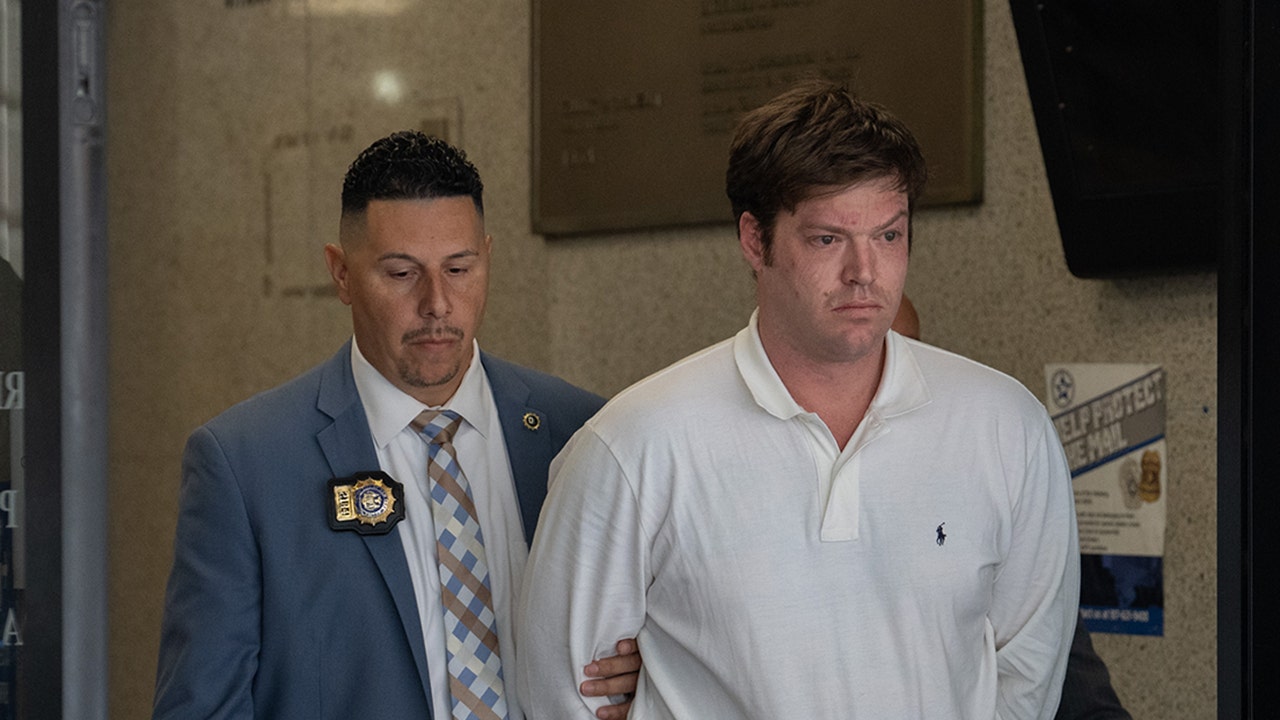
John Woeltz and William Duplessie have been charged with kidnapping after police say an Italian tourist was allegedly held hostage and tortured for his crypto account information inside a SoHo townhouse. (Julia Bonavita/Fox News Digital)
Both suspects have now been charged with assault, kidnapping in the first degree, unlawful imprisonment in the first degree and criminal possession of a firearm.
2ND SUSPECT DETAINED AFTER CRYPTO INVESTOR ACCUSED OF TORTURING BUSINESS PARTNER IN NYC
William Duplessie is pictured in police custody leaving the NYPD’s 13th Precinct stationhouse in Manhattan, New York, on Tuesday, May 27, 2025. (Barry Williams / New York Daily News via Getty Images)
Woeltz was arrested last Friday, just after the man escaped. Duplessie turned himself in on Tuesday.
The latter reportedly appeared in front of a judge in a Manhattan courtroom Friday, waiting to be officially indicted. He is being held without bail.
Fox News’ Michael Dorgan and Greg Norman contributed to this report.
Read the full article from Here


WALLINGFORD, Conn. (WFSB) – The Connecticut Department of Transportation is marking two years since the death of Andrew DiDomenico, a DOT worker killed in a work zone crash on June 28, 2024, in Wallingford.
DiDomenico, 26, of Meriden, was struck and killed while working along the shoulder of the Wharton Brook Connector of Interstate 91.
Denise Lucibello, 55, of East Haven, was driving under the influence when her vehicle left the roadway and struck him, according to the state’s attorney’s office.
Lucibello was sentenced to 10 years in prison, execution suspended after five years served, followed by five years of probation. She pleaded guilty to second-degree manslaughter and operating a motor vehicle under the influence.
“The defendant chose to drive under the influence and because of that choice, a young life full of promise was senselessly taken,” State’s Attorney John P. Doyle Jr. said.
DiDomenico’s family started the Andrew DiDomenico Memorial Foundation to honor his legacy and provide scholarships and donations in his name.
CT DOT continues to remind drivers to keep others in mind on the road and themselves.
“Roadside workers put themselves at risk every time they step onto a job site, and it’s on all of us to keep them safe. Drive sober, put the phone away, and slow down and move over in work zones. Lives depend on it.”
Copyright 2026 WFSB. All rights reserved.

Purchase this image
FREEPORT — Flo Edwards and Alexus Bond have been shucking oysters under a tent and serving them to mollusk enthusiasts from all over the country for three days.
Their bounty is helping the 5th annual Maine Oyster Festival reach a new record for oyster sales, which is predicted to be well over last year’s 40,000.
The event started in 2021, when a group of oyster farmers approached Visit Freeport to ask about a statewide oyster festival, lead planner Margaret Hoffman said.
“They really desired to have a festival in Maine that was free and open to the public, low cost, broke down barriers, because people think oysters are this kind of exclusive thing that you can only eat in fancy restaurants,” Hoffman said. The farmers also wanted an event that welcomed farmers from anywhere in Maine.
Dozens of restaurants, artists and marine specialists take over the parking lot behind the iconic L.L. Bean flagship store in Freeport. At any given time during the three-day event, 20 of these tents represented oyster farms.

Purchase this image
“The best office I’ve ever worked in is out on the water during the daytime,” Edwards — whose main gig is dentistry — said. She and Bond, a logistician, started their business, Indigo Oyster Co., three years ago.
Indigo is a two-woman job, the lifelong friends said. They had spent years bonding over their shared love of oysters until one day they asked each other: “Should we try this?” Then, they started their farm in Yarmouth.
“Usually women who look like us are in the factories where they’re just shucking or canning, like not taking part in the ownership,” Bond said.
They chose the name “Indigo” because it honors Bond’s Asian heritage and Edwards’s African heritage. Taking the leap to launch a life on the water meant an opportunity to highlight women and people of color — two underrepresented populations in oyster farming, Bond said.
This was their first year at the festival, and it went well. Some visitors even saved their last oyster ticket to return to the booth, labelling Indigo oysters as their favorite of the weekend.
Hoffman said turnout this year has been great thanks to the weather and the offerings, with some farms selling out on the second day of the festival. She met one woman who said she had driven from Arizona just for the event.

Purchase this image
Freeport welcomed farmers and educators from as far south as Eliot, and as far north as Brooksville, all eager to teach visitors about the world of oyster farming.
Most oyster farmers in Maine use a top culture method, where oysters are harvested in a cage at the surface of the water. Top culture harvesting is relatively fast, and produces small oysters, said John Clapp, the owner of Mimi’s Oysters.
“We’re really focused on dive harvesting and working on our bottom sites,” Clapp said. They are one of a few farms in the state that uses both top and bottom culture.
All of Mimi’s oysters spend an entire season on the surface, but the largest get planted directly on the bottom where they grow for another two years. Bottom culture makes for a bigger oyster and a more complex flavor palate, Clapp said.
“Despite the extra time that it takes to get there, we feel that the, you know, the more time you spend with the oyster, the better product that you’re getting in the end,” he said.
Clapp and his team came to the festival with 4,000 oysters. After selling 2,400 on Saturday, the crew was confident they’d sell out of their remaining 1,600 Sunday.
Between sampling dozens of oysters, browsing the goods for sale and listening to live music, visitors had the opportunity to watch the festival’s culminating event on Sunday; an oyster shucking competition.

Purchase this image
No two oysters are the same, and no one knows that better than the professional shuckers who competed this year.
Spectators gathered as Kelly Punch, Firat Kocan and defending champion Chad Michael Egeland carefully slid their shucking knives between each oyster shell. Any leftover grit or cracks in the shell resulted in a penalty.
Egeland finished first, followed by Kocan and Punch. After a few minutes of inspection, judges wrote down final scores on the lid of a paper takeout box, crowning Egeland winner for the second year in a row.
The oysters were slightly dry and gave the competitors some trouble this year, Egeland — who is also the raw bar sous chef at Portland’s Scales — said. But, he couldn’t be happier with his win.

Norman Rockwell painted Stockbridge so often that the real Main Street now looks like one of his canvases come to life. That is the trick these Massachusetts towns pull off. A whaling-era cobblestone lane on Nantucket and a Revolutionary common in Concord do the same thing in different accents. Each one packs its best landmarks into a few blocks you can cover on foot. The eight New England streets here all sit under 50,000 residents and earn their reputation the honest way.
Stockbridge
Fewer than 2,000 people live in Stockbridge, yet its Main Street may be the most recognizable in the state. Credit Norman Rockwell, who lived here and painted the view down the street so many times it lodged in the national memory. The white clapboard buildings, the old inns, and the big shade trees are all still right where he left them, and people still use them.
The Red Lion Inn has welcomed guests on this corner since 1773, and its long front porch is the street’s anchor in every sense. A short walk away, the Norman Rockwell Museum holds the largest collection of his work and even his relocated studio. Naumkeag adds a Gilded Age cottage with terraced gardens climbing the hillside. Come December, the town recreates Rockwell’s famous “Main Street at Christmas” scene with vintage cars parked along the curb, which is about as close as a real place gets to stepping into a painting.
Lenox

Edith Wharton built her dream house just outside Lenox, and the writer’s eye for proportion seems to have rubbed off on the whole town. The center is small enough to park once and walk, with bookshops, cafes, and galleries shoulder to shoulder under the trees. Under 10,000 people live here, and the place wears its Berkshire elegance lightly.
The Mount, Wharton’s 1902 estate, runs as a house museum and public garden and hosts readings and outdoor events all summer. Ventfort Hall, a Jacobean-style mansion built for a sister of J.P. Morgan, fills in more of the Gilded Age story. Just up the road, Tanglewood draws crowds every July and August as the summer home of the Boston Symphony Orchestra, so a quiet shopping street can be ten minutes from a world-famous concert lawn. Few towns this size balance that kind of culture against that little traffic.
Concord
On April 19, 1775, the shot heard round the world was fired a short walk from where Concord shoppers now buy their morning coffee. That is the strange gift of this town. Its pretty village center sits below 20,000 residents, and its old houses, churches, and civic buildings look calm until you remember what happened among them.
Minute Man National Historical Park preserves the battle road and the fields where colonial militia turned back British regulars. Old North Bridge marks the spot itself, with Daniel Chester French’s Minute Man statue standing guard. Concord also raised more than its share of writers, and Louisa May Alcott’s Orchard House, where she wrote “Little Women,” still opens for tours. Two miles south, Walden Pond holds the woods Thoreau made famous, an easy swim or walk that closes the loop between the town’s history and its quieter ideas.
Marblehead
The streets in Marblehead’s Old Town were laid out for foot traffic and fishing nets, not cars, so they bend and narrow and dead-end at the water. The town tops 20,000 residents now, but the historic core feels far older and more intimate. Washington Street and the lanes around it run past brick sidewalks and preserved houses, with the harbor flashing into view between rooftops.
The Jeremiah Lee Mansion, a grand Georgian house built in 1768 for the wealthiest merchant in colonial Massachusetts, still keeps its original hand-painted English wallpaper. Old Burial Hill rises above town with weathered colonial gravestones and one of the best harbor views around. Abbot Hall, the brick town hall with the clock tower, houses the original “Spirit of ’76” painting. Walk the waterfront and the reason for the whole town becomes obvious. Marblehead grew up facing the sea, and it never turned away.
Newburyport
Federal-era sea captains built their fortunes at the mouth of the Merrimack, and their three-story brick blocks still line the streets of downtown Newburyport. The Main Street feeling here spreads across several streets rather than one. Under 20,000 residents keep the center humming, with shops and restaurants filling old facades right down to the riverbank.
Market Square and State Street form the heart of it, a tight grid of brick that survived a great fire and a wave of 1970s urban renewal to come out the other side intact. The Custom House Maritime Museum, set in a granite 1835 building, tells the port’s seafaring story. Waterfront Park gives you a bench and a view of the boats. A few miles out on Plum Island, the Parker River refuge at Joppa Flats turns the same trip into prime birdwatching, so a downtown afternoon can end with herons instead of storefronts.
Rockport
A plain red fishing shack on a granite pier may be the most painted building in America, and it sits right in Rockport’s harbor. Locals call it Motif No. 1, after an art teacher who got tired of seeing his students paint it. The town runs under 10,000 residents and folds its best parts into a few tight blocks by the water.
Main Street leads to Bearskin Neck, a skinny peninsula crammed with galleries, candy shops, and lobster shacks that ends with the open Atlantic. Front Beach puts sand and water within a short stroll of the shops. The Shalin Liu Performance Center, opened in 2010, built a concert hall with a wall of glass behind the stage, so the ocean becomes the backdrop for a string quartet. You can wander from a storefront to a harbor view to a gallery without ever breaking stride.
Great Barrington
Great Barrington wired the first downtown in the world lit entirely by alternating current, back in 1886, and the place has kept that forward lean ever since. Under 10,000 residents fill a center that feels genuinely busy, with restaurants, bookstores, and galleries spread along Main Street and Railroad Street. It looks like an old Berkshire town and behaves like a young one.
The Mahaiwe Performing Arts Center, a restored 1905 theater, books films, concerts, and live broadcasts year-round. The Housatonic River Walk threads a half-mile greenway along the water right behind Main Street, the work of volunteers who spent decades clearing a once-polluted bank. Just outside town, Monument Mountain offers a short climb to a quartzite ridge and a long view over the Housatonic River valley, the same trail Herman Melville and Nathaniel Hawthorne hiked together in 1850.
Nantucket
Whaling money built Nantucket’s Main Street, and the cobblestones laid to keep wagon wheels out of the mud are still there to rattle your suitcase. The island stays well under 50,000 year-round residents even at the height of summer. Brick sidewalks, weathered shingles, and window boxes give the downtown the texture of an old port rather than a new outdoor mall.
The Whaling Museum, set in an 1847 candle factory, explains how a small island once lit the lamps of the world, right down to a full sperm whale skeleton. Brant Point Lighthouse marks the harbor entrance and ranks among the most photographed beacons in New England. Straight Wharf keeps the working waterfront within steps of the shops, and the Oldest House, built in 1686, anchors the streetscape in the island’s first century. Every detail down to the gray shingles seems to point back to the same seafaring story.
Massachusetts Main Streets Worth Slowing Down For
What ties these eight together is not a shared look but a shared honesty. Stockbridge and Lenox lean on Berkshire culture, Concord carries the weight of 1775, and Great Barrington keeps reinventing itself. Marblehead, Newburyport, Rockport, and Nantucket all grew up facing salt water and never lost the habit. The best Main Streets here are not stage sets. They are working downtowns that happen to be worth a long, slow look.
-
 Alaska4 minutes ago
Mat-Su Initial Attack Responding to Fire in Flat Lake
-

 Arizona11 minutes ago
NFL power rankings: Arizona Cardinals are in lowest tier
-

 Arkansas14 minutes ago
Arkansas Storm Team Forecast: Triple-digit heat here to stay
-

 California19 minutes ago
At least 117 dead dogs found in search at California animal rescue accused of abuse, officials said
-

 Colorado26 minutes ago
Here’s the latest on fires burning in western Colorado
-

 Connecticut29 minutes ago
2 years since DOT worker, Andrew DiDomenico was killed in Wallingford work zone crash
-

 Delaware34 minutes ago
Top Democrat lawmaker suffers minor injuries in Delaware car crash
-

 Florida41 minutes ago
Florida woman dies when SUV rolls backward in Port. St. Lucie driveway

