Northeast
NY prosecutors scour social media accounts of man arrested near airport with massive cache of weapons

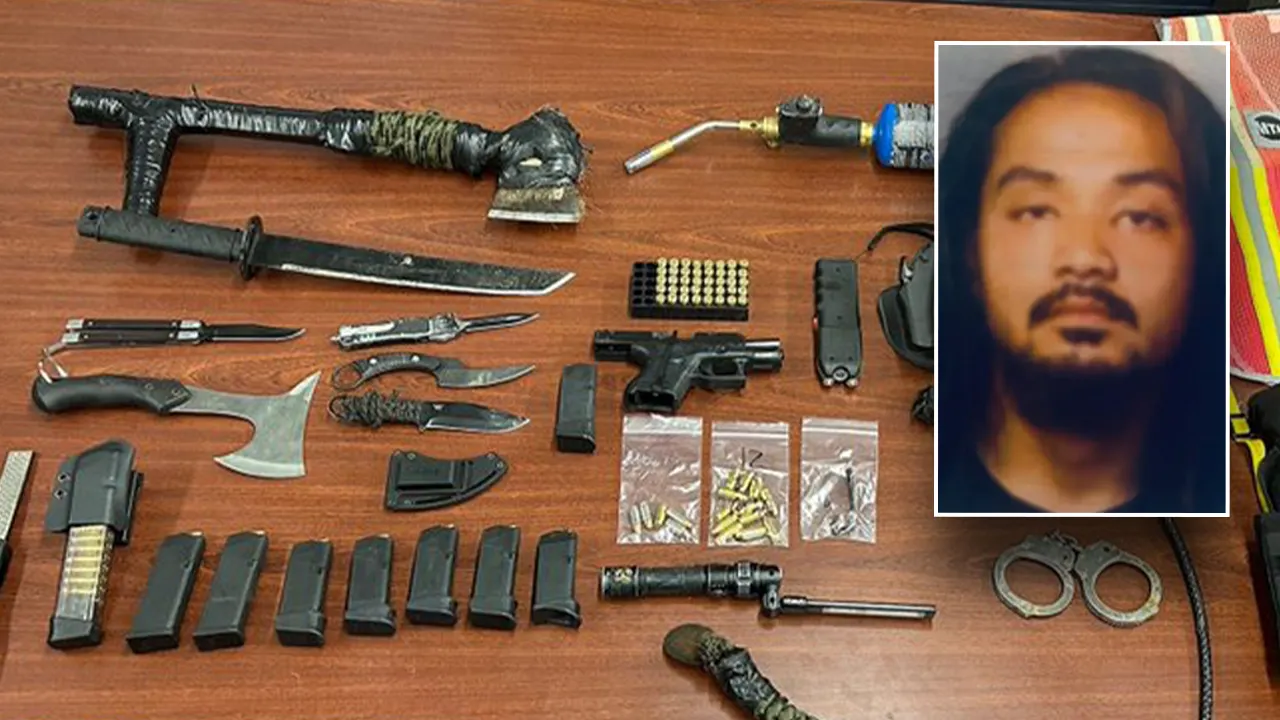
New York authorities are looking at social media accounts to ascertain the motivation of a Queens man pulled over with an arsenal of weapons and NYPD uniform items just blocks from LaGuardia International Airport.
Judd Sanson, 27, was arrested Wednesday on multiple illegal weapons charges after police say they recovered a 9 mm Glock handgun, nine loaded magazines, 179 rounds of ammunition, heavy body armor, handcuffs, a stun gun, multiple knives, a makeshift sword, a weighted whip, an expandable baton and two axes.
Police also recovered a Guy Fawkes mask, which is sometimes used as an anti-government symbol, an orange MTA vest and an NYPD bulletproof vest.
Thomas Montella of Queens Defenders, Sanson’s lawyer, said at Sanson’s arraignment Thursday this was, “at the end of the day, a gun case,” the New York Post reported. But his client was sent to Rikers Island without bail.
NYPD ARRESTS MAN ARMED WITH HANDGUN, BODY ARMOR, AXES AND KNIVES AT TRAFFIC STOP IN QUEENS
Judd Sanson is pictured at his arraignment in Queens Criminal Court Thursday. He was in custody without bail at Rikers Island. (Shawn Inglima/Pool)
District Attorney Dylan Nesturrick said police “averted what could have been a disaster for the citizens of Queens, New York City and potentially even the country” when they pulled Sanson over for an illegally blacked-out license plate.
Investigators found a “disturbing photo” on the man’s Facebook page, Nestrurrick said without elaboration.
“We are asking for social media,” Queens District Attorney Melinda Katz told reporters Thursday. “We’re going to look at what he said on social media. We’re going to look at the computers. We’re going to actually find out what his intent is.
“When someone is driving around with 11 different weapons, all of this ammunition, language on the baton that sounds threatening … transit uniforms that can be used almost anywhere in our subway system or in our transit system, we have reason to be concerned.
ELDERLY WOMAN STRUCK BY STRAY BULLET OUTSIDE HER BROOKLYN APARTMENT
Officers conducted a vehicle stop in Queens and recovered a 9 mm Glock handgun along with nine loaded magazines, heavy body armor, handcuffs, NYPD uniform items, two axes, multiple knives, a weighted whip and an expandable baton. (NYPD NEWS)
“A lot of [the weapons were] makeshift, so that he was making them. So, there is thought that goes into that. … It’s not just that you throw a weapon in a car,” Katz added.
Katz also mentioned troubling words inscribed on Sanson’s recovered baton:.”You left me no choice, I am sorry, You gon [sic] learn today,” it allegedly says with the Arabic word for “God forgive me.”
“At the moment, we don’t have terrorism charges, but we are still continuing the investigation, especially considering the language that was used,” Katz said. “We’re prosecuting right now for gun possession and for the intent to use that gun. And we are going to continue this investigation to make sure that we are safe. About his mental state.”
FEDERAL INMATE CAUGHT RUNNING BLACK MARKET MACHINE GUN TRADE BEHIND BARS, AUTHORITIES SAY
Suspect Judd Sanson, 27, was arrested on charges of criminal possession of a loaded firearm, nine additional charges of criminal possession of a weapon, four charges of unlawful possession of an ammo-feeding device and one charge of having an obscured license plate. (Fox News)
Katz declined to comment on Sanson’s social media posts but said a search warrant had been executed at the man’s father’s home and that there was a lockbox for a weapon with a serial number that didn’t match any of the guns found by police in the vehicle.
“As a result of that search, (there is) a weapon that we have not found yet,” she said.
Katz also said she and her office were unaware of Sanson having a gun license.
Former New York Homeland Security adviser Michael Balboni walked Fox News Digital through the process of investigating a potential terrorist on social media.
“They’re going to go to his social media accounts and see who he’s in contact with,” Balboni said. “There are all sorts of groups that have already been identified that have targeted transportation networks. They’re going to see if he was in touch with any of those individuals.
“They’re also going to see if there are any plans — verbal, sketched out, schematics — like how you would reach a secure terminal of [the airport].
“[They] want to know not only who he is in contact with. Has he received any training? Has he visited any gun ranges? Has he had any prior arrests involving incendiary devices, explosives, firearms? Those are the things [they] want to know so [they] can develop a profile to see if this individual has a violent history or violent motivations.
“This obviously has an indication that he’s not going to the mall to go shopping, that he is, in fact, trying to do something nefarious. That’s a reasonable perception,” Balboni added. “But you let the facts lead you. You don’t get any preconceived notions. Everyone has a right to be judged by a jury of their peers. … You can’t jump and say this guy is a terrorist.”
The FBI declined to comment on whether it was involved in the investigation. Fox New Digital could not reach the Department of Homeland Security for comment before press time.
Fox News Digital’s Chris Pandolfo contributed to this report.
Read the full article from Here


The World Cup economic windfall boosting Boston gives rise to a question: Could the Hub host the Olympics?
Certainly Bostonians have more than risen to the occasion in terms of welcoming international visitors to our city and showing them a good time (and vice versa, Tartan Army). But it takes more than great hosts and a convivial atmosphere to pull off an epic sporting event.
It takes money, lots of it, political transparency, and a process open to public scrutiny and feedback. In other words, no, we couldn’t.
Public reception to the 2014 Olympics bid was tepid at best, as it would entail multiple construction projects. And when big construction projects are presented in Boston, taxpayers get suspicious. Big Dig, anyone?
Boston 24 announced it estimated the Games would produce at least $4.8 billion in revenues from television broadcast rights, ticket sales, corporate sponsorships and other revenues, the Associated Press reported. They assumed nearly $4.6 billion in costs, including $176 million for a temporary Olympic Stadium, $90 million for the athletes’ village, about $754 million to build other Olympic venues and another $132 million to rent other locations.
They reportedly announced all this to answer critics who said the privately funded Boston 2024 withheld details of the bid to prevent the public from assessing whether the Games could be staged, as promised, without the need for taxpayer money.
We learned the answer to that soon enough.
In this case, as the Herald reported that year, details from Boston 2024’s so-called bid book indicated that plans sent to the U.S. Olympic Committee called for the Hub to fund “land acquisition and infrastructure costs” at Widett Circle, where a temporary Olympic stadium was being proposed. It came after months of promises that the group planned to run a privately funded Olympics.
“They’ve been saying for months, ‘No taxpayer (money),’ ” said Evan Falchuk, a vocal bid critic who pushed for a statewide ballot question on hosting the games. “Then you read what they told the USOC. … It’s a devastating blow to their credibility. There’s a reason why voters don’t trust what they’ve heard and (Boston 2024 has) got a lot of work to do to earn that trust.”
And all this talk of money came before any cost overruns made an appearance. London’s budget for the 2012 Summer Games escalated by about 300%, ending somewhere in the $14 billion range. What were the chances we’d fare any better?
No wonder Bostonians gave the Olympics idea the cold shoulder.
But what of the city’s World Cup success story? For starters, Gillette Stadium is already built, and the only large element requiring a cash infusion was the MBTA, which shelled out $35 million to upgrade Foxboro Station in advance of the Cup. They’ll make a nice chunk of that back, as the T spiked round-trip Commuter Rail ticket prices between South Station and Gillette Stadium for fútbol fans to $80.
In this case, Bostonians are on the winning side, reaping benefits from free-spending (and thirsty) visitors, and reveling in the good vibes.
It would be great for the city if megaprojects, or even minor ones, came with the guarantee of financial transparency before shovels hit the dirt. Optimists should look at White Stadium before calling it a day.

Pittsburgh ranks among the top 25 best places to live, work and visit in the U.S., according to a new report.
The 2026 “America’s Best Cities” report from Resonance, an international business consulting company, ranks the top 100 U.S. metro areas overall based on factors such as economic data, quality of living and public perception. Pittsburgh scored in the top quarter of cities nationwide.
Here’s a breakdown of how Pittsburgh ranks.
Pittsburgh ranks among top U.S. cities
Overall, Pittsburgh scored at No. 25 among U.S. cities.
Top-scoring cities almost all “made the visitor and resident experience a strategic priority,” according to the report. Rankings were also further broken down based on each key scoring components.
Pittsburgh has put a focus on its cultural amenities and food scene, as well as in revitalizing its neighborhoods, the report noted. While other similarly sized cities in the ranking have fallen, Pittsburgh climbed by five spots in 2026.
Pittsburgh among best cities for livability
Pittsburgh scored at No. 24 among U.S. cities for its livability.
The report’s livability scores were ranked in accordance to the quality of daily life in a city based on factors such as walkability, transit access, air quality, climate risk, green space, housing costs relative to income, broadband connectivity, healthcare access and life expectancy, as well as if the location is somewhere people would want to live.
Pittsburgh ranks in top 30 cities for lovability, prosperity
Pittsburgh ranked among the top 30 U.S. cities for both its lovability and its prosperity, scoring at No. 26 for lovability and No. 28 for prosperity.
Lovability was scored based on factors like the quality and quantity of venues such as restaurants, arts and entertainment sites, museums, outdoor experiences and nightlife. Digital data such as search trends, social media activity and other user-generated content was also considered.
Prosperity rankings were based on factors such as gross domestic product per capita, labor force participation, innovation capital intensity, educational attainment, unemployment and poverty rates, the presence of major corporate headquarters, university quality and the number of direct air connections.
Philadelphia ranked just a few spots above Pittsburgh at No. 20 overall.
Top 10 cities in 2026 ‘Best Cities’ ranking
The top 10 cities in the ranking are:
- New York, NY
- Los Angeles, CA
- Chicago, IL
- Miami, FL
- San Francisco, CA
- Seattle, WA
- Las Vegas, NV
- Dallas, TX
- Houston, TX
- Boston, MA
Finch Walker is the Pittsburgh Connect Reporter for the USA TODAY Network. Contact Walker at FWalker@usatodayco.com. Instagram: @finchwalker_. X: @_finchwalker.

-

 Los Angeles, Ca50 minutes ago
School Superintendent Alberto Carvalho steps down. Now what for LAUSD?
-

 Detroit, MI1 hour ago
Police investigation at Monica and Clarita streets in Detroit
-

 San Francisco, CA1 hour ago
Where to watch Athletics vs San Francisco Giants: TV channel, start time, streaming for June 23
-

 Dallas, TX1 hour ago
Dallas Man Convicted of Distributing Fentanyl
-

 Miami, FL1 hour ago
Fiery, fatal crash shuts down southbound lanes of Don Shula Expressway in southwest Miami-Dade
-

 Boston, MA2 hours ago
Editorial: With Boston’s World Cup win, could we host Olympics?
-
 Denver, CO2 hours ago
When falling housing prices are good news — and when they’re not
-

 Seattle, WA2 hours ago
Storm edged by Dallas Wings 112-110 in overtime heartbreaker

