Northeast
Northern border sector gets slammed with more apprehensions than previous 13 years combined

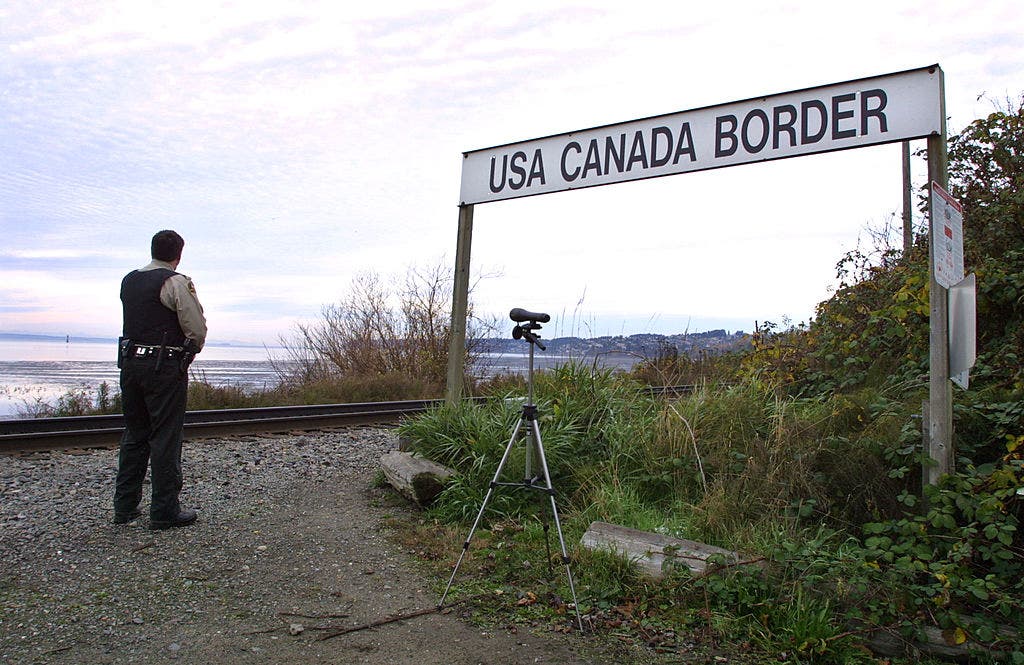
A U.S. Customs and Border Protection (CBP) sector on the northern border has seen more apprehensions in the last fiscal year than the previous 13 years combined.
The Swanton Sector Border sector has seen 15,000 apprehensions in the 10 months of fiscal year 2024, the largest volume ever recorded by the sector, over 14,000 more than was recorded in fiscal year 2021, according to a report on CBS 19.
The sector, which spans 295 miles of the border with Canada and covers all of Vermont and parts of upstate New York and New Hampshire, has seen its numbers of apprehensions in just part of this fiscal year exceed the previous 13 combined, the report notes, adding that illegal migrants from 85 different countries have attempted to illegally cross in the area.
WATCH: RESIDENTS ALONG THE BORDER TRUST TRUMP OVER HARRIS ON BORDER SECURITY
A Canadian Customs and Fisheries officer watches over the U.S.-Canada border between Blaine, Washington, and White Rock, British Columbia, on Nov. 8, 2001 in White Rock, Brithish Columbia. (Photo by Jeff Vinnick/Getty Images)
The report comes as illegal immigration continues to be an issue at the top of voters’ minds ahead of November’s election, with many polls showing voters have been dissatisfied with the record amount of illegal crossings at the nation’s southern border between 2021 and 2023.
While the southern border has received much of the attention, the report notes that the northern border has also reported a record number of illegal entries and apprehensions so far this fiscal year. In FY 2023, a record number of 190,000 migrants were apprehended at the U.S. border, while 162,865 have so far been apprehended at the border with Canada in the current fiscal year.
Royal Canadian Mounted Police officers greet refugees as they arrive at the Roxham Road border crossing in Champlain, New York, on March 25, 2023. (Photo by LARS HAGBERG/AFP via Getty Images)
TEXAS RESIDENTS AFFECTED BY BORDER SECURITY UNDER BIDEN-HARRIS ADMIN EXPRESS FEAR OF FUTURE ATTACK
The report also noted that close to 1,100 known or suspected terrorists (KSTs) have attempted to enter the U.S. from Canada between 2021 and 2023, making up a large percentage of the over 1,700 total KSTs that have been apprehended nationwide since FY 2021.
Border Patrol stakes out a rural area near the Canadian border, which borders New Hampshire and Vermont, in Canaan, Vermont, on Jan. 20, 2024. (Gina Ferazzi / Los Angeles Times via Getty Images)
Reached for comment by Fox News Digital, a White House spokesperson argued that President Biden has “worked to find bipartisan solutions to secure our border and fix our broken immigration system. Congressional Republicans have failed to act, twice voting against the toughest and fairest bipartisan border security agreement in decades.”
“President Biden announced actions in June that have significantly reduced encounters at the Southern border and the Department of Homeland Security recently announced changes designed to enhance our ability to remove individuals encountered along our Northern border,” the spokesperson added. “However, the only lasting solution to fixing America’s broken immigration system is for Congressional Republicans to stop playing politics and pass the bipartisan border deal.”
Get the latest updates on the ongoing border crisis from the Fox News Digital immigration hub.
Read the full article from Here



WASHINGTON (AP) — There’s no shortage of competitive, high-stakes races and candidates with famous last names in Maine’s state primary on Tuesday.
Primaries for U.S. Senate and U.S. House will set the stage for a midterm general election in which Maine is expected to play a critical role in deciding control of both chambers. Maine voters will also have the opportunity in November to demonstrate the state’s fiercely independent streak when it comes to electing a new governor.
READ MORE: Amid controversial Senate campaigns, Paxton and Platner visit Washington to shore up support
The races feature the son of a U.S. senator, the daughter of a congresswoman, the brother of a former governor and the nephew and cousin of two presidents.
Republican Sen. Susan Collins is unopposed for renomination to a sixth term, which would put her on track to become the chamber’s longest-serving member from Maine.
Collins, the only Senate Republican to represent a state that Democratic presidential nominee Kamala Harris carried in 2024, is a pivotal figure in the effort to win control of the chamber in November. The 51% of the vote she received in her 2020 election bid was her poorest showing since the 49% she received in her first successful run in 1996. She is frequently at the top of Democrats’ list of incumbents to oust, but her Democratic opponents have never surpassed the 44% mark in her five previous races.
READ MORE: Platner’s wife calls reports about Senate candidate’s explicit texts with women ‘shameful’
Graham Platner is the leading contender for the Democratic nomination to challenge Collins. He’s a Marine and U.S. Army veteran who took up oyster farming following combat tours in Iraq and Afghanistan. Platner originally faced a competitive primary against Gov. Janet Mills, the preferred candidate among some national Democratic leaders, but the second-term governor dropped out of the race in April citing fundraising challenges.
Platner has two remaining primary opponents, one of them a write-in candidate. Mills is still on the ballot, despite suspending her campaign.
As of May 20, Platner led all candidates, including Collins, in fundraising for the cycle, although Collins sat atop a larger war chest.
WATCH: Dissecting what the latest primary races mean for November elections
He received key early backing from Vermont U.S. Sen. Bernie Sanders, who reiterated his support despite recent allegations that Platner had sent sexually explicit text messages to several women while married. Platner was embroiled in another controversy earlier in the campaign regarding a tattoo he once had that was recognized as a Nazi symbol.
In the 2nd Congressional District, Democratic U.S. Rep. Jared Golden announced in November that he would not seek a fifth term in a district Trump won in 2024, along with its one electoral vote. Maine is one of two states that allocates some of its presidential electoral votes by congressional district.
The Democratic field to replace Golden includes former congressional aide Jordan Wood, state Auditor Matt Dunlap and state Sen. Joe Baldacci, brother of Democratic former Gov. John Baldacci.
The winner will face former two-term Republican Gov. Paul LePage, who is unopposed for the nomination.
Wood has far outraised the field, including LePage, in campaign contributions, although LePage had the most money in the bank as of May 20.
In the gubernatorial primaries, state Secretary of State Shenna Bellows, former state Senate President Troy Jackson, renewable energy company co-founder Angus King III, former state House Speaker Hannah Pingree and former Centers for Disease Control and Prevention Deputy Director Nirav Shah all seek the Democratic nomination.
The Republican field includes former healthcare CEO Jonathan Bush, former U.S. State Department official Bobby Charles, former state Senate Majority Leader Garrett Mason and businessman Ben Midgley.
King is the son of independent U.S. Sen. Angus King. Pingree is the daughter of Democratic U.S. Rep. Chellie Pingree. Bush is related to Republican former Presidents George H.W. Bush and George W. Bush.
The governor’s office in Maine frequently changes party hands. The state hasn’t elected consecutive governors from the same party in 74 years.
Maine is divided into 16 counties, but elections are run by the state’s hundreds of cities and towns, a practice common in New England. Portland is by far Maine’s most populous city and forms the heart of the state’s Democratic base. The two congressional districts largely track with the state’s political demographics. The 1st Congressional District along the Southern Maine Coast is heavily Democratic, while the massive 2nd District to the north includes the bulk of the smaller, more rural areas where Trump performed best.
The state uses a ranked-choice voting system in which voters rank the candidates in order of preference. If no candidate receives a majority of first-place votes, the last-place candidate is dropped, and votes cast for that candidate are reallocated among the rest of the field according to the preferences of the dropped candidate’s voters. This process repeats until one candidate emerges with a majority of votes.
Here are some of the key facts about the election and data points the AP Decision Team will monitor as the votes are tallied.
When do polls close?
Polls close at 8 p.m. ET.
What’s on the ballot?
The Associated Press will provide vote results and declare winners in contested primaries for U.S. Senate, U.S. House, governor, state Senate and state House.
Who gets to vote?
Registered party members may vote only in their own party’s primary. In other words, Democrats can’t vote in the Republican primary or vice versa. Independent or unaffiliated voters may participate in either primary.
How many voters are there?
As of January, there were about 354,000 registered Democrats, about 309,000 registered Republicans and about 334,000 voters with no party affiliation.
How many people actually vote?
About 69,000 Democratic primary votes and about 60,000 Republican primary votes were cast in the gubernatorial primaries in 2022, when both nominees ran unopposed.
How much of the vote is cast early or by absentee ballot?
About 26% of the Democratic primary vote and about 12% of the Republican primary vote in the 2022 primaries for governor was cast before primary day.
As of Thursday, about 56,000 ballots had already been cast in Tuesday’s election, about 33,000 from Democrats, about 13,000 from Republicans and about 10,000 from voters not affiliated with any party.
When are early and absentee votes released?
In the 2024 general election, the state’s most populous cities and towns tended to release results from all types of voting together at the beginning of the night.
How long does vote-counting usually take?
In the 2024 general election, the AP first reported results at 8:44 p.m. ET, or 44 minutes after polls closed. About 50% of the total vote had been counted by 12:54 a.m. ET, and counting stopped for the night at 4:11 a.m. ET. By 3:13 p.m. ET the day after Election Day, about 90% of the vote had been counted.
When will the AP declare a winner?
The AP does not make projections and will declare a winner only when it’s determined there is no scenario that would allow a trailing candidate to close the gap. If a race has not been called, the AP will continue to cover any newsworthy developments, such as candidate concessions or declarations of victory. In doing so, the AP will make clear that it has not yet declared a winner and explain why.
How do recounts work?
Under a 2025 law, recounts in Maine are automatic if the vote is tied. A candidate for statewide or multicounty office may request and pay for a recount, although the charges are waived if the vote margin is not more than 1% of the total votes cast or not more than 1,000 votes, whichever is less. The AP may declare a winner in a race that is subject to a recount if it can determine the lead is too large for a recount or legal challenge to change the outcome.
Are we there yet?
As of Tuesday, there will be 147 days until the 2026 midterm elections.
— Robert Yoon, Associated Press
A free press is a cornerstone of a healthy democracy.
Support trusted journalism and civil dialogue.

AMHERST, Mass. (WWLP) – The Massachusetts Department of Conservation and Recreation (DCR) has announced the return of its Pride Hikes, a series of guided walks across several state parks in celebration of the LGBTQ+ community.
These events will take place throughout June to create welcoming outdoor experiences for all communities during Pride Month. Each of the six hikes will be held at a different DCR property, with the events varying in length, terrain, and level of difficulty.
Participants are welcome to dress in Pride colors and are encouraged to bring necessary hiking supplies, including sturdy footwear, water, bug spray, and sunscreen.
“Our public lands and open spaces belong to everyone, and our Pride Hikes are a chance to celebrate the beauty of our landscapes and of each other,” said DCR Commissioner Nicole LaChapelle. “We’re welcoming members of the LGBTQIA+ community, their families, friends, and allies into our parks to enjoy the outdoors together and strengthen connections to nature and one another. We’re grateful to our partners across the state for helping create welcoming spaces where people can celebrate Pride, build community and experience a sense of belonging.”
The DCR is partnering with Queer Men of the Berkshires, the Stonewall Center at UMass Amherst, OUT MetroWest, and the Greater Boston and Franklin-Hampshire chapters of Parents, Families and Friends of Lesbians and Gays to host this series of hikes, with additional support from volunteers with Mass Audubon and RiverCulture.
This year’s Pride Hikes will take place at the following DCR properties:
- Great Falls Discovery Center, Montague
- Sunday, June 14, 10 a.m. to 2 p.m.
- Wachusett Reservoir, Clinton
- Saturday, June 20, 7:30 to 9:15 p.m.
- Mount Holyoke Range State Park, Amherst
- Saturday, June 27, 10 a.m. to 12 p.m.
- Riverfront State Park, Lawrence
- Saturday, June 27, 1 to 3 p.m.
- Douglas State Forest, Douglas
- Saturday, June 27, 2 to 4 p.m.
- Bristol Blake State Reservation, Norfolk
- Sunday, June 28, 11 a.m. to 12 p.m.
The hikes are subject to cancellation in the event of inclement weather. To learn more about each Pride Hike location, visit mass.gov.
All facts in this report were gathered by journalists employed by WWLP. Artificial intelligence tools were used to reformat information into a news article for our website. This report was edited and fact-checked by WWLP staff before being published.
Local News Headlines
WWLP-22News, an NBC affiliate, began broadcasting in March 1953 to provide local news, network, syndicated, and local programming to western Massachusetts. Download the 22News Plus app on your TV to watch live-streaming newscasts and video on demand.
-

 Connecticut3 minutes ago
Kids Count conveys mixed picture of how children fare in CT
-

 Delaware6 minutes ago
Missing Swimmer’s Body Found Along Delaware River, Authorities Say
-

 Florida11 minutes ago
Florida man accused of shooting cat in eye with BB gun, killing it
-

 Georgia18 minutes ago
Georgia early voting begins for primary runoffs ahead of June 16 Election Day
-

 Hawaii21 minutes ago
Hanalei homicide suspect caught after hours-long ocean manhunt
-
 Idaho26 minutes ago
Gas dips 10 cents in one week across Idaho as Iran ceasefire hangs in the balance
-

 Illinois33 minutes ago
Central Illinois braces for severe storms and oppressive heat
-

 Indiana36 minutes ago
Indiana sheriff busted for theft after GPS locator ties him to stolen election campaign signs

