Northeast
NJ Transit train operator killed, nearly two dozen injured after light rail train strikes fallen tree

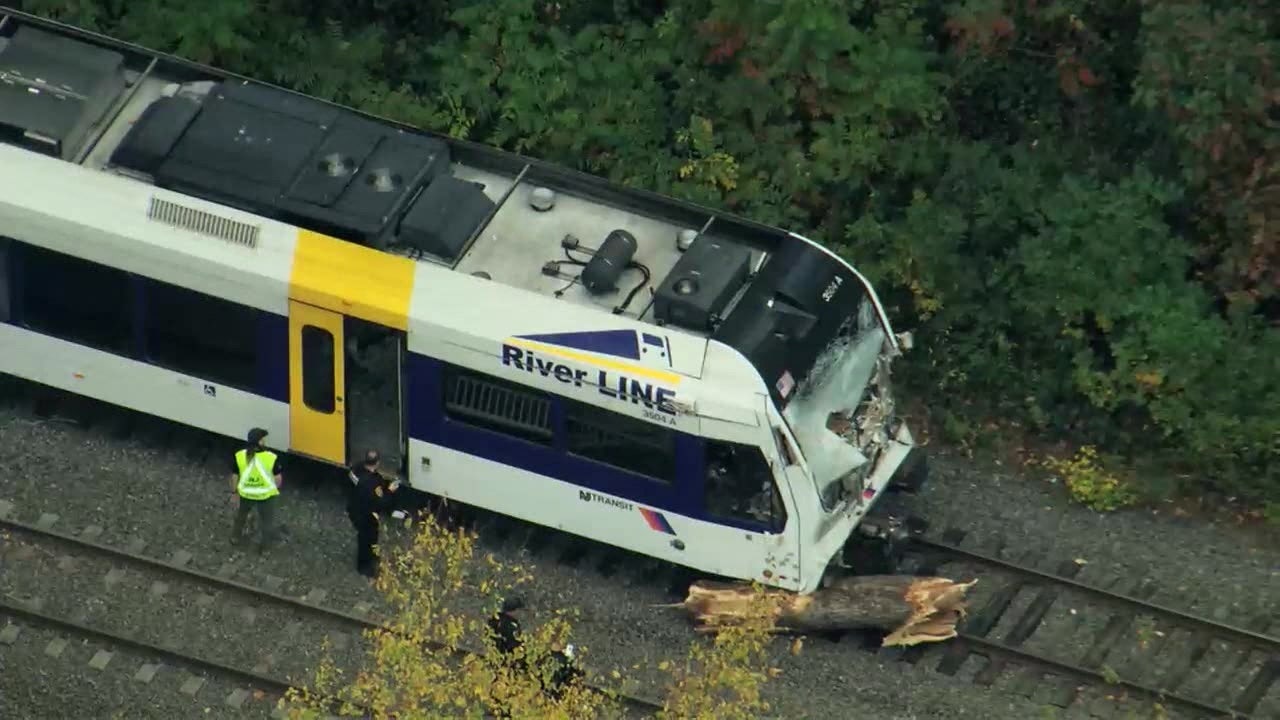
A New Jersey Transit train operator was killed and nearly two dozen passengers were injured Monday after a train collided with a fallen tree on the tracks, officials say.
The fatal incident happened around 6 a.m. on the River Line near the Roebling station outside of Trenton.
“I have been briefed on an accident on the NJ Transit River Line earlier today in which the light rail struck a tree on the tracks, leading to the death of the train operator and injuring passengers,” New Jersey Gov. Phil Murphy wrote on X.
“An investigation is underway. Our prayers are with all affected by this tragic incident,” he added.
TRAIN COLLIDES WITH MILITARY MOBILE ARTILLERY VEHICLE BEING HAULED ON A SEMI-TRUCK
An NJ Transit River Line train is seen stopped on tracks outside of Trenton, New Jersey, on Monday, Oct. 14, following a collision with a tree. (WTXF)
NJ Transit informed Fox News Digital that “of the 42 customers on board, 23 sustained non-life-threatening injuries, mostly minor.”
“The train operator is confirmed deceased. The remaining 19 passengers were accommodated by a bus. New Jersey Transit Police are on scene and investigating,” a spokesperson added.
NEW JERSEY WOMAN LOSES LEG IN TRAIN ACCIDENT, THEN PULLS HERSELF OFF TRACKS
The accident on Monday left 23 passengers with non life-threatening injuries, NJ Transit says. (WTXF)
It is currently unclear what caused the tree to be on the tracks.
“River Line service continues to be suspended in both directions between Trenton and Florence stations due to downed trees across the tracks near Roebling. Substitute bus service is being provided,” NJ Transit wrote on X following the incident.
Trees are seen strewn across the tracks north of Roebling Station. (WTXF)
The River Line branch of New Jersey Transit runs between Trenton and Camden.
Read the full article from Here

Pittsburg, PA
Analysis: Most Pittsburgh‑area communities are losing residents — here’s why that might be OK


WETHERSFIELD, Conn. (WFSB) – A tractor trailer’s diesel fuel saddle tank ruptured on I-91 north between exits 25 and 27, state police said.
Approximately 25 to 30 gallons of fuel was released to the road surface, according to the state Department of Energy and Environmental Protection. No ground soil or waterways were involved, DEEP said.
The two right lanes were closed, according to the state Department of Transportation.
No other vehicles were involved and no injuries were reported, state police said.
Wethersfield Fire Department solidified the diesel fuel on the ground surface with Speedy Dry, DEEP said. An environmental cleanup contractor was en route for cleanup.
Copyright 2026 WFSB. All rights reserved.

Scott A. Harrison, Ed.D., M.B.A., is a senior advisor at The Harrison Group, a consultancy based in Yarmouth.
Maine has long valued local control in education. That tradition reflects an important belief that communities should have a strong voice in shaping their schools. But local control should not prevent us from asking a harder question: Are there core functions that could be delivered more effectively through a single statewide framework?
One of the most important is educator evaluation and professional growth. Maine law already recognizes the importance of this work. Under Title 20-A, Chapter 508 (Educator Effectiveness), districts must implement performance evaluation and professional
growth systems that evaluate educators, assign effectiveness ratings and support
professional growth.
The law further requires superintendents to use those ratings to inform key human capital decisions, including recruitment, hiring, induction, mentoring, professional development, compensation, assignment and dismissal. In short, educator evaluation is not intended to be a compliance exercise. It is intended to be a primary lever for the continual improvement of teaching and learning.
In 2012, LD 1858 sought to advance that vision by giving districts broad flexibility to design their own systems. Districts could choose instructional frameworks, establish measures of effectiveness and determine how evaluators would be trained and calibrated. The goal was to balance local autonomy with professional accountability.
More than a decade later, however, the evidence suggests that flexibility alone has not produced consistent results.
My research involving 130 educators across four Maine school districts found only modest perceptions of performance evaluation and professional growth systems’ effectiveness.
On a four-point scale, average ratings ranged from 2.48 to 2.99. While educators generally agreed that districts provide individualized growth plans and can differentiate levels of instructional effectiveness, they rated several critical implementation areas notably lower, including instructional coaching, evaluator training, feedback quality, evaluator calibration and the use of evaluation data to inform professional learning and personnel decisions.
Although the sample was relatively small, the findings closely mirror what I have observed while working with predominantly rural Maine districts over the past decade.
The qualitative findings were equally revealing. Teachers and administrators described systems that are often cumbersome, inconsistently implemented and difficult to sustain. Educators reported spending significant time developing goals and documenting evidence, while administrators acknowledged that competing priorities frequently reduce evaluation to a compliance exercise rather than a meaningful opportunity for growth.
Participants cited insufficient training, inconsistent expectations, limited coaching support and weak connections between evaluation results and professional learning. Perhaps most significant, though not surprising given the realities of today’s schools, the primary obstacle appears to be not commitment, but capacity — the time, expertise and tools required to implement these complex systems with fidelity.
Designing and sustaining high-quality evaluation systems requires expertise in instructional leadership, observation and feedback, adult learning, professional development, data use and evaluator calibration. While some districts have built this capacity, many — particularly smaller and rural systems — have not. Even where expertise exists, time remains a major barrier.
Effective evaluation depends on regular observation, coaching, feedback and calibration. Yet for principals balancing instructional leadership with the daily demands of running a school, carrying out these responsibilities consistently can be extraordinarily difficult.
As a result, Maine has effectively asked more than 250 districts to independently build and maintain highly complex educator effectiveness systems. The outcome is predictable: uneven quality and implementation, and variable impact on teaching and learning.
This raises an important policy question: Should every district continue to design, train, calibrate and maintain its own evaluation system, or would educators and students be better served by a common statewide framework supported by regional and state expertise?
A statewide approach would not eliminate local control. Districts would continue to make decisions about hiring, staffing, curriculum, budgeting and school improvement priorities. Instead, the state would provide shared infrastructure: a common instructional and evaluation framework, validated tools, evaluator training, calibration supports, professional learning resources and implementation assistance.
The benefits extend beyond evaluation. A common framework would create stronger alignment across Maine’s educator pipeline. Colleges and universities could align coursework, clinical experiences and assessments to the exact same standards used in schools while sharing responsibility for educator success beyond initial placement.
Preparation programs, districts and the state would become partners in a continuous system of educator development, creating mutual accountability for results and a stronger return on Maine’s investment in teacher preparation.
Such alignment matters. As systems thinker Peter Senge observed, people working within the same system tend to produce similar results. If we want more consistent outcomes for students, we must pay closer attention to the systems shaping educator practice.
A statewide approach would not eliminate local control. Districts would continue to make decisions about hiring, staffing, curriculum, budgeting and school improvement priorities.
A common framework would establish a shared language and clearer expectations throughout the career continuum. It would also make continuous improvement easier. Rather than asking hundreds of districts to independently revise complex systems, the state could evaluate implementation, refine practices, share lessons learned and respond to emerging research. Educators have experienced too many short-lived initiatives that consume considerable time and effort before fading away.
A coherent statewide system would provide greater stability and more meaningful long-term improvement. The question is not whether local control matters. It does. The question is whether every district should be expected to independently build and sustain complex systems that require specialized expertise, significant resources and ongoing refinement.
If Maine is serious about improving outcomes for students, it should rethink which functions are best managed locally and which are better supported through statewide infrastructure. Educator effectiveness is one example. There are likely others.
In a previous op-ed here, I argued that Maine should reconsider whether teacher compensation is best negotiated district by district. The same question applies here. When critical human capital systems are essential to student success, a coherent statewide framework may be better positioned to advance equity, efficiency and effectiveness while preserving local decision-making where it matters most.
The goal is not less local control, but a smarter balance between local autonomy and statewide support — one that strengthens schools and improves outcomes for every student, regardless of geography.
-

 San Diego, CA2 minutes ago
Neymar expected to return from right calf injury and play for Brazil in World Cup against Scotland
-
 Milwaukee, WI7 minutes ago
Today’s Summerfest schedule and picks: Saturday, June 20
-

 Atlanta, GA14 minutes ago
Atlanta Ballet Returns to the Fox Theatre to Present Cinderella for One Weekend Only This Fall
-

 Minneapolis, MN17 minutes ago
MERAUDER, JUDGE, ARKANGEL and many more announced for Minneapolis’ Snow and Flurry 2026
-

 Indianapolis, IN22 minutes ago
Third Public Safety Camera Added on Washington Street in Downtown Indy
-

 Pittsburg, PA29 minutes ago
Analysis: Most Pittsburgh‑area communities are losing residents — here’s why that might be OK
-

 Washington, D.C32 minutes ago
Trump’s DC makeover frenzy bewilders locals and visitors: ‘It’s like we’re under occupation’
-

 Augusta, GA32 minutes ago
Augusta Regional Airport hosts drone camp for students

