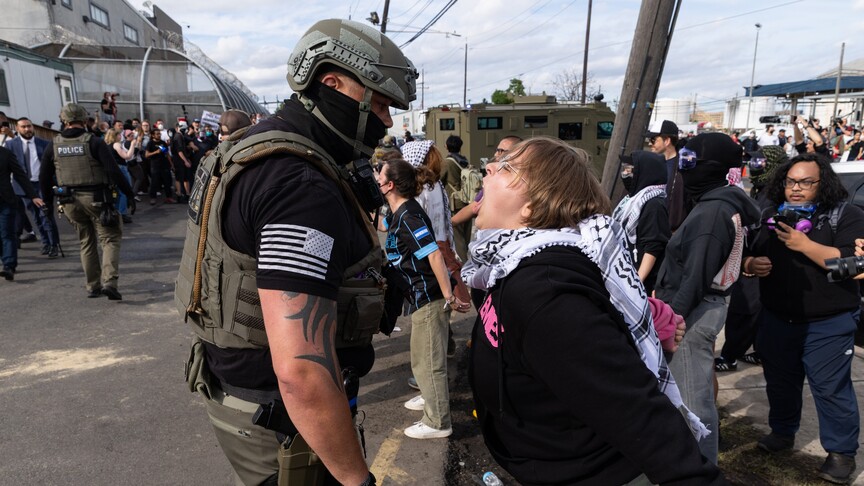
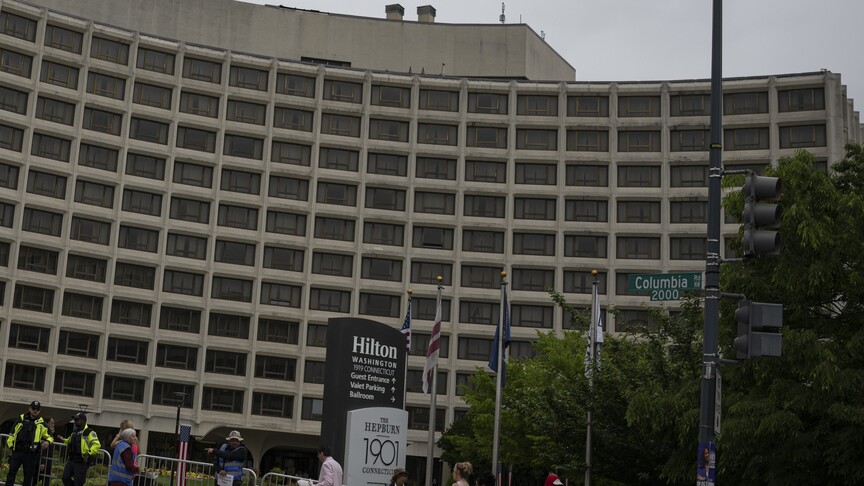
US immigration officers and protesters clashed outside a detention facility in New Jersey, local media reported, as criticism mounted over conditions inside the center, according to local media.
The demonstration took place outside Delaney Hall, a privately operated immigration detention facility in Newark that houses migrants detained by US Immigration and Customs Enforcement (ICE), according to Fox News.
Advertisement
Protesters attempted to form a human chain outside the facility while chanting slogans against ICE. Some demonstrators threw water at agents, and several people were detained during the confrontation.
New Jersey Governor Mikie Sherrill said her request to enter the facility earlier Monday had been rejected.
“My request for access to Delaney Hall was formally denied this morning, raising serious questions about what they are trying to hide from public view,” Sherrill said in a statement.
Videos shared by local broadcasters showed protesters and ICE agents standing face-to-face near the entrance to the facility before tensions later eased.
The protests came amid a reported hunger and labor strike by detainees inside the center over alleged poor living conditions, lack of medical care and restrictions on family visits.
Advertisement
In a letter released last week, nearly 300 detainees described conditions inside the facility as “inhumane,” citing poor food quality and medical neglect.
A spokesperson for the US Department of Homeland Security rejected the allegations, saying detainees are provided meals, clean water, hygiene supplies and access to communication with relatives and lawyers.
Family members and supporters of detainees have maintained a vigil outside the facility since Friday.

A chaotic scene erupted early Monday outside a federal immigration detention center in New Jersey, which has been the site of protests, the arrests of lawmakers and reports of a labor and hunger strike by detainees.
Protesters were seen blocking unmarked government vehicles and, at some point, were part of a skirmish with armed, masked Immigration and Customs Enforcement agents outside Delaney Hall, a privately owned 1,000-bed facility ICE uses as a detention center in Newark, as shown in video from Freedom News TV and obtained by CNN.
Tensions outside the facility escalated over the weekend and politicians called for oversight after months of accusations of inhumane conditions. Other ICE facilities across the country have also faced accusations of subpar conditions as President Donald Trump’s administration continues a massive nationwide deportation campaign. A recent CNN investigation found that nearly 50 ICE detainees have died since Trump’s return to office, the highest death toll in at least two decades.
The Department of Homeland Security refuted the claims posted by elected officials over the weekend, saying the politicians were “spreading smears about ICE law enforcement and the Delaney Hall ICE facility.”
Advertisement
Here is what we know about the New Jersey facility and why it’s at the center of another wave of protests and allegations of subpar living conditions.
Before clashes between protesters and federal agents took place, more than 300 detainees went on a hunger and labor strike Friday in an effort to draw attention to the inhumane conditions they say they have endured, NJ.com reported.
US Sen. Andy Kim of New Jersey said he visited Delaney Hall on Saturday after hearing reports of the hunger strike. The Democratic lawmaker wrote in a post on X that he spoke with people who said they were arrested at scheduled immigration interviews for green cards, and witnessed “a carton with the milk inside congealed solid.”
He says he spoke with female detainees who said they were unable to access medical care and were away from their infant children.
DHS denied the claims from Kim and other politicians in a news release Monday afternoon.
Advertisement
“The facts are all detainees are provided with 3 meals a day, clean water, clothing, bedding, showers, soap, and toiletries,” the news release said. “Illegal aliens also have access to phones to communicate with their family members and lawyers. Certified dieticians evaluate meals. In fact, ICE has higher detention standards than most U.S. prisons that hold actual U.S. citizens.”
DHS also said it “provide(s) comprehensive medical care from the moment an alien enters ICE custody,” and the care detainees get “is the best healthcare they have received their entire lives.”
“This is nothing more than a political stunt by New Jersey sanctuary politicians for fundraising clicks,” acting Assistant Secretary Lauren Bis said in a statement. “There is NO hunger strike at Delaney Hall. There are NO subprime conditions or abuse at the facility.”
CNN has also reached out to GEO Group, which operates the facility, for comment about the detainees’ claims.
Protesters and DHS agents clash outside detention center
At least a dozen people gathered outside Delaney Hall Sunday night into early Monday and were met by several federal agents.
Advertisement
Law enforcement wearing masks and vests marked with ICE patches were seen pulling protesters out of a crowd and detaining them, with at least one protester dragged across the ground, video from Freedom News TV shows. It is not immediately clear what led to the encounter.
Protesters could be heard yelling “stop” as agents went into the crowd.
The video later shows protesters placing yellow barricades in front of an unmarked vehicle blaring its sirens and with flashing emergency lights.
A spokesperson for DHS told CNN approximately 125 people “surrounded” Delaney Hall. They formed “a human chain around entrances to the facility and set up barricades, blocking all entries and exits,” the agency said.
DHS said the early Monday skirmish stemmed from protesters attempting to stop the transfer of detainee Martin Alonso Soto Hernandez. His wife had organized a rally Friday announcing the hunger strike at Delaney Hall, NJ.com reported.
Advertisement
“Martin Alonso Soto Hernandez, an illegal alien charged with assault, was scheduled for a transfer to another ICE detention facility, but agitators obstructed the vehicle’s path…” DHS said in the statement. “Later in the evening, ICE successfully dispersed approximately 70 agitators and removed the barricades obstructing operations and were able to transfer Soto Hernandez to the Elizabeth Contract Detention Facility.”
Attorneys representing Soto Hernandez said they were able to see him at Elizabeth Detention Center, another facility in New Jersey that he was transferred to in the middle of the night.
“He was telling us how he now weighs like 110 pounds,” said attorney Alex Minogue. “Like he’s skin and bones. I could blow him away.”
New Jersey Gov. Mikie Sherrill and other Democratic lawmakers said they were not allowed inside the detention center Sunday and Monday.
A spokesperson for DHS told CNN Monday “visitation has been suspended out of an abundance of caution” following the clashes.
Advertisement
The governor, who previously said she was “disturbed” by reports of poor conditions at Delaney Hall, said she would continue to advocate for the closure of the detention center.
“The people inside Delaney Hall are fathers and mothers, sons and daughters and members of our community. In New Jersey, we believe in the rule of law and that everyone deserves to be treated with basic dignity. We have a duty to safeguard the rights, health, and well-being of everyone within our borders,” Sherrill said.
Congressman Rob Menendez Jr., who represents the area around Delaney Hall, posted on X he visited the facility “to conduct an unannounced oversight visit” after learning that a constituent was at risk of transfer or deportation due to his involvement in the recent strike, but he was denied access to the facility.
“I’m not even asking for any special treatment. You’re denying my right to go inside and do an oversight tour,” Menendez said. He has since been able to visit Soto Hernandez at Elizabeth Detention Center, he said in a later post.
US Sen. Cory Booker of New Jersey denounced conditions at Delaney Hall in a social media post Monday, saying “Immigrants at Delaney Hall are on a hunger strike because they are fighting for their human rights” as conditions are “deplorable.”
Advertisement
“We’re working with our partners in the state to bring an end to this nightmare and I’ll be going to Delaney Hall again to conduct oversight,” he said.
Sign up for the Slatest to get the most insightful analysis, criticism, and advice out there, delivered to your inbox daily.
I don’t think I actually wanted a gun. I grew up in Newark, New Jersey, where there was this saying: People with knives get stabbed. People with guns get shot. The conventional wisdom was that it was safer to be unarmed. If someone mugged you, just give them what you’ve got.
But things changed as I got older. I’m Arab. Muslim. Like many Muslim families after 9/11, I internalized the idea that being inviting and performatively friendly was more essential for survival than anything else. At my mosque growing up, the imam bought a box of American flags of all sizes and handed them out to worshippers. He hung one outside the mosque, and people stuck them in their car windows. Anything to not seem like a threat.
Now that I’m an adult, I’ve grown a bit bored of reassuring others I’m safe to be around. And if I’m honest, there’s something fun about poking a stereotype in the eye. Before, I never thought of myself as someone who could be a gun guy. True, I didn’t really think a gun would make me or my family safer. But as I wrote about gun culture for Slate and thought about my own relationship with guns, I became curious to own one of my own.
Advertisement
So in 2020, I applied for a Firearm Purchaser Identification, a permit to purchase a firearm that is required in New Jersey. After fingerprints, references, application fees, and months of waiting, I was told over the phone that I had no choice but to withdraw my application. The issue was a misdemeanor trespassing charge in New York from my street-photographer days. Under New Jersey law, that should not have disqualified me from owning a gun. I had never been convicted of a felony. No domestic violence charges. No mental health issues. It didn’t matter. The Newark Police Department’s firearm permitting office told me my application was being withdrawn. They insisted they were doing me a favor, and that a denial would bar me from reapplying if I got my record expunged.
Again, I wasn’t even sure I wanted a gun. But the interaction was curious. It didn’t matter that I pointed out I met the legal requirements. Again and again, I was unsuccessful. It had me thinking about who is presumed “safe” to own a gun, and who isn’t. I began speaking with Black and brown gun owners across northern New Jersey, particularly in cities where violence, policing, and race overlap in complicated ways. An Afro-Cuban neighborhood friend I went to high school with in Newark told me he had applied for his own permit and received it in just two weeks. When I explained that I tried multiple times and was still waiting months after my latest application, he looked genuinely confused. Then he asked what race I’d listed on the paperwork. “Other,” I told him. He burst out laughing. “You idiot,” he said. “You’re supposed to put white.”
The more people I spoke to, the more I learned I was far from alone in making that “mistake.” The greater question of who gets to, and should, own a gun turned out to far more complicated than I knew. Few people—on the left or the right—want to talk about it. The ending of my own story helps explain why.
In Paterson, New Jersey, Fanny, a nurse, applied for her permit more than six months ago—far longer than the legal limit of 30 days. She was bubbly, almost nervous, when talking about guns. “I just want to protect myself,” she told me. She had grown up without guns and found them scary and intimidating. Her interest only developed after she worked as a probation officer around sheriff’s officers and court staff. At first, she tried taking lessons with a white male instructor, but left discouraged and uncomfortable. “They’ve already been doing it for years,” she said. “Sometimes they’re not the most patient.”
Years later, when she was living alone in Paterson after buying her own home, her interest grew again. Crime in the city felt worse to her than it had when she was younger, and she felt increasingly uneasy about the world around her. “What if, God forbid, something happens and I can’t get to the phone right away? The cops may not come for 10 or 15 minutes,” she said. She summoned the courage to try again after she found a Black advocate for firearms training and safety, Valentina Richardson Green, on Instagram.
Advertisement
She arrived at her first lesson terrified. “When I first met with her, I was so scared,” Fanny said, laughing. “Seeing the gun and picking up the gun, I’m like, Oh my God, I don’t know what I got myself into.” Before they even stepped onto the range, Green sat her down and asked why she wanted to learn, where the fear came from, what made her nervous. Then she walked her through every part of the firearm, every safety rule, every mechanical detail. “I instantly felt comfortable,” Fanny said. “Instantly.”
Within weeks, she was returning every Saturday. Eventually Green convinced her to buy a membership at the range. “I never thought about doing that,” she said.
Then she applied for a permit in October 2025. She is still waiting. At one point, while browsing guns at the range, Fanny met a man from Woodland Park who casually mentioned that his permit had arrived in two weeks. She remembers feeling stunned. “It made me feel like I wanted to move,” she said.
Fanny struggled to explain why some people seemed to move effortlessly through the system while others stalled inside it: “I hate to say this. I believe it has to do with race.” She talked about the reputation of Paterson as being a “Black city,” about the sense that legal access to firearms isn’t meant for people like her. “I think they think that if we have access to these weapons, we’ll use them in a manner that will be destructive, and that’s not the case. With the political climate, a lot of people want to protect themselves. And minorities want to protect themselves, too,” she said. “They’re thinking, ‘If they get their permits and they get their guns, it’s going to be a war.’ But we’re not even thinking in terms of that. Like, we just want to protect ourselves. Especially women. We need to learn how to protect ourselves.”
What Fanny described wasn’t really about enthusiasm for guns so much as a growing distrust in the idea that someone like her shouldn’t have them. She did not sound eager about any of this. Even while discussing permits and training, she still spoke with caution and hesitation. At one point, when I asked whether more guns were really the answer in cities already struggling with gun violence, she stopped mid-thought. “It’s so hard,” she admitted. “It’s so hard to say.”
Advertisement
If Fanny represented the uncertainty surrounding gun ownership among women like her, her teacher, Valentina Richardson Green, represented the growing ecosystem built around answering it. She was easy to spot on Port 14 of Gun for Hire, New Jersey’s cavernous, fluorescent‑lit gun range. She’s a 5‑foot‑11 Black woman who was wearing a black T-shirt with “Naturally Armed” written in bold pink, shoulders squared behind a Glock 45, coaching a nervous first‑timer through breathing. She organizes monthly sessions for other women of color who are curious about shooting recreationally, or, in most cases, exploring avenues of self-defense. When the slide snaps forward and the handgun fires a round, Green nods briskly with approval, then resets for her next student, a nurse in borrowed safety glasses.
Green was born 5 miles south in North Newark. Her father was a police officer and kept his service pistol locked in a hall closet, but firearms were “never a thing we talked about.” Still, the threat of gun violence in a city like Newark is never too far away, and that colored her perceptions of ever owning one.
After earning a sociology degree, she climbed her county’s social services ladder, eventually running the entire welfare division. “Stress lived in my shoulders,” she says. On a birthday range trip in 2021, a friend put a pistol in her hands for the first time. “One squeeze, and every piece of weight left my body,” she said. That trigger shifted the way she felt about guns forever. On another visit to the range, she mentioned to an employee that she didn’t see too many people who looked like her there. “Why don’t you work here?” they asked. At one point, she kept three jobs: working in government, armed security shifts, and being a range safety officer. She does it so “women who look like me feel comfortable, feel seen,” she said.
Courtesy of Valentina Richardson Green
Last August, she emptied her savings into establishing roving gun safety and education workshops specifically for women of color in a neighborhood ice‑cream shop. The owner offered her a steep discount. She used the setting as an opportunity to vet women who show up before she takes them to the range.
Twenty‑five women came to the inaugural session. One arrived by cab from Manhattan. Green told me one woman said she owned a gun already but wanted to learn how to use it. Another woman said she was experiencing domestic violence at home and wanted to defend herself. A single mother brought her young son, looking for ways to defend her family. The goal, Green said, was to create a place where women of color can feel comfortable to explore arming themselves, “to step into spaces where they didn’t think that they belonged and showing them we do belong.”
Part of the stigma among Black women in particular about owning a firearm, Green admitted, comes from a lack of awareness, but also an apparent systemic effort to keep guns out of the hands of Black and brown people. She learned how hard it can be to get the necessary permits to purchase a handgun. Green’s first permit took eight months. “I was giving them grace,” she said, “but I later learned it’s not eight months for everybody.” She also says the necessary application fees can be prohibitively expensive, as well as the steep costs of guns, which can pose another barrier for gun ownership among Black women: $1,500, she says, “is the low end.”
Advertisement
Though many gun stores and ranges have made recent strides in increasing the diversity of their staff, some ranges can feel intimidating when you don’t see someone who looks like you, she explained. She described the experience of “constantly being watched”—”the kind of watching we already know outside a gun range.”
The suspicion that race is factored into applications that Fanny described is difficult to prove from a single application. A long wait can always be explained away. With a system built out of individual decisions, each one becomes small enough to fall through any number of administrative cracks.
Ben Shore, the co-founder and director of Rise Against Hate, a nonprofit that uses data to investigate racial disparities, wanted to know what those decisions looked like in aggregate. The problem was that when he began looking at New Jersey’s public dashboard of firearm permit approvals and denials, he told me the dashboard did not make it easy to see race. “I think they did this on purpose. It makes no sense to do it this way. But they strategically pulled out different portions of race and other things that would show disparities,” he said. “If a data scientist is working on that, they would not have pulled that out.”
So Shore and volunteers at Rise Against Hate rebuilt the data themselves. “We had to actually take all the numbers from all the dashboards and create our own dashboards just to get down to the bottom of it,” he said. What they found, he says, was alarming. In Ocean County, he told me, “a Black person is about 50 times more likely to be denied a permit to carry versus a white person.” Statewide, he said, the disparity was roughly 10-to-1.
He compared those numbers to racial disparity cases involving marijuana enforcement. But even those cases, he said, paled in comparison. “Those numbers were usually like, they’re three times more likely, five times more likely. And that was enough to find discrimination,” Shore said. “Here we’re talking about numbers that are 10 times more likely, across the state, to be denied a permit.”
Advertisement
These weren’t people who were legitimately disqualified, either. “We’re not talking about people who are committing criminal acts. We’re talking about a law-abiding citizen, somebody with a clean criminal record, somebody who’s never been convicted of a crime, someone who applies for their firearm ID card,” he said. “They get approved for it. And then when they apply for the permit to carry with the same exact qualifications as their initial ID card, they’re getting denied if they’re Black. If they’re white, they’re not, because it’s up to the police officer’s discretion. Why is it that the same qualifications applied, but Black people are being denied at extremely high rates?”
“Your constitutional right varies by your ZIP code in New Jersey,” he said.
That stayed with me, because it matched what I had heard from Fanny in Paterson, and what a man from Woodland Park casually told her at a gun store when he said his approval came in two weeks. Shore said he knew of applicants who were denied in one part of New Jersey and approved after moving elsewhere, with no meaningful change in their background. “If you did move, and you moved to another county in New Jersey,” he told me, “you will 100 percent have your right.”
And even Shore’s study, he said, did not fully capture the issue. It counted formal denials, not withdrawals, like mine in Newark. “We did not count the withdrawals in the study,” he said, “but we do know that there are many withdrawals.” Indeed, my own application had not been officially denied. It had been withdrawn after a police officer told me I could not proceed unless I first expunged a misdemeanor that should not have disqualified me.
Shore also pointed me to a pending federal case involving a Muslim New Jersey attorney who said his gun-license application was denied after officials cited pro-Palestinian political posts online as threatening or terrorism-related. The case raised a different version of the same concern: that discretion in firearm licensing can turn race, religion, politics, or speech into suspicion. “It’s just crazy,” Shore said, “because even what you say can be used. Your First Amendment can be used to deprive you of your Second Amendment.”
Advertisement
The disparities Shore identified have begun attracting attention beyond gun-rights circles. John Petrolino, a firearms instructor and freelance Second Amendment journalist who has reported on New Jersey’s permitting system, told me he began filing records requests after noticing Black applicants were being denied at more than twice the rate of white applicants in the state’s permit-to-carry data. What troubled him most was how often denials appeared to rest not on criminal convictions or clear statutory disqualifiers, but on New Jersey’s broad “public health, safety or welfare” standard—the same kind of catchall that had swallowed my own application years earlier. “It’s an opinion-based thing,” he told me. “You could fill in the blank on how this could be abused.” He is now suing the state for not releasing those records.
Earlier this year, lawmakers reintroduced legislation in Trenton that would require the state to publicly report firearm permit approvals and denials by race, ethnicity, and gender. Supporters argue the measure is necessary because existing public dashboards obscure patterns that civil-rights advocates and researchers say have become increasingly difficult to ignore.
At the same time, more than 20 municipalities across New Jersey have passed resolutions reimbursing firearm permitting fees on the grounds that high costs attached to a constitutional right function as a discriminatory barrier, particularly in working-class communities. The resolutions have appeared in towns spanning eight counties, creating an unusual overlap between libertarian gun-rights arguments and broader concerns about racial and economic inequality.
Even as the debate gains more traction, much of it still unfolds at the margins of mainstream politics, carried largely by activists, independent researchers, and a loose coalition of gun-rights litigators who argue New Jersey’s permitting system remains structurally unequal. Joe La Porto, a libertarian journalist who has spent years around Second Amendment litigation, drafted the bill that was introduced by New Jersey state Rep. Dawn Fantasia that would have local agencies track the racial makeup of approvals and denials for firearm permits.
He hopes that by pulling the data and making it visible, New Jersey’s Legislature will “have an honest conversation about what to do about this.” He expects bipartisan support for it: “All we’re asking for is public discourse here. It’s simply data. Nobody should be afraid of data.”
Advertisement
We talked at a local gun range, and under the loud pops rattling behind the thick glass, he told me the gun debate has become intellectually dishonest. The moment firearms enter the conversation, he said, many liberals stop applying the same civil-rights framework they would bring to almost any other area of criminal justice. “Because this whole issue touches fingers in some way with gun control, it just becomes like a blackout zone,” he said. “Nobody wants to touch it. Even though I would argue that this is the central issue as it relates to criminal justice reform and looking at our society as a whole and what’s working and what’s not,” he said.
La Porto’s argument begins with the very first gun laws. “If we were to go back in time and we look at firearms regulation in 1791, or in 1868 when the 14th Amendment was passed, we don’t really have a long history of regulating firearms, except for in 1791,” he said. “If you were Black, you couldn’t own a firearm. If you were a Catholic, you couldn’t own a firearm. If you were a Native American, you couldn’t own a firearm.” After the Civil War, he said, the pattern became even clearer. “In the 1860s, after the Civil War, the immediate counterpunch to the Civil War was the Black Codes,” La Porto said. “Basically, the Southern states said, ‘OK, fine, we lost, we can’t have slaves anymore, but you know what we’re going to do? We’re going to pass a whole bunch of laws that make it impossible for Black people to have a job or own property or exercise a core constitutional right.’ ”
This, he says, is precisely why the modern Supreme Court cases that remade American gun law are so dangerous. He pointed to the Bruen case in 2022 that required modern gun regulations to be justified through the nation’s historical tradition of firearm regulation. “By creating a system where the government has to go back and link its current regulation to some heritage of regulation,” he said, “all we’ve got is racism.”
“The application of these laws has been almost uniformly to the detriment of poor and largely minority populations,” he said. That is where his argument shifted away from licensing and toward criminal justice. New Jersey’s Graves Act essentially establishes mandatory minimum sentencing if you’re arrested with a firearm. The law was originally aimed at combating gun crime, but La Porto says it unfairly targets Black New Jerseyans. “If you talk to folks in the public defenders’ offices, they’ll tell you that 90 percent of Graves Act cases these days are simple possession,” he said. “And in the vast majority of those cases, these are not criminals. These are just poor people living in dangerous communities that are just possessing firearms because they’re afraid for their lives.”
At the gun range, I asked La Porto to contend with New Jersey’s high gun‑death rate in cities like Camden, Paterson, and Newark, where I live. La Porto retorted saying this: “Poverty correlates perfectly with violent crime. Gun control doesn’t,” he said. “As long as we have to live in a world where there’s even moderate scarcity, violence is never going to go away.”
Advertisement
I should say that not everyone thinks the history here is so clear. Chris Rasmussen, a historian at Fairleigh Dickinson University in New Jersey who studies crime and punishment in America, was less willing to draw one straight line for every modern gun restriction back to racist intent. But he didn’t dismiss La Porto’s argument outright. In New Jersey, he said, gun ownership appears to have risen in the 1960s, especially after the urban uprisings of 1967 and 1968. Newark was central to that fear. “A lot of white suburbanites living near where you live, near Newark, started arming themselves because they were afraid of the Black people,” Rasmussen said. The same fear surfaced nationally around the Black Panther Party. In California, Panther members legally carried rifles to the state Capitol in Sacramento. Immediately afterward, California passed the Mulford Act. “I think a lot of white Americans got really freaked out,” Rasmussen said. “White people just saw Black men with guns.”
Still, Rasmussen resisted the cleanest version of La Porto’s argument. Modern gun laws, he said, were often driven by fear of crime as much as racial control: gangsters in the 1930s, the assassination of John F. Kennedy, Lee Harvey Oswald’s mail-order rifle, the assassinations of Martin Luther King Jr. and Robert F. Kennedy, rising violent crime, and a broader sense that the country was becoming harder to govern.
“I can imagine they have been used that way by some discriminatory officials,” Rasmussen said. “But I think the extreme gun control is usually more directly connected to crime. Fears of crime.”
Still, he did not erase the racial question. Rasmussen compared the way gun laws are enforced to the war on drugs. “You couldn’t write the law to say people of color should receive longer sentences for possessing drugs. But you could enforce the law very selectively. You could arrest more Black men, and you could have judges give harsher sentences to Black men,” he said.
Aymann Ismail
That felt closer to what happened to me in Newark. The statute did not explicitly forbid me from buying a gun. But in the space between the law and the person reviewing your permit application, everything is subject to one human’s impression of another. My friend in Newark said he didn’t think twice about listing himself as white on his application. “It’s 2026,” he joked. “Good luck telling anybody what race they are.”
That leads me to a twist that unfolded as I reported this story. Six years after I first applied for a firearm permit in New Jersey, I finally received one a few weeks ago. (I didn’t even have to check “white.”) The application that succeeded was submitted in January. Four months later, an approval arrived digitally in my inbox, without explanation. I can now legally purchase as many rifles as I want, and a handgun.
Advertisement
For years, the permit itself had taken on a symbolic meaning in my mind—less about ever actually getting a gun than what it meant to be told no over and over again. But once it finally arrived, I found myself wondering if I actually want one.
I texted a close friend from northern New Jersey, a Palestinian American Muslim who attended the same Islamic school I did growing up. He was ecstatic. Within minutes, he was joking about starting a gun club for former Islamic-school kids, schooling me about differences in calibers.
A few days later, that same friend brought me with him to the range on Memorial Day weekend. It was packed. He brought his 10-year-old son, too, along with what looked to me like an arsenal: rifles, handguns, and a large plastic container filled with ammunition. That may have been the first moment I understood how far I still was from the culture of this. My body still jumped at every loud pop from guns shot behind the thick glass. My friend’s son seemed entirely unfazed by all of it. While I stood at the counter filling out a lengthy waiver, he casually surveyed the wall of accessories for sale.
Later, at his house, he let me hold a few of his guns. He talked me through what to notice: weight, grip, balance, whether it felt like something I could actually learn on. I felt a little overwhelmed. Not afraid exactly, but aware that I was still at the very beginning of something that goes much deeper.
His advice was simple: “This is the fun part,” he said, smiling as he talked through the options. For as overwhelming it could all feel, it was nice to be reminded by someone like me that this was supposed to be fun. For all the symbolism I’ve attached to it, it’s something most gun owners just own to collect and practice shooting with.
Advertisement
Maybe gun ownership will remain something symbolic for me, and I’ll keep putting off actually buying one. For now, having the permit feels like enough. I waited six years for the state to decide if I was allowed to be the type of person who owns guns. I can wait a little longer before deciding whether I am.
The weather overnight sent trees toppling onto cars and homes in New York and New Jersey.
Advertisement
The clean-up began Sunday, though rain is expected to return Monday.
Weather damage in New Jersey
In Linden, New Jersey, a fallen tree damaged Robert Goldson’s house.
“All we heard was– it felt like an earthquake,” he said. “We seen all the trunk basically tore up my garage in the back end of my house, so basically, the fire department got it.”
A tree fell on a garage in Linden, New Jersey, on May 24, 2026.
Advertisement
CBS News New York
In Secaucus, New Jersey, part of Route 3 flooded near the Rodeway Inn. Crews were on scene to pump out the water. Local businesses did not appear to be affected, but traffic was impacted.
There was flooding on Route 3 in Secaucus, New Jersey, on May 24, 2026.
CBS News New York
Weather damage in NYC
Meanwhile, in New York City, a large tree fell across bike lanes in Central Park.
Advertisement
Over in Brownsville, Brooklyn, a tree fell on Aaron Williams’ family car.
A large tree fell on multiple cars in Brownsville, Brooklyn, on May 24, 2026.
CBS News New York
“So we don’t know the nature of the vehicle and how it’s going to function until the tree is removed,” he said. “And I’m hurting more than anything. And I know financially at the moment, we don’t have the finance to really fix this vehicle at the moment.”
He’s now thinking about how he’s going to take his children to school, swim practice, and how he’ll be getting his groceries.
Advertisement
Stay with CBS News New York for the latest on the forecast and weather damage across the region.