New Jersey
N.J. art gallery opens a show of places you can no longer visit


From Camden and Cherry Hill to Trenton and the Jersey Shore, what about life in New Jersey do you want WHYY News to cover? Let us know.
The Rowan University Art Gallery and Museum in South Jersey will soon open an exhibit of hundreds of small paintings depicting nostalgic places that no longer exist
Artist Ellen Harvey began her Disappointed Tourist project 5 years ago.
“They kind of look like those old postcards that were sort of printed in black and white and then hand-colored sometimes,” she said.
All of the paintings have names and dates on them. The dates are all when those places were destroyed, she said.
“So it’s a room full of almost painted postcards of places you can’t go,” Harvey said. Harvey embarked on this project in 2019, when she began inviting people from around the world to send her suggestions of places they would like to visit, but they only exist in their memories..
She said The Disappointed Tourist collection includes submissions from 40 countries.
“There are lots of, of course, happy childhood memories and places people wish they could have gone, and then of course very sad and traumatic stories as well,” she said.
Gary Marino, 72, of Newfield, New Jersey, had suggested painting the Vineland Speedway because he has fond memories of going there with his father in the 1950s. The Speedway closed in 1967.
He said he was shocked when he found out Harvey had painted it.
“It made me feel like I was there at the time, back when I was young, it’s a feeling of remembrance, the good old days,” he said.
Marino, who works at Rowan University, said he got a sneak peek at the exhibit being assembled.
“I could spend hours in there, every painting looks like a personal postcard,” he said.

Harvey, who is now a resident of New York City, said she began working on The Disappointed Tourist at a time when many people felt divided and isolated.
Harvey said the project gained momentum at the start of the pandemic.
“I began to wonder what is it about the physical world that people love, what do they miss, where would they like to be able to go, that’s what I was thinking,” she said. “I wanted to make an art project that was incredibly welcoming to everyone, and that kind of took seriously the fact that we all feel nostalgic for things, but we all have very different nostalgic stories.”



The risks and costs of being a data broker in the United States just went up — again. On 30 June 2026, Gov. Mikie Sherrill, D-N.J., signed A 5328 into law, making New Jersey the seventh state to enact a data broker law, and the second this year, following Connecticut. The bill was introduced and signed over the course of a few days, as New Jersey’s Legislature sprinted toward an end-of-fiscal-year budget deadline.
This is not a simple copy-paste of any other state. The most notable divergence is its breadth. It creates requirements not only for data brokers, but also for data collectors, entities that have a direct relationship with individuals but sell their personal data to data brokers.
Its greatest impact comes from the creation of a tiered — and costly — structure for annual registration fees, requiring the largest data brokers and data collectors to pay a USD1.5 million annual registration fee. Although the minimum fee, payable for selling the personal data of any number of New Jersey consumers, is not the highest in the country, the second tier is higher than any other state, and kicks in at 100,000 consumers. Data brokers and data collectors also face significant fines for failing to register or update their registration information.
Further, the law prohibits the sale of sensitive data both through the data broker provisions and by amending New Jersey’s consumer data privacy law. Violations of that prohibition carry a severe USD50,000-per-record fine.
The law takes effect immediately, except for the requirement that the New Jersey Division of Consumer Affairs create a registry, which takes effect 270 days after enactment, on 27 March 2027.
Data brokers and their suppliers


Who’s the couple that climbed the Empire State Building?
Daredevil climbers Angela Nikolau and Ivan Beerkus are making waves after their apparent proposal atop the Empire State Building.
The daredevils who climbed to the top of Empire State Building’s spire on July 1 are from New Jersey.
Angela Nikolau, 33, and Ivan Beerkus, 32, who originate from Russia, are residents of East Orange in Essex County, according to the NYPD.
The couple climbed the antenna spire atop New York City’s most famous building to hang a large banner that read: “When the power of love beats the love of power the world knows peace.”
Beerkus then appeared to propose to Nikolau atop the skyscraper some 1,454 feet about the Manhattan streets below.
Nikolau, wearing her trademark Catwoman-style headgear, then was seen admiring her hand and taking photographs of her ring to share on Instagram. The couple and their adventures in what has become known as “rooftopping” were the subject of a 2024 documentary called “Skywalkers: A Love Story.”
When the couple climbed down, they were arrested and charged with burglary, reckless endangerment, criminal mischief, violation of local law, possession of burglar’s tools, criminal tampering, criminal trespass and disorderly conduct, according to the NYPD.
Nikolau’s acrobatics run in the family, and her father, the Russian circus artist Dmitriy Nikolau, was aware of his daughter’s climb when answering a call from a reporter.
“I think it is normal to climb up a roof in any country, including the United States, according to any constitution,” he said. Asked if he was worried about his daughter, he said: “Why should I be worried? I climb up roofs myself.”
Reuters contributed to this article.
New Jersey
Exclusive | NJ’s suburbs are in a full-blown bidding war frenzy — with houses going 33% above asking

New Jersey’s suburban gold rush has no ceiling in sight, and buyers are paying whatever it takes.
Forty-two Euclid Ave in Maplewood hit the market at $1,795,000. It sold for $2,279,000, a staggering 27% above ask. Down the road in South Orange, 376 Melrose Pl listed for $998,999 and closed at $1,332,200, a 33% premium.
These aren’t outliers. They’re the new normal across a stretch of Essex and Union County suburbs where inventory has all but evaporated and buyers are throwing caution, and hundreds of thousands of dollars, to the wind.
Maplewood, South Orange and Montclair are leading the charge, with homes across the region averaging double digit percentages over asking price and spending under two weeks on the market before going under contract.
The numbers, according to weekly market data compiled by Mark Slade of Keller Williams Midtown Direct Realty, tell the story clearly.
Maplewood’s average sale price sits at $1.34 million as of late June, with buyers paying 15.6% over ask. South Orange isn’t far behind at 16.2% over asking with an average sale price topping $1.27 million. Montclair, meanwhile, is running the hottest of the bunch, with buyers paying nearly 25% over list.
Slade, who has tracked these markets since becoming a realtor in 2009, says the upward march has been remarkably steady.
“I don’t think I’ve ever seen a down-trending year in Maplewood, South Orange or Montclair,” he told The Post, adding that the last several years in particular have brought “dramatic changes in the performance of the market.”
The pandemic supercharged an existing trend, according to Slade, who traces the appeal of these towns back to 1997, two years after Midtown Direct train service began running straight into Penn Station without a transfer in Hoboken.
“That’s when we started to see some movement, some significant movement and attraction to the area,” he said.
Slade has a name for what’s happening now. He calls it “value convergence equilibrium” — a theory built on the idea that Northern New Jersey buyers are catching up to what Westchester and Long Island commuters have paid for decades.
“What we now see is that more and more people as buyers, are recognizing that with their economics, they can afford more house for less money in Northern New Jersey,” he said.
The buyers driving this frenzy aren’t only fleeing Manhattan. Slade says most are also coming from Brooklyn, Hoboken and Queens, current apartment dwellers looking to trade up.
“Northern New Jersey offers some of the best values as much as it may seem crazy for someone like me watching these prices grow by leaps and bounds,” he said. “It’s still a better value if you’re looking for a 45 minute and under commute to the city.”
Basic economics explains the rest. Supply simply hasn’t kept pace. Slade points to Maplewood specifically, a town of 25,000 residents with more than 5,500 single family homes, yet only a couple dozen actively listed at any given time.
“I mean, that’s just ridiculous,” he said. He tracks a metric he calls a “hypermarket,” where the number of homes under contract nearly doubles the number of active listings, a ratio he considers more telling than the traditional six month absorption rate used across the industry.
The demand has changed the character of these towns, longtime residents complain.
Slade says he’s heard grumbling that the small town feel is being “supplanted by more New York, impatient, higher end buyers.”
He offered an only half joking anecdote about downtown Maplewood’s diagonal parking spots, where illegal U-turns into spaces happen constantly despite signage every 30 feet.
“I think that today’s buyers are much more affluent,” he said. “They’re even more time pressed, so to speak, which is why they’re choosing these areas to live for the more manageable commutes.”
Township meetings haven’t been immune to the anxiety. After a record breaking sale in Maplewood’s Hilton neighborhood last year, Slade recalls committee members raising concerns at the next public meeting about what runaway prices mean for longtime residents. Still, he sees the appreciation as a feature, not a bug, of homeownership.
“This is real estate,” he said. “This is what real estate is all about.”
Momentum tends to soften slightly as the year goes on, Slade says, a seasonal pattern he attributes half jokingly to what he calls “bonus baby syndrome,” when buyers flush with year end bonuses resolve to finally buy a house “so we don’t have to trip over the stroller.”
When buyers get priced out of one town, they simply move to the next rung down.
Montclair shoppers frustrated by bidding wars often land in Maplewood. Maplewood buyers priced out end up in West Orange, where the year to date average sits at $763,000 with a 10.7% premium over ask, or Union, averaging around $600,000.
Bidding wars, meanwhile, have become simply expected.
“Bidding wars are very much part of the current market scenario, given the limited number of homes for sale and the fact that the amount of buyers far outweighs the supply,” Slade said.
“Buyer’s should generally expect some type of bidding war.”
He uses an ice cream metaphor to describe buyer psychology, borrowed from a Cold Stone Creamery portion chart.
“There are three sizes of ice cream at Cold Stone Creamary, Like It, Love it and Gotta Have It!,” he said. “So, if a buyer is in the Gotta Have It mode, their offer could likely blow everyone else away.”
Homes that have recently traded well above ask include 8 Colony Dr in West Orange, which sold for $1,178,000 against an $865,000 list, a 36% jump, and 35 Porter Pl in Montclair, which closed at $1,525,000 on a $1,395,000 ask, pricing out at 30% higher per square foot than the town average.
Whether this run has a natural endpoint is another matter. Slade doesn’t see one coming, short of the state “building a wall around Manhattan.”
New Jersey remains the most densely populated state in the country, meaning new construction is largely limited to developers subdividing larger lots rather than building fresh inventory from scratch.
Relief in the form of significantly lower mortgage rates also seems unlikely anytime soon, Slade says, leaving buyers to keep competing for a shrinking pool of homes in towns that offer what he still considers, even amid the chaos, the better deal.
-
 Politics1 minute ago
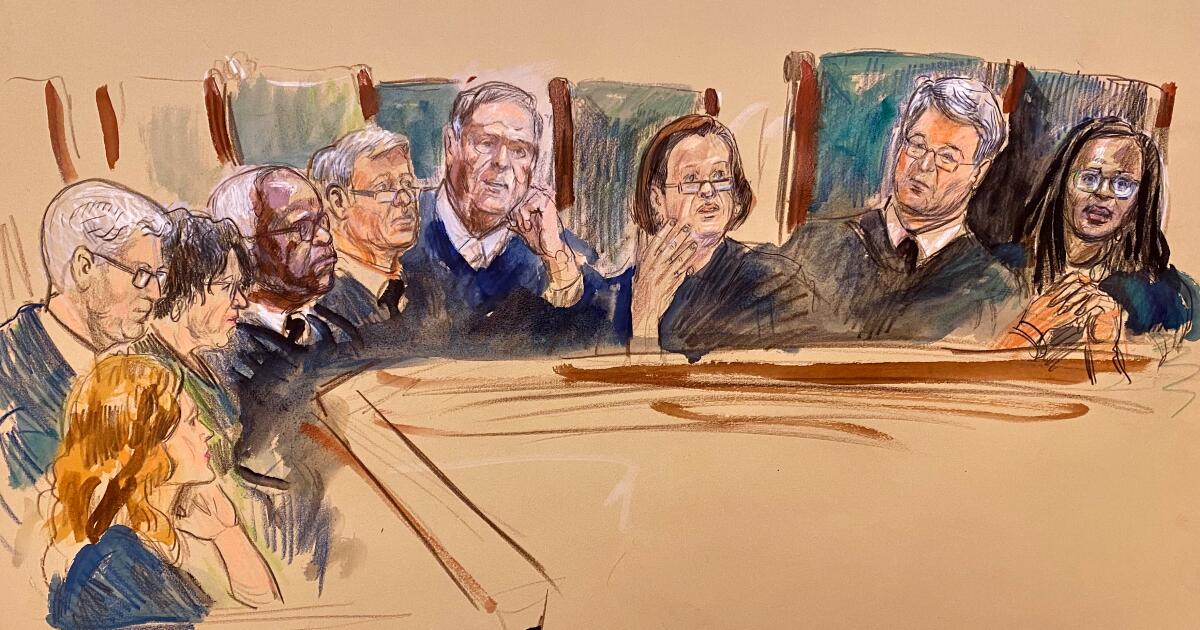
How Roberts led a fractured Supreme Court to wins for the right and defeats for Trump
-
 Science6 minutes ago
Contributor: Alcohol should be stigmatized like smoking
-
 Sports13 minutes ago
Thousand Oaks native Claire Liu finally reaches Wimbledon’s third round, will face Coco Gauff
-

 World21 minutes ago
Could water become a flashpoint between Islamabad and New Delhi?
-
 News46 minutes ago
Ukraine latest / Limits of military might / Can major powers regain dominance? : Sources & Methods
-

 Los Angeles, Ca2 hours ago
Juvenile charged with murder after 4-month-old Claremont infant thrown to her death
-

 Detroit, MI2 hours ago
Silence from Jalen Duren’s camp is what the Pistons want to hear
-

 San Francisco, CA3 hours ago
Jury deadlocked on 2 counts for Golden Gate Bridge pro-Palestinian protesters

