News
How a Nation of Immigrants Traces Its Roots


Why are there so many Greeks in Tarpon Springs, Fla.? Because in the early 1900s, Greek sponge divers came from the Dodecanese islands and revolutionized the sponge industry on Florida’s gulf coast.
What explains the pockets of Portuguese and Cape Verdeans in New Bedford, Mass.? In the 1800s, winds pushed whaling boats east to the Azores and Cape Verde, where experienced whalers joined the crews.
There’s the Basque population in Boise, Idaho, whose ancestors traded a mountainous region between France and Spain for the American West in the hopes of finding gold but later turned to sheep herding. There are the families of Yemeni immigrants hired by Ford Motor Company to build cars in Detroit, and the Vietnamese refugees who were resettled near New Orleans and Houston, where they could carry on shrimping.
These stories are everywhere on this map of American ancestry, which shows how people described their backgrounds to the Census Bureau. There are nearly 200 unique identities represented; blend them — as 340 million Americans do — and we arrive at a jumbled, overlapping, story-filled infinity.
Much of what we see is a history of immigration. Over 250 years, the country has absorbed more than 100 million people. We can trace the pressures that pushed and pulled them here — and the policies that welcomed certain groups while keeping others out — through the patterns in where their descendants live today.
Now, a larger share of the country was born abroad than ever before, and the Trump administration’s sweeping immigration bans echo exclusionist policies enacted in response to similar demographic conditions a century ago.
Those policies defined Americans for generations. Recent efforts to limit immigration will likewise affect how future Americans understand their heritage and themselves.
How we got here
In the late 1700s, the area that would become the present-day United States was already diverse. At least 1.5 million Native people, and possibly many more, were living across the territory. They were joined by about three million Europeans and enslaved Africans living in both the English colonies and the French and Spanish territories.
From colonial times, immigration was an important contributor to population growth. It accelerated as the new country’s territory expanded west and immigrants arrived to settle it. From 1820 to 1860, more than five million people came, through a mostly open door.
With the advent of the steamship, the cost of passage plummeted, and companies offered special immigrant fares that were often coupled with rail tickets to the interior of the country. Once a community of immigrants was established somewhere, it tended to grow.
After 1840, immigration from Western Europe began to rise quickly as political instability in Germany and the famine in Ireland drove people to leave. Asian immigrants, drawn by the discovery of gold in California in 1848, were recruited to work on farms and railroads.
Later in the 19th century, pogroms across Eastern Europe and the aftermath of Italian reunification drove a surge of migration to the United States. From 1880 to 1920, 24 million immigrants arrived. They went almost everywhere except the South, where the land-owning elite already had cheap labor from the formerly enslaved and poor tenant farmers.
Cities swelled. In 1910, according to the Ellis Island National Museum of Immigration, three-quarters of the residents of Boston, Chicago, Cleveland, Detroit and New York City were immigrants or children of immigrants.
1850
2 million total immigrants
The 1850 census did not include data on the birthplace of enslaved people.
1910
14 million total immigrants
1970
9 million total immigrants
2024
50 million total immigrants
Many rural areas in the Midwest had a similar share of immigrants in 1910, but newcomers to the cities tended to be from novel sources like Russia or Italy. That meant there were more languages, more cuisines and more workers. It also meant there were more crowds, more slums and more people behaving in unfamiliar ways — fodder to drive views that the new immigrants were unassimilable and that policies were needed to keep them out.
The first federal law to severely limit immigration had come much earlier, in 1882, when practically all Chinese people were barred from entering the country. More restrictions followed, and eventually animosity toward new immigrants led to the passage of laws in the 1920s creating a quota system tied to nationality.
Western Europeans were given generous quotas and Southern and Eastern Europeans much smaller ones. For the rest of the Eastern Hemisphere, the quotas were set to almost nothing. Ships raced through the night to reach New York Harbor, all trying to be first to dock at Ellis Island.
There weren’t quotas for countries in the Americas and the Caribbean, but there were other restrictions. Mexicans faced mass deportation campaigns in the 1930s and 1950s, even as millions were recruited as temporary workers to fill agricultural jobs across the Southwest.
Over the next 40 years, these rules drove the foreign-born population in the United States to its lowest levels. Children of immigrants replaced immigrants, blending into American society while retaining their own cultural traditions.
Then, alongside the civil rights movement of the 1960s, activists and lawmakers who saw the national quota system as racist pushed to replace it with one based on employment and family ties.
Another decades-long wave of immigration followed, this time from different parts of the world.
Chart data is unavailable.
Share of immigrants in the United States by region of birth
The new rules allowed people to sponsor their family members and relatives, and they gave preference to workers with advanced degrees and specialized skills. The family visas, in particular, led to an unforeseen boom in immigration.
An expanded refugee program also brought more immigrants, many from Southeast Asia who were displaced by Cold War conflicts.
For the first time, immigrants from the Western Hemisphere faced limits on their numbers. Similar to the European workers who arrived earlier in the century, many chose to settle in the United States permanently instead of risking returning to their home countries between periods of working in the United States. Millions who couldn’t get visas turned to entering illegally.
The most recent immigration wave, during the Biden administration, was different still: The number of visas for immigrants remained steady, while migrants from Central America arrived at the southwest border in large numbers to seek asylum. Desperate conditions in Cuba, Haiti and Venezuela, as well as wars in Afghanistan, Ukraine and elsewhere led hundreds of thousands of people to flee to the United States — many of them drawn to established communities of immigrants from their countries.
Where we are today
The lines of American ancestry today are not neatly drawn, and groups overlap and spill into one another. Some people don’t answer the census questions about their origins at all. For others, it’s complicated. Descendents of enslaved people, for example, may identify themselves as African American because they are unable to trace their roots to a specific place.
Many areas have truly mixed populations, with people of several different ancestries nearly equally represented.
Take this area just southwest of Houston, for example:
Nigerian, Jordanian, Mexican, Vietnamese, African American, Salvadoran, Iraqi, German, English, Irish and Chinese people are all among the top groups in these neighborhoods.
Every city has its own distinct pattern, visualized in the the patchwork of gold, green and blue in Los Angeles, the stark reds, blues and yellows of Chicago, a purple Minneapolis, a green Honolulu:
Who comes next?
If the patterns in these maps reflect the immigration policies of at least a century ago, we can expect them to shift and change again as a result of contemporary decisions about who makes up the American mosaic.
No comprehensive immigration legislation has passed Congress since the 1980s. After a surge of immigration during the Biden administration, in which an estimated eight million people entered the country over three years, demographic experts now estimate that the United States could reach net-zero or negative immigration sometime soon. That is in part because of the Trump administration’s aggressive actions to speed deportations of people who are in the country illegally and to limit pathways to legal immigration.
At the same time, the factors that pull immigrants to the United States remain strong. And, unlike 100 years ago, the country now faces a declining population and work force. The tension between the need for new workers and resurgent nativist politics will influence who comes, who settles and who is counted among the ancestors of future generations.
About the data
The ancestry maps in this article and the related interactive map draw from seven tables of race, ethnicity and ancestry data that the Census Bureau published as part of the American Community Survey estimates for 2019-2024.
The census ancestry and origin data are estimates based on a sample of the population and include margins of error that can be large for small population groups. We used the estimates published by the Census Bureau without adjustment.
In the survey, respondents are asked questions about their race and whether they are of Hispanic or Latino origin. Each of those questions allows respondents to list their national origins. An additional question asks about their ancestries. People can claim multiple ancestries or origins and appear in multiple categories.
Some groups appear in multiple tables. For example, people can select “white” as their race and list “German” as a specific origin. Separately, anyone can also choose “German” in response to the survey’s ancestry question. For such groups, we used the table with the higher value for the country as a whole. In a small number of cases, similar ancestries were grouped together.
Colors for each census tract are blended based on the adjusted number of people who reported being of each race and ancestry in the tract, for each group above a minimum threshold.
In charts of the immigrant population, counts come from Census Bureau research publications, the 2000 census and the American Community Survey. Those counts include only foreign-born residents and exclude any descendants born in the United States.



Former Federal Election Commission Chairman Trevor Potter testifies during a Senate Rules and Administration Committee hearing on artificial intelligence and the future of elections on Capitol Hill in Washington, D.C., Sept. 27, 2023.
Drew Angerer/Getty Images
hide caption
toggle caption
Drew Angerer/Getty Images
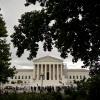
The Supreme Court struck down limits on how much political parties can spend in coordination with their candidates in a 6-3 decision split along ideological lines. The ruling is the latest in a series of Supreme Court decisions that have loosened campaign finance restrictions, overturning a 2001 precedent that upheld the spending limits.
Former Federal Election Commission Chairman Trevor Potter, who now serves as president of the Campaign Legal Center, joined NPR’s Morning Edition to break down the ruling. Speaking to NPR’s Michel Martin, Potter discussed why the court reversed its earlier precedent, how the ruling changes campaign finance rules and whether greater transparency could address concerns about corruption.
Listen to the full interview by clicking on the blue play button above. And read takeaways from the conversation below.
The post-Watergate limits were meant to prevent corruption
Potter said they were designed to stop donors from routing large contributions through national party committees to directly fund a favored candidate’s campaign. The restrictions were intended to prevent “an obvious way around” campaign contribution limits.
The court previously upheld the same limits
Asked why the Supreme Court upheld the law about 20 years ago, Potter said the justices concluded the restrictions were a constitutional way to prevent corruption. He said the court viewed them as an “anti-circumvention measure” to stop donors from using political parties to bypass contribution limits.
Potter rejects the majority’s rationale
Potter rejected the majority’s view that political parties have less political power than outside groups, saying earlier Supreme Court decisions allowing unlimited outside spending created that imbalance. He pointed to Justice Elena Kagan’s dissent in support of that argument.
Disclosure wouldn’t necessarily reveal private fundraising arrangements
Potter said disclosure alone would not address his concerns because it cannot reveal private agreements between candidates and donors. While campaign donations to political parties are public, he said voters would not see behind-the-scenes requests from candidates asking donors to contribute to party committees that later support their campaigns.
“We’re never going to see that,” Potter said. “I don’t think there’s a way to practically disclose those backroom deals.”
This interview was written for the web by Majd Al-Waheidi and edited by Treye Green.

A woman suffered several injuries but survived falling 1,500 feet down California’s Mount Shasta on Sunday, officials said.
The climber, 31, was attempting to ascend the mountain, which is technically a stratovolcano with the second-highest peak in the Cascades, according to the U.S. Forest Service. She was climbing in a group of three novices at an elevation of around 13,000 feet when she fell.
She suffered a suspected ankle fracture and “additional injuries consistent with the significant fall,” although she was found alert and “in good spirits,” the forest service said. Officials haven’t identified the climber.
Efforts to locate and rescue the woman got underway at around noon on Sunday and involved three climbing rangers from the forest service as well as members of the California Highway Patrol. An initial helicopter search was limited because of cloud cover on the mountain, the forest service said, prompting one ranger to ascend a portion of the mountain on foot to reach her. One member of the woman’s climbing party helped carry rescue equipment, as did a fourth climber who stopped to assist.
California Highway Patrol safely removed the woman from the mountain at around 5:30 p.m., and she was eventually taken to Mercy Medical Center Mount Shasta for medical care, according to the forest service.
The agency said the woman’s fall “serves as an important reminder that Mount Shasta is a high-altitude mountaineering environment, not a hike,” and “experienced climbers can encounter rapidly ranging weather, steep snow and ice, rockfall, and hazardous fall conditions.”
It also encouraged prospective climbers to “be honest about your experience and physical conditioning” before attempting to summit the mountain.
The woman and her climbing party were ascending Mount Shasta along a route called Avalanche Gulch, which “is steep and rigorous requiring crampons, a mountain axe, helmet, and basic snow travel skills,” according to the Mount Shasta Avalanche Center. It takes climbers up a 7,000-foot vertical ascent that features “steep snow and ice, rock fall, and weather extremes,” the center said.

It’s a tiny restaurant in the Little Morocco neighborhood of Queens. But throughout this World Cup, it has swelled with pride, song and beating drums as the Moroccan national team has pushed its way deep into soccer’s biggest international tournament.
It’s a scene that has been echoed across the United States — in a multitude of languages and colors, as soccer fans from all over the world, many now making their homes in America, have packed bars, restaurants, living rooms and concert venues.
No matter where they came from or where they gathered, they all sought the same experience: a chance to watch their nations compete while surrounded by others who share passion and pride for the country they or their ancestors once called home.
Together, these fans have brought places throughout the United States to life.
Bosnia vs Qatar
Bosnians Rejoice in St. Louis, Mo.
Thousands of Bosnians settled in the St. Louis area during the 1990s, as war and genocide ripped their communities apart. The city is now home to more than 60,000 Bosnians, scores of whom gathered at Bevo Caffe Lounge on June 24 to watch Bosnia and Herzegovina play.
This is only the second time the team has qualified for the World Cup — and the first time it has reached the knockout round. Its reward: Meeting one of the hosts, the United States, on Wednesday in Santa Clara, Calif.
Haiti vs Brazil
In Miami, Little Haiti Comes to Life
More than 100,000 residents of Miami-Dade County, Fla., are of Haitian descent, and the Little Haiti neighborhood of Miami has long been their central hub.
During the World Cup, fans of Haiti’s team have flocked to the neighborhood, packing restaurants, bars and even parking lots to watch the action. Many have come wearing jerseys, while others simply dressed in the red and blue of the Haitian flag.
Haiti ended up in a tough group, losing all of its matches, including a 3-0 defeat to Brazil on June 19. But for some fans, the fact that the team had qualified at all was its one victory. Before this year, Haiti had played in only one other World Cup, in 1974.
Morocco
Moroccan Joy in Queens, N.Y.
Touria Lamtahaf worked as a chef four years ago at a restaurant in Astoria, Queens, in the heart of an enclave on Steinway Avenue known as Little Morocco.
After the Moroccan team upset Portugal in a World Cup quarterfinal, Ms. Lamtahaf remembers hundreds of Morocco fans surging onto Steinway Avenue, setting off flares and red smoke bombs to celebrate.
“It was a good memory for all of us,” she said. “We were very proud. You just needed something to be happy. After Covid, this was amazing.”
The neighborhood has long been a hub for immigrant communities from North African countries, including Egypt, and is also home to a large Greek community.
Many settled in Astoria decades ago, drawn by low rents and a neighborhood that could feel calm compared with other bustling parts of New York. Ms. Lamtahaf, who moved to the United States in 2007, said that she originally lived in Ridgewood neighborhood of Queens, but word of mouth led her to Astoria, where she now runs her own restaurant.
The restaurant, Dar Lbahja, is just a few blocks from where she used to work. Ms. Lamtahaf said that when she opened it just over a year ago, she wanted to create a space where people could not just eat, but also gather to watch soccer, like she did growing up with her father in Morocco.
“It was only one TV, and we had to watch with him,” Ms. Lamtahaf said. “So we grew up with the soccer.”
During this tournament, Morocco fans have packed into Dar Lbahja on game days, with many in Morocco’s red jersey, and others in the team’s white kit. They were rewarded with a berth in the knockout stages, and then again on Monday when their team won a tense matchup with the Netherlands in a penalty shootout.
Fans took to the streets in jubilant celebration, just as they did in 2022.
Kacem Ettahali, 19, of Houston, is spending the summer in New York for an internship and watched the first Morocco game of the tournament on June 13 at the restaurant.
After the team scored, Mr. Ettahali received a flurry of texts from his friends. “When they think of Morocco, they think of me,” he said.
He wasn’t the only Texan in the joint. Jori and Ahmed Lamghari traveled from the Dallas area because Ms. Lamghari, 43, wanted her husband to experience the city during the tournament. “I wanted him to get the New York World Cup vibe,” she said.
Mr. Lamghari, 33, said that “Moroccans make their own ambience,” adding, “We want to live it.”
France vs Norway
In Chicago, Hope for Another French Title
The French love a good outdoor drinking venue. For the country’s June 26 match against the rowing Norwegians, fans gathered on the outdoor patio of Soccer House in Chicago, a city whose deep French roots stretch back to the colonial days.
France is widely considered a tournament favorite, potentially giving its fans several more opportunities to celebrate.
Argentina vs Austria
In Provo, Utah, Messi Mania Is a Family Affair
Sporting the colors is intergenerational in Provo, Utah. Luis and Lidia Peve moved there 25 years ago, following a son who emigrated first, and decorated their home with small Argentina flags ahead of the team’s match against Austria on June 22.
As game time approached, about a dozen members of the family painted their faces with the sky blue and white of Argentina’s flag. Together, they sat around the TV with their eyes trained particularly on Lionel Messi, the team’s star, who is likely playing in his last World Cup.
He finished the game with three goals — a hat trick — and a new generation of fans in the Peve household.
D.R. Congo vs Colombia
In Silver Spring, Md., a Happy Return to the World Cup
Congolese fans in Silver Spring, Md., belted out their national anthem in a veterans hall, hands over their hearts, ahead of the country’s match against Colombia on June 23.
Refugee aid programs have resettled many Congolese families in the suburbs north of the nation’s capital, as their nation has been rived by war, unrest and now an Ebola outbreak.
The Congolese side lost its match to Colombia on that day. But the team managed to advance out of the group stage for the first time in its history. Before this World Cup, the country had been to the tournament only once, in 1974, when it lost all of its matches.
Portugal
A Block Party of Red and Green in Rhode Island
The go-to drink special last weekend in East Providence, R.I., was a vodka cocktail called the CR7. And you’d be hard-pressed to find a resident of the region who didn’t know it was in honor of Cristiano Ronaldo, the 41-year-old Portuguese striker who is playing in his sixth — and likely last — World Cup, wearing his famous No. 7.
The drink was served at the Portuguese restaurant O Dinis, a neighborhood staple. A large number of Portuguese immigrants settled in this corner of Rhode Island and nearby Massachusetts during the Industrial Revolution, finding work in the textile, whaling and manufacturing industries.
“Life is beautiful in Portugal,” said Natalia Paiva-Neves, who moved to the United States when she was 16 and now runs O Dinis, which was founded by her father. “But at the time, there was a lot of poverty, because there were no jobs, and there was no tourism. There was none of that stuff going on, so you had to find a means to provide for your family.”
After pre-gaming over CR7s, along with beer, wine, meats and shrimp, some fans walked from O Dinis to a watch party that stretched for two blocks, from a screen in the parking lot of nearby Cafe Alma to Campino’s, another Portuguese restaurant.
“It’s just a great feeling,” said Kevin Matos, the cafe’s owner. “Everybody’s enjoying themselves. It doesn’t matter the result on the screen.”
Some fans might not have agreed, though a scoreless draw sent both teams through to the knockout stage.
The block party, with hundreds of fans lining the streets, was in part the brainchild of East Providence’s mayor, Roberto DaSilva. “We had no idea that it’d be this many people showing up,” he said. “We thought we got a good crowd, but this is much more than than I ever expected.”
Some had to stand on their tiptoes see the screens. Others packed into shops to sit down and watch the game, while others pulled out their phones as they stood in line to buy beer and snacks from food trucks and vendors.
Mexico vs South Korea
A Backyard Party in a Texas Border Town
Roughly four out of five residents in the Texas border town of Weslaco are of Mexican descent, making the country’s June 18 match in Guadalajara feel like a home game.
For a youth soccer team, it was a chance to watch their heroes take another step toward the knockout rounds.
Under the night sky, they watched anxiously, breaking into dance after Mexico won.
Uruguay vs Spain
Elimination Brings Anguish to Uruguay Fans in Miami
Uruguay needed this one. The nation that hosted the first World Cup in 1930, winning the tournament that year and again in 1950, was on the brink of elimination last week against Spain — considered one of the strongest teams in the tournament.
Fans at Doña Paulina, a Uruguayan restaurant in Miami, anxiously watched their team fight for a chance to stay in the competition.
It wasn’t to be. Spain emerged victorious, 1-0.
Japan vs Tunisia
In San Diego, Fans Cheer the Samurai Blue
Their team is called the Samurai Blue, and the many Japanese fans living in Southern California — a diaspora that first settled there in the late 19th century as farmers and fishermen, and endured harsh incarceration during World War II — made their blue kits prominent as the team played its way through a so-called group of death.
They eventually earned a second-place finish to reach the round of 32. The result was a Monday matchup with Brazil, in which Japan fell 2-1.
Iran
In Los Angeles, Mixed Feelings About the Iranian Team
For Americans from Iran, supporting the Iranian national team has been a thorny issue.
Some have refused to even watch the matches. To them, the team feels like an extension of the government, whose persecution drove many to flee the country. It’s especially difficult as their new home, the United States, and their old home are at war.
“That’s a little conflict for me,” said Roozbeh Farahanipour, who helped lead an Iranian student uprising in 1999 and fled the country the following year, seeking political asylum in America. “I am a little different from other fans, because no way I can cheer or stand for either Islamic Republic of Iran’s national anthem, nor for the flags.”
He added, “I am American now. My flag is the U.S. flag.”
Others of Iranian descent have eagerly backed the national team and bristled at its travails, especially in Southern California, which was host to the team’s first match and is home to the largest diaspora of Iranians outside Iran. Many live, shop and eat in the Westwood area of Los Angeles, where an enclave has become known as Tehrangeles, after the Iranian capital.
Still, compared with those of other diasporas, gatherings to back the Iranian team have seemed smaller and more muted. Only a handful of fans gathered at Attari Sandwich Shop, a Persian eatery in the heart of Tehrangeles, during Iran’s June 21 match against Belgium at SoFi Stadium in nearby Inglewood, Calif.
Inside the restaurant, some fans anxiously watched the game over kebab plates and pastries. Others outside proudly waved their flags on the neighborhood thoroughfare, Westwood Boulevard.
Bijan Bahmani, who lives in Los Angeles, took his 2-year-old son to Iran’s match against New Zealand on June 15 in Inglewood with his father-in-law. While he opposes the Iranian regime and hopes for democracy one day, Mr. Bahmani said he still wanted to cheer to the national team.
“It’s complicated, because we have feelings a lot of different ways, with the complicated politics,” said Mr. Bahmani, 41, who moved to the United States in 2001. “I am definitely rooting for Iran because they represent Iran, not the government.”
Even as he took in the game with this family, Mr. Bahmani said the war was on his mind.
“I hope this peace lasts,” he said, referring to the current fragile cease-fire. “Every day, we’re worried.”
Cape Verde vs Saudi Arabia
Celebrating the Small but Mighty in New Bedford, Mass.
Every tournament has a surprise underdog. This year, it’s Cape Verde, a small island nation off the western coast of Africa. Its team had an opportunity on Friday to become the smallest country by population ever to advance to a World Cup knockout round.
The pivotal match drew people of Cape Verdean descent to a veterans hall in New Bedford, Mass., about an hour drive south of Boston. Like Portugal and Brazil, whaling and related industries brought a sizable population of immigrants from Cape Verde to southeastern New England.
A scoreless tie with Saudi Arabia was all it took for tears and roars to erupt in the veterans hall. Their team would keep playing, for at least one more game.
Brazil vs Haiti
A Brazilian Dance Party Near Boston
Massachusetts has a long history of Portuguese-speaking settlers, making Brazilians feel welcome in the Boston area. That’s especially the case in the southwest suburb of Framingham, Mass., where the Brazilian-born population rivals that of Boston.
They packed into Tropical Cafe, a Brazilian restaurant in Framingham, gathering around hightop tables as their team played Haiti on June 19. After Brazil secured a 3-0 win, fans made the restaurant an impromptu dance club to celebrate.
Germany vs Curaçao
In Texas, German Fans Root, and Eat, to Honor a Neighbor
Bratwurst and steins of beer accompanied the match at Bavarian Grill in Plano, Texas, a Dallas suburb, as Germany played Curaçao in Houston on June 14. But perhaps the city’s most important fan of the German team was not there.
Jürgen Mahneke, who was born in Braunschweig, Germany, immigrated to the United States in 1984, and worked in hotels across the country before settling in Plano.
He opened the restaurant in 1993, and died at age 67 on June 10, a day before the World Cup began.
His restaurant went on with the planned festivities. One of the managers said Mr. Mahneke would have wanted them to. His team won its opener, 7-1, but went home on Monday, falling to Paraguay in a heartbreaking penalty shootout — the opposite of Morocco’s elating win hours later.
-

 South Dakota2 minutes ago
Families celebrate 250th in South Dakota
-

 Tennessee7 minutes ago
Parasite-induced ‘explosive’ diarrhea cases rise in Tennessee. Here’s what to know
-

 Texas14 minutes ago
New date set for opening of Six Flags Over Texas’ Tormenta Rampaging Run coaster after delay
-

 Utah17 minutes ago
Wasatch Front cities running out of water called a ‘myth’
-
Vermont22 minutes ago
VT Lottery Powerball, Gimme 5 results for July 1, 2026
-

 Virginia29 minutes ago
House Bill 301 takes effect in VA, ending 50 years of limits on adoptee birth records
-

 Washington32 minutes ago
Where Texas became Texas: Washington-on-the-Brazos plans July 4 celebrations
-

 Wisconsin37 minutes ago
How much will Shawn Eichorst make as Wisconsin Badgers’ athletic director?

