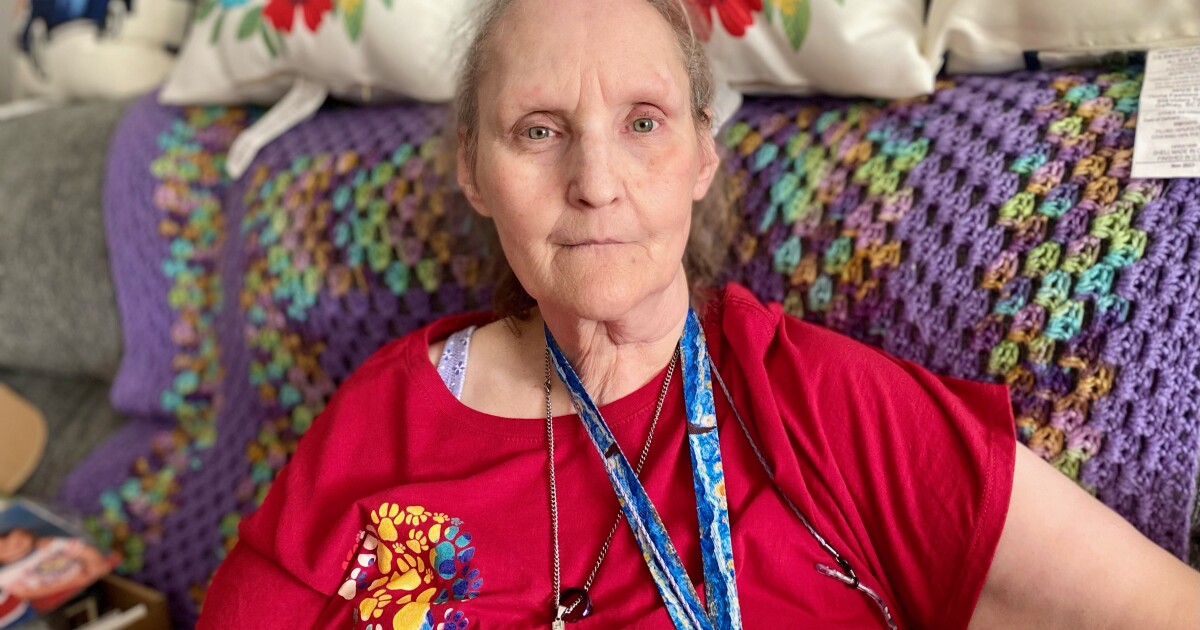
When her husband died in 2021, Lorraine Blanchard didn’t know what to do. It had been a while since she’d lived by herself, and she ended up getting sick and landing in a hospital. When she was released, she moved into a shared room in an assisted living facility.
“I felt it wasn’t my home,” she said, “and I really need to be in my own home.”
Then, Blanchard learned about Champlin Place, a new 65-unit building in Rochester. The low-income independent living community, run by Easterseals New Hampshire, is designed for seniors like her. Blanchard applied and moved in this year.
Blanchard, who has secondary Parkinson’s, gets visits from a home health aide a few times a week, catches rides to an adult day center down the street, and receives deliveries from Meals on Wheels. She can navigate her apartment with her walker. She spends time doing art projects, listening to music and hosting friends.
Advertisement
“This is the place to come,” she said during a recent interview in her apartment, surrounded by boxes of family photos. “There’s no discrimination — everyone accepts each other for who they are.”
Low-income seniors pay between around $350 and $1,400 a month for apartments in Champlin Place, a new affordable housing property in Rochester run by Easterseals.
But there’s a lot of demand for this kind of living. At Champlin Place alone, the waitlist is more than 100 people long. Across New Hampshire, about one in five people are above age 65, and the population is steadily growing older. But with rents soaring and vacant housing in short supply, seniors with limited incomes face a particular challenge: finding an apartment that’s safe, affordable and aging-ready.
The shortage of affordable housing for older adults reflects the state’s larger housing crisis. Over the last five years, median rent has increased by 36%, according to New Hampshire Housing. Marie Poole, who manages properties and facilities for Easterseals, says some people’s rents have spiked by $400 to $600 a month.
“There are lots of people in the state of New Hampshire that are paying over 50% of their gross income in rent,” Poole said. “It’s a disastrous train wreck about to happen, if anything goes wrong in their lives.”
Advertisement
RoddHersey says worrying less about paying medical and housing bills, since finding a more affordable place to live, has given him more time to pursue artwork, ministry, and time with family.
Before moving into Champlin Place, Rodd Hersey was living in a mobile home in Nottingham. He heated it with firewood that he split and stacked himself. But he was also living with lung cancer, and the wood smoke was becoming dangerous. When his family first suggested Champlin Place, he hesitated.
“You know when you’re an old horse, you don’t like new things,” Hersey said. “But I learned to adapt.”
Hersey requested an apartment with a view onto the woods. In his living room, he’s set up his painting easel by the window.
Rent at Champlin Place costs between $1,100 and $1,400 a month, including utilities. Some residents, including Hersey, receive rental assistance and pay even less.
Advertisement
“I could never have dreamt that I would be in a place that is as nice as this for what I pay,” Hersey said, gesturing towards the kitchen’s granite countertops and new appliances.
Like many senior housing properties, Hersey’s apartment is designed for easy modification in case he starts using a walker or wheelchair. The cabinets under the sink are removable; the doors, windows and cupboards are easy to open. There are communal lounge areas indoors and outdoors to relieve social isolation, and paved walkways to accommodate wheelchairs.
Poole, who manages the property, said many people tell her that worrying less about how to pay medical bills and rent frees up time for the things that give life meaning.
“There are a lot of people here who have commented about how – not only have their lives become easier, they feel a sense of calm here that they did not have before,” she said.
The scarcity of housing like Champlin Place is prompting some seniors to move prematurely into assisted living facilities and nursing homes, which can be five times as expensive as monthly rent. Others stay in their houses even when it’s no longer safe, exposing themselves to health risks and their properties to decline.
Advertisement
Betsey Andrews Parker, the CEO of the Community Action Partnership of Strafford County, said she has seen this firsthand: some seniors live out of one room because they can’t afford to heat their large homes, others can no longer reach second-floor bathrooms and resort to using a bucket instead.
“There are really thousands of residents in New Hampshire who are living this way,” she said, “and people don’t know.”
A number of non-profit organizations, such as Avesta Housing, Easterseals, and local Community Action Partnerships, have helped build and operate affordable housing units in New Hampshire. The Gafney Home, shown here, was renovated by the Strafford County Community Action Partnership.
New Hampshire Housing Director Rob Dapice said some seniors are ready to move into more accessible and affordable units, but it’s not always easy — due to high interest rates, and a shortage of smaller homes and apartments.
“In many cases, downsizing would be prohibitively expensive,” he said.
Advertisement
Thus begins a vicious cycle, Dapice said. Seniors have nowhere to move, so their larger homes and apartments never become available for younger families. Those younger families continue to rent, rather than buy, which puts more pressure on the rental market. As a result, rent for everyone continues to rise.
Betsey Andrews Parker in the historic Gafney Home in Rochester. Once renovated, the property will have a communal downstairs space, 21 affordable housing units, and a garden.
Efforts to address New Hampshire’s housing shortage have been slow to take shape at the State House. As advocates push to modify zoning rules and make it easier to build from the ground up, some organizations have turned to another strategy: retrofitting existing buildings into senior housing.
In Berlin, developers recently converted a shuttered elementary school into affordable housing. In Laconia, a historic inn became affordable housing for seniors. In Rochester, the Community Action Partnership (CAP) of Strafford County is turning a Victorian mansion called the Gafney Home into 21 small apartments.
Converting a historic property into apartment buildings is often more expensive than a new build. At the Gafney Home, preserving the historic character — oversized windows, ornate fireplaces, stained glass windows — came at a cost. And there were other hurdles: supply chain delays, and retrofitting areas to make them handicap-accessible. The project has run $2 million over budget.
Advertisement
But Andrews Parker, who’s overseeing this work, says the ordeal is worth it.
On a recent tour of the project, she stood inside a two-bedroom apartment that already has a long list of applicants. She teared up imagining who might move in next month: a senior who needs a live-in caregiver, or someone who is still caring for a grown child or grandkids.
“This is exactly the kind of housing we need,” Andrews Parker said. “We need housing that’s beautiful, that’s safe, that people can really age in place in.”
The 120-year old Gafney Home served as an assisted living facility before closing in 2019. It needed significant renovations to reopen as an apartment building.
Sunflowers are my absolute FAVORITE flowers. I truly feel like they have magical uplifting abilities. Hence, why I’ve always kept fresh sunflowers in my house, brightening up my kitchen table or even my TV stand.
Obviously, it was a dream of mine to have my maternity photos taken in a sunflower field. They reflect sunshine and exude happiness.
Not to mention, one of my favorite quotes is about sunflowers! “Keep your face to the sunshine and you cannot see the shadow. It’s what sunflowers do.” Helen Keller
A beautiful reminder to keep an optimistic outlook on life and not dwell on the negative.
Advertisement
So, you can imagine the joy I felt when I learned that New Hampshire had its very own Sunflower Festival at Coppal House Farm in Lee!
Coppal House Farm via FacebookCoppal House Farm via Facebook
About the Sunflower Festival:
During the summer, the farm transforms into a sea of golden blooms, giving visitors the chance to wander through thousands of sunflowers, snap photos, enjoy local food vendors, artisan crafts, listen to live music, and experience one of New Hampshire’s most beautiful summer traditions.
Other unique activities on the itinerary? Sip-n-snip! Guests can enjoy a cocktail or mocktail of their choice and cut their own fresh bouquet of flowers.
Coppal House Farm via FacebookCoppal House Farm via Facebook
Or maybe you’re a yoga fan? You can join a 60-minute sweat session from Lee, New Hampshire yoga instructors right in the heart of the flower field.
And because the farm grows oilseed sunflowers for culinary oil (which they harvest in the fall months), the flowers only stay at their peak for a brief window, making the festival a limited-time experience, according to the festival organizers…
Advertisement
What makes this event even more special is the reason behind it. The festival started as a way to share the beauty of the sunflower fields, but it has grown into something much bigger. Organizers say the event has raised more than $90,000 for Make-A-Wish New Hampshire over the years and now shares a portion of its proceeds with several local nonprofit organizations serving the Seacoast community.
Anyone who knows me knows that paying it forward is something that’s incredibly important to me. It’s right up there with my love of sunflowers because both fill my cup in the best way. So, when I found out this festival celebrates my favorite flower and gives back to the community, I knew I had to share it.
Sunflower Festival Details:
This festival only runs from Saturday, July 25th until Sunday, August 2nd. You can get the full list of activities and more on the Coppal Farm website.
Daily Field Hours
Advertisement
10:00 AM – 6:30 PM (last admission at 6PM because fields close at 6:30) Weekend Tickets (prepurchased online – day before) $12 per person ages 13 & older $10 per person ages 5-12 $10 per person Seniors (65+) & Military 4 yrs & under are always free Weekend Tickets (purchased day of – online or at farm): $16 per person ages 13 & older $14 per person ages 5-12 $14 per person Seniors (65+) & Military 4 yrs & under are always free includes: access to sunflower fields, craft fair, food vending area, tented shade area, picnic area, farm animals, & live music
Weekday Tickets (prepurchased online – day before) $8 per person ages 13 & older $6 per person ages 5-12 $6 per person Seniors (65+) & Military 4 yrs & under are always free
Weekday Tickets (purchased day of – online or at farm) $12 per person ages 13 & older $10 per person ages 5-12 $10 per person Seniors (65+) & Military 4 yrs & under are always free
What tickets include: Access to sunflower fields, food vending area, tented shade area, picnic area, and farm animals
READ MORE: A Classic Fairy Tale Comes To Life At Portsmouth’s Prescott Park This Summer
Advertisement
This festival might just leave you smiling long after you leave the fields!
What Flowers Thrive in New England
See what flowers thrive in New England weather: Maine, Massachusetts, and New Hampshire.
Gallery Credit: Logan
14 of the Best New Hampshire Farms Offering Locally Grown Strawberries
14 of the Best New Hampshire Farms Offering PYO Strawberries
Ed. Note: If this was you and you are interested, please email [email protected] so I can put you in touch with OP.
“Dear PoPville,
I was biking home from a doctor appointment a little before noon on Friday, and stopped at a red light on New Hampshire & L st nw. There was a woman across the street who was looking fine in her dark blue (I think they were) scrubs. I might be crazy, but it felt like we kept checking each other out. By the third time,
if we were in a romcom, one of us would have waved. Sorry I didn’t, but if you are reading this and date men, reach out to the Prince if you are interested in that man on the bike. Have a great weekend!”
Ed. Note: If this is you, please email [email protected] so I can put you in touch with OP. PoPville is not affiliated with either party, please proceed with any potential connection at your own risk using caution as you would any online encounter. For those curious about past missed connections, many have been made and when possible I’ll try to update when/if more are made.
A New Hampshire motorcyclist who had been missing since the Fourth of July was found dead in Shelburne late Thursday night.
State police say they received a request from the Berlin Police Department just after 7:30 p.m. Thursday for help locating 41-year-old Wesley Grondin — the Berlin man was last seen riding his motorcycle on Saturday, July 4, and had been reported missing.
Troopers received a call a couple of hours later, around 10:10 p.m. Thursday, from a concerned resident who had been out looking for Grondin along Route 2 in Shelburne. The person told police they had found Grondin dead, along with his Harley Davidson.
According to state police, a preliminary investigation determined that Grondin was riding his Harley on Route 2 westbound in Shelburne when, for reasons that remain under investigation, he crossed over into the opposing lane, struck a post, and came to a final rest in the wood line.
Advertisement
The crash is believed to have occurred just before midnight on July 4. At this time, police say there’s no indication that another vehicle or person was involved.
All aspects of the crash remain under investigation, however. Anyone with information that may assist investigators is asked to contact Trooper Hunter Newsham at Hunter.P.Newsham@dos.nh.gov.