Northeast
Meet the American who was the 'working man' Founding Father, Irish ironsmith George Taylor

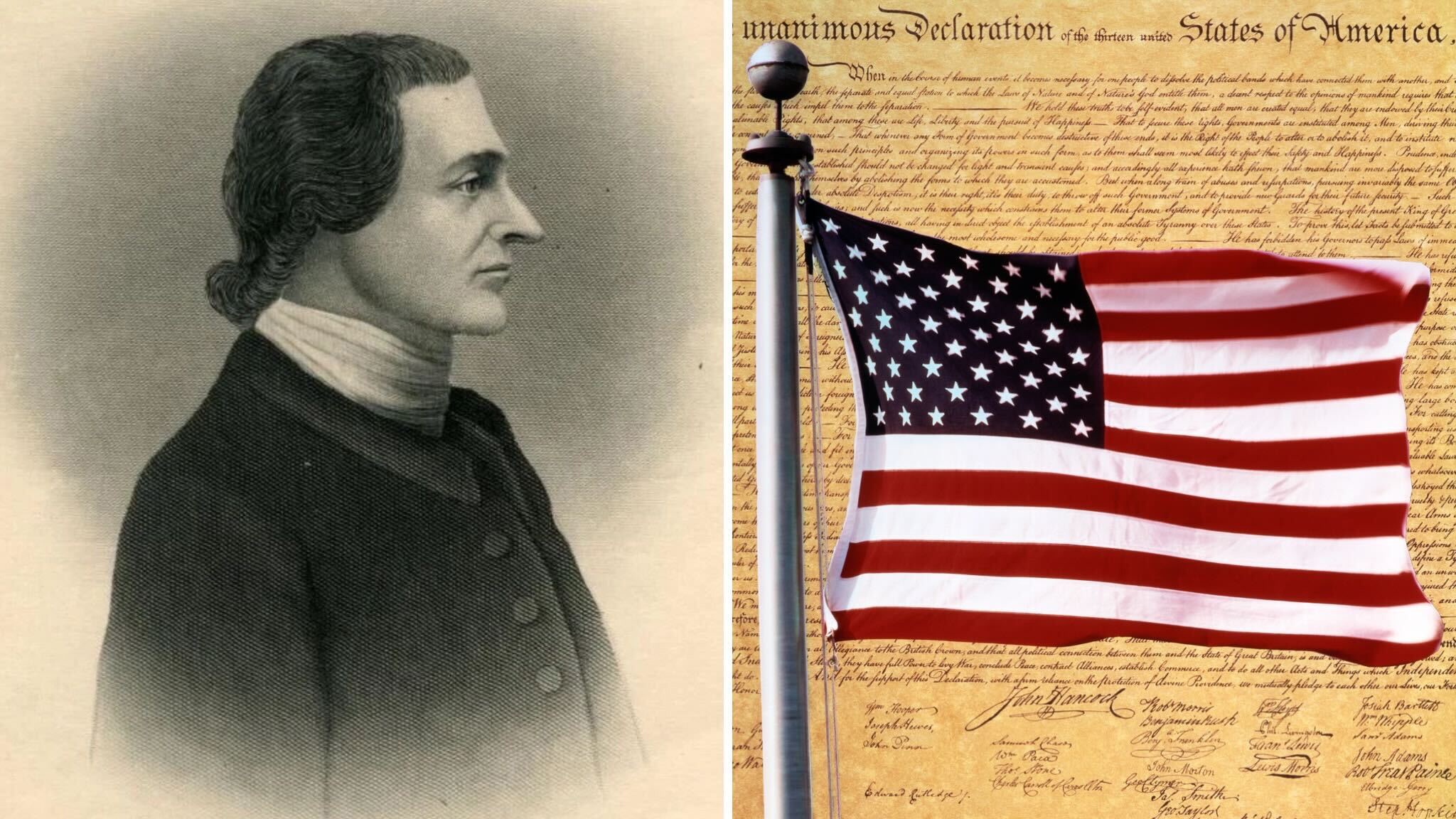
George Taylor was the Founding Father who earned his keep in America by sweating over hot coals.
He arrived in Pennsylvania from Ireland in 1736, an indentured servant to an iron foundry owner who paid for his passage to America.
He shoveled coal into a blast furnace, melting the abundant ore of the Lehigh Valley into pig, wrought and cast iron – later into musket and cannon shot, an arsenal of independence.
“Hard, dirty work,” said historian and author Tim Betz, curator of exhibitions at the Northampton County Historical and Genealogical Society in Easton, Pennsylvania.
MEET THE AMERICAN WHO MENDED DEFECTIVE INFANT HEARTS, VIVIEN THOMAS, HIGH-SCHOOL EDUCATED CARDIAC SURGEON
Taylor rose to become a wealthy foundry owner himself. In 1776, he joined a short list of just 56 men who propelled humanity out of darkness when he inked his name upon the Declaration of Independence.
Three of those men — Taylor, James Smith and Matthew Thornton — were born in Ireland, according to the National Archives.
George Taylor (1716-1781), circa 1765. A continental politician born in Ireland, he came to the American colonies in 1736 and became a member of the Pennsylvania provincial assembly and a signer of the Declaration of Independence. (Hulton Archive/Getty Images)
The Irish are the most represented people, other than those born in America, on the daring but triumphant call for a new world order.
Eminent historian Joseph Ellis, himself of Irish descent, told Fox News Digital that Ireland’s imprint on the foundational document of the United States is no surprise.
“The Irish were already committed to American independence.”
“The Irish already had hatred for Britain and King George III,” said Ellis, who wrote the Pulitzer Prize-winning historical account, “Founding Brothers,” among other books.
“Their own country had been overtaken and destroyed by the British. They didn’t have to read Thomas Paine’s ‘Common Sense.’ The Irish were already committed to American independence.”
Arrived in America ‘destitute’
George Taylor was born around 1716, most likely in the province of Ulster, in what is now Northern Ireland. Some accounts say he was born in Dublin, now the capital of the Republic of Ireland.
“He was the son of a responsible clergyman,” the Rev. Charles A. Goodrich wrote in an 1840 tome, “The Signers to the Declaration of Independence.”
View of the City of Philadelphia in the 18th century. Artist: George Heap (1714–1752). (Sepia Times/Universal Images Group via Getty Images)
Taylor planned to study medicine, Goodrich writes, but instead arrived in America “destitute.”
He went to work for Samuel Savage Jr., who owned the Durham iron works on the Delaware River, near Easton, and who paid for Taylor’s journey to America. The Irishman, like other newcomers of the era, was an indentured servant.
“Exploitative labor,” said historian Betz.
MEET THE AMERICAN WHO ROWED WASHINGTON ACROSS THE DELAWARE ON CHRISTMAS: SAILOR-SOLDIER JOHN GLOVER
Taylor began at the bottom, fueling fires hot enough to melt iron.
“He worked his way up from furnace filler, to clerk, and then manager as the owner became aware of his education and aptitudes,” writes the Durham Historical Society.
Durham Iron Works, where Taylor oversaw production of cannon shot and shells for the Continental Army. (“History of Bucks County, Pennsylvania,” William Watts Hunt Davis, 1876, Public Domain)
Taylor’s aptitudes apparently caught the attention of another Savage: the owner’s wife.
Samuel Savage died in 1742. Taylor married his widow, Ann, in 1743.
The circumstances of their relationship are unknown, said Betz.
Goodrich writes only, “Upon the death of Mr. Savage, [Taylor] became connected in marriage with his widow.”
“He worked his way up from furnace filler, to clerk, then manager as the owner became aware of his education and aptitudes.”
One circumstance is known. “In a few years the fortune of Mr. Taylor was considerably farther increased.”
The indentured servant who shoveled coal spent much of his time running the business of ironmaking.
The Pennsylvania Regiment, 1760. Corporal. One of a collection of 12 watercolors of American Colonial militia uniforms, 1756-1761. Figure in blue, orange and white with rifle facing right. Artist Herbert Knotel, 1949. (Pierce Archive LLC/Buyenlarge via Getty Images)
He also served as a captain in the Pennsylvania militia, and became a vocal member of both the Pennsylvania assembly and its Committee of Correspondence.
Those same colonial committees eventually served as a shadow government that pushed the American colonies toward independence from Britain.
His ‘sacred honor’
The Founding Fathers are widely portrayed as triumphantly signing the Declaration of Independence on July 4, 1776 — Independence Day in America.
The reality is quite convoluted and procedural. Most notably, “nothing really happened on July 4th,” said Ellis.
A feather quill and inkwell sitting on top of the American Declaration of Independence. The quill and inkwell sit next to the scribing of one of the most famous dates in world history, July 4, 1776. (iStock)
The Second Continental Congress voted for independence two days earlier. Twelve of the 13 colonies voted in favor; New York abstained.
“The Second Day of July 1776, will be the most memorable Epocha, in the History of America,” John Adams wrote to his wife Abigail in Massachusetts the following day.
MEET THE AMERICAN WHO LED 77 MINUTEMEN AGAINST 700 REDCOATS AT BATTLE OF LEXINGTON: CAPTAIN JOHN PARKER
“I am apt to believe that it will be celebrated, by succeeding Generations, as the great anniversary Festival.”
Congress approved the language and sent it to the printer two days later. Splashed in bold across the top of the document was this: “In Congress, July 4, 1776.”
The Declaration of Independence that we picture today, headlined by the dramatic signature of John Hancock, was not signed until Aug. 2.
George Taylor’s signature, as featured on the Declaration of Independence. (Descendants of the Signers of the Declaration of Independence (DSDI))
It was the moment of truth, the day the revolutionaries publicly declared their opposition to King George — and, in the eyes of the crown, declared themselves traitors to suffer death by hanging.
“We mutually pledge to each other our Lives, our Fortunes and our sacred Honor,” reads the last sentence of the most influential and politically radical document in human history.
“We mutually pledge to each other our Lives, our Fortunes and our sacred Honor.”
John Hancock added his oversized splash of ink below those words first; 49 of 56 signatories followed, Taylor among them. The remaining six followed at later dates.
“I would say that of all the people who are in that room,” said Betz, “he was the one we might say was a regular guy. Just a working guy.”
The working man Taylor’s labor in support of the American Revolution was not over.
George Taylor discussed the iron forge business in a 1780 letter while the American Revolution was still being fought. Taylor arrived in America as an indentured servant from Ireland in 1736, later signing the Declaration of Independence in 1776. (Paul Frasier/Paul Frasier Collectibles)
“Taylor transformed the ironworks into a munitions factory for the Continental Army. Durham produced cannon, cannonballs, shot, and other military equipment, probably at a financial loss,” writes ExploreHistoryPA.com.
“Taylor’s commitment to an independent United States took precedence over financial gain.”
A ‘promise for future generations’
George Taylor died on Feb. 23, 1781 in Easton, around age 65.
He had been stricken with illness in 1777 and ended his public service, according to the Pennsylvania Center for the Book.
He’s buried at Easton Cemetery, beneath a monument erected in his honor in 1854.
George Taylor, as he appeared in a document, circa 1876, of portraits and autographs of the signers of the Declaration of Independence. (HUM Images/Universal Images Group via Getty Images)
Taylor did not himself live up to the standards set forth in the Declaration of Independence, most notably the ideal that “all men are created equal.” He owned two slaves.
But the power of the Declaration of Independence is that it gave humanity, for the first time in its history, political standards and ideals.
“Abraham Lincoln called those words the most important in American history,” said Ellis. “He said they were not for immediate effect, but were a promise — a promise that we in future generations need to live up to.”
The Declaration of Independence “helped to inspire countless movements for independence, self-determination and revolution after 1776.”
Ireland’s impact on the Declaration of Independence ran deeper than just its three signatories, each of whom represented Pennsylvania.
Charles Thomson, the secretary of the Continental Congress, assigned among other duties to revising the final Declaration, was born in Ireland.
So, too, was printer John Dunlap, the man who put the July 4th date on the document.
The signatures to the American Declaration of Independence. Illustration from “Story of the British Nation, Volume III,” Walter Hutchinson (London, c1920s). (The Print Collector/Print Collector/Getty Images)
They came from what’s now both Northern Ireland and the Republic of Ireland.
“The people of the United States and of Northern Ireland remain closely bound by these deep, historic ties and by the values we share,” James Applegate, Consul General for the U.S. Consulate General Belfast, said in a statement sent to Fox News Digital.
Fox News Digital requested comment from the Embassy of the Republic of Ireland in Washington, D.C.
Signers Thomas McKean, George Reed and Edward Rutledge were the children of Irish immigrants. Lt. Col. John Nixon, the first man to read the Declaration of Independence in public in Philadelphia on July 8, was also the son of an Irish immigrant.
George Taylor was born in Ireland, arrived in America as an indentured servant and signed the Declaration of Independence, with U.S. flag and Declaration composite. (Hulton Archive and H. Armstrong Roberts/ClassicStock both via Getty Images)
The statement of purpose and revolt was “the first successful declaration of independence in world history,” historian and author David Armitage wrote for the Gilder Lehrman Institute of American History.
“Its example helped to inspire countless movements for independence, self-determination, and revolution after 1776.”
Ireland in 1776 had already lived under British subjugation for 500 years.
George Taylor and the Irish in America “carried in their hearts and souls and memories a history of the kind of horrid treatment that their country and their countrymen and their ancestors had received from the Brits,” said author and historian Ellis.
“They didn’t need to be convinced at all to support American Independence.”
To read more stories in this unique “Meet the American Who…” series from Fox News Digital, click here.
For more Lifestyle articles, visit www.foxnews.com/lifestyle.
Read the full article from Here



On Sept. 17, multi-platinum country music star Luke Bryan will bring his Farm Tour to 1846 Farms near Latrobe.
Westmoreland County is no stranger to large outdoor concerts. Some may remember the Rolling Rock Town Fair in the early 2000s, while others may recall Luke Bryan’s stop at a farm in South Huntingdon Township just two years ago. Now the country music superstar is returning to the area.
The Unity Township farm’s general manager, Aleisha Stas, gave KDKA a tour of the family farm, which dates back to before the Civil War. She says Bryan’s team first reached out after finding the farm on social media, but she says at first, she and her family thought it was too good to be true.
“This was around April Fools, so we thought it was an April Fools prank,” Stas said. “My whole family, we were like, there’s no way this is about to happen. But this has been incredible.”
Stas says Bryan’s team is handling everything logistically from parking and bathrooms to deciding exactly where the concert will be staged.
“If we have it on this side of the property, we can hold 12,000 people,” Stas said. “And if we have it on (the other side) of the property, it can be up to 20,000. But we have not determined that yet.”
Many of those decisions will be made as September gets closer. In the meantime, however, the farm is holding off on planting in certain fields until the final concert location is selected.
And while hosting thousands of people may sound a little intimidating, Stas says her family is excited to welcome fans to the farm for what they hope will be a memorable night.
“Obviously, we’ve never had this many people here before, so it will be a new thing for all of us, but we are not worried,” said Stas. “Luke Bryan’s team are experts with this, and I think it will go great.”
Tickets for this concert are currently on sale, and they will run you about $77 per person, plus tax for general admission.
Connecticut
How a carjacking in Connecticut led back to a man known as the crypto ‘Godfather’ in California

On a leafy Connecticut road in the summer of 2024, would-be kidnappers pulled a couple from their Lamborghini SUV, beat them in broad daylight and threw them into a van, only to be arrested shortly thereafter as multiple witnesses, including a passing off-duty FBI agent, called police.
The investigation would lead police to some sensational findings.
The attack turned out to be linked to a $245 million Bitcoin heist the month before involving the couple’s son. And this week, a California cryptocurrency mogul who authorities say called himself “The Godfather” and had previously hired off-duty sheriff’s deputies to strongarm his enemies admitted to orchestrating the attempted abduction to get a piece of the son’s stolen loot.
The California man, 25-year-old Adam Iza, pleaded guilty Monday to conspiracy to interfere with commerce by robbery. Federal prosecutors are seeking a prison term of at least 14 years when he’s sentenced.
Iza’s lawyer, William Paetzold, didn’t immediately respond to Tuesday phone and email messages seeking comment.
The case is part of an increasing trend worldwide of cryptocurrency theft spilling over to violence.
Nightclub fight spawns kidnapping plot
A month before the abduction attempt, one of Iza’s alleged co-conspirators got into a beef with the couple’s son, Veer Chetal, at a Miami nightclub, according to an FBI affidavit. The man, James Schwab, then told an acquaintance to rob Chetal and his friends at their Miami rental home, authorities said. It’s not clear if the robbery happened.
Schwab’s lawyers didn’t immediately respond to phone messages seeking comment.
Then came the Bitcoin heist. A few weeks after the nightclub fight, Chetal and two other men hatched an elaborate online scheme that involved impersonating technical support staff for Google and a cryptocurrency exchange. They managed to steal 4,100 Bitcoins — worth about $245 million at the time — from a Washington, D.C., resident, according to court documents.
The trio lived large after the theft, spending millions of dollars on cars, clothing, jewelry, rental mansions and nightclub parties before being arrested, prosecutors said. Chetal pleaded guilty last November and awaits sentencing, while the two other men have pleaded not guilty.
Iza and Schwab, meanwhile, came up with the idea to take Chetal’s parents hostage in a bid to snatch some of his ill-gotten riches, the FBI said, citing information from informants. Schwab and Iza’s brother, Saif Faiq, also were charged in the kidnapping attempt and pleaded not guilty.
They recruited six other men to go to Connecticut, paying for their travel and lodging, authorities said. A week after the Bitcoin heist, the group surveilled Chetal’s parents hours before the kidnapping, according to court records.
Abduction quickly goes awry
Sushil and Radhika Chetal were driving in the Lamborghini on Aug. 25, 2024, near Danbury High School when they were rear-ended by a car. A white van then pulled in front of the SUV and several men surrounded them, police said.
The men pulled the Chetals out of the SUV and forced them into their van, beating Sushil Chetal with a baseball bat and dragging Radhika Chetal by her hair. The couple were bound with duct tape and the van drove off, according to court documents.
After witnesses called police, officers soon spotted the van and a chase ensued. The van eventually crashed and four of the men got out and fled on foot but were arrested shortly thereafter. The other two men were later found at a home the group had rented in a nearby town. The Chetals were taken to a hospital and released.
The six men, all from Florida, have pleaded guilty in connection with the kidnapping. Two have been sentenced to 11 years in prison and the others await sentencing.
How the ‘Godfather’ went from a Bel Air mansion to federal charges
Before Iza’s arrest in the Connecticut case, he was under investigation by federal authorities in California for extorting money and property from victims in Los Angeles and elsewhere, court records show. He was charged in that case a month after the kidnapping and later pleaded guilty.
Iza, also known as Ahmed Faiq, was living in a mansion in the Bel Air section of Los Angeles, calling himself The Godfather while running a crypto trading company, Zort. While stealing millions of dollars and funneling it through shell companies, Iza spent freely on luxury cars and other extravagances, including cosmetic surgery to lengthen his legs, prosecutors said.
Beginning in August 2021, Iza paid around $100,000 a month for his personal protection to a private security firm founded by a Los Angeles County sheriff’s deputy that also employed other deputies, prosecutors said.
Iza, authorities said, hired off-duty deputies to act as enforcers against people with whom he had personal and business disputes. He used the deputies to extort, intimidate, set people up for arrest and abuse the legal process, prosecutors said.
The deputies used law enforcement databases to generate information about Iza’s enemies and obtained search warrants under false pretenses, authorities said. On one occasion, two deputies held a victim at gunpoint inside Iza’s home, pressuring the victim to transfer $25,000 to Iza’s bank account, prosecutors said.
When he pleaded guilty in that case in January, Iza also admitted to stealing more than $37 million by fraudulently accessing the business manager accounts of Meta Platforms, owner of Facebook, and their lines of credit from 2020 to 2022. He awaits sentencing after pleading guilty to wire fraud, conspiracy against rights and tax evasion.
His attorney in California, Josef Sadat, declined to comment Tuesday.
Several deputies also were charged in the investigation.
-

 World6 minutes ago
Iranians speak out over possible Trump-regime deal
-

 Politics9 minutes ago
DOJ expands indictment against SPLC, alleging $4M secretly funneled to KKK and extremist groups
-

 Health14 minutes ago
Cancer survivors saw major improvements in sleep and well-being with one weekly practice
-

 Sports21 minutes ago
Tomas Hertl scores game-winner as Golden Knights rally to beat Hurricanes in Game 1 of Stanley Cup Final
-

 Technology24 minutes ago
Would you ride in Waymo’s new Ojai robotaxi?
-
 Business29 minutes ago
Aspiration co-founder sentenced to 14 years for fraud
-
 Entertainment36 minutes ago
Scott Pelley fired from ‘60 Minutes’ after accusing CBS News bosses of ‘murdering’ the program
-
 Politics44 minutes ago
California congressional race results threaten GOP power in DC

