Northeast
Massachusetts man dies 2 months after becoming first person to receive successful pig kidney transplant

A Massachusetts man has died nearly two months after he made history as the first recipient of a genetically modified pig kidney transplant, his family and the hospital that performed the procedure announced Saturday.
Richard Slayman, 62, had the transplant at Massachusetts General Hospital in March, when surgeons predicted the pig kidney would last for at least two years.
The transplant team at the hospital said in a statement it was deeply saddened by Slayman’s death and offered condolences to his family. The hospital said there was no indication he died because of the transplant.
Slayman was the first living person to undergo the procedure, but pig kidneys had previously been temporarily transplanted into brain-dead donors. Two men received heart transplants from pigs, but both died within months.
MASSACHUSETTS MAN, RECIPIENT OF FIRST SUCCESSFUL PIG KIDNEY TRANSPLANT, IS DISCHARGED FROM HOSPITAL
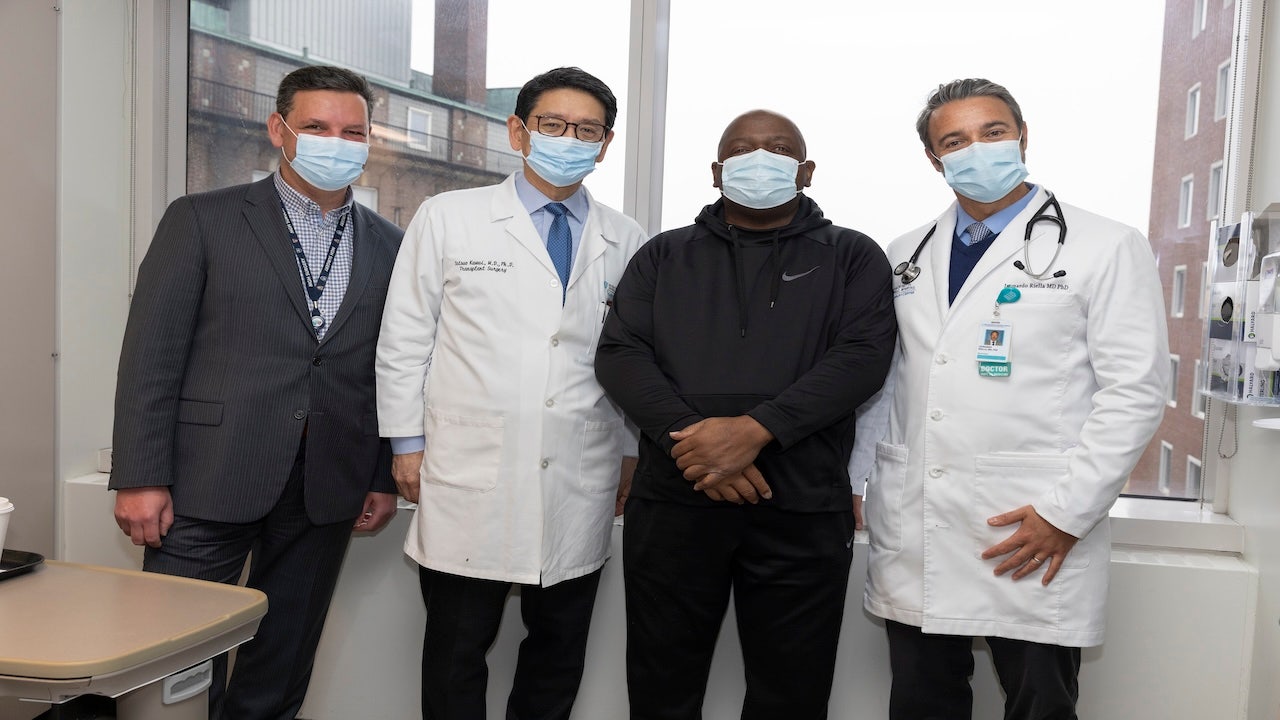
Richard Slayman (second from right) died nearly two months after he made history as the first recipient of a genetically modified pig kidney transplant. (Courtesy of Michelle Rose/Massachusetts General Hospital)
After having a kidney transplant at the hospital in 2018, Slayman had to go back on dialysis last year because it showed signs of failure. Then, after dialysis complications came up and required frequent procedures, his doctors suggested a pig kidney transplant.
Slayman’s family thanked his doctors for extending his life.
“Their enormous efforts leading the xenotransplant gave our family seven more weeks with Rick, and our memories made during that time will remain in our minds and hearts,” the family said in a statement.
The family said Slayman underwent the surgery, in part, to provide hope for the thousands of people who also require a transplant to live.
MASSACHUSETTS MAN RECEIVES SUCCESSFUL PIG KIDNEY TRANSPLANT: ‘UNCHARTED TERRITORY’
Richard Slayman with (left to right) Dr. Leo Riella, Medical Director of Kidney Transplantation, Dr. Nahel Elias, Interim Chief, Division of Transplant Surgery, his partner, Faren, and Dr. Tatsuo Kawai, Director, Legorreta Center for Clinical Transplant Tolerance (Courtesy of Michelle Rose/Massachusetts General Hospital)
“Rick accomplished that goal and his hope and optimism will endure forever,” the family said.
Xenotransplantation refers to healing human patients with cells, tissues or organs from animals. These attempts have long been unsuccessful because the human immune system immediately destroys foreign animal tissue. Recent attempts have included pigs that have been modified, so their organs more closely resemble those of a human.
More than 100,000 people are on the national waiting list for a transplant, with most of them being kidney patients. Thousands of people die every year before they receive a transplant.
The Associated Press contributed to this report.
Read the full article from Here


PRESQUE ISLE (WGME) — The first successful trans-Atlantic balloon launched from Presque Isle in 1978.
Early Thursday morning, a group of pilots took flight with the goal of crossing the Atlantic Ocean and landing in Europe.
The hydrogen balloon in the air on its way to Europe. (Courtesy: Bert Padelt)
The Atlantic Explorer 2026 is a gas balloon that uses hydrogen.
If successful, this balloon team would be the first to cross the Atlantic using hydrogen as the lifting gas. All others used helium.
“They can vent hydrogen to go down, although they try to avoid doing that. They have expendable weight in the form of sand ballast,” Atlantic Explorer 2026 Press Officer Kim Vesley said.

The hydrogen balloon in the air on its way to Europe. (Courtesy: Bert Padelt)
They can offload the weight to make the balloon go up, or keep it from coming down.
And there are three pilots inside.
“They work in shifts, and they have everything they need: food, clothing, water, a little port-a-potty type bucket,” Vesley said.
The hydrogen balloon in the air on its way to Europe. (Courtesy: Bert Padelt)
“The trajectory and the winds that they have available to them determine where they will come into Europe. It could be probably 3,100 to 3,500 miles, in that vicinity. They expect to be aloft four to six days,” Vesley said.
They have survival equipment, including a life raft, survival suit and more in case of an emergency, but they’re all optimistic.
The hydrogen balloon in the air on its way to Europe. (Courtesy: Bert Padelt)
“These are all friends with a common goal. That is to do something very special and very rare. The other thing is they may also set a couple of world records during this for the size and type of balloon they are flying,” Vesley said.
To track where the balloon is and the flight path it’s taken, you can visit their website.
Massachusetts
Cheers! Mass. House passes proposal to extend bar hours to 3 a.m. during World Cup, putting bill on fast track. – The Boston Globe

The legislation, first filed by state Representative Carole A. Fiola, would enable — but not require — bars and restaurants with liquor licenses to sell alcohol an additional hour past current closing times, starting Monday through July 31, albeit with the blessing of local licensing boards.
House lawmakers scaled the language back from the original bill, which had proposed allowing the later last call through Aug. 31.
“Summer 2026 presents a unique opportunity for Massachusetts,” Fiola, a Fall River Democrat, told lawmakers ahead of their vote Thursday. “While we may refer to it as soccer, football is the world’s most popular sport. . . . This bill will help capture economic opportunity.”
Pushing back last call has gained a drumbeat of support in recent weeks among leaders, including Mayor Michelle Wu, Governor Maura Healey, and state Senate President Karen Spilka, who have said the bill would help local businesses benefit from an expected surge of visitors for the World Cup matches at Gillette Stadium in Foxborough.
In Rhode Island, whose border is less than 30 miles from the stadium, Governor Daniel J. McKee signed a similar bill into law last week. Kansas, Missouri, New Jersey, Pennsylvania, and Washington — states either hosting World Cup matches or geographically adjacent to those hosting the tournament — have also approved measures to extend alcohol sales hours.
Wu has said city officials have been preparing for late-night crowds regardless of whether the bill passes, noting that some World Cup matches and related festivities are expected to run late into the evening. The city is, for example, allowing businesses that are licensed to close at 1 a.m. to apply for temporary permits to extend their hours to 2 a.m.
“The question isn’t whether it will cause people to be out and about,” Wu said. “It’s whether people will have something fun to do that also supports our local economy.”
The support marks a notable shift among legislators who have long been resistant to boozy measures. A repeated proposal to end a 40-year ban on happy hours has faced an uphill battle on Beacon Hill.
“Massachusetts has a persistent fun problem,” said state Senator Julian Cyr, a Provincetown Democrat who has proposed lifting the ban on happy hours in the last two legislative sessions.
“We’re an outlier in how restrictive we are with alcohol consumption,” he added. “In Massachusetts, you can gamble to your heart’s desire and buy cannabis legally. Why can’t we have happy hour or later last call?”
The Massachusetts Restaurant Association, which represents about 1,800 restaurants, said the short trial period for the later last call allows bar operators to try something new, according to the association’s president Steve Clark.
“Why not?” he said. “Rarely do you get the opportunity to pilot things.”
Among those excited to test the waters is Oran McGonagle, who can see the FIFA Fan Festival at Boston City Hall from his perch at the Dubliner, which the Irish native owns and operates.
McGonagle said the Dubliner has already added a back patio to expand capacity, complete with 15 brand-new televisions, food, and bar service. Fans coming from other countries will expect later service, he said, and he is excited to welcome visitors.
“Anything that is pro-bar, pro-getting people energetic, I’m all about,” McGonagle said. “And anything positive toward bars and nightlife might open the door for something to happen in the future.”
George Aboujaoude, owner of Committee in the Seaport and Eva on Newbury Street, is a 30-year nightclub industry veteran who also ran Bijou Nightclub and HUE Boston.
He said the industry has, for years, asked for later last call. He recalled being told that the city doesn’t have the infrastructure to support it, even when Boston hosted the Democratic National Convention in 2004.
Aboujaoude said he would consider pursuing the later license at Eva, but not at Committee, which is already open until 2 a.m.
“Extending hours can create additional revenue and opportunities,” he said. “I’d love Boston to become more open to business.”
Aboujaoude and others, however, are approaching the idea with caution. They note the liabilities that come with serving people who have been out drinking all day. MBTA service also ends around 1 a.m., leaving employees and patrons alike to find alternative ways home late at night.
Bartenders around Boston have also lamented the possibility of their shifts dragging deeper into the night.
“When you are serving drinks after midnight or 1 a.m., you are serving the people who have more than they should have had already. You open yourself up to liability,” said Chris Lute, owner of the bar, Miracle of Science, in Cambridge.
He said that while he supports an operator’s right to decide how late they stay open, a 3 a.m. last call “is not appealing to me.”
Nick Stoico of the Globe staff contributed to this report.
Samantha J. Gross can be reached at samantha.gross@globe.com. Follow her @samanthajgross.
New Hampshire
More businesses would be exempt from a key state tax under a proposal heading to Ayotte’s desk

The New Hampshire House and Senate stopped shy of cutting a major state business tax outright Thursday, but did pass a plan to lift the tax’s filing threshold, and spend $2.5 million to lift Medicaid provider rates at state nursing homes.
“What you have before you is a bill that will protect our nursing homes, and protect our small businesses,” said Republican Sen. Tim Lang of Sanbornton.
Under the bill, the threshold on the state business and enterprise tax would be lifted from $297,000 to $400,000, a move GOP leaders expect will exempt about 4,000 small businesses from having to pay the tax.
The bill’s inclusion of money to boost provider rates for nursing homes was a policy the Senate prioritized, and its inclusion in the bill earned the plan some Democratic support. But that evaporated when Republicans in the House pushed to add a trigger to the bill to automatically reduce the rate of the tax when collections from the levy far exceeded estimates.
“The rate cuts are reckless and irresponsible and would potentially cost hundreds of millions of dollars in the future,” said Sen. Cindy Rosenwald of Nashua.
Under the plan, the tax rate, which now stands at 0.55%, would automatically drop by .005% anytime collections on the tax surpassed estimates by $100 million until the rate of the levy reached 0.25%, equivalent to the rate when the tax was created in 1993. Any reduction would also require the state’s Rainy Day Fund to hold a strong balance.
Cutting business taxes has been a focus for GOP leaders in Concord for years, and they’ve dropped the rate of the Business Enterprise Tax four times since 2016.
-

 Louisiana57 seconds ago
Louisiana Tech launches Center for Literacy and Learning to support students, educators
-

 Maine8 minutes ago
Pilots aboard hydrogen balloon are attempting to cross Atlantic Ocean from Maine
-

 Maryland11 minutes ago
Maryland troopers attend high school graduation of student whose dad died in line of duty
-

 Michigan16 minutes ago
Michigan football beats out Alabama, Texas for 4-star DB Blake Jenkins
-

 Massachusetts23 minutes ago
Cheers! Mass. House passes proposal to extend bar hours to 3 a.m. during World Cup, putting bill on fast track. – The Boston Globe
-

 Minnesota26 minutes ago
The Scoop – June 4
-

 Mississippi31 minutes ago
Mississippi lawmakers talk school consolidation, closures in state
-

 Missouri38 minutes ago
Arapahoe County Mounted Unit heading to Missouri for the 2026 FIFA World Cup

