Maine
Why the garment workers of Bangladesh are feeling poorer than ever


Ayesha Begum is working hard on her sewing machine. Her slender fingers glide the needle along the jeans she is piecing together, sewing on pockets before passing the pants to the next garment worker. It’s for the international clothing chain, Zara. The jeans will sell for around $50 each. She handles around 90 pairs an hour and earns $134 a month.
“I can’t get by on what I earn,” she says, “I have to pay for my son’s schooling, I have to pay rent, I have to look after my mother and my parents-in-law. It’s just not enough.”
Begum, 26, lives in the town of Gazipur, a few hours north of Bangladesh’s capital, Dhaka. She and her husband work at Beximco, one of the largest garment factories in the country, employing 23,000 workers. But even with their combined income, they find it hard to make ends meet.
Begum one of four million garment workers in Bangladesh making clothes for American and European markets – brands such as Michael Kors, Calvin Klein, Zara and others. Zara did not respond to NPR’s requests for comment on this story.
Bangladesh is the second largest export of readymade garments in the world after China, with 4,000 or so garment factories that generated $47 billion in revenue last year.
The country’s garment workers have always been paid low wages, but now they’re facing a triple-barreled threat. Western buyers are paying less for the clothes, while food prices in the country have gone up by around 10% since last year.
Khaled Shahrior, a manager at Beximco, says retailers aren’t concerned with paying more for garments to address the increased costs most local factories are bearing.
“They don’t bother about everyday inflation and food prices and everything,” he says, “they should have that accountability.”
Politics has an impact
Added to this, the industry has also suffered after a wave of political unrest. In August, former prime minister Sheikh Hasina fled the country following a student uprising. At least four factories were set on fire, including Beximco, after the factory owners were accused of having close ties with Hasina and her government.
The instability has resulted in a loss of business for the industry as some brands have taken their business to other countries.
Mushfiq Mobarak, professor of economics at Yale University, says those brands are, in fact, now paying higher prices.
“In those other countries they’re actually paying around 20% more,” he says, “so that suggests that they can afford to pay, it’s just that when they’re sourcing from Bangladesh, they’re not willing to.”
Union leaders and workers hope the recent political changes will lead to improvements in their conditions.
T-shirts sell for less
But at the moment, it’s harder than ever for garment workers like Begum to get by.
According to the U.S. International Trade Commission, the average price American retailers paid two years ago for a cotton t-shirt made in Bangladesh was $1.83. This year, it’s $1.65 – nearly a 10% drop.
One reason is increased competition among factories in Bangladesh to sell their wares, so prices are dropping.
At the same time, the country is experiencing a wave of inflation that has meant greater expenses for the workers in their daily lives — and for factories as well.
Economist and nobel laureate Mohammad Yunus is serving as the chief adviser for Bangladesh’s caretaker government.
Mobarak says that Yunus has an opportunity to use his influence to protect workers’ rights.
“He could use his voice effectively to bring international buyers to the table and help them recognize their ethical obligations toward poor Bangladeshi workers,” he says.
So far, Yunus has not publicly addressed this issue.
They’re protesting
Meanwhile, since the uprising, some garment workers have been protesting for higher pay.
Union leader Kalpana Akter says a raise in the minimum wage to 12,500 taka ($104) last year – up from 8,000 taka ($69) – didn’t go far enough. And that there isn’t universal compliance.
“It is not enforced in many factories.” she says.
Even those who make slightly more than minimum wage are struggling.
Iti khatun, 44, who has been a garment worker for 22 years, earns $126 a month, sometimes more if overtime is available.
She pays $25 a month for rent and household bills such as gas and electricity.
She lives in a dimly lit windowless room in a large, crumbling building and shares a bathroom and kitchen with a dozen other residents.
Another $30 goes toward her 18-year-old son’s schooling. She spends the rest on food, but with one kilo of rice — 2.2 pounds — costing as much as a dollar, she has to stick to a basic diet.
“Meat costs 6 dollars a kilo,” says Khatun. “If I eat meat, it will be too difficult for me to budget for the rest of the month.”
And she’s aware of the irony that she could never afford the clothes she makes.
Mobarak says Western consumers need to be more aware of the impact of their shopping habits.
“They need to understand the decisions they make,” he says, “such as going to another retailer to chase lower prices, ultimately will have an effect on the wages paid to the workers who produce those garments.”
NPR contacted the Ministry of Labour and the Bangladesh Garments Manufacturers and Exporters Association, which represents the factories, for comment but got no response.
Begum, the 26-year-old who sews pockets on jeans, has a simple wish: “If I could earn a bit more money I could plan for my son’s future. I’d be able to save, to live better, eat better. Even 3,000 taka [$25] more a month would make a big difference.”
Shamim Chowdhury is a London-based freelance journalist and writer. She spent six weeks in Bangladesh following the recent student uprising.
Copyright 2024 NPR



Many Maine municipalities will open cooling centers this week with the National Weather Service issuing a variety of heat advisories covering the next few days.
The Maine DEP also issued an air quality alert for Wednesday with ground-level ozone expected to reach levels that are unhealthy for sensitive groups.
All of York County, interior Cumberland and Androscoggin counties, and the southern half of Oxford County will fall under an extreme heat warning from 11 a.m. Wednesday to 8 p.m. Friday.
The warning calls for “dangerously hot conditions” that could feature heat index values of up to 110 degrees, with overnight lows only expected to fall into the 70s, according to the weather service’s office in Gray.
The rest of the state — save northern Aroostook, Piscataquis and Somerset counties — falls under a heat advisory from 11 a.m. to 8 p.m. on Wednesday. However, the weather service has also placed much of the state under an extreme heat watch for Thursday.
Heat index values, which measure how hot it feels to the human body when relative humidity is combined with the air temperature, are expected to reach up to 104 degrees during the heat advisory period, the weather service warns. They could reach 110 degrees Thursday, when the extreme heat watch is in effect.
Northern Oxford and Franklin counties, and central Somerset County, can expect a heat index value of up to 99 degrees Wednesday, according to the weather service.
The weather service advises people to drink plenty of fluids, stay in air-conditioned rooms when possible, avoid extended periods in the sun and check up on relatives and neighbors. It also warns not to leave young children and pets in unattended vehicles, as “car interiors will reach lethal temperatures in a matter of minutes.”
Cooling Centers
The Maine Department of Environmental Protection has also issued an air quality alert from 10 a.m. to 11 p.m. on Wednesday along the coast from Kittery to Acadia National Park. The agency warns that ground-level ozone concentrations are expected to reach levels that are unhealthy for sensitive groups.
Ozone levels may reach “moderate levels” further inland, according to the Maine DEP, including in all of Androscoggin and Kennebec counties, as well as parts of Cumberland, Knox, Lincoln, Penobscot, Sagadahoc, Waldo, Washington and York counties.
Elevated ozone levels can pose a risk to children, older adults and people suffering from respiratory or heart diseases, according to the Maine DEP. Anyone exerting themselves outdoors may also experience health effects, which could include coughing, shortness of breath, throat irritation and mild chest pain.
Ozone levels were already climbing in southern New England on Tuesday, according to the Maine DEP, and winds are expected to bring those conditions to Maine on Wednesday.
The Maine DEP recommends that vulnerable populations avoid strenuous outdoor activities, keep windows closed, and circulate indoor air with fans or air conditioners. Those with asthma are also advised to keep quick-relief medication handy.
Particle pollution levels are also expected to be moderate across the state on Wednesday due to wildfire smoke, the Maine DEP said in its announcement Tuesday. Wildfires in Colorado, which have claimed the lives of three firefighters, had burned nearly 90,000 acres as of Tuesday, according to the Denver Post.
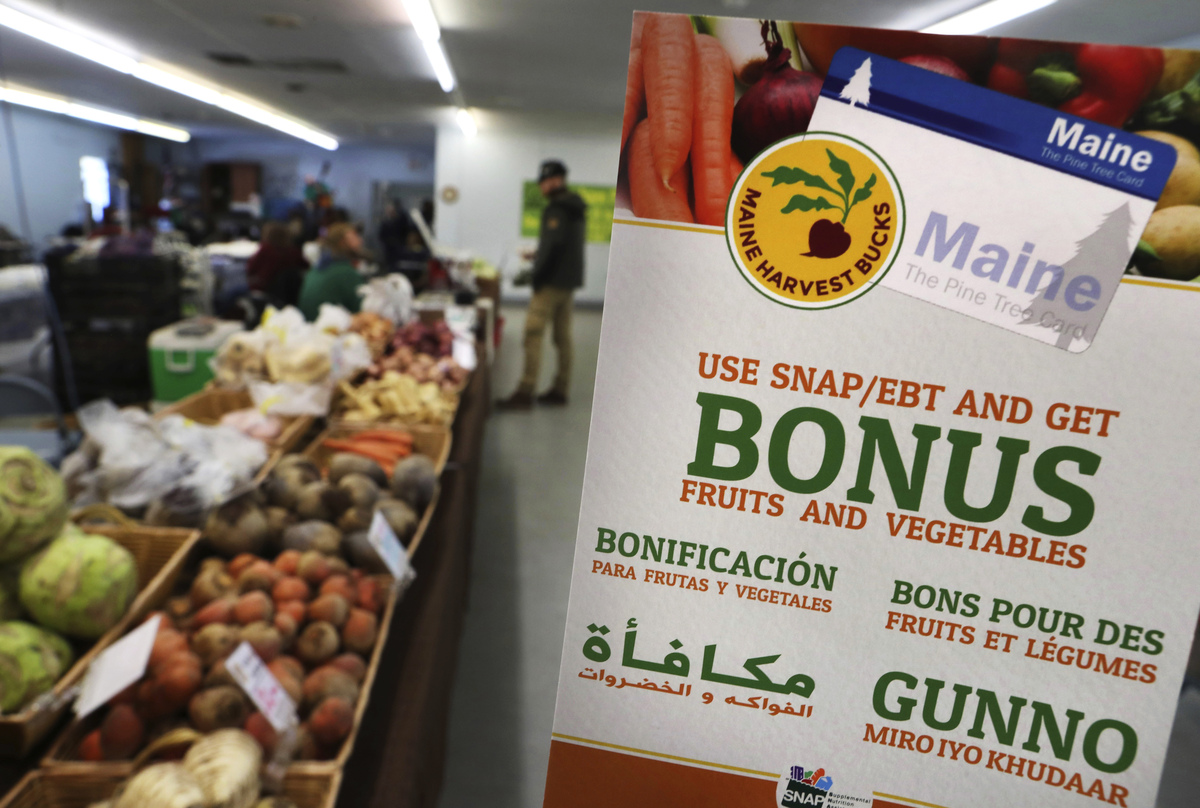
Maine could face up to $50 million in penalties next year due to errors in its payments for federal food benefits under the Supplemental Nutrition Assistance Program.
Newly released data from the U.S. Department of Agriculture find that Maine’s error rate last year was nearly 11%, the bulk of which were overpayments. That’s in line with the U.S. average. But starting in October of next year, states with error rates above 6% must cover a portion of the SNAP benefits.
Anna Korsen, executive director of Full Plates, Full Potential, said the overpayments aren’t fraud — they’re human error. She said this new cost-shifting policy enacted last year under the Trump administration further complicates the SNAP application process.
“Instead, we could make this program more accessible and more efficient,” Korsen said. “And that would reduce the number of errors and also ensure that Mainers who are eligible for SNAP have access to it.”
She’s urging Congress to delay or reverse the policy under the farm bill that’s currently under consideration.
Maine’s Department of Health and Human Services said it’s taking steps to reduce the error rate, including modernizing its systems and hiring an additional 40 eligibility specialists.
This story appears through a media partnership with Maine Public.
-

 Texas19 seconds ago
SCHEELS CEDAR PARK
-
Utah7 minutes ago
Lakers trade for center Walker Kessler from Utah, make their big swing with rush of signings
-

 Vermont10 minutes ago
In Post-pandemic Vermont, The High-end Destination Wedding Industry Has ‘exploded’
-

 Virginia15 minutes ago
Virginia’s Clean Slate Law takes effect, sealing records of certain convictions, offenses
-

 Washington22 minutes ago
Where can you watch fireworks in Washington DC on the Fourth of July?
-

 Wisconsin25 minutes ago
9-year-old drowns at western Wisconsin water park, sheriff says
-

 West Virginia30 minutes ago
Save Women’s Sports Act now the law of the land – WV MetroNews
-

 Wyoming37 minutes ago
Young bull moose captured wandering Laramie, relocated by Game and Fish

