Maine
‘Tragic loss’: Maine’s first official comfort dog, Baxter, found dead inside state vehicle


An investigation is underway after Maine’s first official comfort dog, Baxter, was found dead inside a state vehicle, officials said Friday.
Baxter’s death was “accidental,” the Maine Department of Public Safety said in a statement.
Baxter, a three-year-old chocolate lab, joined the Maine Bureau of Emergency Communications in 2022 as the state’s first official comfort dog, officials said.

Baxter was found dead inside a state vehicle located at the Bangor Regional Communications Center at approximately 2 p.m. Wednesday.
“DPS is currently reviewing the circumstances surrounding Baxter’s death,” officials said in their statement.
“The state vehicle, in which Baxter was regularly transported, is undergoing a thorough inspection to identify potential malfunctions that may have led it to unexpectedly stop running, which caused the vehicle’s air conditioning to cease operating,” officials said.
It was unclear Friday whether any state employees would face disciplinary action or charges in connection with Baxter’s death.
The department, meanwhile, is mourning his loss.
“As a comfort dog, Baxter’s mission was to help improve the mood and well-being of first-line responders in Maine’s three emergency communication centers; his calming and cheerful presence will be deeply missed by all those who interacted with him,” officials said in their statement.
“The Department extends its deepest condolences to Baxter’s handler and his family, as well as the entire emergency telecommunication team,” officials said.
Police and animal advocates routinely urge all pet owners not to leave their pets inside their vehicle for any amount of time.
The interior of a vehicle can rapidly become hot in a short amount of time which can lead to serious injury or death of an animal.
“ON A WARM DAY, the temperature in a car can exceed 120° in a matter of minutes—even with the windows partially open,“ according to The Humane Society of the United States. ”Your pet can quickly suffer brain damage or die from heatstroke or suffocation.”
This is a developing story. Check back for updates as more information becomes available.
Download the FREE Boston 25 News app for breaking news alerts.
Follow Boston 25 News on Facebook and Twitter. | Watch Boston 25 News NOW



BRUNSWICK — A eighth grade student from Washington County returned for a second crack at the Maine State Spelling Bee Saturday and booked a ticket to the 2026 Scripps National Spelling Bee in May. He’s also headed somewhere else special — his school’s spring dance.
“It feels really awesome, especially since I made the biggest bet on winning,” winner Tristan Singh said following the bee. “There’s a spring dance coming up at my school next week, and I said I would only (go) if I won.”
Singh, a student at Rose M. Gaffney Elementary School in Machias, beat out 13 other spellers from all over the state at Bowdoin College and took the final prize with the word “stratosphere.” Each student had won bees at the school and county level to win a spot at the state competition.
The bee, which was presented by the Maine Trust for Local News, went on for 18 rounds. It came down to Singh and the student representing Androscoggin County, Turner Elementary School sixth grader Grace Morris.
Spectators were biting their nails as Morris and Singh went back and forth spelling words for six rounds.

At round 14, Singh misspelled “cognizant,” giving Morris the chance to win. Then, Morris misspelled “millennial” — sending the final two into more rounds until a misspelling of “philosophize” ultimately took Morris out of contention.
The heated competition was all in good fun as spellers high-fived each other on stage and celebrated each others’ wins.
“We ended up chatting a lot, (and) cheering each other on,” said sixth grader Harmony Hoyt, the speller from Aroostook County.
And families in the audience were waiting with congratulatory hugs no matter their students’ place in the standings.
“(We’re) so proud of him. He’s worked really hard; he’s done a lot of hours of studying,” said Elizabeth Singh, Tristan’s mom.
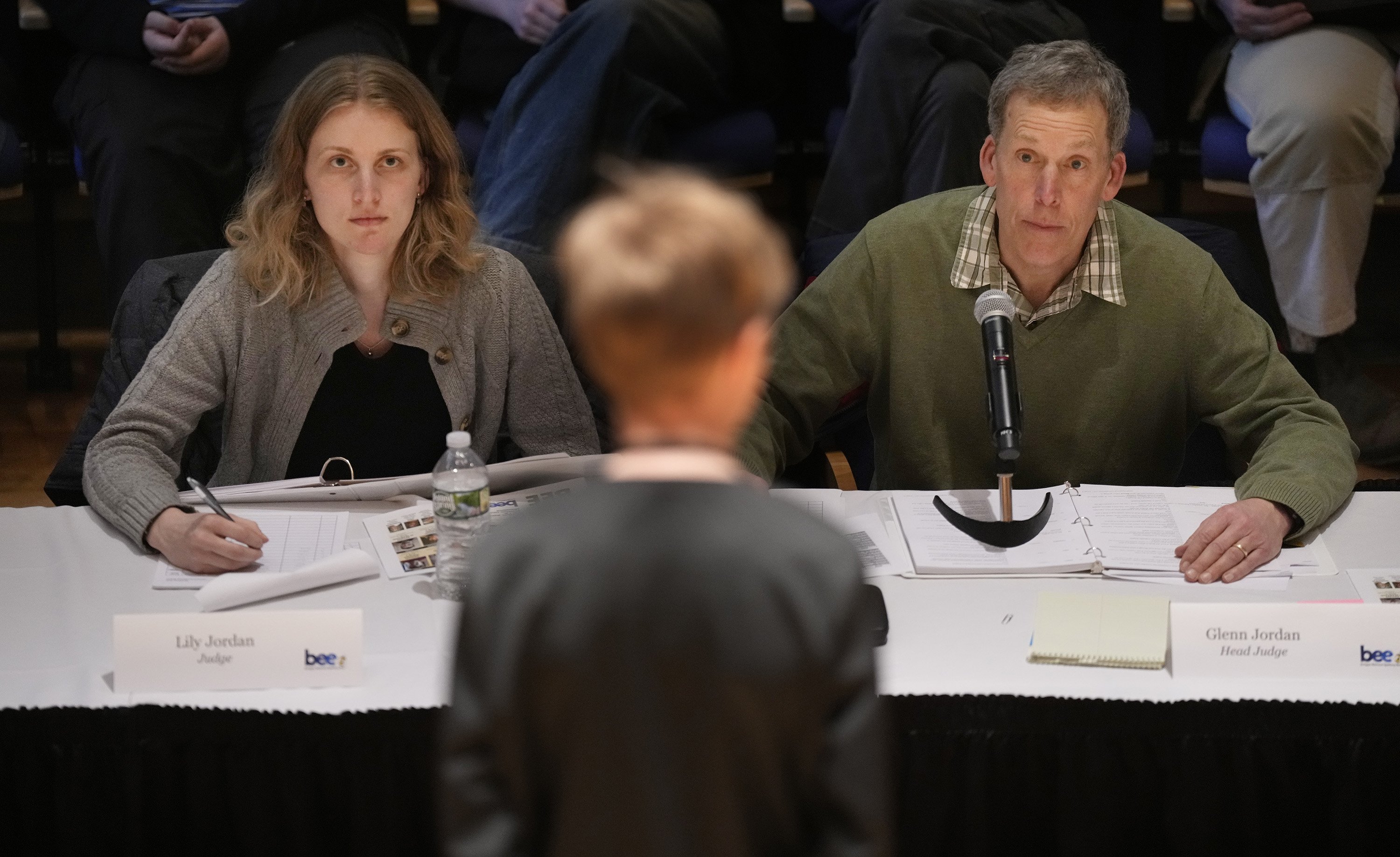
Three members of a spelling bee family and the president of Thomas College made up the judging team for the state bee. For each word, students could ask the judges for its definition, origin, part of speech and to use it in a sentence.
Lily Jordan, of San Francisco, returned to her home state to judge this year’s bee after winning it twice as a middle schooler. Her dad, Glenn Jordan, a retired Press Herald sports writer, and her mom, Nancy Jordan, the lead content developer at National Geographic Learning, were also at the judges’ table. Meanwhile, their dog, Webster — like the dictionary — took a nap under the table.
“It almost feels like being a kid again, and feeling the nervousness of the moment, but it’s a lot of fun,” Lily Jordan said.
Jeannine Uzzi, the president of Thomas College, served as the word pronouncer Saturday, a role she’s been coming back to for more than 15 years.

“It’s a great way to reinforce academics in the state,” Uzzi said.
A bee afficionado, Singh plans on competing in the Maine State Civics Bee at Colby College in June — that is, after he appears at the nation’s largest spelling competition.

Anna Nasset is an international speaker, trainer and author of the memoir “Now I Speak,” specializing in stalking awareness, victim rights and trauma-informed practices. Sheriff Troy Morton serves as the sheriff of Penobscot County, Maine and as the president of the Maine Sheriffs’ Association.
In the quiet moments of a survivor’s life, the most dangerous thing isn’t always a person; it’s the unknown.
For more than a decade, one of us (Anna) has lived with the reality of a serial stalker. After years of torment, this stalker was finally sentenced to 10 years in prison — one of the longest stalking sentences in U.S. history. But for a survivor, a sentence is not the end of the story. The “job” of being a victim never ends. It simply shifts into a state of constant vigilance.
For survivors across the country, safety planning depends on a simple, life-saving tool: VINE (Victim Information and Notification Everyday). This automated platform provides real-time alerts when an offender’s custody status changes. It is the difference between a survivor being able to sleep at night or living in a state of “psychological warfare,” wondering if the person who harmed them has been released, transferred or bailed out.
Currently, Maine is the only state in the nation that does not provide victims with this essential tool. We are the national outlier, and it is a distinction that puts Maine lives at risk.
Protecting victims is a critical responsibility within the criminal justice system. Law enforcement professionals work to provide safety, resources and advocacy for those affected by crime, while also ensuring victims are empowered and kept informed throughout the process.
Maine’s criminal statutes already require victim notifications for certain crimes, and that process would remain unchanged. However, it can be significantly strengthened through electronic victim notification systems, which allow victims, family members, witnesses and others affected by criminal activity to receive alerts when an individual is released from custody.
Maine has already taken an important step forward with a pilot program operating in the Aroostook, Penobscot, Somerset and Two Bridges Regional jails. In just these four facilities, more than 8,500 notifications have been issued, and nearly 6,500 individuals have registered to receive alerts. Those users include not only victims of domestic violence, but also witnesses, family members and concerned community members who rely on the system to stay informed.
Information is power. Yet in Maine, that power remains fragmented. Whether someone receives a critical alert should not depend on which county line a jail sits behind. Expanding electronic victim notification statewide would help ensure consistent, timely information for those who need it most.
Investing in automated victim notification is a no-brainer. This is a critical, common-sense investment that will move our state from last in the nation to a leader in victim services. The VINE system is designed to supplement, not replace, our existing statutory obligations. It offers a confidential layer of protection, available 24/7, without requiring overstretched jail staff to perform extra data entry. VINE simply and effectively connects existing records to the people who need that information most.
Maine prides itself on community and compassion. It is common sense to provide victims with the tools they need to stay safe. It is an essential responsibility of our criminal justice system to ensure that survivors are not the last to know when their offender is back on the street.
Let’s stop asking why Maine is the last in the nation and start showing the rest of the country how we put victims first by funding a statewide automated victim notification system now.

CALAIS — Superintendent Mary Anne Spearin told the Calais School Committee earlier this month that proposed changes to the state’s school funding formula could benefit the district.
The Maine Legislature voted Thursday to pass L.D. 2226 — An Act to Amend the Essential Programs and Services School Funding Formula — and adopt three of the report’s four recommendations.
Last year, state lawmakers directed the Maine Department of Education and the Maine Education Policy Research Institute, which is funded by the Legislature and the University of Maine System, to study the models used to determine state funding for public schools.
The EPS Funding Report, released last month, identifies several problems with Maine’s school funding model — in place since 2005 — that have been especially hard on public schools in Washington County.
Spearin said the proposed changes, if enacted, could bring about $50,000 to $60,000 in additional education funding to Calais.
“I’m hopeful that it’s more than that,” she said, adding that “every little bit helps.”
The bill will change how the state calculates salaries for Maine’s educators. Previously, the Legislature set a $40,000 base salary for teachers, and schools received funding based on the difference between that base and their average teacher pay.
Calais salaries are now indexed at 0.94, meaning teachers earn about 6 percent less than the state’s base.
The report recommended changing the formula so the base salary becomes a true minimum salary, which means Calais and some other districts would receive additional funding to meet the new standard.
Spearin noted that several Washington County districts have even lower indices than Calais, meaning they would benefit even more — though all would see a funding increase.
Machias-Eastport and Jonesport-Milbridge are both currently indexed at 0.84.
The EPS funding report says the changes to the salary index could result in an overall increase of just under $38 million in state funding for schools.
It notes that nearly every district in the state would receive more money after the reindexing, with the only exception being Maine School Administrative District 54 in Skowhegan.
The second change recommended by MEPRI — and potentially the most significant for Calais — is a refinement to how the state determines a community’s “ability to contribute.”
Public school funding has traditionally relied on a community’s property tax rate — also called the mill rate — to determine how much state support a district receives. But this approach puts many rural Maine communities at a disadvantage, where high property values do not necessarily translate into high wages.
The report recommends adjusting this model to include a community’s income level when determining how much state funding its schools receive. It outlines several ways the formula could be revised by shifting the weighting between the property tax rate and a “regional adjustment” based on differences in the cost of living.
According to the report, the change will not affect the state’s overall spending on public schools. Instead, it redistributes existing funds, with about $13 million shifted to districts with greater need.
The Legislature voted to adopt this measure as part of L.D. 2226.
Spearin said a crucial part of implementing these formula changes will be maintaining the district’s understanding of the Calais school community’s overall financial situation.
Traditionally, the district gathered this information through questionnaires sent home to determine eligibility for school lunch. But with free meals available to all Calais students since 2020, the district has had to find other ways to collect the data.
Calais now sends home an “Economic Status Form,” provided by the state Department of Education.
Spearin emphasized that having accurate information about the economic situations Calais families face will be essential to securing appropriate funding if and when these changes are implemented.
The other changes recommended in the report — but not included in L.D. 2226 — were adjustments to funding for instructional staff support to better reflect what schools actually spend on training and supplies, and shifting to a regional model for managing special education.
L.D. 2226 also includes changes to how the state allocates funding for transportation, a change that is likely to benefit Calais, which, despite being one of Maine’s smallest cities by population, covers a relatively large geographic area.

From the Archives: Hospital has 70-year history in Southwest Florida

Texas A&M drops series vs. Georgia after 8-2 Game 2 loss

Kokua Line: Will smaller airports close in Hawaii? | Honolulu Star-Advertiser

LIVE UPDATES: No. 11 VCU vs. No. 3 Illinois in NCAA tournament. Follow along here.

San Antonio vs. Indiana, Final Score: Spurs got serious when they needed to, winning 134-119

Florida High School Football Rankings: Top 25 teams – Oct. 21

How old is Bo Nix? What to know about Oregon quarterback ahead of 2024 NFL Draft

Cleary's 21 help Le Moyne down Central Connecticut State 69-64 in OT

99th annual Pony Swim held in Virginia

Indiana Members Credit Union announced as new anchor tenant at Bottleworks District

Video: Former F.B.I. Director Robert Mueller Dies at 81

Trump gives Iran 48-hour ultimatum to reopen Strait of Hormuz or face strikes on power plants

Macron pushes tougher EU digital action ahead of key votes

Airport security lines are long. Here’s what to know if you’re flying

Schumer gambit fails as DHS shutdown hits 36 days and airport lines grow
-

 Detroit, MI3 days ago
Drummer Brian Pastoria, longtime Detroit music advocate, dies at 68
-

 Oklahoma1 week ago
Family rallies around Oklahoma father after head-on crash
-

 Nebraska1 week ago
Wildfire forces immediate evacuation order for Farnam residents
-

 Georgia6 days ago
How ICE plans for a detention warehouse pushed a Georgia town to fight back | CNN Politics
-

 Alaska1 week ago
Police looking for man considered ‘armed and dangerous’
-
 Science1 week ago
Federal EPA moves to roll back recent limits on ethylene oxide, a carcinogen
-
 Science1 week ago
H5N1 bird flu spreads to sea otters and sea lions along San Mateo coast, wildlife experts say
-

 Movie Reviews3 days ago
‘Youth’ Twitter review: Ken Karunaas impresses audiences; Suraj Venjaramoodu adds charm; music wins praise | – The Times of India