The inside of the University of Maine’s first 3D printed home is visible on Oct. 12, 2023, in Orono, Maine. The printer that created the house can cut construction time and labor. An even larger printer unveiled on Tuesday, April 23, 2024, may one day create entire neighborhoods. Credit: AP Photo/Kevin Bennett
The world’s largest 3D printer has created a house that can cut construction time and labor. An even larger printer unveiled on Tuesday may one day create entire neighborhoods.
The machine revealed Tuesday at the University of Maine is four times larger than the first one—commissioned less than five years ago—and capable of printing ever mightier objects. That includes scaling up its 3D-printed home technology using bio-based materials to eventually demonstrate how printed neighborhoods can offer an avenue to affordable housing to address homelessness in the region.
Thermoplastic polymers are extruded from a printer dubbed the “Factory of the Future 1.0.” There could be even larger printers after the University of Maine breaks ground this summer on a new building, a spokesperson said.
Advertisement
The massive printer “opens up new research frontiers to integrate these collaborative robotics operations at a very large scale with new sensors, high-performance computing and artificial intelligence,” said Habib Dagher, director of UMaine’s Advanced Structures & Composite Center, where both of the printers are located.
Those attending the event included representatives from departments of defense, energy and housing, as well as other stakeholders who plan to utilize the new technologies made available by the printer. Heidi Shyu, under secretary of defense for research and engineering, said the printer “stands as a beacon of innovation.”
A bed sits inside the University of Maine’s first 3D printed home on Oct. 12, 2023, in Orono, Maine. The printer that created the house can cut construction time and labor. An even larger printer unveiled on Tuesday, April 23, 2024, may one day create entire neighborhoods. Credit: AP Photo/Kevin Bennett
The printer’s frame fills up the large building in which it’s housed on the UMaine campus, and can print objects 96 feet long by 32 feet wide by 18 feet high (29 meters by 10 meters by 5.5 meters).
It has a voracious appetite, consuming as much as 500 pounds (227 kilograms) of material per hour.
Advertisement
The original printer, christened in 2019, was certified by Guinness World Records as the world’s largest polymer 3D printer, the university said. It was used to create a 600-square-foot, single-family home made of wood fiber and bio-resin materials that are recyclable. Dubbed “BioHome3D,” it showed an ability to quickly produce homes. To meet the growing demand for housing, Maine alone will need another 80,000 homes over the next six years, according to MaineHousing.
Dagher said there’s a shortage of both affordable housing and workers to build homes. The university wants to show how homes can be constructed nearly entirely by a printer with a lower carbon footprint. The buildings and construction sector accounts for roughly 37% of global greenhouse gas emissions, largely due to the production and use of materials such as cement, steel and aluminum that have a significant carbon footprint, according to the United Nations Environment Programme.
A cross section of an exterior wall of a house is being printed on a 3D printer at the University of Maine’s Advanced Structures & Composite Center on Oct. 12, 2023, in Orono, Maine. An even larger printer unveiled on Tuesday, April 23, 2024, may one day create entire neighborhoods. Credit: AP Photo/Kevin Bennett
Such printed buildings can be recycled, which is unique compared to current construction. “You can basically deconstruct it, you can grind it up if you wish, the 3D printed parts, and reprint with them, do it again,” Dagher said before the event.
“It’s not about building a cheap house or a biohome,” he added, referring to the first 3D-printed house made entirely with bio-based materials. “We wanted to build a house that people would say, ‘Wow, I really want to live there.’”
Looking ahead, researchers plan to tinker with the material consumed by the machine, including more bio-based feedstocks from wood residuals that are abundant in Maine, the nation’s most heavily forested state.
Advertisement
But it can be used for a variety of other creations and already has been used for a range of things, from boats to defense department structures. In the past, the university showed off a 25-foot boat created by the first printer.
The University of Maine’s first 3D printed home sits on Oct. 12, 2023, in Orono, Maine. The printer that created the house can cut construction time and labor. An even larger printer unveiled on Tuesday, April 23, 2024, may one day create entire neighborhoods. Credit: AP Photo/Kevin Bennett
As for the original 3D printer, it isn’t going away. The two printers can be used in concert to streamline manufacturing by working on the same project—or even part if necessary—and there will be even more of them working together in the future, officials said.
Citation:
The world’s largest 3D printer is at a university in Maine. It just unveiled an even bigger one (2024, April 23)
retrieved 23 April 2024
from https://techxplore.com/news/2024-04-world-largest-3d-printer-university.html
Advertisement
This document is subject to copyright. Apart from any fair dealing for the purpose of private study or research, no
part may be reproduced without the written permission. The content is provided for information purposes only.
Join Girl Scouts of Maine for a sweet summer stop you won’t want to miss!
We’re popping up at local ice cream shops around Maine for our Ice Cream Socials—fun, casual events where families can enjoy a free treat and learn more about Girl Scouts.
Here’s what to expect: 🍦 One FREE kid-sized cone per family when you stop by and connect with us 🌱 Hands-on activity for kids (like a planting activity or fidget spinner craft) 💬 A chance to chat with our team and learn how Girl Scouts builds confidence, friendships, and unforgettable experiences
Whether you’re curious about joining, looking for activities for your child, or just want to enjoy a sweet treat, we’d love to meet you!
Advertisement
✨ Open to all families—no registration required. Just stop by, say hello, and enjoy some ice cream with us.
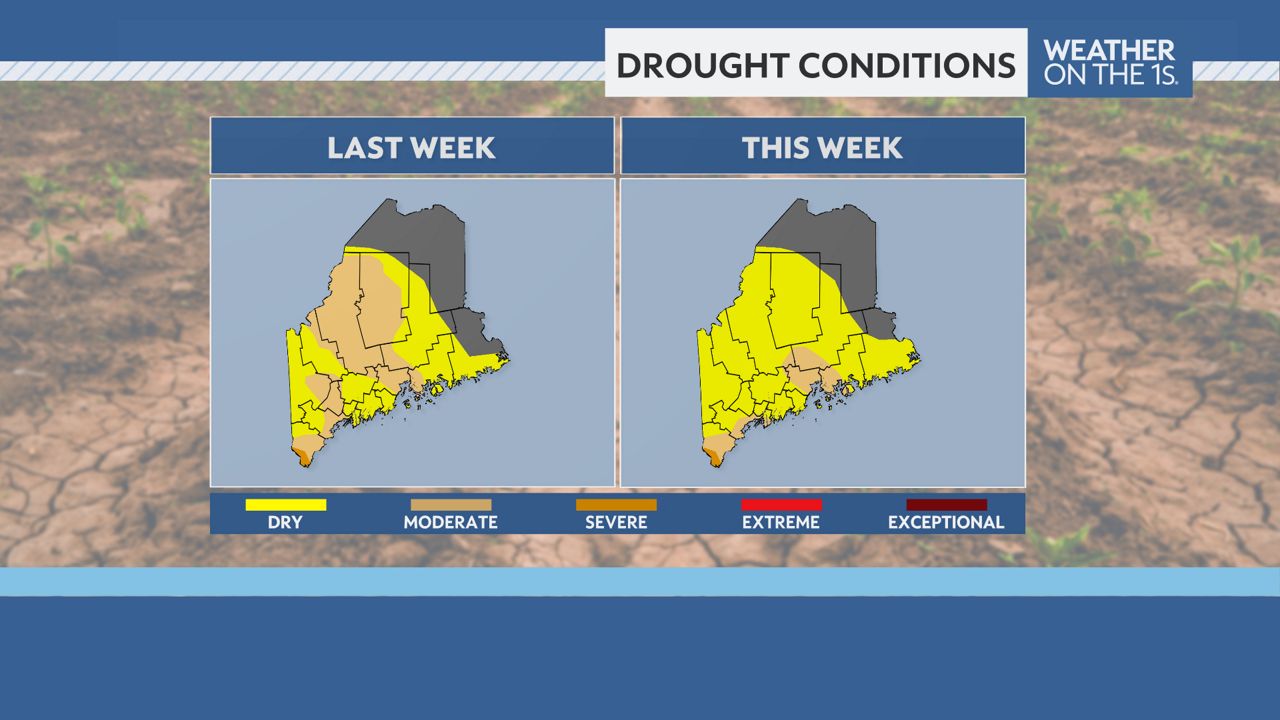
The recent rain in Maine is easing the drought that parts of the state have been experiencing since the fall.
Scott Dean, a Spectrum meteorologist, said much of Maine has been at least “dry” for several months. Parts of the state, including Portland, Bangor and Bar Harbor, are under a “moderate” drought.
Much of the country is also experiencing a drought, Dean added. The Southeast is seeing extreme levels of drought, and the West coast has been under a drought for years. There are many factors that go into this, including climate change, weather patterns like El Niño and La Niña and other factors.
And, when an area does experience drought, it can become a feedback loop. With less moisture in the ground and atmosphere, the drought can “feed upon itself,” Dean said.
Advertisement
“It takes a while to get into a drought and it also takes a while to get out of one,” Dean said.
But, the rainy days in Maine have been alleviating the drought, Dean said. And, the trend is likely to continue — the forecast is predicting above average levels of precipitation for the next three to four weeks.
“Hopefully, we are continuing to head in the right direction as the drought has eased in these areas,” Dean said.
In fact, if these rains do continue, Maine could come out of the drought sometime this summer.
STANDISH – Craig J. Ahlemeyer, 48 of Standish, passed away unexpectedly, Saturday, June 13, 2026.A memorial service will be held at 1 p.m., Saturday, June 27 th at Standish Congregational Church, 25 Oak Hill Road in Standish. A reception will follow.To see Craig’s full obituary, share a memory or leave the family an online condolence, please visit http://www.athutchins.com.