Maine
“I’m Ashamed of My Country”: Biddeford, Maine Locals Grieve Neighbor Killed by ICE


A poster of Joan Sebastián Durán Guerrero, the man killed by US Immigration and Customs Enforcement, is displayed at a memorial in Biddeford, Maine.Robert F. Bukaty/AP
The day after hundreds of locals poured into the streets of Biddeford, Maine in protest of ICE’s killing of 26-year-old Joan Sebastián Durán Guerrero on Monday, I drove through the former mill town. It seemed eerily still, as if in shock. When the horrors of Minneapolis and Houston come to your small corner of New England, what can you do?
In Mechanics Park in Biddeford, a small but diligent group presented one answer: you keep showing up.
“When I woke up this morning, I knew that this was the place I should go right to,” said Wayne Miller, 71, a retired pilot of 35 years and resident of Beverly, Massachusetts. “This is my backyard. This is my neighborhood.”
He paused, then started to cry. “I’m ashamed of my country. I love the country. I’m ashamed.”
Miller was standing with a sign that read “Dissent while you still can” at the corner of Mechanics Park in Biddeford, where the protest and vigil for Guerrero had been held the day before. A nearby chain-link fence served as a memorial, lined with flowers, signs, and letters of grief and apology for Guerrero and his family. One read, “3-year-olds should be watching Bluey, not their fathers being executed.” Above a “No Trespassing” sign, someone had placed another: “Biddeford was built by immigrants.”
I spoke with Miller and others who had come out on Tuesday to continue expressing their grief for their neighbor, the second person killed by federal agents in less than a week.
“It’s one thing to see a news story from a distance,” said Tessa, 28, a waitress and resident of Biddeford. “But watching it happen close to home, it really recontextualizes the safety that you feel walking around in your neighborhood.”
For Linda Henry, 27, a retired firefighter and Gloucester, Massachusetts resident, it was only a matter of time. “I know that it doesn’t matter where you live. It’s going to happen, you know. ICE is going to come.”
“I’m ashamed of my country. I love the country. I’m ashamed.”
Guerrero was a Colombian citizen who lived in Biddeford, Maine with his partner and 3-year-old daughter. He is one of at least nine people killed by federal immigration agents since the start of Donald Trump’s second term. Homeland Security Secretary Markwayne Mullin claims Guerrero “weaponized” his vehicle during a traffic stop. But similar claims by DHS have quickly fallen apart after video footage of shootings has come to light.
Reports say that not only was Guerrero authorized to legally work in the US, but he wasn’t the target of ICE’s operations that day.
Katie, a 48-year-old educator from New Hampshire, shared her anger. “A gun is not a license to kill. These agents have no business drawing their guns,” she said. “They aren’t judge, jury, and executioner, and they don’t have the right to be killing people the way that they are.”
“We were taught from the time we were little, ‘liberty and justice for all.’ We were taught that the United States was a place for everyone, and the current regime has changed that,” Katie continued.

Most of the protesters were standing with signs on the sidewalk along the adjacent intersection, shouting “ICE OUT” while passing cars honked. Near the memorial, a man on a bike caught my eye. He was off to the side, alone, quietly reading the letters addressed to Guerrero.
He introduced himself as Diego, 30, a restaurant worker and Biddeford resident. “I knew the guy. He was always around,” he said. “I was working and I was about to cry, to be honest. Because it’s injustice, you know? I’m an immigrant, and this country was built for immigrants.”
“We work, we pay taxes. We also need rights, as everybody does,” he said. “It’s not about left or right. It’s not about a political party. It’s about human rights.”
He told me that while he’s never felt disrespected by his neighbors and the people of Biddeford are good, the government is not the same. He said he feels unsafe and his community of immigrants feels like it’s hiding.
“How many need to die for us to understand?” Diego said. “He’d got a kid, a little daughter. And that’s the most devastating. Because, you know, if I do something wrong, I can say ‘I’m sorry, I apologize.’ But he’s dead. There’s no apology that can bring him back, you know? He’s dead. I can’t even believe it, I can’t even believe this is happening.”

When I asked Diego why he had stopped on his bike, he said out of solidarity—for Guerrero, for his partner and daughter. And when I asked what he would say to his community, he said, “Thank you for all the solidarity of people. Thank you for all the understanding. And I hope we can stop the violence.”

Maine
How a tragedy changed the timeline — and the politics — of Maine’s Senate race – The Boston Globe

And while this is the role that many Democratic leaders would be expected to play in this situation, this crop of candidates has an added challenge.
Because this also means there are no meaningful distinctions among the candidates to help guide the eventual 601 delegates who will decide who should run in one of the most closely watched Senate contests in the country.
Indeed, the practical political impact of the tragic situation in Biddeford on the Maine Senate contest is this: What was expected to be an intense two-week primary campaign has effectively been reduced to one week. And the week currently being overtaken by the shock and anger is likely the most crucial.
That’s because 5 p.m. Wednesday is the deadline for supporters to sign up to become delegate candidates for the July 25 statewide convention in Bangor.
Those delegate candidates will then be elected at caucuses held in each of the state’s 16 counties over this coming weekend. From that process will come the 601 delegates who will decide which Democrat will challenge five-term Republican incumbent Susan Collins this fall.
In fact, the best organized campaigns will likely know by Sunday who has already won the contest because they can simply add up how many of their own supporters became delegates.
In other words, the contest could be effectively over before most Mainers even begin to really pay attention.
Further, unlike some major news developments that provide a moment of political clarity, this tragic situation in Biddeford resolves nothing. Instead, it raises the stakes for Democrats to make the right choice.
What that means in the context of choosing between a more progressive populist candidate in the mold of Platner or a more traditional Democrat in the mold of this year’s Democratic nominee for governor, Hannah Pingree, remains an open question.
There is simply less time now to discuss it.
Now, none of the above is meant to take away from the discussion about a husband and father who was killed by the government and whatever circumstances led to that tragedy.
To be sure, the moment a Democratic nominee is selected, the role of ICE will immediately become the first real dividing-line issue in the Senate race. After all, Collins oversees ICE’s budget as chair of the Senate Appropriations Committee and has been actively involved in conversations with the administration about enforcement in Maine.
But as to who should face her, the clarity and contrasts that campaigns tend to reveal are not currently there among Democrats at a time when they would be most helpful. As it stands, all of the candidates oppose the Trump administration’s overall agenda, oppose the Iran war, promote some version of an affordability message, and, above all, oppose Collins.
Nor is there an obvious choice if Maine Democratic delegates decide electability should be their highest priority.
Campaigns rarely unfold on the timetable candidates expect. Outside events intervene, reshaping what voters hear, what campaigns can talk about, and, ultimately, what party insiders have to evaluate.
In this case, Democrats face the unusual challenge of selecting a Senate nominee while the issue dominating the public conversation is one on which nearly all of the candidates already agree. That may produce unity after a bruising week, but it also leaves delegates with fewer opportunities to distinguish between the people asking for their votes before making one of the biggest political decisions in Maine this year.
James Pindell is a Globe political reporter who reports and analyzes American politics, especially in New England.


Maine Senate hopeful, Democrat David Costello, speaks with a potential voter as he gathers signatures, required to be considered at the party’s convention, in downtown Brunswick, Maine on July 12.
Tamara Keith/NPR
hide caption
toggle caption
Tamara Keith/NPR
BRUNSWICK, Maine – On a sunny Sunday, Senate hopeful David Costello worked the sidewalk in downtown Brunswick asking for signatures.
“Woud you happen to be a registered Democrat?” he asked one woman before engaging in a back and forth conversation. She asks if he’s progressive.
“Very progressive,” Costello said.
Costello is one of several Maine Democrats who see the fall of Graham Platner’s senate campaign as an opportunity to represent Maine in Washington.
Platner won June’s Democratic primary election handily. But allegations of rape by a former romantic partner last week forced him to drop out of the race. It leaves Maine Democrats scrambling to find a new nominee before the July 27 deadline to put a name on the ballot. Platner denies the allegations.
The Maine Democratic Party will hold a convention on July 25 where 601 delegates will choose that nominee. That candidate will need to capitalize on the enthusiasm Platner generated to defeat Republican Sen. Susan Collins.
An unstoppable incumbent or a top pick-up opportunity?

Sen. Susan Collins, R-Maine, leans down to listen to a young paradegoer at the annual Moxie Day Parade is Lisbon, Maine on July 11.
Susan Sharon/Maine Public
hide caption
toggle caption
Susan Sharon/Maine Public
Collins remained quiet at the end of Platner’s campaign but at the annual Moxie Day parade Saturday in Lisbon, Maine, she walked with volunteers in red shirts.
“People appreciate the fact that I provide steady leadership — and the word steady does come up a lot,” Collins said at the parade, “and that I continue to work really hard for Maine.”
Collins has represented Maine in the Senate since 1997. She has managed to stay in her seat even as Maine has voted for Democrats for president statewide, including in 2020 when the state voted for Joe Biden. Collins last won reelection that year with a comfortable margin — more than 8.5%.

At the annual Moxie Day Parade in Lisbon, Maine, supporters of Sen. Susan Collins, R-Maine, march with signs and giant letters spelling S-U-S-A-N, on July 11.
Susan Sharon/Maine Public
hide caption
toggle caption
Susan Sharon/Maine Public
Democrats see Maine as pivotal to their chances to retake the Senate. Platner’s departure from the race puts pressure on the party to choose a replacement candidate who can win over Platner’s loyal voters and appeal to independents who are key to Collins’ electoral success. Maine state Senate President Mattie Daughtry, a Democrat, is encouraged to see many of the candidates running on Platner’s progressive platform of transformational change. But she’s worried about voters being turned off by the process.
“I do have that deep seated concern of how many folks are going to say ‘oh well, this man failed me. Why trust someone ever again?’” Daughtry said.
Daughtry did not endorse Platner and she quickly called on him to drop out of the race after the rape allegations surfaced. Still, she thinks his message resonated.
“I ran for office when I was 25 because I was really really angry. I was working 4 jobs. I couldn’t afford an apartment and I had no healthcare. And unfortunately that story has not changed and it is a lived reality for millions of us across this country,” Daughtry said.
“And we need to find who can pick up that mantle. Who understands what that life is like and really tap into that raw energy,” she added.
Supporters weigh what’s next
Just one month ago, Alan Crichton was playing saxophone at Graham Platner’s primary night victory party. At a brewery in Belfast, Maine this weekend, he noted his ambivalence.
“I have so many mixed feelings. I like the guy. I like his message a great deal and I think he galvanized people who are just kind of sick of what’s happening,” Crichton said.
Now, though, Crichton calls the situation “a big old mess.” As a Democrat, he hoped the charismatic populist Platner would be the one to finally knock out Collins. Though, at this point, he’ll vote for whoever the Maine Democratic party selects.
“I hope it’s somebody who can kind of carry the torch that Graham kind of lit and held out there very strongly. He was a very inspiring guy,” he said.
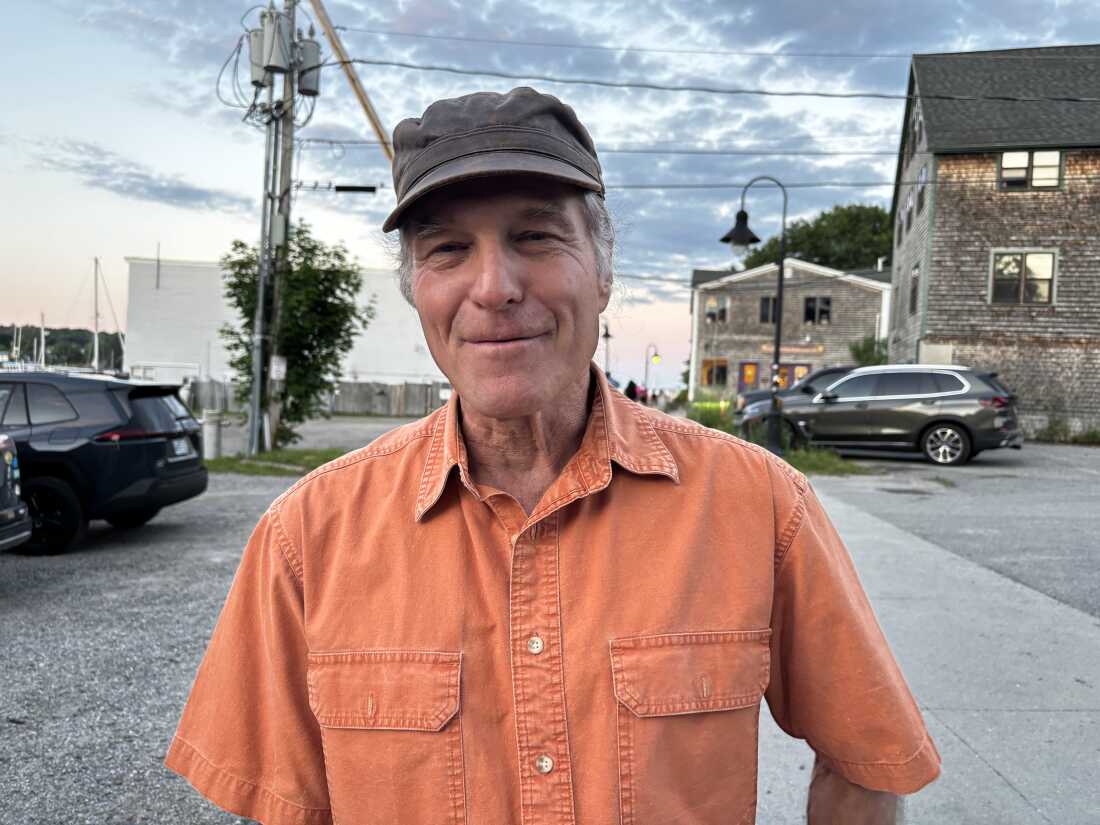
Joseph Berube of Northport, Maine, gave up on politics in 1972 after Democrat George McGovern lost the race for president in a landslide. This year, though, he got excited about Graham Platner’s candidacy for U.S. Senate.
Tamara Keith/NPR
hide caption
toggle caption
Tamara Keith/NPR
Joseph Berube is an independent voter who lives in Northport, Maine. After decades disengaged from politics, Graham Platner sparked something in him he could hardly believe.
“Because I am so apolitical,” Berube said, “I want nothing to do with it. [But] I was actually considering giving money to his campaign.”
Charlotte Agell is on the opposite end of the engagement spectrum. A registered Democrat, she is very politically involved and has been for decades. She met Platner early on in his campaign.
“One of our neighbors said, ‘hey would you like to come to my backyard and meet Graham Platner?’ I had sort of heard of him,” she remembered. “When I went to that back yard event, I just by happenstance walked in with him. It was me and Graham Platner walking in.”
By the time that event ended, she had signed up to volunteer for his campaign.
“I felt a kinship with everything that was coming out of his mouth basically. Very smart. Good at identifying the problem,” Agell said.
Core to Platner’s economic populist message was that the system has been failing regular people while the rich and powerful get more rich and more powerful. He had faced controversies throughout his campaign. He easily won the nomination anyway. But then came the rape allegation. Berube believes the rush to judgment was too swift.

“I agree with women’s rights and women shouldn’t be abused,” he said. “But to have one person come up and stand up and say, ‘he abused me,’ and then that’s it? It’s just not really fair to him.””I just think they didn’t want him,” Berube added.
Berube says Democrats chopped the legs out from under someone who had brought people back into politics.
“He was bringing in people like me and that’s what’s going to do this. And you know what, we’re in the middle of a war to save this country,” Berube said. “And we have the other side that’s fighting with the gloves off and we’re putting the gloves on. We’re in trouble.”
Charlotte Agell has been processing it all a little differently. Agell admits to being a chronic optimist but says this was never about one man.
“You know, we’re not a cult. We’re just a movement that wants to take back this country for the middle and the working class,” she said.
Agell wants to believe this massive disruption won’t sap the momentum for change she felt.
“It’s really been like a rocket ship. We’ve all been on it. And that’s why, when these very serious things have been alleged and rightly he has dropped out of the race, we’re kinda still flying at 90 million miles an hour and saying ‘who can take the controls’ and we’re going to figure that out,” Agell said.
State Senator Chip Curry says the state party is doing the best it can with a tight timeline.
“It’s a winnable race and we’ve got some great people. We’ve got to get there,” Curry said.
There are more than half a dozen announced candidates. And for Democrats the stakes couldn’t be higher. No clear frontrunner has emerged from the candidates who have put themselves forward to be considered. It’s also not clear if one candidate can capitalize on the momentum that Platner was building in Maine. Still, some are remaining optimistic.
“People are going to grumble. I’ve grumbled a little bit. But I think we’ll get through this,” Senate hopeful David Costello predicted. “I think whoever the nominee is will have tremendous support.”
-

 Arkansas2 minutes ago
Rock City Margarita & Arkansas Beer Festivals: An Interview with Organizer Reed Llewellyn
-

 California8 minutes ago
California DMV orders 11,000 drivers to retake exams due to suspected cheating
-

 Colorado14 minutes ago
CPW implements voluntary fishing closures on stretches of the Rio Grande
-

 Connecticut20 minutes ago
Connecticut Technical Education and Career System under investigation by U.S. Department of Education
-

 Delaware26 minutes ago
Delaware man identified after fatal pedestrian crash
-

 Florida32 minutes ago
Cyclosporiasis cases in Florida, US could be undercounted, health expert says
-

 Georgia38 minutes ago
Created in a small Georgia town, a cup has become 1 of the World Cup’s biggest souvenirs
-
Hawaii44 minutes ago
Kilauea eruption’s Episode 51 begins


