Northeast
Liberty bellwethers: Five Pennsylvania counties to watch on election night

Pennsylvania is once again likely the closest-watched state on election night, as the commonwealth’s 19 electoral votes are poised to swing the election one way or another.
Five counties — Bucks, Northampton, Erie, Centre and Luzerne — out of 67 are likely the ones that will tell the tale of whether former President Donald Trump or Vice President Kamala Harris will win the 2024 presidential election.
BUCKS COUNTY – COUNTY SEAT: DOYLESTOWN
Bucks County made national headlines last week after the RNC and the Trump campaign took legal action against county officials after lines for “on-demand” voting were truncated prior to the stated closing time.
A judge ultimately allowed Bucks voters involved in the process until Friday to cast their early ballots. Bucks is also known as one major county where voters typically split their votes.
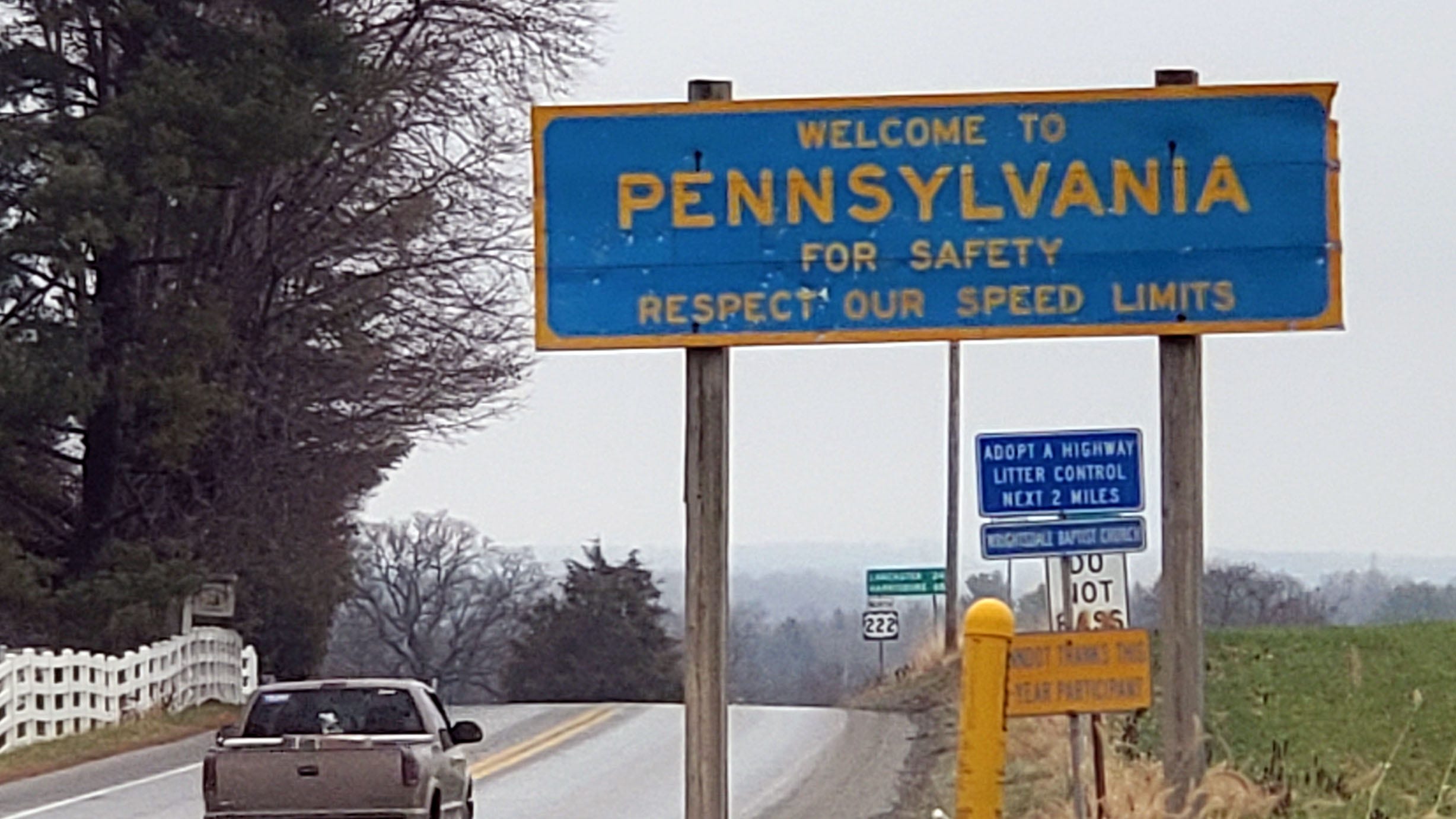
A Pennsylvania welcome sign greets drivers on US-222 entering Peach Bottom, Pa., from Maryland, 2022. (Charlie Creitz)
Rep. Brian Fitzpatrick and his late brother, Rep. Mike Fitzpatrick, both Republicans, enjoyed consistent-but-close wins in the county, while national and gubernatorial results are often a mixed bag. Brian was re-elected in 2020 just as Biden won the county.
The county also flipped to a GOP voter registration advantage this cycle, with the Philadelphia Inquirer reporting the Republicans enjoy just under a 1,000-registrant majority.
While Trump lost all of Philadelphia’s once-Republican collar counties — Delaware, Chester, Montgomery and Bucks — in 2016, only the latter appears in play this cycle.
NORTHAMPTON COUNTY – COUNTY SEAT: EASTON
Bordering Bucks, Lehigh and Northampton counties geopolitically unite to form the key, postindustrial Lehigh Valley region. The congressional seat currently held by Rep. Susan Wild, a Democrat, is always a tight contest.
While Lehigh typically remains in Democrat hands due to Pennsylvania’s third-largest city — Allentown — as its anchor, neighboring Northampton County surprised everyone when Trump took it in 2016.
CRISSCROSSING PA TO REGISTER VOTERS, SCOTT PRESLER SEEKS TO FLIP KEY COUNTIES RED
The Moravian Star shines on South Mountain above the Ofc. Philip J. Fahy Memorial Bridge in Bethlehem, Pa. (Charles Creitz)
Northampton’s Republican Party leader, Andrew Azan III, said in a recent interview he is very optimistic again this year, and said there was recently a “waitlist” for Trump yard signs.
ERIE COUNTY – COUNTY SEAT: ERIE
Far to the west, Erie sticks up into the great lakes like a thumb, and its electorate could put their collective thumb on the scale for either candidate.
Erie GOP chair Tom Eddy recently said that Erie is “unique… in the fact it’s able to pick the winners.” Trump won Erie County and the election in 2016, and Biden won in 2020.
Eddy called the county “Little Pennsylvania” — as it has a bit of every piece of the state within its bounds: an urban area, agricultural lands and industry.
LUZERNE COUNTY – COUNTY SEAT: WILKES-BARRE
Meanwhile, in Luzerne County, anchored by Wilkes-Barre and Hazleton, Republicans recently shocked observers in September by becoming a majority there.
The union-heavy county neighboring Biden’s Lackawanna went for Trump in 2016 and 2020 despite its then-Democratic bent.
“We’d all like to thank the Democrats and the Democratic platform because they’re the ones that really inspired people to leave the party and become Republicans,” Luzerne County GOP 119th District Chairman T.J. Fitzgerald said.
Early Vote Action leader Scott Presler, who has crisscrossed Pennsylvania to register Republican voters, previously said it was a major feat ahead of an expectedly close election.
PENNSYLVANIA LEADERS TALK ‘EXCITING’ GROUND GAME ON BOTH SIDES, AS GOP SEEKS TO UNDO DEM GAINS
A Harris-Walz supporter arrives in Wilkes-Barre in a campaign-logo-emblazoned police-style vehicle. (Charlie Creitz)
When Fox News Digital covered a weekend of Presler’s work in red counties like Lancaster and Dauphin, he also identified Bucks, Luzerne and Centre as those most ripe for Republicans’ picking.
CENTRE COUNTY – COUNTY SEAT: BELLEFONTE
Centre County is the rare blue dot in the middle of northwestern Pennsylvania’s forested expanse. Much of the county reflects the Republicanism of neighboring Clinton, Huntingdon and Blair — but the presence of Penn State University in State College skews it Democratic.
Of the approximately 110,000 voters there, 41.2% are Democrats and 40.3% are Republicans. Prior to the Nittany Lions’ blowout of Kent State in September, however, Presler and volunteers registered tailgaters to vote and encountered students who were fervently pro-Trump.
State Sen. Cris Dush, a Republican who represents Centre and six other neighboring counties, said the prospect of flipping the blue enclave is “actually getting very exciting.”
Dush said one of them — rural Clinton County — was solidly Democratic until the Trump era and recently went “over 3-1 Republican.”
PSU (Gregory Fisher via Getty Images)
Centre may have a shot at the red column this year in part because Gen Z is suddenly battling a rough economy for young hires.
While Pennsylvania industry faces hurdles in regulation and more, Dush commented, the most regrettable outsourcing has been among those young voters.
“The fact that they’re putting such restrictions on the development of businesses in the northern tier and western Pennsylvania: There’s not a state in the United States that doesn’t have a Steelers bar in it, and that’s because working-class kids have become our best export. I want them back,” he said.
Read the full article from Here

Boston, MA
When will the big nor’easters return? Boston in midst of second-longest streak without hefty snowfalls. – The Boston Globe

Have you noticed a lack of major snowstorms over the past several winters here in New England? Perhaps you’re wondering if this is a new permanent pattern. Snowfall across New England is highly variable, particularly here in the Boston area and the rest of Southern New England, where we lie on the southern edge of consistent snowfall.
First, let’s look at how radically different winter snowfall can be. On Feb. 25, 2022, Boston received 8½ inches of snow. That was the last time the city saw a 6-inch snowfall, which is meteorologically considered a “major snowfall” in New England (accumulation of at least 6 inches of snow). Roughly 1,414 days later and counting, we are now in the midst of our second-longest streak devoid of 6-inch snowfalls, since data was first recorded in 1872. You have to go back to 1988-92 to find a similar “major snow” drought. That streak lasted 1,772 days.
As a side note, the Boston area would have to make it through this entire winter without a major snowstorm to move into the No. 1 spot. Will we do it?
These gaps in significant snowstorms might be considered mini snow droughts, but when they end, the winter weather pattern tends to shift in the other direction. For example, when that streak ended in 1992, it ushered in three of four blockbuster winters, including one that dumped over 107 inches of snow in the winter of 1995-96.
This very snowy mid-’90s was followed by highly variable snowfall seasons with as little as 15 inches of snow in 2001-02 and as much as nearly 87 inches of snow several years later during the 2004-05 winter season.
Snowiest decade on record (2008-18) vs. least snowfall (2015-present)
Then, starting in 2008 and lasting until 2018, we experienced the snowiest decade on record in Greater Boston with a total of 543 inches of snowfall.
If you move the starting point to winter 2015-16 and conclude through 2025, we received only 333 inches of snow, marking the lowest 10-year period of snowfall on record. This is where we currently sit, and it makes sense with the lack of major nor’easters nearing New England over the past several winters.
Even winter storm warnings issued by the National Weather Service have fallen. Check out the chart below, and you’ll notice that the past several years have seen fewer than six winter storm warnings issued.
All of this should not lull you into a false sense that we are in some new paradigm without major coastal storms or that it’s not going to be snowy again. On the contrary, nor’easters are actually getting stronger and are generating more precipitation than they used to. According to research published last summer on the intensification of the strongest nor’easters, noted climate scientist Michael Mann and five of his colleagues at the University of Pennsylvania looked at how our famous coastal storms have changed over the past several decades.
“Our analysis of nor’easter characteristics reveals that the strongest nor’easters are becoming stronger, with both the maximum wind speeds of the most intense nor’easters and hourly precipitation rates increasing since 1940,” the researchers said.

The reason why I’m mentioning this while also talking about the lack of snow in our region is that both can be true. As we have seen, snowfall itself is very cyclical. That cycle is occurring amid a backdrop of a warming climate. With more and more anthropogenic CO2 — carbon dioxide emissions resulting from human activity, primarily the burning of fossil fuels — average temperatures have increased, and that rise has led to an availability of more energy for coastal storms.
‘Climate change has made crippling snow and flooding rain more likely despite the recent dearth of these types of storms locally. ’
As the oceans warm, they provide more latent heat or fuel for these nor’easters. Additionally, with warmer temperatures and still an availability of cold air to the north, there’s an increase in temperature contrast, or what meteorologists call “baroclinicity.” This is a critical feature and aids in the rapid intensification or bombogenesis of low-pressure areas east of the Atlantic Seaboard.
The Perfect Storm back in 1991, the Storm of the Century in 1993, the so-named Snowmageddons in February 2010 and winter 2015, and the January 2018 blizzard are all examples of unusually strong nor’easters.

The trend in maximum wind speed in nor’easters has increased since the middle of the last century. You can see from the Mann paper some of the actual data used to reach this conclusion.
In addition, hourly precipitation has also increased in these coastal storms. This means that crippling snow and flooding rain are becoming more likely in spite of the recent dearth of these types of storms locally.
In the same way that we haven’t had a hurricane reach the shores of New England since 1991, so too are we overdue for a major nor’easter. Both are in our future. It’s just a matter of when.
Sign up here for our daily Globe Weather Forecast that will arrive straight into your inbox bright and early each weekday morning.
Pittsburg, PA
Curtain Calls: Pittsburg Community Theatre unites behind powerful musical ‘The Color Purple’

Based upon Alice Walker’s novel, this epic tale with book by Marsha Norman follows Celie, a young woman who despite unbelievable hardship embarks on an intense personal journey over the course of 40 years.
Thanks to composers Brenda Russel, Allee Willis and Stephen Bray, the musical enjoys a dynamic score of jazz, ragtime, gospel, blues and African music.
Tanika Baptiste directs the musical with Jon Gallo as music director and Carla BaNu Dejesus creating the choreography.
For a complete cast listing, go to pittsburgcommunitytheatre.org/color-purple.
“The Color Purple” runs Jan. 30 through Feb. 8 at the California Theatre on 351 Railroad Ave. in Pittsburg, then Feb. 13-22 at the Campbell Theater on 636 Ward St. in Martinez. To purchase tickets, go to tickets831.com (California Theatre) or campbelltheater.com (Campbell Theater).
Berkeley: An improbable love story, not to mention music that pulls you in and won’t let you, go highlights February at Berkeley Playhouse.
Whether you’ve seen the movie (which won the 2007 Academy Award for Best Original song) or the Tony Award-winning musical, you know how mesmerizing and just plain fun “Once” can be. As the musical captivates your heart, you are reminded how powerful music can be and how complicated relationships often are.
Set in Dublin, an Irish busker and a Czech immigrant, who is an accomplished pianist, meet and find a connection through their love of music. Over the course of one week, both sparks and chords fly.
As their friendship evolves into a complicated love story, their chemistry leads them to a new level of songwriting. The gorgeous melodies played throughout add another level to their relationship and a love that only happens once.
“I’ve always loved ‘Once’ because it digs into something I think about a lot: what music really is and how it connects us as human beings,” said Director Josh Marx. “I loved the movie ‘Once’ when I first saw it — and then the Broadway production pulled me in even deeper, especially the way it evoked a sense of community; similar to drinking a pint of Guinness in an Irish pub while patrons play music together. For Berkeley Playhouse’s production, we’re looking to put something truly special together; each actor plays their own instrument (sometimes more than one!), and we want to create an unforgettable experience that capitalizes on the amazing talent that we’re bringing into the room.”
Jake Gale (Guy) and Gillian Eichenberger (Girl) play the lovestruck couple calling upon their instrumental skills as well as acting talents. Other cast members include Michael Barrett Austin (Billy) and Dyan McBride (Baruska).
“Once” runs Feb. 20 through March 8 at the historic Julia Morgan Theater on 2640 College Ave. in Berkeley. For tickets, call 510-845-8542×351 or go to tickets.berkeleyplayhouse.org.
Orinda: Vacant for the past year without the hustle and bustle of various performing arts events, the Bruns Memorial Amphitheater in Orinda finally has a new tenant. East Bay Municipal Utility District (EBMUD) announced a 15-year lease of the nine-acre property at 100 Gateway Blvd. to the nonprofit Siesta Valley Foundation (SVF)
SVF hopes to preserve the EBMUD watershed and revitalize its impressive amphitheater. According to the foundation’s website, they will program projects that “reduce fire risk, restore habitat and protect water quality” while also offering live music, theater, film and dance events. The agreement lists approximately 40-50 events, which in addition to the performing arts would include an EBMUD native plant and bird garden and Watershed Community Center for public education and environmental literacy.
“EBMUD looks forward to seeing this agreement preserve the watershed, revive a regional arts landmark and generate sustained community and financial value,” said EBMUD Board President Marguerite Young. “This unique site will once again be a vibrant East Bay destination.”
I, for one, hope Young is right. I’d love to be back in that beautiful valley enjoying a live performance.
The foundation’s operating partner Siesta Valley Bowl plans to run the facility as a mixed-use performing arts center with a tentative date of April for its first events. Ultimately, the group hopes to build an indoor facility that will allow programming year-round.
For more information, go to siestavalley.org.
Martinez: Onstage Theatre is auditioning for the outrageously fun “The Rocky Horror Show” Feb. 27 and 28 at The Campbell Theater on 636 Ward St.
Dianna Schepers directs with Shelly McDowell as choreographer and Adam Green as musical director. Rehearsals begin in late August with performances Oct. 30 through Nov. 22.
For more information, go to campbelltheater.com/auditions.
Reach Sally Hogarty at sallyhogarty@gmail.com, and read more of her reviews online at eastbaytimes.com/author/sally-hogarty.
Connecticut
Nestled Along Connecticut’s Coast Is A Walkable Village With Mini Cottages And A Calm Beach – Islands

New England is full of atmospheric, storybook villages — particularly along the Connecticut coast, where changing seasons shape the romantic shoreline. Quaint houses, stone walls, historic churches, and harbors create picturesque scenes. Towns like cozy Stonington blend classic New England charm with eclectic boutiques, while Branford boasts a beautiful shoreline with its historic town. In a corner of Branford sits Stony Creek, a quiet coastal enclave listed on the National Register of Historic Places. This small village is dotted with charming historic homes running the gamut of architectural styles, many of them small, Queen Anne-era cottages with stick-style motifs that define the New England coastal aesthetic. At less than a mile long, threaded by a paved path, a stroll here or along the tiny village-front beach is not only scenic but easy. As New England Magazine describes, “You could probably throw a Frisbee farther than the length of Stony Creek Beach.”
Stony Creek was Branford’s first shoreline community, settled in the late 1700s around pink granite quarries that supplied many of New York and D.C.’s ornate buildings and iconic landmarks including the Statue of Liberty, and parts of the George Washington Bridge and Smithsonian buildings. Today, visitors can see historic exhibits and artifacts at the Stony Creek Museum, or schedule an appointment to visit the still-operational quarry. As the gateway to the 365 Thimble Islands (only 23 inhabited), spending time on the water in Stony Creek is a great option. Catch a Thimble Island cruise along the Long Island Sound to hear tales of pirates who hid in the area’s coves, or book a sunset cocktail sail. Rent kayaks or canoes from Thimble Island Kayak, which delivers right to Stony Creek, or take a paddle tour around the Thimble Islands (named for the thimbleberry, a rare cousin of the blackberry).
Stony Creek has plenty to explore

History, coastal aesthetic, and quiet charm live on in Stony Creek — the perfect Connecticut getaway. One summer-only attraction you’ll find in this village is the Stony Creek Fife & Drum Corps, a group of re-enactors who work to preserve historic music and perform seasonally in historic costumes — a quintessential New England vacation vibe. Year-round, Stony Creek Market offers breakfast or lunch with views of the harbor, and stays open later for pizza in summer. The Thimbleberry serves ice cream you can enjoy while strolling through Madeira Park or on the beach. The historic Legacy Theatre was once a silent movie theater, then a parachute factory, and is now a live performance venue, and a fun place to catch a show. While the Branford Historical Society remains a source of information on Branford and Stony Creek; the organization also owns the historic Harrison House and grounds which includes a museum, open June through September. Stony Creek also offers ferry service to the Thimbles with regular seasonal schedules and off-season availability.
Visitors can also enjoy the area’s vibrant nature trails: The Stony Creek Quarry Preserve, a 480-acre tract around the old quarry, has plenty of pathways. Meander along the Stony Creek Loop, one of several comprising the Branford Trail, a 30-mile network winding through the region. You can also explore the Trolley Trail, a marshy walk retracing old trolley tracks with beautiful views.
Stony Creek is roughly 13 miles from New Haven and its closest airport, though Bradley International Airport in Hartford, 55 miles away, might offer more flight options. Stony Creek’s also just 90 miles from New York City, making it ideal for weekend getaways. The village sits delightfully just off the Route 146 scenic drive and is 8 miles away from Guilford, another charming seaside town with historic sites and serene beaches.
Stony Creek’s once-thriving resort town now has limited lodging
Though it’s so tranquil now it’s hard to believe, by the time of the Civil War, Branford and quiet Stony Creek had evolved into a resort destination, partly because of its granite industry but also thanks to “no mosquitoes, flies, or malaria,” per Branford’s official website. Steamships, the train, and trolley also made it accessible. By World War I, it was attracting celebrity guests like Greta Garbo and Sinclair Lewis, where Harbor View Hotel and Shoshone Inn on Money Island, one of the Thimbles — became landmarks. Yet once the automobile equalized travel in the early 20th century, local hotels couldn’t accommodate mass tourists now flocking to the area. By the Great Depression, many notable Stony Creek hotels had shuttered, burned, or transformed into different enterprises, though today in Branford proper, the historic Owenego, or the “O,” built in 1847, still operates as a hotel and tennis club. Additionally, many of the Queen Anne cottages with Stick-style motifs that housed local workers and defined 1800s coastal Connecticut remain.
There are limited lodging offers available in Stony Creek itself. Stony Creek Depot offers two suites on Airbnb, and the modern Money Island Home on Vrbo offers water views and kayaks just a short ferry ride away. There’s just one bed and breakfast in Stony Creek itself — Thimble Islands B&B. With only two sea-facing rooms, the B&B still offers a charming, exclusive experience with modern amenities, home-cooked breakfasts, and afternoon charcuterie. “The private setting is breathtaking, with stunning views of the Thimble Islands,” wrote one reviewer on Tripadvisor. “It was a wonderful trip from start to finish.” Another wrote: “The property is right on the water with walking trails nearby and serene surroundings. It’s the perfect getaway.”

Parents fear closing of Good Street Learning Center as leaders push to stay open

College football player transferred from Miami to Indiana before national championship

When will the big nor’easters return? Boston in midst of second-longest streak without hefty snowfalls. – The Boston Globe

Broncos healthy compared to Bills

UPDATE: Another incident reported near ‘the curve’ toward southwest end of westbound West Seattle Bridge

Florida High School Football Rankings: Top 25 teams – Oct. 21

Cleary's 21 help Le Moyne down Central Connecticut State 69-64 in OT

How old is Bo Nix? What to know about Oregon quarterback ahead of 2024 NFL Draft

99th annual Pony Swim held in Virginia

Video: ‘It Didn’t Have to Happen This Way:’ U.Va. Faculty Call for Review of Police Response to Protests

San Antonio ends its abortion travel fund after new state law, legal action

UN top court set to open Myanmar Rohingya genocide case

Arson engulfs Mississippi synagogue, a congregation once bombed by Ku Klux Klan

Federal judge blocks Trump administration from enforcing mail-in voting rules in executive order

Four killed, 20 injured in overnight Russian strikes across Ukraine
-

 Detroit, MI1 week ago
2 hospitalized after shooting on Lodge Freeway in Detroit
-

 Technology6 days ago
Power bank feature creep is out of control
-

 Dallas, TX4 days ago
Anti-ICE protest outside Dallas City Hall follows deadly shooting in Minneapolis
-

 Delaware3 days ago
MERR responds to dead humpback whale washed up near Bethany Beach
-

 Dallas, TX1 week ago
Defensive coordinator candidates who could improve Cowboys’ brutal secondary in 2026
-

 Iowa6 days ago
Pat McAfee praises Audi Crooks, plays hype song for Iowa State star
-

 Montana2 days ago
Service door of Crans-Montana bar where 40 died in fire was locked from inside, owner says
-

 Health1 week ago
Viral New Year reset routine is helping people adopt healthier habits