Northeast
Key Trump witness nixed after Merchan's stringent rulings reveals what his testimony would have been

Jury dismissed after Trump defense rests
Fox News’ Trey Gowdy breaks down the final day of testimony in the NY v. Trump trial as jurors were dismissed without hearing from the former president on the witness stand.
Former President Trump’s legal team was slated to call on a former commissioner of the Federal Election Commission to testify in the NY v. Trump case, but the expert’s testimony was not heard after the presiding judge curbed the scope of what he could discuss before the jury.
“Judge Merchan has so restricted my testimony that defense has decided not to call me. Now, it’s elementary that the judge instructs the jury on the law, so I understand his reluctance,” former FEC Commissioner Bradley Smith posted on X on Monday.
“But the Federal Election Campaign Act is very complex. Even Antonin Scalia – a pretty smart guy, even you hate him – once said ‘this [campaign finance] law is so intricate that I can’t figure it out.’ Picture a jury in a product liability case trying to figure out if a complex machine was negligently designed, based only on a boilerplate recitation of the general definition of ‘negligence.’ They’d be lost without knowing technology & industry norms,” he continued.
Smith is an election law expert who Trump has called the “Rolls-Royce” of experts in his field, but he will not testify after Judge Juan Merchan ruled that Smith could speak before the court on the basic definitions surrounding election law but not expand beyond that scope.
NY V TRUMP: HOUSE JUDICIARY INVESTIGATES BRAGG PROSECUTOR WHO HELD SENIOR ROLE IN BIDEN DOJ
Former President Trump sits in the courtroom during his trial at Manhattan Criminal Court in New York City on May 21, 2024. (Michael M. Santiago/Getty Images)
Trump was charged with 34 counts of falsifying business records in the first degree in the case. Manhattan District Attorney Alvin Bragg must prove to the jury that not only did Trump falsify the business records related to payments to former porn actress Stormy Daniels but that he did so in furtherance of another crime: conspiracy to promote or prevent election.
Smith served as an FEC commissioner and chair between 2000 and 2005. The FEC is the U.S. agency dedicated to enforcing campaign finance laws. His testimony was slated to shed light on prosecutors’ allegations that Trump falsified business records, which is a misdemeanor that has already passed the statute of limitations, in order to cover up an election violation.
TRUMP PROSECUTOR QUIT TOP DOJ POST FOR LOWLY NY JOB IN LIKELY BID TO ‘GET’ FORMER PRESIDENT, EXPERT SAYS
Smith wrote on social media that while the prosecution’s star witness, Michael Cohen, was allowed to go “on at length about whether and how his activity violated” the Federal Election Campaign Act (FECA), he was barred from broadening the scope of his previously anticipated testimony, which “effectively” led to the jury getting “its instructions on FECA from Michael Cohen!”
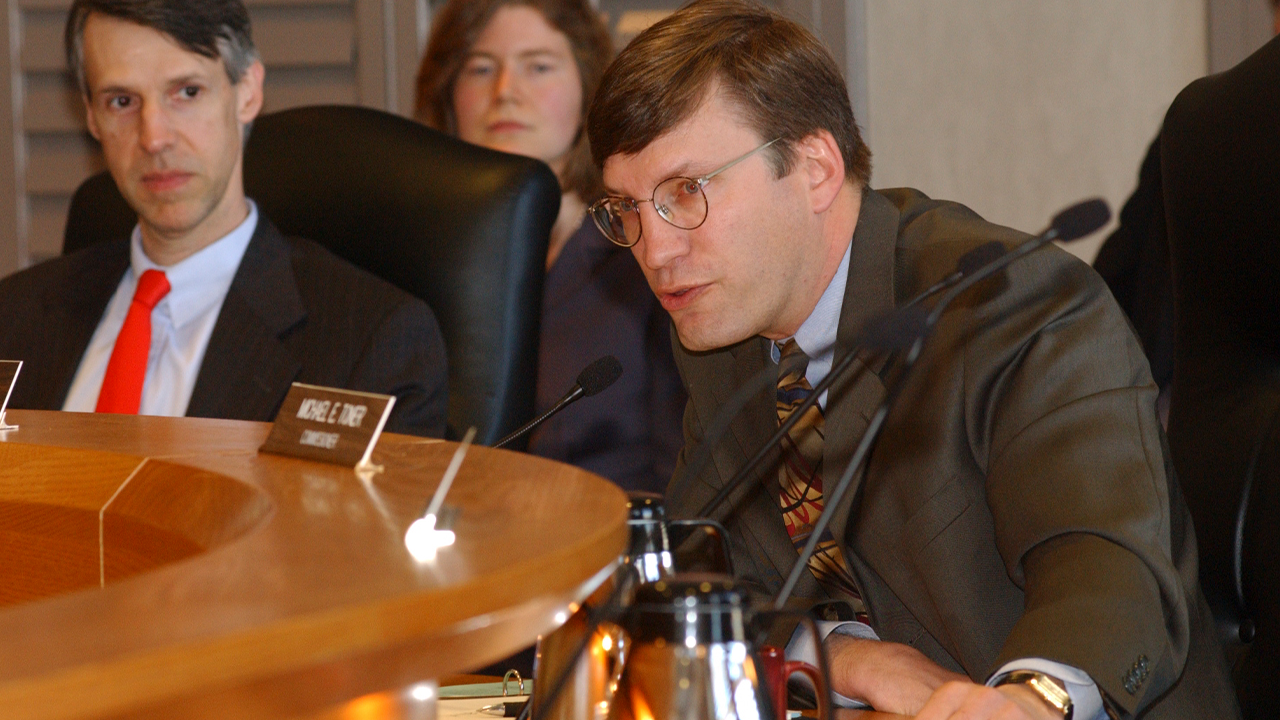
Bradley Smith was supposed to be a defense witness in the NY v. Trump case. (Douglas Graham/Roll Call/Getty Images/File)
Smith spoke with the Washington Examiner on Monday and discussed what he would have said in court if he testified.
“Judges instruct the juries on the law,” Smith told the outlet. “And they don’t want a battle of competing experts saying here’s what the law is. They feel it’s their province to make that determination. The problem, of course, is that campaign finance law is extremely complex and just reading the statute to people isn’t really going to help them very much.”
Smith said he anticipated “to lay out the ways the law has been interpreted in ways that might not be obvious” while noting election laws are very complicated matters.
9 QUESTIONS ABOUT TRUMP TRIAL, ANSWERED
Michael Cohen is questioned by prosecutor Susan Hoffinger on redirect during former President Trump’s criminal trial in New York City on May 20, 2024. (Reuters/Jane Rosenberg)
“You read the law, and it says that anything intended for the purpose of influencing an election is a contribution or an expenditure,” Smith said. “But that’s not in fact the entirety of the law. There is the obscure, and separate from the definitional part, idea of personal use, which is a separate part of the law that says you can’t divert campaign funds to personal use. That has a number of specific prohibitions, like you can’t buy a country club membership, you can’t normally pay yourself a salary or living expenses, you can’t go on vacation, all these kinds of things. And then it includes a broader, general prohibition that says you can’t divert [campaign funds] to any obligation that would exist even if you were not running for office.”
COHEN’S BOMBSHELL ADMISSION COULD LEAD TO HUNG JURY, IF NOT ACQUITTAL: EXPERT
“We would have liked to flag that exception for the jury and talk a little bit about what it means,” Smith said. “And also, we would have talked about ‘for the purpose of influencing an election’ is not a subjective test, like, ‘What was my intention?’ It’s an objective test.”
Michael Cohen and former President Trump (Getty Images)
The case surrounding Trump’s payments is one that both the Justice Department and FEC rejected to prosecute in recent years. The Justice Department in 2019 “effectively concluded” its investigation into Trump’s payments. While in 2021, the Federal Elections Commission announced that it had dropped a case looking into whether Trump had violated election laws for the payment to Daniels.
JIM JORDAN DEMANDS NY AG HAND OVER DOCUMENTS RELATED TO FORMER DOJ OFFICIAL AT HEART OF NY V TRUMP
Smith has previously joined Fox News, where he also noted that the “Federal Election Commission chose not to act on this.”
Bradley Smith testifies during a House subcommittee hearing on lobbying reform on March 1, 2007. (Bill Clark/Roll Call/Getty Images)
“DA Bragg in this case waited, I think it was almost a year, before even bringing the charges. And I think that’s because the charges were flimsy. And as you point out, they’ve been, you know, the prior DA had said, ‘No, we’re not going to bring this.’ The DOJ said no. The Federal Election Commission said no. And when he got increased political pressure, he brought the case,” Smith told Fox News host Mark Levin earlier this year before the trial kicked off.
Smith also wrote an opinion piece published by The Federalist last month, when the trial kicked off, arguing that Bragg’s office had “one big problem” with the case.
Former President Trump sits in the courtroom in New York City on May 21, 2024. (Michael M. Santiago/Getty Images)
“The [prosecution’s] theory is that Trump’s payments to Daniels were campaign expenditures and thus needed to be publicly reported as such. By not reporting the expenditure, the theory goes, Trump prevented the public from knowing information that might have influenced their votes,” he wrote in the opinion piece.
NY PROSECUTORS REVEAL ‘ANOTHER CRIME’ TRUMP ALLEGEDLY TRIED TO CONCEAL WITH FALSIFIED BUSINESS RECORDS
“There is one big problem with this theory: The payments to Daniels were not campaign payments.”
He said political candidates frequently act in ways that could be interpreted as serving a “purpose of influencing an election,” that politicians could get their teeth whitened or buy a new suit with campaign funds to look snappy on the campaign trail.
Rhona Graff testifies as former President Trump watches during his criminal trial in New York City on April 26, 2024. (Reuters/Jane Rosenberg)
“That’s because, in campaign finance law, these types of expenditures are known as ‘personal use.’ FECA specifically prohibits the conversion of campaign funds to personal use, defined as any expenditure ‘used to fulfill any commitment, obligation, or expense that would exist irrespective of the candidate’s election campaign,’” he wrote.
TRUMP TOUTS DEFENSE TEAM HAS ‘WON’ MANHATTAN CASE AS HE CALLS ON MERCHAN TO DISMISS
Smith continued on X on Tuesday that Bragg’s case hinges on prosecutors proving that Trump tried to influence an election through “unlawful means,” but the office has to rely on their own evidence as the DOJ and FEC both denied pursuing the case.
Judge Juan Merchan (AP Photos/File)
“If that’s the case, isn’t it entirely relevant (not dispositive, but relevant) to the jury’s fact-finding on that question that neither DOJ nor FEC chose to prosecute? But Judge Merchan won’t allow that in,” he wrote. “He will, though, allow in numerous references to Cohen’s guilty plea, and allow Cohen to testify as to how he thinks he and Trump violated FECA – though it appears that Cohen is a dunce about campaign finance laws.”
The defense team rested Tuesday, with Merchan dismissing the jury until after Memorial Day. Closing arguments are anticipated to kick off next Tuesday following the holiday.
Read the full article from Here


A broken elevator has left some residents of a Boston apartment building unable to leave, but a new stairlift has brought temporary relief.
When 80-year-old Silke Evans, who lives at the Villa Michelangelo Apartments in the North End, spoke with NBC10 Boston last Wednesday, she had been stuck inside for weeks.
“I feel imprisoned. That’s it,” she said at the time. “I feel like I’m in prison.”
Silke Evans, an 80-year-old woman living at the Villa Michelangelo Apartments in the North End, has been unable to use the elevator at her building for three weeks.
“She was stuck up on the third floor for a total of three-and-a-half weeks,” her daughter, Katharine Clark, said Thursday.
Thursday, Metro Management, which runs the building, installed the stairlift as a temporary solution while waiting for elevator repairs.
It allowed Evans to leave for the first time in nearly a month.
“They had food, and got to eat out, and just feel like a normal person,” Clark said. “She’s been looking kind of sad for weeks, so it’s the first time I saw some pictures where she was genuinely smiling.”
The fix brought major joy to Evans, with hopes of a long-term solution in the future.
“We’re not out of the woods. We still have a broken elevator. Hopefully, it’s not too many months with just a chairlift,” Clark said.
Jeff Buono, director of property management, told NBC10 Boston last week that the process to repair the elevator has been difficult.
“They’re estimating four to five weeks to get the parts and then four to five weeks for the install,” Buono said in a phone interview. “It’s tough to get parts in general. It takes longer to get them than it ever has before. So the systems now just need to be modernized. I mean, it does take a toll on our elderly population — it really does. And we do feel for them. They’re likely family to us.”
NBC10 Boston reached out to the management company for further comment Thursday, but staff had already left for the holiday weekend.
Pittsburg, PA
Pittsburgh is promising its biggest fireworks show ever. Here’s what the setup looks like.

We are just two days away from the Fourth of July, and that means fireworks. The final preparations are underway for the City of Pittsburgh’s show, which is promised to be the largest in history. In all, five barges full of fireworks will be set off for this show.
Under the blistering sun, the true heat is packed on the barges along the Ohio River. Thousands upon thousands of fireworks will go off during the 25-minute show Saturday night, done by Starfire Corporation.
“Being down here, for our family to be able to perform for Pittsburgh is such an honor,” Starfire Corporation vice president Vince Terrizzi Jr. said.
Planning started back in February for this event. The barges will go on the Mon, Allegheny and right near The Point, creating a triangle effect around the Golden Triangle.
“We have one rooftop location that will surprise people and come in and out during the show,” Terrizzi said.
In all, nine truckloads of fireworks were brought in to be part of the show. Inspectors with the Pittsburgh Bureau of Fire inspected and will do a final inspection before the show. For the inspector, it’s her last show as she plans to retire in a few months.
“Going out with literally the biggest bang the city has ever seen,” Lisa Epps-Cuda said with a laugh.
Starfire has done the about a half dozen of the city’s shows over the years, and it never gets old for them.
“Listening to the crowd’s response, boats cheering, those kind of things make it worth its while,” Terrizzi said.
As for the weather, the big concern will be lightning; the fireworks can still be fired off in the rain. The show is set to go off at 9:35 on Saturday night.

In order to get to the truth, it’s important to define your terms.
For example, what precisely do you mean by the word Connecticut? Or is it Quinnehtukqut, in the Algonquin language?
It’s also important how you frame your story.
That is, what do we miss if we only start Connecticut’s story in 1776? What about the long, century-and-a-half colonial/religious run-up beginning in 1638? What about the 10,000 years before that, of indigenous habitation along our state’s long and short rivers? And what of all Long Island Sound?
Depending on where you start, you might have a geography story, a political story, a theological struggle.
You also need to include not only 50 or 60 founding fathers, but a full range of voices — you must try to expand the historical house, and also tell a whole story, not a partial.
For example, even in a copiously told tale of the Elm City Signer-in-Chief Roger Sherman, if you stopped his story at the mere signing of the Declaration of Independence, he’d still be a guy in a homespun suit among many in the founders’ chorus.
Although John Hancock appointed Sherman to the committee — along with Jefferson, Franklin, and Adams, to write the document we are all celebrating this year — it’s clear he wasn’t much of a writer, or editor, or speller. John Adams, when he recollected those days, couldn’t even remember Sherman in the room of the writing of the document that changed the world. Apparently only Franklin and Adams dared to edit the brilliant Jefferson’s prose.
However, continue the story to 1787, and Roger Sherman’s political and personal skills help lead the way to the bicameral compromise — a Congress with one legislative house based on population side by side with another house of equal number of senators from each state.
Without this deal — known as the Connecticut Compromise — there would have been two-and-a-half strikes against the possibility of ever passing a Constitution; and as a consequence, perhaps no United States. That makes Sherman a profound hero of the democratic story, and, of course, earns our sobriquet as the Constitution State.
All this fascinating, perspective-altering stuff was at the heart of a by-turns erudite and entertaining lecture — call it a sermon on history– entitled “Why Connecticut 250 Matters,” delivered by Connecticut State Historian Andy Horowitz.
Receiving it Wednesday night was a standing-room-only crowd of some 200 New Haven history glitterati gathered at the New Haven Museum.
Horowitz’s lecture was the companion piece to a gala evening marking the opening of the New Haven Museum’s new exhibition, “New Haven’s Unfinished Revolutions.”
With opening remarks by City Historian Michael Morand and exhibition director Joanna Steinberg and designers David Jon Walker and John Kudos, attendees also took in the spiffy photo and large, wall-text-festooned new space — the gallery to the left as you enter the museum’s first floor.
The exhibition is designed to include all those voices that Horowitz talked about — the centerpiece being a kind of grand kiosk or large table where you can put “tablets” of, so far, largely 18th century documents into a “cradle,” and then the docs come alive.
You hear, for example, a selection of the deposition by Sarah Townsend of the British invasion of New Haven in 1779. It’s a rare document in the NHM’s collection, but how many have had a chance to read it?
Enter the new exhibition, and the text appears on a screen in front of you — in both the original handwriting and an easy-to-read print version, as her voice speaks in the voice of local actors from New Haven who have done the recordings.
It’s immersive and the whole packed space — 900 square feet, which is not much bigger than a comfortable one-bedroom Elm City apartment — is trying to tell a Big Story, much of it under-told or never-told. It’s also designed for classes and groups and to be a kind of teaching house, said Steinberg.
The “table” is its centerpiece, a kind of hearth — designer John Kudos agreed to this reporter’s characterization — is where an individual, a family, or a group of school kids gather round to warm to the sounds and evocations of long ago and also to not-so-long-ago overlooked voices.
And the design is such that new documents can be added, indeed, are being added from the museum’s collection, along with contemporary documents/voices as they emerge in the living history of the city.
“The soul of New Haven is on display,” said Walker, one of the designers, via video hook up.
By that he meant, in part, under-told stories such as that of the Winchester Repeating Arms Company and those many African American immigrants from a racist South who labored on its factory floors and built new lives and institutions in the Elm City; the Model City era of the late 1960s; May Day of 1970, with the mutual aid groups such as the Hill Parents Association and the local Black Panthers who organized in the run-up; and New Haven’s important labor history as captured in the watershed 1975 teachers strike. The exhibition ends with material from the environmental movement of the 1980s.
In addition to Roger Sherman, the two other “souls” from New Haven’s 1776-era history whom Horowitz summoned and evoked to structure his tale were Hannah Mamanash, an indigenous woman of the Wangunk tribe (related to the Quinnipiacs and Mohegans); and Cuff Wells (also known as Cuffee Saunders), kidnapped as a child from Guiana, in South America, and enslaved in Colchester, Connecticut.
Known mostly through land deeds and an extensive petition for Revolutionary War pensions, Mamanash saw four of her sons enlist in George Washington’s forces. Three, perhaps all four, were killed in the Revolutionary War fighting.
“It’s hard to believe,” said Horowitz, “that anyone made a larger sacrifice to the American Revolution than Hannah Mamanash.”
But Horowitz deepend the story: Mamanash also had a daughter, who married a Samson Occam, a Mohegan who was Christianized, became a minister, and was the first Native American to publish a book. In another document, from 1775, a letter to the Oneida tribe, Mamanash’s son-in-law Occam tried to explain and advise which side that tribe should take in the fast-arriving rupture with Great Britain.
He basically took a neutral position, citing Jesus as a template for being peace-makers, not side-takers, although he did characterize the English as the oppressors and the patriots as the oppressed.
Yet Horowitz’s point is that there was no inherent, clear, obvious reason for Mamanash and her sons to make the choices they made, and the sacrifices they gave. Their history goes back much farther, sometimes siding with the English, sometimes the French, often with no one. You widen the story, and it gets deeper, more complex.
Wells’s enslaver was an apothecary and with that skill, which he learned, Wells enlisted in the Continental Army tending the sick and likely saving lives at the army hospital in Danbury, and later at Valley Forge.
And yet, Horowitz taught, it’s important to know that at the start of the Revolution neither Washington nor the creators of the Declaration wanted Blacks to enlist at all, whether they were apothecaries or not. Like the British they were afraid of what enslaved people might do if given firearms.
In fact, the phrase, among the list of colonists’ grievances in the Declaration itself, is the tell in this context: “Exciting domestic insurrections amongst us” primarily refers to British inducements to enslaved African Americans to flee their American masters and to fight for the king in exchange for offers of freedom.
And still Wells enlisted and deployed his skills, survived the war, received a pension, bought three acres of land in Lebanon, and sired a son, Prince, who went on to graduate from Dartmouth College.
If that isn’t a little-known American story that should be better known, I don’t know what is.
Horowitz was at pains to point out, also, that Wells is known, in the extensive 127-page pension file, the key source of his biography, also as Cuff Saunders.
“He changed his name,” Horowitz surmised, “because he did not want Wells, his enslaver’s name.”
“And such stories are not that unusual,” Horowitz added, “among Black soldiers, who gave themselves names like Caesar, Liberty, Beman. Every description is a form of argument.”
“So what to make of these stories?” Horowtiz drew towards his conclusion and, of course, the relation of the past to the present.
He said the kind of historical research, the poring over documents in archives, that yielded these stories is precisely the kind that is being threatened today, along with, of course, doing the opposite of expanding the historical frame, which is the policy direction of the current administration.
He didn’t mention the name of President Trump, but the narrowing of history, the bee in the bonnet of the current administration, was clearly the elephant in the room, to mix the zoological metaphors.
“When I began, there were three people in the office of state historian. Now I’m the only one. Seventy percent of professors teaching history are un-tenured. History departments are closing down. As a tenured historian I’m like a typewriter repairman, the last of my kind.”
And if there were a single theme to this wide-ranging yet also deep dive into Connecticut’s 1776, it was this: “A narrow sense of history yields a narrow sense of the future.”
Which is why Morand had concluded his remarks, in the new exhibition space of “New Haven’s Unfinished Revolutions,” singing from the same hymnal, with similar congratulatory, if minatory, praise:
“This is a major addition to understanding what New Haven has been and what it has become and to what they and we can do to affect the future. . . Our history is not about the past, it’s made active, it’s story upon story, not punctuated by a period, but an ellipsis. This show is really about America 251, 252, 253 . . . ”
 100vw, 1024px”/><figcaption class=) State Rep. Pat Dillon and local historian Aaron Goode discuss democracy and what to do with the U.S, Supreme Court!
State Rep. Pat Dillon and local historian Aaron Goode discuss democracy and what to do with the U.S, Supreme Court!
 100vw, 1024px”/><figcaption class=) Former teachers union President Frank Carrano, listening to what he said about the 1975 strike.
Former teachers union President Frank Carrano, listening to what he said about the 1975 strike.
Related
-

 Los Angeles, Ca16 minutes ago
Boy, 17, with autism accused in murder of 4-month-old girl at Claremont daycare
-

 Detroit, MI38 minutes ago
Brief rally not enough for Tigers vs Rangers as win streak ends at 3
-

 San Francisco, CA46 minutes ago
Crash on freeway in Millbrae leaves driver dead after reportedly overturning multiple times, CHP says
-

 Dallas, TX53 minutes ago
Paige Bueckers, Azzi Fudd do the usual in Hartford, win. This time with Dallas Wings
-

 Miami, FL56 minutes ago
World Cup-inspired art exhibit transforms Miami’s Wynwood with interactive soccer experience
-

 Boston, MA1 hour ago
Stairlift brings relief to residents stuck in building with broken elevator
-

 Denver, CO1 hour ago
Free agent point guard Tyus Jones re-signs with the Denver Nuggets – Denver Stiffs
-

 Seattle, WA1 hour ago
Husky Recruit To Move From Seattle to Florida For High School Ball

